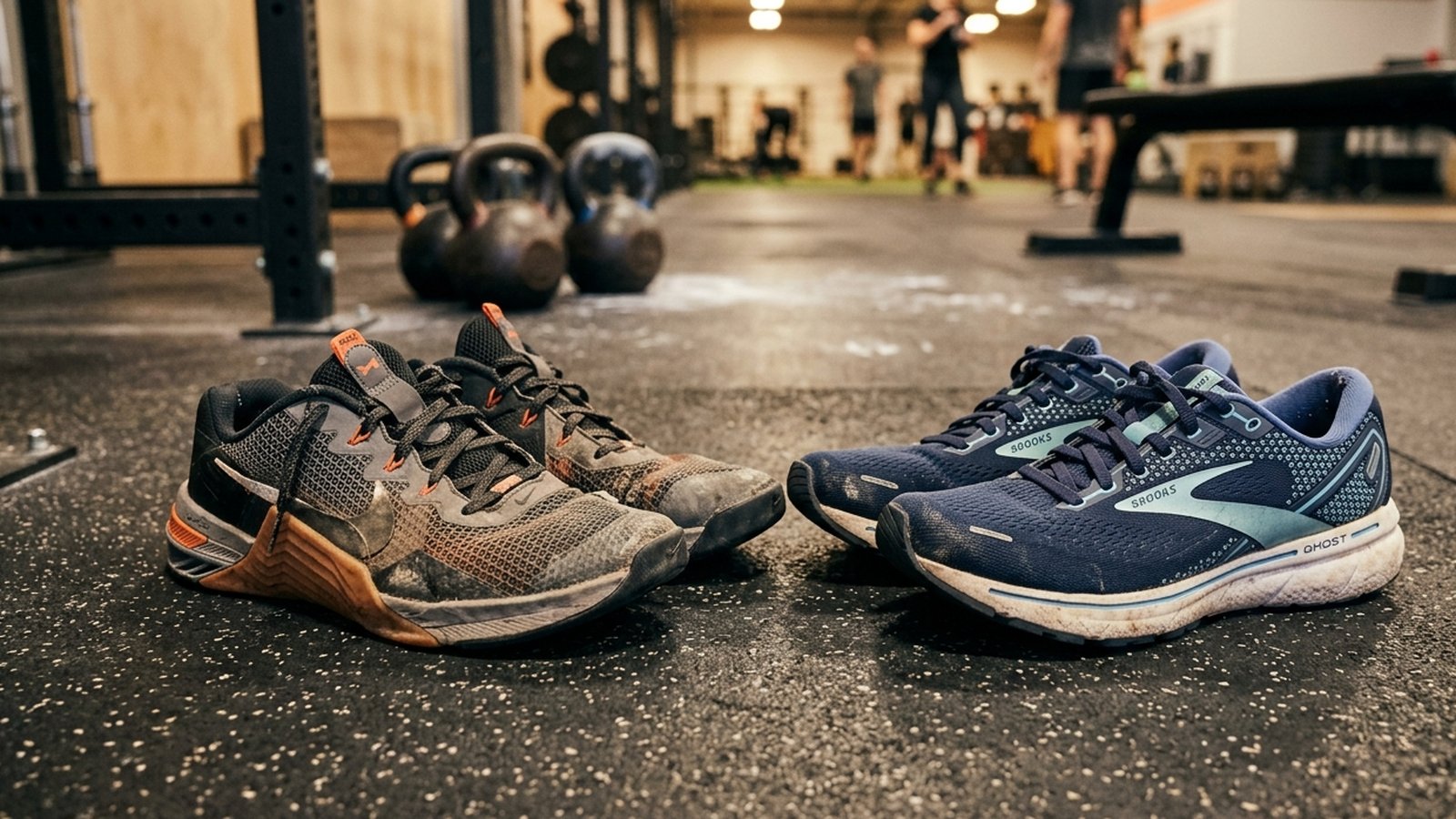
The 60-second version
For running, comfort beats category: the best-evidenced selection rule is the “preferred movement path / comfort filter” Framework Nigg 2015. Pronation matching has been disproven in randomised trials Knapik 2014 Richards 2009 Malisoux 2016. Heel-strikers in cushioned shoes are not doomed, but high-mileage heel-strikers had roughly 2× The repetitive injury rate of forefoot-strikers in the Daoud Harvard group Daoud 2012. For lifting, a flat, hard sole (or barefoot/socks) is best for deadlifts and most pulling work. An elevated-heel Olympic shoe helps depth in squats for tall or limited-mobility lifters. Replace running shoes around 500–800 km based on midsole compression, not pure mileage. Transition to minimalist or low-drop shoes slowly — Calf and Achilles injury rates are higher in fast transitioners Ryan 2014. And surface decides more than category: on soft dry sand, shod and barefoot running cost the same energy Pinnington 2001, while on snow and ice a slip-on traction device cut injurious falls in a randomised trial McKiernan 2005.
Walk into any running store and you’ll get a pronation analysis, a stability category, and a confident shoe recommendation. The science underneath is shakier than most retailers admit. The 2014 US military trial — the largest prescriptive-shoe study ever run — found that matching shoes to arch height did not reduce injuries Knapik 2014. The 2009 BJSM systematic review by Richards reached the same conclusion: there is no published evidence to support shoe prescription based on pronation Richards 2009. This article walks through what the literature actually says — and what to do about it.
Educational journalism, not medical advice. Every claim here is checked against its cited sources by editor Timothy Bunce — a health writer, not a physician. It isn’t specific to your situation: for health decisions, talk to your own clinician. How we work →
Some links in this article are affiliate links. If you buy through one, The Beachside Reader earns a commission at no extra cost to you. It never changes which products we pick, or what we say about them. Full affiliate disclosure →
Shoes by surface: what South Georgian Bay asks of a shoe
Almost all footwear advice is written for one surface — smooth pavement — and then applied to everything else. Within a short drive of Wasaga Beach there are four surfaces that behave very differently under a foot. Two of them make the shoe matter less than the shop suggests Pinnington 2001; one makes it matter more Voloshina 2015; and one is the only surface here where footwear changed an injury outcome under randomisation McKiernan 2005.
Soft dry sand — the 14 km beach
Wasaga Beach Provincial Park is 14 kilometres of sand, and the park describes it as a relict beach whose sand is non-replenishing Ontario Parks. For a runner or walker the property that matters is that dry sand yields: it absorbs work a firm surface would give back.
The size of that penalty is well measured. Walking on sand costs 2.1–2.7 times more energy than walking on a hard surface at the same speed, and running on sand about 1.6 times more Lejeune 1998. A separate comparison of grass against soft dry beach sand put the net energy-cost ratio at roughly 1.5 Pinnington 2001.
The finding that actually bears on shoe choice is the one usually skipped. In that same study, running on sand barefoot and running on sand in shoes did not differ significantly in aerobic, anaerobic or total energy cost Pinnington 2001. On soft dry sand the surface is doing the work, not the shoe. That argues for choosing on protection — heat, debris, sand ingress — rather than on cushioning or category, and for treating the added cost as training load rather than as a footwear problem. The strength side of the same surface is covered in our piece on barefoot walking on sand.
Stone dust and hard pack — the rail bed
The Georgian Trail runs 33 kilometres from Collingwood through Thornbury to Meaford — 21 kilometres Collingwood to Thornbury, 13 Thornbury to Meaford — on the compacted, hard-packed bed of a former railway corridor Grey County.
Underfoot that is closer to road than to trail: firm, uniform, and graded for freight, so there is very little variation in how the foot meets the ground. It is road-shoe terrain. A lugged trail outsole buys little on hard pack, because there is no soft ground for lugs to bite into. And the proposition that a shoe category protects a runner on a uniform surface is precisely the one that has repeatedly failed to appear in randomised trials Knapik 2014 Richards 2009 Malisoux 2016. Comfort remains the best-supported selection rule Nigg 2015.
Escarpment rock and root — the technical trails
The Niagara Escarpment trails above the bay are the opposite case: the ground is uneven at effectively every step, on the Bruce Trail through Loree Forest as much as on the climbs at Pretty River Valley.
Uneven ground has a measured cost. Running on a treadmill with up to 2.5 cm of height variation raised energy expenditure by 5% against smooth ground, increased step width and step length variability by 27% and 26%, and increased leg stiffness by 20% Voloshina 2015. The detail with the most practical bite is that positive and negative ankle work both fell on the uneven surface, by 22% and 18% Voloshina 2015: the ankle gives up part of its spring role and the leg stiffens to compensate.
This is the surface where a shoe earns its keep, and what it argues for is a stable platform, a grippy outsole, and enough underfoot protection that rock does not dictate foot placement — not maximal cushioning, whose softness works against stability. The honest limit: what was measured on that treadmill is biomechanics, not injuries Voloshina 2015. The randomised trials that did measure injury outcomes tested shoe category in general training, not shoe choice on technical trail Knapik 2014 Malisoux 2016.
Snow and ice — the snowbelt half of the year
Winter is the one surface on this list where footwear has changed a hard outcome under randomisation. Fall-prone adults aged 65 and over were randomised to a slip-on gait-stabilising traction device or their usual winter footwear for a winter of outdoor walking. On days they walked on snow and ice, the relative risk of an outdoor fall with the device was 0.42, and the relative risk of an injurious fall 0.13; six people needed to use it for one winter to prevent one non-serious injurious fall McKiernan 2005.
Two caveats the trial supplies itself. Twelve of the nineteen outdoor falls among device users happened when they were not wearing the device — the thing only works while it is on the foot. And the participants were older adults with a fall history, not runners; traction on ice is not age-specific, but the effect size was measured in that group McKiernan 2005.
Cobble and water entries
Where a shoreline entry is cobble and stone rather than sand, the question stops being cushioning and becomes foot protection and grip on wet rock. We treat that case separately in water shoes vs barefoot.
Shoe categories — what they actually mean
Most running shoes fall into one of four buckets: neutral (a flexible foam midsole, no medial post), stability (a firmer medial post or guide-rails to resist pronation), motion-control (heavy stability shoes for severe overpronators), and minimalist (low stack height, low drop, flexible). The categories are real engineering distinctions; the idea that runners must be matched to one based on arch or gait is what the evidence does not support Richards 2009.
Lifting and gym footwear are simpler:
- Flat-soled shoes (Converse Chuck Taylors, Vans, dedicated deadlift shoes): hard, incompressible sole; close to barefoot. Ideal for deadlifts, rows, presses, and most general gym work where ground feel and stability matter more than cushioning.
- Olympic weightlifting shoes (Adidas Adipower, Nike Romaleos): rigid wooden or TPU heel of 15–22 mm, non-compressible sole. Improve squat depth in lifters with limited ankle dorsiflexion and shift load slightly forward onto the quadriceps.
- Cross-trainers: a hybrid — some cushioning for short runs and box jumps, but firmer and flatter than running shoes for lateral stability.
- Hyrox / multi-modal shoes: cross-trainer-leaning, with enough cushioning for a cumulative ~8 km of running between stations and enough lateral stability for sled work, lunges, and burpees.
The pronation classification myth
The orthodoxy — overpronators need stability shoes, neutral runners get neutral shoes, supinators get cushioning — was never built on randomised evidence. It came from biomechanical theory in the 1980s and was widely adopted by retailers. When it was finally tested, it failed Knapik 2014 Richards 2009.
- Knapik 2014 reviewed three large US military trials totalling over 7,000 recruits randomised either to shoes prescribed by foot-arch height or to a single neutral shoe. Prescribing shoes by arch height did not reduce injuries in any branch Knapik 2014.
- Malisoux 2016, a Luxembourg RCT in BJSM, randomised 372 leisure runners to either standard shoes or motion-control shoes irrespective of foot type, and followed them for 6 months. Motion-control shoes reduced injury risk — 17.6% of the motion-control group were injured versus 32.4% of the standard-shoe group (HR 0.55, 95% CI 0.36–0.85, p=0.005), with the protective effect concentrated in runners with pronated feet (HR 0.34) Malisoux 2016.
- Richards 2009 in BJSM screened the literature and concluded: “The prescription of this shoe type to distance runners is not evidence-based.” Fifteen years later, that statement still holds Richards 2009.
What replaces pronation matching? The Nigg 2015 framework in BJSM — the “preferred movement path” and “comfort filter” paradigms — is the best current synthesis. Runners self-select shoes that allow their joints to follow their habitual movement pattern; shoes that fight that pattern increase muscle work and injury risk. The simplest practical rule that emerges: try several shoes, run in them, pick the one that feels most comfortable Nigg 2015.
“The currently dominant paradigms of impact-force reduction and pronation control should be replaced by two new paradigms based on a preferred movement path and a comfort filter.” — per Nigg 2015, British Journal of Sports Medicine
The minimalist / barefoot debate
Daniel Lieberman’s 2010 Nature paper is the foundational modern barefoot-running citation. Comparing habitually barefoot Kenyan and US runners with shod Western runners, his lab showed that barefoot runners predominantly land on the forefoot or midfoot, generating much smaller impact transients than shod heel-strikers Lieberman 2010. The thick foam heel of a modern shoe partly encourages a heel strike that the unshod foot does not naturally produce.
The follow-up evidence is more nuanced. Hatala 2013 studied the Daasanach of northern Kenya — another habitually barefoot population — and found that on hard surfaces at slower running speeds, most Daasanach actually heel-struck Hatala 2013. So “barefoot equals forefoot” is too simple. Strike pattern is influenced by speed, surface, and individual habit, not solely by footwear.
What about injury rates? Daoud 2012 retrospectively examined a Harvard varsity cross-country team and found habitual rearfoot-strikers had ~twice the rate of mild and moderate repetitive stress injuries as forefoot-strikers, even though both groups wore conventional cushioned shoes Daoud 2012. Davis 2017 argued the lower vertical loading rates in forefoot-striking minimalist runners may explain reduced stress-fracture and tibial-pain rates Davis 2017.
However — and this is the critical caveat — Ryan 2014 in BJSM followed runners transitioning to minimalist shoes and reported significantly higher rates of shin and calf pain in the transition group. The Achilles tendon, soleus, and gastrocnemius take dramatically more load in a forefoot-striking gait, and these tissues need months to adapt Ryan 2014. The rule that emerges:
- If you’re a long-time heel-striker in cushioned shoes and pain-free: you do not need to switch.
- If you have recurrent knee pain, IT-band issues, or runner’s knee: a gradual transition to a lower-drop shoe and slightly more midfoot strike is plausibly helpful (and reduces patellofemoral loading Kulmala 2013).
- If you transition: do it over 3–6 months, with calf and Achilles strength work built in.
Cushioning level and injury risk
One of the more interesting recent findings is that more cushioning is not obviously safer. Theisen 2014 randomised 247 leisure runners to either soft- or hard-midsole versions of the same shoe and tracked them for 5 months. The two groups had no meaningful difference in injury rate — the softer shoe was not protective Theisen 2014. Malisoux’s lab has reported similar non-effects across multiple later trials Malisoux 2016.
Two things this does not mean. It does not mean cushioning is bad — soft shoes feel better to many runners and the “comfort filter” suggests that matters. And it does not address modern carbon-plated super-shoes. The systematic review usually cited on footwear and economy predates that generation of shoe and, in its own words, found no studies reporting effects on running performance; what it did find were small beneficial effects on running economy for lighter shoes and for barefoot compared with heavy shoes Fuller 2015. The carbon-plate evidence is a separate literature: a prototype plated shoe lowered the energetic cost of running by about 4% against established racing shoes in all 18 high-calibre athletes tested — in a study funded by the shoe’s manufacturer Hoogkamer 2018.
Foot strike: heel, midfoot, forefoot
The three patterns:
- Heel (rearfoot) strike: most common pattern in shod recreational runners. Generates a sharp early impact transient, especially at slower speeds. Higher knee/patellofemoral loading. Lower calf/Achilles loading.
- Midfoot strike: foot lands roughly flat. Often a natural compromise; common in middle-distance runners.
- Forefoot strike: ball of foot lands first; heel may not touch the ground. Common in sprinters, barefoot runners, and many elite distance runners. Lower knee loading Kulmala 2013; higher Achilles and calf loading.
Kulmala 2013 compared 19 forefoot-strikers with 19 pair-matched rearfoot-strikers and found that forefoot-strikers had roughly 15–19% lower patellofemoral joint contact force and stress (4.3 vs 5.1 body weights; 11.1 vs 13.0 MPa) at the same pace — a modest but real difference that helps explain why anterior knee pain is more common in cushioned-shoe heel-strikers Kulmala 2013. The trade-off is just shifted loading to the calf and Achilles.
Should you change your strike? Probably not deliberately if you’re injury-free. If you have chronic knee pain, an experienced coach can help you experiment with cadence — raising step rate ~10% reduces knee and hip loading and often nudges the strike forward without conscious retraining Heiderscheit 2011 — and with lower-drop shoes, but allow weeks per change.
Lifting shoes
Squats
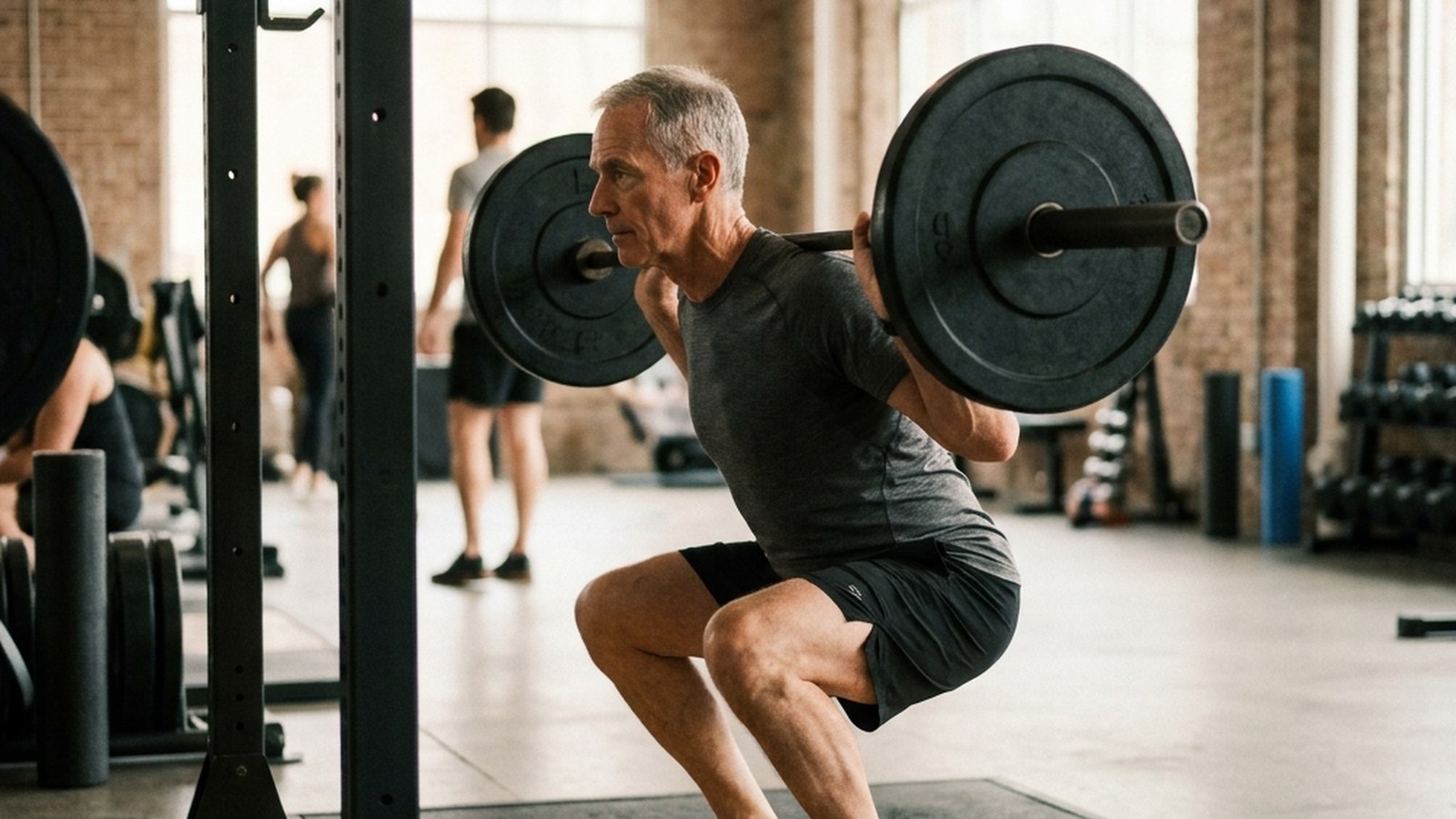
An Olympic weightlifting shoe — a rigid sole under a raised heel — changes squat mechanics in a consistent direction. Reviewed against running shoes and against barefoot lifting, weightlifting shoes reduced trunk lean and produced more plantarflexion, and external heel wedges had similar effects Pangan 2021. That same review notes the specific influence of heel-elevation height has not been characterised, so treat the usual 15–22 mm as a product convention rather than an evidenced optimum. It is most useful for the back squat and front squat when:
- You’re tall (longer femurs) and struggle to keep an upright torso.
- You have limited ankle dorsiflexion (can’t get knees over toes without your heel lifting).
- You compete in Olympic lifting and need depth on snatches and cleans.
The raised heel reduces the dorsiflexion required, allowing a deeper squat with a more upright torso, and the rigid sole transmits force without energy loss. It is not necessary — plenty of strong lifters squat heavy in flat shoes or barefoot.
Deadlifts and pulling
For deadlifts, a flat, thin sole — or socks where allowed — is the standard. Reasons:
- Lower bar travel distance (every centimetre of sole = a centimetre more pull).
- Better ground feel and stability through the whole foot.
- No compression in the heel that could shift the bar path.
Cushioned running shoes are the worst option — foam compresses unevenly under load. Chucks, Vans, or dedicated slippers (Sabo, Notorious Lift) all work.
General gym training
For mixed sessions — squats, presses, rows, accessory work — a flat, firm cross-trainer covers most needs. Save Olympic shoes for heavy squat day and slippers for deadlift day; one decent cross-trainer handles the rest.
Hyrox and multi-modal shoes
Hyrox is unusual: 8 km of running broken by 8 functional stations (sleds, burpee broad jumps, wall balls, lunges, rower, ski erg, farmer carry). The shoe needs cushioning for cumulative ~50 minutes of running, lateral stability for sled work, and grip on indoor flooring.
What works well:
- Hybrid cross-trainers with extra cushioning (Nike Metcon-style with foam underfoot, or dedicated Hyrox shoes from Nike, Puma, and Reebok).
- Avoid maximal road running shoes — the soft midsole is unstable for sled work and lateral lunges.
- Avoid pure lifting shoes — insufficient cushioning for the running portions.
When to replace shoes
The traditional “500 km / 300 mile” rule oversimplifies, but the decay under it is real and has been measured. Rearfoot-striking runners issued new shoes lost 16–33% of the cushioning in the heel region of the midsole after 480 km — and, tellingly, none of them could report the loss on a comfort questionnaire even after 640 km Cornwall 2017. How fast it happens varies by foam, and manufacturers claim modern PEBA and supercritical-EVA midsoles hold up longer than older EVA; we have not found a peer-reviewed durability comparison that tests that claim, so treat it as unverified rather than established.
Practical replacement signals:
- 500–800 km for most cushioned road shoes; the upper end for heavier runners and softer foams.
- Visible compression of the midsole (look at the side — wrinkles, asymmetric collapse).
- Wear-through of the outsole rubber exposing midsole foam.
- New aches that resolve in a fresh pair — often the most reliable signal.
- Time: even unworn, EVA midsoles oxidise and stiffen. Don’t race in the pristine pair you’ve had in the closet for three years.
Lifting shoes have a much longer service life — the rigid heel and minimal foam don’t degrade the same way. A pair of Olympic shoes can last a decade of regular gym use; deadlift slippers similarly.
Wear pattern reading — with caveats
Retailers read sole wear to infer pronation; the evidence base mirrors the pronation literature — weak. A wear pattern tells you where you’ve been loading the shoe, not what shoe to buy next. Use it as a lifespan sanity check, not a prescription.
Practical guidance
- Try shoes on and run in them. Comfort is the best-evidenced selection criterion Nigg 2015. Most good running stores will let you treadmill-test.
- Don’t take a pronation diagnosis as gospel. If a stability shoe feels wrong, a neutral shoe is unlikely to harm you.
- Rotate two pairs if you run more than 3×/week. Different shoes load slightly differently and the foams recover between runs.
- Build a strike change slowly. Months, not weeks. Calf and Achilles strength work in parallel.
- Use the right tool for lifting. Flat for deadlifts; flat or Olympic for squats; lifting shoes are meaningfully different from running shoes.
- Replace based on midsole condition, not the calendar alone.
- Be sceptical of marketing. Carbon-plated super-shoes do lower the energetic cost of running — about 4% in the best-known trial Hoogkamer 2018 — while pronation-control claims have not held up in trials Knapik 2014.
Beachside note
If you’re training Hyrox at Beachside or doing the strength + cardio classes, a single decent flat-soled cross-trainer with modest cushioning will cover ~95% of what you need. See our gym essentials piece for the rest of the kit list, and the strength training primer for what to actually do in those shoes.
The bottom line
- Pronation matching is not evidence-based — pick on comfort, not arch Knapik 2014 Richards 2009 Malisoux 2016.
- Habitually barefoot runners forefoot-strike on hard surfaces at speed, but heel-strike too at slower paces Lieberman 2010 Hatala 2013.
- Forefoot strikers had ~half the repetitive injury rate of heel-strikers in a Harvard group Daoud 2012; loading distribution is the likely mechanism Kulmala 2013.
- Cushioning level does not strongly predict injury in healthy runners Theisen 2014.
- Transition to minimalist slowly — calf and shin injuries spike in fast transitioners Ryan 2014 Davis 2017.
- Lifting tools are different from running shoes: flat for deadlifts; Olympic shoes for limited-mobility squatters.
- Replace at 500–800 km based on midsole compression; lifting shoes last far longer.
Frequently asked questions
Do I need a stability shoe if I overpronate?
Mostly not. Knapik 2014’s large randomised trial found that assigning shoes by foot arch or pronation type did not reduce injury overall, and the 2009 BJSM systematic review reached the same conclusion. The exception: Malisoux 2016 found motion-control shoes did reduce injury specifically in runners with pronated feet. For most runners, picking the shoe that feels most comfortable remains the best-evidenced approach.
Are barefoot or minimalist shoes safer?
It depends on transition. Forefoot-striking in minimalist shoes reduces patellofemoral loading and was associated with lower repetitive injury rates in Daoud's Harvard cohort (2012). But Ryan 2014 showed runners who transitioned quickly had higher rates of shin and calf pain. Allow 3-6 months and add calf/Achilles strength work.
How often should I replace running shoes?
Heel cushioning declines measurably with mileage: rearfoot strikers lost 16–33% of it by 480 km, and could not perceive the loss themselves even at 640 km Cornwall 2017. Most cushioned road shoes are replaced between 500 and 800 km — heavier runners and softer foams closer to 500, lighter runners toward 800. Because feel is unreliable, new aches that resolve in a fresh pair are a better signal than how the shoe seems underfoot.
What shoes should I deadlift in?
Flat, hard, thin-soled. Converse Chuck Taylors, Vans, or dedicated deadlift slippers (Sabo, Notorious Lift). Many gyms allow socks. Avoid running shoes — the compressible foam under load creates an unstable platform and adds bar travel.
Do I need Olympic weightlifting shoes for squats?
Not necessary, but useful if you have limited ankle dorsiflexion or long femurs. The 15-22 mm rigid heel allows a deeper squat with a more upright torso and shifts load slightly toward the quadriceps. Many strong lifters squat heavy in flat shoes.
What's the best shoe for Hyrox or mixed CrossFit-style training?
A hybrid cross-trainer with modest cushioning and good lateral stability — Nike Metcon-style shoes, the dedicated Hyrox releases from major brands, or general cross-trainers. Avoid both maximal road running shoes (unstable for sled work) and pure lifting shoes (insufficient cushioning for the running).
References
Lieberman 2010Lieberman DE, Venkadesan M, Werbel WA, et al. (2010) Foot strike patterns and collision forces in habitually barefoot versus shod runners. Nature. 463(7280):531-535. View source →Knapik 2014Knapik JJ, Trone DW, Tchandja J, Jones BH. (2014) Injury-reduction effectiveness of prescribing running shoes on the basis of foot arch height: summary of military investigations. J Orthop Sports Phys Ther. 44(10):805-812. View source →Richards 2009Richards CE, Magin PJ, Callister R. (2009) Is your prescription of distance running shoes evidence-based? Br J Sports Med. 43(3):159-162. View source →Davis 2017Davis IS, Rice HM, Wearing SC. (2017) Why forefoot striking in minimal shoes might positively change the course of running injuries. J Sport Health Sci. 6(2):154-161. View source →Malisoux 2016Malisoux L, Chambon N, Delattre N, Gueguen N, Urhausen A, Theisen D. (2016) Injury risk in runners using standard or motion control shoes: a randomised controlled trial with participant and assessor blinding. Br J Sports Med. 50(8):481-487. View source →Daoud 2012Daoud AI, Geissler GJ, Wang F, Saretsky J, Daoud YA, Lieberman DE. (2012) Foot strike and injury rates in endurance runners: a retrospective study. Med Sci Sports Exerc. 44(7):1325-1334. View source →Hatala 2013Hatala KG, Dingwall HL, Wunderlich RE, Richmond BG. (2013) Variation in foot strike patterns during running among habitually barefoot populations. PLoS ONE. 8(1):e52548. View source →Ryan 2014Ryan M, Elashi M, Newsham-West R, Taunton J. (2014) Examining injury risk and pain perception in runners using minimalist footwear. Br J Sports Med. 48(16):1257-1262. View source →Nigg 2015Nigg BM, Baltich J, Hoerzer S, Enders H. (2015) Running shoes and running injuries: mythbusting and a proposal for two new paradigms: 'preferred movement path' and 'comfort filter'. Br J Sports Med. 49(20):1290-1294. View source →Theisen 2014Theisen D, Malisoux L, Genin J, Delattre N, Seil R, Urhausen A. (2014) Influence of midsole hardness of standard cushioned shoes on running-related injury risk. Br J Sports Med. 48(5):371-376. View source →Kulmala 2013Kulmala JP, Avela J, Pasanen K, Parkkari J. (2013) Forefoot strikers exhibit lower running-induced knee loading than rearfoot strikers. Med Sci Sports Exerc. 45(12):2306-2313. View source →Fuller 2015Fuller JT, Bellenger CR, Thewlis D, Tsiros MD, Buckley JD. (2015) The effect of footwear on running performance and running economy in distance runners. Sports Med. 45(3):411-422. doi:10.1007/s40279-014-0283-6. View source →Heiderscheit 2011Heiderscheit BC, Chumanov ES, Michalski MP, Wille CM, Ryan MB. (2011) Effects of step rate manipulation on joint mechanics during running. Med Sci Sports Exerc. 43(2):296-302. View source →Lejeune 1998Lejeune TM, Willems PA, Heglund NC. (1998) Mechanics and energetics of human locomotion on sand. J Exp Biol. 201(Pt 13):2071-2080. doi:10.1242/jeb.201.13.2071. PMID: 9622579. View source →Pinnington 2001Pinnington HC, Dawson B. (2001) The energy cost of running on grass compared to soft dry beach sand. J Sci Med Sport. 4(4):416-430. doi:10.1016/s1440-2440(01)80051-7. PMID: 11905936. View source →Voloshina 2015Voloshina AS, Ferris DP. (2015) Biomechanics and energetics of running on uneven terrain. J Exp Biol. 218(Pt 5):711-719. doi:10.1242/jeb.106518. PMID: 25617451. View source →McKiernan 2005McKiernan FE. (2005) A simple gait-stabilizing device reduces outdoor falls and nonserious injurious falls in fall-prone older people during the winter. J Am Geriatr Soc. 53(6):943-947. doi:10.1111/j.1532-5415.2005.53302.x. PMID: 15935015. View source →Hoogkamer 2018Hoogkamer W, Kipp S, Frank JH, Farina EM, Luo G, Kram R. (2018) A comparison of the energetic cost of running in marathon racing shoes. Sports Med. 48(4):1009-1019. doi:10.1007/s40279-017-0811-2. PMID: 29143929. View source →Ontario ParksOntario Parks. How to plan your visit to Wasaga Beach Provincial Park. 14 km of sand; a relict, non-replenishing beach across eight beach areas. View source →Grey CountyGrey County Tourism. Georgian Trail. Rail trail, Collingwood–Thornbury–Meaford, 33 km total (Thornbury–Collingwood 21 km, Meaford–Thornbury 13 km); compacted, hard-packed surface. View source →Cornwall 2017Cornwall MW, McPoil TG. (2017) Can runners perceive changes in heel cushioning as the shoe ages with increased mileage? Int J Sports Phys Ther. 12(4):616-624. PMID: 28900568. View source →Pangan 2021Pangan AM, Leineweber M. (2021) Footwear and elevated heel influence on barbell back squat: a review. J Biomech Eng. 143(9):090801. doi:10.1115/1.4050820. PMID: 33844006. View source →