The 60-second version
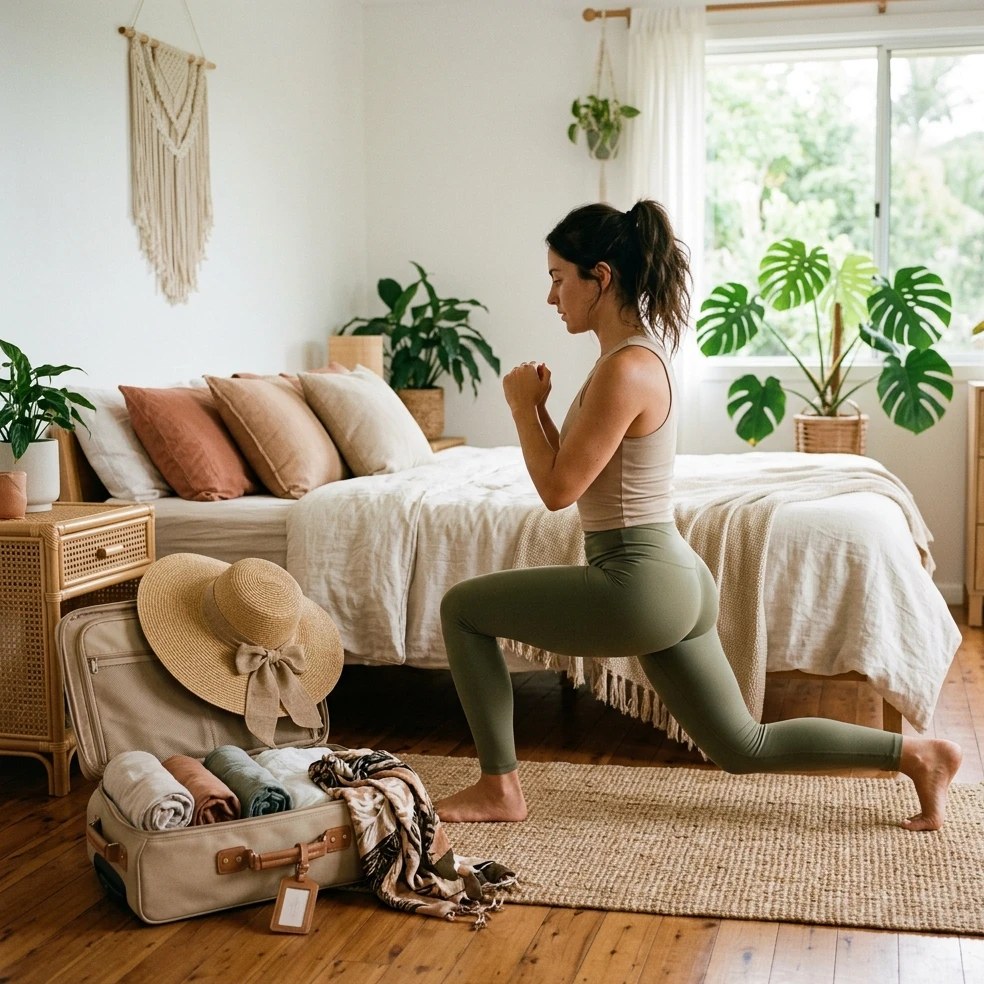
Hotel-room workouts work better than most lifters expect. Research comparing low-load and high-load resistance training found hypertrophy gains were comparable across the load spectrum when effort and volume were matched, with heavier loads producing significantly greater strength gains Schoenfeld 2017 — a pattern that extends reasonably well to bodyweight training in untrained-to-intermediate populations, since most bodyweight exercises fall in the lower-load range of that spectrum. The honest scope: bodyweight training maintains performance and supports modest gains during travel periods of days to a few weeks; serious advanced lifters will need to add resistance for continued progression. The minimum effective protocol: 2–3 sessions per week, 15–30 minutes each, hitting all five basic patterns (squat, hinge, push, pull, carry/core). The harder problem isn’t programming; it’s motivation in an unfamiliar environment with travel fatigue. This article covers what bodyweight training can and cannot do, the format with the strongest evidence for travel maintenance, three template circuits, and the realistic expectations for outcomes.
Educational journalism, not medical advice. Every claim here is checked against its cited sources by editor Timothy Bunce — a health writer, not a physician. It isn’t specific to your situation: for health decisions, talk to your own clinician. How we work →
Some links in this article are affiliate links. If you buy through one, The Beachside Reader earns a commission at no extra cost to you. It never changes which products we pick, or what we say about them. Full affiliate disclosure →
What bodyweight training can actually do
The bodyweight-vs-equipment training literature is more flattering to bodyweight than gym culture often acknowledges:
- Strength gains: the 2017 Schoenfeld et al. meta-analysis of low- vs. high-load resistance training (not a bodyweight-specific trial) found heavier loads produced significantly greater strength gains than lighter, bodyweight-equivalent loads, though both produced meaningful increases in untrained-to-intermediate lifters. Trained populations show a larger advantage for heavier external loads as progression becomes necessary Schoenfeld 2017.
- Hypertrophy: the 2018 Kotarsky et al. trial randomized 23 moderately-trained men to progressive push-up training or bench press training, 3 days a week for 4 weeks. Chest and triceps muscle thickness increased comparably in both groups, though the bench-press group gained more biceps thickness Kotarsky 2018.
- Cardiovascular fitness: bodyweight HIIT circuits (burpees, mountain climbers, jumping squats) produce VO2max improvements comparable to traditional cardio.
- Muscle endurance: bodyweight training is genuinely better than light-load free-weight work for muscle endurance outcomes.
What bodyweight training does less well:
- Continuing strength gains in trained lifters: when bodyweight squats become easy at any rep range, you’ve hit a load ceiling. Single-leg variations and tempo manipulations extend the range, but eventually external load is needed.
- Heavy-load adaptations: tendon stiffness, neural drive at near-1RM intensities, peak power. These require external resistance.
- Direct posterior-chain work: hamstrings and glutes are harder to load adequately with bodyweight alone (Nordic curls, single-leg hip thrusts help but are technically demanding).
“Muscle hypertrophy can be equally achieved across a spectrum of loading ranges,” while maximal strength gains favor heavier loads — a pattern that applies to bodyweight training as a lower-load method, though it does not directly replicate heavy free-weight loading.
— Schoenfeld et al., J Strength Cond Res, 2017 view source
The five movement patterns
A complete hotel-room session covers the five basic movement patterns:
1. Squat (knee-dominant)
- Bodyweight squats, single-leg squats (assisted or pistol), Bulgarian split squats (use chair for back foot), reverse lunges, jump squats.
- Progression: increase reps; switch to single-leg; add tempo (3-second descent); add jumps.
2. Hinge (hip-dominant)
- Single-leg Romanian deadlift (no weight or with backpack), glute bridges, single-leg glute bridges, Nordic curl negatives (advanced), good mornings with backpack.
- Progression: single-leg variations; add tempo; isometric holds at lockout.
- The hardest pattern to load with bodyweight; single-leg variations are necessary.
3. Push (horizontal and vertical)
- Push-ups (multiple variations), pike push-ups, handstand push-ups against wall, decline push-ups (feet on chair).
- Progression: standard → diamond → archer → one-arm. Vertical: pike → wall handstand.
4. Pull (horizontal and vertical)
- Hardest pattern in hotel rooms. Options: door pull-ups (sturdy door with towel anchor), table inverted rows (under sturdy table), towel rows on a doorknob (low-load).
- If no pull options exist: row-pattern substitutes with backpack (bent-over rows with heavy backpack), Y-T-W shoulder work.
5. Carry / Core
- Plank variations (front, side, single-arm), hollow holds, dead bug, bird dog, mountain climbers, suitcase carries with the heaviest object available.
- Progression: longer holds; add limb movement; single-arm/leg.
Effort matters more than load
The most important factor in bodyweight training success is genuine effort. As a practical guideline, working 3 sets to RPE 8–9 (close to muscular failure) on each movement helps prevent bodyweight training from under-stimulating trained lifters. “Easy” bodyweight workouts (well below failure) produce minimal training adaptation. The work has to be hard — and using a full range of motion adds a further hypertrophy advantage over partial reps, particularly for lower-body movements Schoenfeld 2020.
Three template circuits
The 15-minute travel maintenance (no equipment)
Cycle through 3 rounds:
- 15 squats (or 8 single-leg squats per side).
- 10 push-ups.
- 10 reverse lunges per leg.
- 30-second plank.
- 15 hip bridges.
- 30 seconds rest between rounds.
Twice per week is enough for maintenance. Adjust rep counts to your level.
The 25-minute strength-focus (with backpack)
Pack a sturdy backpack with the heaviest objects you can find (water bottles, books, hotel towels wrapped tight). Ramp through 4 rounds:
- 10 backpack-loaded squats (3-second descent).
- 8 backpack-loaded single-leg Romanian deadlifts per side.
- 10–15 push-ups (decline variation if easy).
- 12–15 backpack rows (bent over at hips).
- 30–45 second front plank.
- 45–60 second rest between rounds.
The 20-minute conditioning circuit
For aerobic maintenance during travel. 5 rounds, minimal rest:
- 20 jumping jacks.
- 15 squats.
- 10 push-ups.
- 10 reverse lunges per leg.
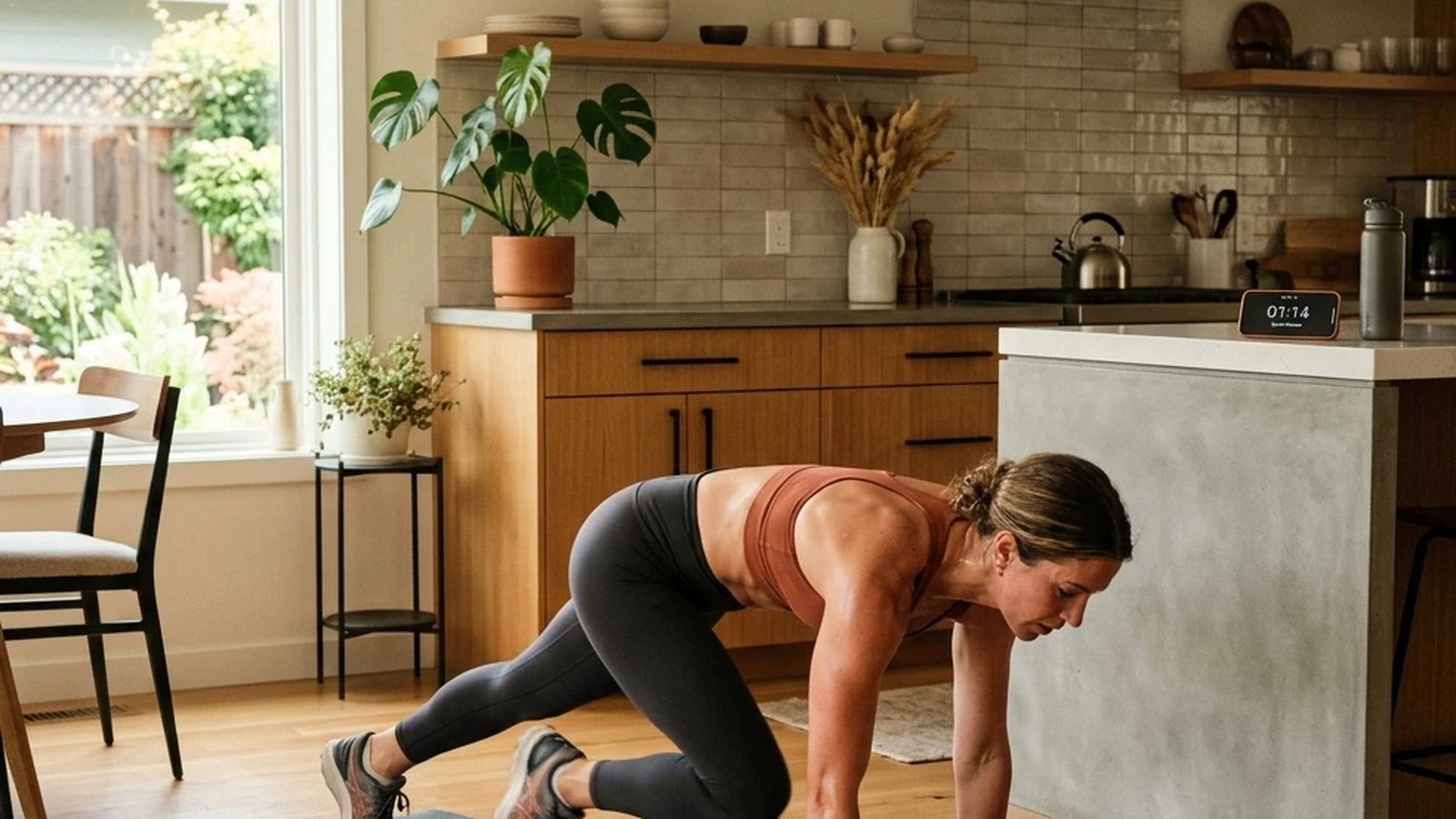
- 30 mountain climbers.
- 15 seconds rest, repeat.
RPE should sit ~7–8. Total work time ~20 minutes; rest minimal. Produces measurable cardio fitness with no equipment.
Space and noise considerations
Hotel rooms have constraints not present in gyms:
- Floor space: many movements require ~6 feet x 6 feet (push-ups, planks, lunges). Most rooms have this between bed and wall.
- Noise: jumping movements (jump squats, burpees, mountain climbers) are loud through floors. Substitute with low-impact alternatives: high-knees in place, slow squats, walking lunges.
- Time of day: avoid jumping movements late at night out of consideration for adjacent rooms.
- Floor surface: carpet is generally fine. Hardwood may need a folded towel for kneeling work.
- Mirrors: most hotel rooms have full-length or large bathroom mirrors. Useful for form-checking.
Travel-specific tactics
- First-day arrival: short, easy session for circulation and routine establishment. Don’t try to set PRs after a long flight.
- Time-zone adjustment: training around the new local time helps circadian re-entrainment. Morning session in destination time even if it feels early.
- Hotel gym vs hotel room: if there’s a basic hotel gym, use it. A few dumbbells and a treadmill expands options. If the gym is unavailable or crowded, the room workouts are reasonable substitutes.
- Warming up matters more during travel: post-flight bodies are stiffer; spend 5 minutes on mobility before starting.
- Recovery is harder when travelling: lower volume than your home training. The session should leave you better than you started, not worse.
Travel equipment that’s worth packing
If you have suitcase space, three items extend hotel-room programming dramatically:
- Resistance bands: a $10–30 set of loop bands or sleeve bands. Restores resistance training options completely. Best single piece of travel equipment.
- Door-anchored band kit: adds rowing and pulling options that bodyweight alone struggles with.
- TRX-style suspension trainer: heavier and bulkier but extends the pull-pattern options significantly. For longer trips.
- Jump rope: cheap, light, packable. Adds a cardio modality without space requirements (where ceiling permits).
Don’t pack: dumbbells (heavy and confiscated by airlines), elaborate kits, gym shoes if you have travel shoes that work.
Common myths
- “Bodyweight is for beginners.” False. Bodyweight gymnastics movements (single-arm push-ups, pistol squats, planches) require advanced strength most lifters never develop. Difficulty is a matter of progression, not equipment.
- “You can’t build muscle without weights.” False. Schoenfeld 2017 and Kotarsky 2018 demonstrated comparable hypertrophy outcomes between matched-effort lower-load (including bodyweight) and higher-load free-weight protocols.
- “Hotel-room workouts are pointless.” Wrong for travel maintenance. 2 sessions per week of 20–30 minutes preserves nearly all strength and most hypertrophy through a 1–2 week trip.
- “You need 60 minutes for it to count.” Wrong. 15 minutes of high-effort work produces real adaptation. Travel-time-constrained sessions still work.
- “You can’t train pulling without a bar.” Difficult, not impossible. Door pull-ups (with caution and a sturdy door), table inverted rows, towel-anchored doorknob rows, backpack rows. Limited options, but real options.
Practical takeaways
- Bodyweight training can match most of the hypertrophy outcomes of free-weight training in untrained-to-intermediate populations when matched for effort, though strength gains lag somewhat without added external load.
- 2–3 sessions per week of 15–30 minutes maintains nearly all fitness through a 1–2 week trip.
- Cover all five movement patterns: squat, hinge, push, pull, carry/core.
- Effort matters more than load. Sets must be at RPE 8–9 to produce adaptation.
- The hardest pattern to bodyweight-train is hinge (hamstrings, glutes); single-leg variations are essential.
- Resistance bands are the single best piece of travel equipment; they restore most resistance-training options at minimal weight.
- For trained lifters on long trips (3+ weeks), bodyweight maintenance preserves fitness but doesn’t continue progression.
Frequently asked questions
Can I really build muscle with just bodyweight?
Yes, especially for untrained-to-intermediate lifters. The 2017 Schoenfeld systematic review pooled studies comparing low-load (bodyweight-equivalent) vs high-load resistance training; when both groups trained to similar effort levels, hypertrophy outcomes were comparable. Trained populations need progressive overload, which becomes harder with bodyweight alone — but still possible with progressions to single-limb and tempo variations.
What if I can't do a single push-up?
Start with elevated push-ups (hands on a bed, dresser, or wall). The angle reduces load until you can do 8 to 12 strict reps, then progressively lower the height. Most adults reach floor push-ups in 4 to 8 weeks of consistent practice from any starting point.
How do I do pull-ups in a hotel room?
If a doorframe or door allows safe loading, hang a sturdy towel over the top to anchor and use it for pull-ups (test the door first). Otherwise: under-table inverted rows (legs straight, body under sturdy table, pulling up); horizontal towel rows on a doorknob; or backpack rows bent over at the hips. None replicate vertical pulling perfectly but cover the pulling pattern adequately for short trips.
Are resistance bands worth packing?
Yes, the single best piece of travel equipment. A loop band set or sleeve band kit weighs under 500g and restores most resistance training options. They add load to bodyweight movements and enable rowing, banded squats, banded deadlifts, and shoulder/posterior chain work.
How long can I rely on hotel-room workouts before I need real gym access?
Untrained-to-intermediate: indefinitely with progressions (single-arm push-ups, pistol squats, archer push-ups, etc.). Trained intermediate-to-advanced: 2 to 4 weeks for full maintenance; longer trips will produce some plateau or regression. For multi-month travel, bands plus bodyweight extends the runway substantially; for permanent travel-only training, gymnastic progressions can take you very far.
References
Schoenfeld 2017Schoenfeld BJ, Grgic J, Ogborn D, Krieger JW. Strength and hypertrophy adaptations between low- vs. high-load resistance training: a systematic review and meta-analysis. J Strength Cond Res. 2017;31(12):3508-3523. View source →Schoenfeld 2020Schoenfeld BJ, Grgic J. Effects of range of motion on muscle development during resistance training interventions: a systematic review. SAGE Open Med. 2020;8:2050312120901559. View source →McGill 2010McGill SM. Core training: evidence translating to better performance and injury prevention. Strength Cond J. 2010;32(3):33-46. View source →Morton 2016Morton RW, Oikawa SY, Wavell CG, et al. Neither load nor systemic hormones determine resistance training-mediated hypertrophy or strength gains in resistance-trained young men. J Appl Physiol. 2016;121(1):129-138. View source →Calatayud 2014Calatayud J, Borreani S, Colado JC, Martín FF, Rogers ME, Behm DG. Muscle activation during push-ups with different suspension training systems. J Sports Sci Med. 2014;13(3):502-510. View source →Ratamess 2009Ratamess NA, Alvar BA, Evetoch TK, et al. American College of Sports Medicine position stand. Progression models in resistance training for healthy adults. Med Sci Sports Exerc. 2009;41(3):687-708. View source →Kotarsky 2018Kotarsky CJ, Christensen BK, Miller JS, Hackney KJ. Effect of progressive calisthenic push-up training on muscle strength & thickness. J Strength Cond Res. 2018;32(3):651-659. View source →Schoenfeld 2014Schoenfeld BJ. Postexercise hypertrophic adaptations: a reexamination of the hormone hypothesis and its applicability to resistance training program design. J Strength Cond Res. 2013;27(6):1720-1730. View source →Scharhag 2009Scharhag-Rosenberger F, Meyer T, Walitzek S, Kindermann W. Time course of changes in endurance capacity: a 1-yr training study. Med Sci Sports Exerc. 2009;41(5):1130-1137. View source →