The 60-second version
The "anabolic window" — the 30-minute post-workout slot where protein supposedly hits different — has been almost entirely walked back by the people who popularised it. The current state of the literature is more nuanced and more practical: total daily intake matters most, distribution matters second, and timing around training matters third. The third level does matter, but the strongest evidence lives on the carbohydrate side, not the protein side. Hit your daily carb target (4 to 7 g/kg for trained lifters; 5 to 10 g/kg for endurance focus); eat a real meal 2 to 3 hours before your hard session; fuel during anything over 90 minutes; and eat a normal carb-and-protein meal within a few hours after. That gets you 90 percent of the available benefit. Use our macros calculator to set the daily target, and our TDEE calculator to set the calorie ceiling.
Educational journalism, not medical advice. Every claim here is checked against its cited sources by editor Timothy Bunce — a health writer, not a physician. It isn’t specific to your situation: for health decisions, talk to your own clinician. How we work →
Some links in this article are affiliate links. If you buy through one, The Beachside Reader earns a commission at no extra cost to you. It never changes which products we pick, or what we say about them. Full affiliate disclosure →
Total intake first
Before timing, total daily carb intake sets the ceiling. A 2017 randomized controlled trial by Schoenfeld and colleagues in PeerJ found that, when daily protein and total calories are equated, shifting a protein dose from immediately before to immediately after the workout produced no statistically significant difference in muscle gains over 10 weeks (p > 0.05) Schoenfeld 2017. In other words, once daily intake is matched, the precise clock-time of the dose is close to irrelevant.
The implication is straightforward: nobody should be optimising carb timing while still under-eating carbohydrate overall. For a moderately trained athlete, that means at least 4 to 7 grams per kilogram of body weight per day. Below that floor, timing tweaks produce nothing because there isn’t enough fuel in the system to redistribute.
Where timing actually matters
Three windows have meaningful evidence behind them.
1 to 4 hours before training
A meal containing 1 to 2 grams of carbohydrate per kilogram of body weight, plus 20 to 40 grams of protein, raises blood glucose and primes glycogen-loading capacity. Burke et al. (2011) reviewed the evidence and concluded that pre-exercise carbohydrate intake improves endurance capacity and time-to-exhaustion by boosting carbohydrate availability, chiefly through higher pre-exercise liver glycogen Burke 2011. The same principle applies to higher-intensity intermittent work, though the magnitude is smaller for shorter sessions.
The practical rule: a real meal 2 to 3 hours before a hard session, with a serving of complex carb (oats, rice, sweet potato, pasta) and lean protein. Not a pre-workout shake; an actual meal.
During training (sessions over 90 minutes)
Carbohydrate intake during exercise becomes a meaningful variable once the session crosses about 90 minutes. The American College of Sports Medicine’s position stand recommends 30 to 60 grams per hour for events between 1 and 2.5 hours, scaling up to 90 grams per hour for events over 2.5 hours when using mixed-source carbs (glucose plus fructose) ACSM 2016.
For most strength training and HIIT sessions of 45 to 75 minutes, no in-workout carb is needed. For a long run, ride, or hike, this is the window where gels, sports drinks, or whole-food alternatives (medjool dates, banana, rice cakes with jam) earn their keep.
0 to 4 hours after training
Glycogen resynthesis happens fastest in the first 30 to 60 minutes after exercise — about 7 to 8 percent per hour, declining to 5 percent per hour after the first hour (Ivy et al., 1988) Ivy 1988. For a single training session a day this rapid resynthesis window is academic; you’ll be fully resynthesised by your next session regardless. For double sessions or back-to-back competition days, it’s the difference between starting the second session full or half-empty.
Practical rule for double sessions: get 1.0 to 1.2 grams of carb per kilogram of body weight in the first hour after the first session. For single daily sessions, eat your normal post-workout meal whenever it’s convenient over the next few hours.
The two-a-day case (where timing actually pays)
The athletes who genuinely need precise post-workout carb timing are the ones training twice a day, fewer than 6 to 8 hours apart. A morning Hyrox session followed by an afternoon strength block, two-a-day Crossfit programming, or back-to-back race-prep days for a multi-day event all fit this pattern. With less than 8 hours of recovery between sessions, the rate of glycogen resynthesis becomes a hard ceiling on the second session’s quality, and the first 60 minutes is where the resynthesis rate is highest.
For everyone training once a day, this stops mattering by the time they next eat. The mistake most lifters make is reading the two-a-day literature, ignoring that it was conducted on two-a-day populations, and adding urgency to a problem they don’t actually have.
Carb type matters less than people think
There is a persistent belief that fast-digesting (high-glycemic) carbs are required post-workout. The evidence on carbohydrate type specifically is much thinner than the evidence on total carb dose, and the two often get conflated in popular writing: total carbohydrate intake is the variable with the strongest evidence behind it, and glycemic index is at most a second-order lever. The reason fast carbs sometimes test better in studies is that they’re easier to over-consume — and the studies didn’t always control for total dose.
The exception: in the immediate post-exercise window for someone doing two-a-days, a higher-glycemic source (white rice, white potato, sports drink) does refill glycogen marginally faster than slow carbs. Marginal but real. For everyone else, eat what you’ll actually digest comfortably.
Where the protein literature lands
Briefly, because this article is about carbs but the question always follows: total daily protein at 1.6 to 2.2 grams per kilogram of body weight, distributed across 3 to 5 meals of 0.4 to 0.55 grams per kilogram each. The post-workout protein window is more like 2 to 4 hours wide than 30 minutes, and the size of the meal matters more than its proximity to the session.
If you’ve eaten a real protein-containing meal within 3 to 4 hours before training, you do not need to chase a shake immediately afterward.
The simple rules that out-perform complicated protocols
- Hit total daily carbs (4 to 7 g/kg for trained, 5 to 10 g/kg for endurance-focused).
- Eat a real carb-and-protein meal 2 to 3 hours before your hard session of the day.
- For sessions over 90 minutes, fuel during.
- Eat a normal carb-and-protein meal within a few hours after; don’t sweat the exact timing.
That’s it. The above gets you 90 percent of the available benefit. The remaining 10 percent — peri-workout fast carbs, intra-workout amino acids, double-session glycogen precision — is real but matters mostly to athletes whose training volume is high enough to justify the optimisation tax.
What this looks like in a normal week
A typical week for a recreationally serious lifter who trains 5 days a week, weighs 75 kg:
- Daily target: roughly 350 g carb, 140 g protein, 75 g fat (set yours with the macros calculator and the TDEE calculator).
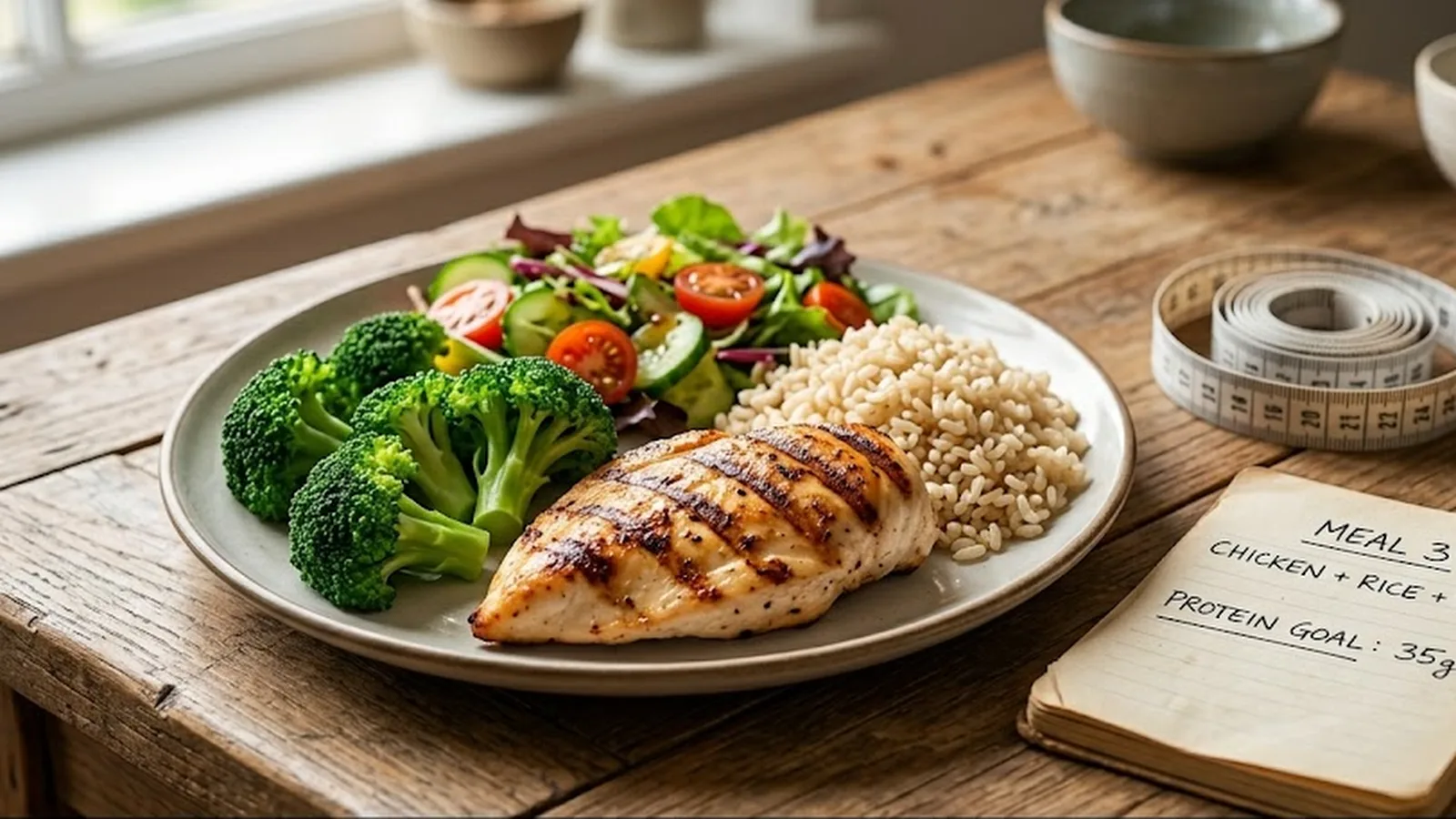
- 3 hours pre-session: ~110 g carb, ~30 g protein meal (oatmeal with whey and a banana, or chicken and rice).
- During sessions of 60 to 75 minutes: water, no carbs needed.
- Post-session: a normal next meal, eaten within a few hours. No urgency.
That’s not exotic. It’s also not glamorous. It works.
Practical takeaways
- Total intake is the ceiling. No timing tweak rescues a chronic carb deficit. Set the daily target first.
- The 30-minute window is largely myth for one-a-day trainees. Most of the published urgency comes from two-a-day populations whose constraints don’t apply to most readers.
- Pre-workout meal beats pre-workout shake. 2 to 3 hours out, real food. Save the shake for fasted morning training where solid food doesn’t sit well.
- Carb type is mostly about digestion comfort. White rice for the two-a-days; whatever you tolerate for everyone else.
- Protein totals are the structural variable. 1.6 to 2.2 g/kg/day, spread across 3 to 5 meals. The window is hours, not minutes.
Frequently asked questions
Do I need carbs if I’m doing keto?
No — fat-adapted athletes can perform well at moderate intensities. Above ~75% of VO2 max, carb-restricted athletes underperform. Choose accordingly.
Should I take a pre-workout shake?
Mostly unnecessary if you’ve eaten a meal in the last 2 to 3 hours. If you train fasted in the morning and don’t tolerate solid food, a shake or a piece of fruit serves as the smallest viable replacement.
What about intra-workout BCAAs?
If your daily protein is sufficient and you’ve eaten a protein-containing meal in the last 3 to 4 hours, BCAAs add nothing measurable. The literature is consistent on this.
Carb cycling — is it worth it?
Cycling carbs (high on training days, lower on rest days) can help adherence to a calorie target. It does not produce metabolic effects beyond what calorie matching achieves on its own.
How do I figure out my daily carb target?
Use our TDEE calculator to set the calorie ceiling, then our macros calculator to split that into protein, carbs, and fat. The ranges in this article (4 to 7 g/kg for trained, 5 to 10 g/kg for endurance-focused) are the guard rails.
References
Schoenfeld 2017Schoenfeld BJ, Aragon AA, Wilborn CD, Urbina SL, Hayward SE, Krieger JW. Pre- versus post-exercise protein intake has similar effects on muscular adaptations. PeerJ. 2017;5:e2825. View source →Burke 2011Burke LM, Hawley JA, Wong SHS, Jeukendrup AE. Carbohydrates for training and competition. Journal of Sports Sciences. 2011;29(sup1):S17-S27. View source →Ivy 1988Ivy JL, Katz AL, Cutler CL, Sherman WM, Coyle EF. Muscle glycogen synthesis after exercise: effect of time of carbohydrate ingestion. Journal of Applied Physiology. 1988;64(4):1480-1485. View source →ACSM 2016Thomas DT, Erdman KA, Burke LM. American College of Sports Medicine Joint Position Statement: Nutrition and Athletic Performance. Medicine & Science in Sports & Exercise. 2016;48(3):543-568. View source →