The 60-second version
Bright morning light exposure is one of the strongest interventions for circadian regulation. The 2013 Wright et al. camping-without-electronics study showed a week of natural light/dark exposure (after a one-week baseline under normal electric lighting) shifted melatonin onset earlier by ~2 hours and synchronised internal time to solar time Wright 2013. The downstream effects matter for training: better-aligned circadian rhythms are associated with deeper sleep and healthier metabolic and cognitive function — the general profile described in circadian-physiology reviews (Czeisler 2009 review and follow-up work) Czeisler 2009. The honest scope: morning light cannot rescue truly bad sleep, undo chronic stress, or replace training. It can help if you’re sleeping poorly, training in the wrong time-of-day for your chronotype, or struggling with seasonal mood. The dose: 10–30 minutes of outdoor light within 30–60 minutes of waking. Window light, even bright artificial light indoors, is meaningfully weaker than direct outdoor exposure. This article covers what the chronobiology evidence shows, what dose actually works, and where the popular “sunlight as performance hack” framing breaks down.
Educational journalism, not medical advice. Every claim here is checked against its cited sources by editor Timothy Bunce — a health writer, not a physician. It isn’t specific to your situation: for health decisions, talk to your own clinician. How we work →
Some links in this article are affiliate links. If you buy through one, The Beachside Reader earns a commission at no extra cost to you. It never changes which products we pick, or what we say about them. Full affiliate disclosure →
How morning light actually works
The body’s master circadian pacemaker (suprachiasmatic nucleus) takes its primary timing input from a specific class of retinal cells (intrinsically photosensitive retinal ganglion cells, ipRGCs) sensitive to short-wavelength (blue-enriched) light around 460–480 nm. Morning bright light:
- Suppresses residual melatonin and signals “morning” to every clock-controlled tissue.
- Phase-advances the circadian system on subsequent nights, making earlier sleep onset easier.
- Triggers cortisol awakening response with morning peak amplitude proportional to light intensity.
- Sets the timing for evening melatonin onset ~14–16 hours later.
The 2013 Wright et al. study moved subjects from typical urban indoor lighting (mostly <200 lux) to a week of camping with no electronics. Two findings:
- Subjects experienced ~4× brighter daytime light exposure (peak natural daylight: 100,000+ lux).
- Internal melatonin onset shifted ~2 hours earlier, aligned with sunset, and bedtime self-aligned with solar darkness Wright 2013.
The implication: most modern sleep timing problems aren’t about behaviour, they’re about insufficient morning light contrast.
“Exposure to natural light–dark cycles results in earlier melatonin onset and offset, and a strengthened circadian rhythm. The amplitude and timing of the rhythm are sensitive to even brief electric light exposure during biological night.”
— Wright et al., Curr Biol, 2013 view source
Effects on athletic performance
The chronobiology of athletic performance has been studied for decades. The convergent findings:
- Time-of-day peak performance: most strength and power outputs peak in the late afternoon (~16:00–19:00) by ~3–7% over morning lows. Endurance shows smaller time-of-day variation.
- Chronotype matters: morning chronotypes (~30% of population) show smaller time-of-day variations and better morning performance; evening chronotypes (~25%) show larger evening peaks. The 2015 Facer-Childs & Brandstaetter study showed evening-types produce ~26% better performance at their personal evening peak vs morning attempt Facer-Childs 2015.
- Misaligned circadian rhythms blunt these effects. Jet lag, shift work, and chronically delayed sleep produce documented performance decrements that morning light helps re-align.
- Sleep quality is downstream of light exposure. Better-timed light produces better-quality sleep produces better next-day performance.
Practical dose
The chronobiology and seasonal-affective-disorder literatures converge on a fairly consistent dose:
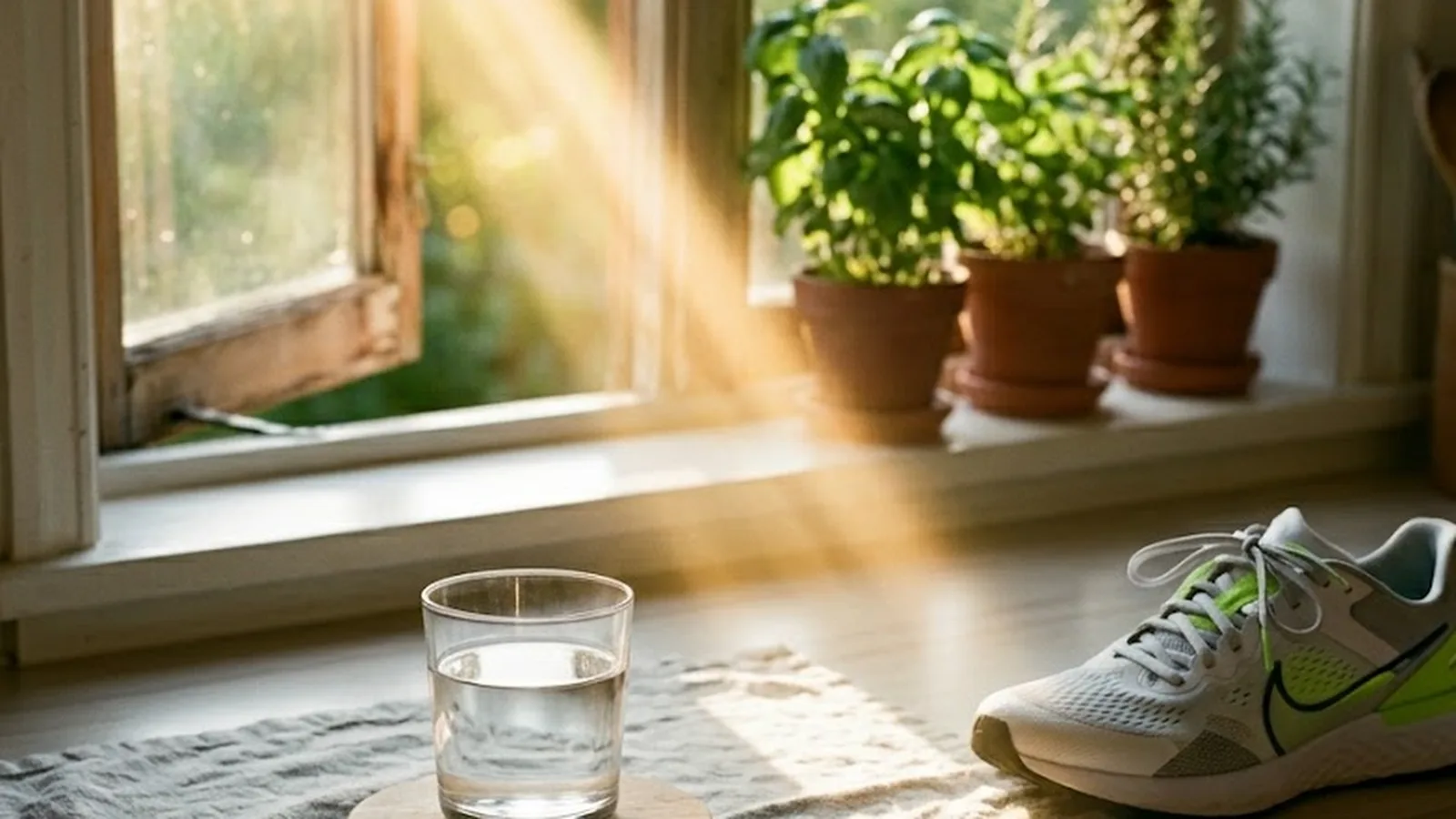
- Timing: within 30–60 minutes of waking. Earlier is generally better.
- Duration: 10–30 minutes outdoors on a sunny day; 20–45 minutes on overcast days.
- Intensity: outdoor light, even on overcast days, is 1,000–25,000+ lux. Indoor light is typically 100–500 lux. The 5–100× intensity difference matters.
- Eye direction: don’t stare at the sun. Be outside; the ambient signal is what matters.
- Through windows: glass blocks ~20–50% of relevant wavelengths and reduces total intensity. Through-window light is better than nothing, weaker than outdoors.
The 10,000-lux box question
Light therapy boxes (10,000 lux at typical face distance) are evidence-based treatments for seasonal affective disorder and can substitute for outdoor light when latitude or season makes outdoor exposure impractical. A related 2015 Lam et al. trial found bright light therapy significantly outperformed placebo (50% vs 33% response rate, d=0.80), while fluoxetine alone was not significantly better than placebo (d=0.24) — though that trial specifically studied nonseasonal major depressive disorder, not seasonal affective disorder. For circadian shifting (without depression), outdoor light is preferable when available; light box is a reasonable winter or shift-work alternative. Expect 30–45 minutes at the box per morning if substituting for outdoor exposure.
Light isn’t the only morning input
Morning light works in concert with other zeitgebers:
- Movement: morning physical activity reinforces the circadian signal. Walking outside in morning light combines two interventions.
- Meal timing: eating breakfast within ~1 hour of waking reinforces peripheral clocks (liver, gut, muscle).
- Social contact: human interaction itself is a weak zeitgeber, especially in older adults.
- Temperature: a slight body-temperature rise in the morning (movement, warm shower) reinforces wake signal.
The intervention with the strongest evidence is the bundle — morning light + movement + breakfast within an hour of waking — not light alone. The 2012 Roenneberg et al. work, drawing on Munich Chronotype Questionnaire data from more than 130,000 respondents, found that social jetlag — the mismatch between the body’s internal clock and social or work schedules — is associated with higher rates of overweight and obesity Roenneberg 2013.
When morning light matters most
Subgroups likely to benefit substantially:
- Sleep-onset insomnia: difficulty falling asleep at the desired time often reflects a delayed circadian phase. Morning light advances the phase.
- Shift workers transitioning back to day schedule: aggressive morning light helps re-anchor.
- Travellers crossing time zones: morning light at the destination accelerates phase realignment.
- Adolescents: developmentally delayed circadian phase responds well to morning light + earlier sleep enforcement.
- Higher latitudes in winter: short photoperiods + indoor lifestyle produces classic seasonal affective patterns. Outdoor light or a 10,000-lux box works.
- Older adults: light-sensitivity declines with age; the morning signal often needs to be longer or more intense to produce equivalent phase shifts.
The morning-evening symmetry
Bright morning light advances the phase. Bright evening light delays it. The two work as opposing forces, and most modern environments give too much evening light and not enough morning light. Practical sleep hygiene therefore involves both:
- Morning: aggressive bright light within 30–60 minutes of waking.
- Evening: dim ambient light, especially blue-enriched light, in the 2–3 hours before bed.
Either alone is helpful; the combination is much stronger.
Common myths
- “30 seconds of morning sun cures sleep problems.” Overstated. Brief intermittent exposure provides smaller signals than 10–30 minutes of sustained exposure. Some signal is better than none, but the dose matters.
- “Morning light boosts testosterone.” Limited and indirect evidence. Morning light reinforces normal cortisol awakening response, and there are observed correlations between bright-light exposure and testosterone in some populations, but the causal chain isn’t strong. Don’t reach for sunlight as an endocrinology hack.
- “You need to look directly at the sun.” No, and don’t. The ipRGCs that drive the circadian signal are stimulated by ambient outdoor light intensity. Looking directly at the sun causes retinal damage with no additional circadian benefit.
- “Light through windows is enough.” Window light is meaningfully weaker than outdoor light (often 5–20×). It’s better than indoor lighting, but not equivalent to being outside.
- “Sunlight makes you stronger.” Indirectly. Better circadian alignment improves sleep, which improves recovery, which improves training adaptation. The pathway runs through sleep, not directly through sunlight.
A workable protocol
If you want to test morning light in your own routine:
- For 4 weeks, get outside for 10–30 minutes within 30–60 minutes of waking. Walk, stretch, drink coffee outdoors, whatever.
- Pair with a 10–15 minute easy walk to layer in morning movement.
- If the weather is awful or you live at high latitude in winter, use a 10,000-lux light therapy box for 20–30 minutes during morning routine.
- Reduce evening light exposure for the 2 hours before bed (dim ambient light, screens to night-mode).
- Track sleep onset, sleep quality, and morning energy weekly. Most subjects notice meaningful change at 2–3 weeks.
Practical takeaways
- Morning bright light is the strongest single zeitgeber for circadian alignment.
- Effective dose: 10–30 minutes outdoors within 30–60 minutes of waking; 20–45 minutes on overcast days.
- Outdoor light is 5–100× brighter than indoor light. Through-window light is intermediate.
- 10,000-lux therapy boxes are reasonable substitutes when outdoor exposure isn’t practical.
- Morning light improves performance via the sleep pathway, not by directly increasing strength.
- Pair morning light with movement + breakfast within an hour of waking, and dim evening light, for the strongest combined effect.
Frequently asked questions
How long do I need to be outside in the morning?
10 to 30 minutes on a sunny day, 20 to 45 minutes on overcast days. The total light dose matters more than precise duration. Effects on circadian phase build over days to weeks of consistent exposure, not hours.
Does light through a window count?
Partially. Glass blocks 20 to 50 percent of the relevant blue wavelengths and reduces total intensity. Through-window light is meaningfully better than dim indoor lighting but weaker than outdoor exposure. If you can step outside, do; if not, sitting near a bright window is a reasonable fallback.
What if I wake up before sunrise?
If you live where mornings are dark in winter or you rise very early, a 10,000-lux light therapy box for 20 to 30 minutes during morning routine is the evidence-based substitute. The 2015 Lam trial actually enrolled patients with nonseasonal major depressive disorder, not seasonal depression, and found light monotherapy significantly outperformed placebo (50% vs 33% response rate; effect size d=0.80, P=.006), while fluoxetine alone was not significantly better than placebo (d=0.24, P=.32) in that trial. For circadian phase shifting (not depression), outdoor light when available is preferable; light boxes are the winter or pre-dawn alternative.
Will morning sunlight directly improve my lifts?
Not directly. The pathway runs through sleep quality and circadian alignment, which improve recovery, which improves training adaptation. The 'sunlight makes you strong' framing oversimplifies. If your sleep is fine and circadian rhythm is well-aligned, adding more morning sun won't add detectable performance benefits.
Should I look at the sun?
No. Direct staring at the sun causes retinal damage with no extra circadian benefit. The retinal cells that signal circadian time respond to ambient outdoor light intensity. Just be outside; eye direction doesn't matter.
References
Wright 2013Wright KP Jr, McHill AW, Birks BR, Griffin BR, Rusterholz T, Chinoy ED. Entrainment of the human circadian clock to the natural light-dark cycle. Curr Biol. 2013;23(16):1554-1558. View source →Czeisler 2009Czeisler CA, Gooley JJ. Sleep and circadian rhythms in humans. Cold Spring Harb Symp Quant Biol. 2007;72:579-597. View source →Roenneberg 2013Roenneberg T, Allebrandt KV, Merrow M, Vetter C. Social jetlag and obesity. Curr Biol. 2012;22(10):939-943. View source →Facer-Childs 2015Facer-Childs E, Brandstätter R. The impact of circadian phenotype and time since awakening on diurnal performance in athletes. Curr Biol. 2015;25(4):518-522. View source →Lam 2015Lam RW, Levitt AJ, Levitan RD, et al. Efficacy of bright light treatment, fluoxetine, and the combination in patients with nonseasonal major depressive disorder: a randomized clinical trial. JAMA Psychiatry. 2016;73(1):56-63. View source →Brainard 2001Brainard GC, Hanifin JP, Greeson JM, et al. Action spectrum for melatonin regulation in humans: evidence for a novel circadian photoreceptor. J Neurosci. 2001;21(16):6405-6412. View source →Burgess 2003Burgess HJ, Sharkey KM, Eastman CI. Bright light, dark and melatonin can promote circadian adaptation in night shift workers. Sleep Med Rev. 2002;6(5):407-420. View source →Hatori 2017Hatori M, Gronfier C, Van Gelder RN, et al. Global rise of potential health hazards caused by blue light-induced circadian disruption in modern aging societies. NPJ Aging Mech Dis. 2017;3:9. View source →Vetter 2021Vetter C, Pattison PM, Houser K, et al. A review of human physiological responses to light: implications for the development of integrative lighting solutions. Leukos. 2022;18(3):387-414. View source →Blume 2019Blume C, Garbazza C, Spitschan M. Effects of light on human circadian rhythms, sleep and mood. Somnologie (Berl). 2019;23(3):147-156. View source →Phillips 2019Phillips AJK, Vidafar P, Burns AC, et al. High sensitivity and interindividual variability in the response of the human circadian system to evening light. Proc Natl Acad Sci USA. 2019;116(24):12019-12024. View source →Kantermann 2007Kantermann T, Juda M, Merrow M, Roenneberg T. The human circadian clock's seasonal adjustment is disrupted by daylight saving time. Curr Biol. 2007;17(22):1996-2000. View source →