The 60-second version
Most adults lose 3 to 8 percent of their muscle mass per decade after age 30, and the rate accelerates after 60. This clinical loss of muscle, called sarcopenia, isn’t just about appearance — it’s a predictor of falls, hospitalization length, and loss of independence. While resistance training is essential, it requires one specific nutritional trigger: leucine. Due to "anabolic resistance," older adults need more protein per meal than younger adults to trigger muscle synthesis. The research points to a leucine threshold of 2.5 to 3.0 g per meal, which usually requires 30 to 40 g of high-quality protein — about triple what’s in a typical North American breakfast.
Educational journalism, not medical advice. Every claim here is checked against its cited sources by editor Timothy Bunce — a health writer, not a physician. It isn’t specific to your situation: for health decisions, talk to your own clinician. How we work →
Some links in this article are affiliate links. If you buy through one, The Beachside Reader earns a commission at no extra cost to you. It never changes which products we pick, or what we say about them. Full affiliate disclosure →
What sarcopenia is, briefly
Sarcopenia is the age-related loss of muscle mass and strength. The European Working Group on Sarcopenia (EWGSOP2) defines it by three criteria: low muscle strength, low muscle quantity or quality, and low physical performance EWGSOP2 2019. By age 80, roughly half of community-dwelling adults meet at least one of these criteria. The consequences are structural: reduced grip strength and falling rates rise in lockstep as quadriceps strength falls.
What "anabolic resistance" means
Younger muscle responds vigorously to a protein-containing meal. Older muscle responds more sluggishly. This is anabolic resistance: the same dose of protein produces a smaller muscle protein synthesis (MPS) response in a 70-year-old than in a 25-year-old. Consequently, older adults need more protein per meal to produce the same stimulus, not less. The conventional advice that "older adults need less food" is correct on total calories but almost exactly wrong on protein density.
The leucine threshold
Leucine is the branched-chain amino acid that triggers the mTOR pathway for muscle synthesis. In younger adults, ~1.7 g of leucine per meal saturates the response. In older adults, that threshold rises to roughly 2.5 to 3.0 g per meal. This roughly maps onto protein serving size: a moderate 30 g serving of high-quality protein raised muscle protein synthesis by about 50% in both young and elderly adults alike, with a much larger 90 g serving adding no further benefit to either group Symons 2009 — in other words, once a meal clears that threshold, roughly 30 to 40 g of protein, piling on more doesn't buy extra muscle-building signal.
Protein targets and distribution
The PROT-AGE Study Group's evidence review recommends that older adults consume 1.0 to 1.2 g/kg of total daily protein — meaningfully above the standard RDA of 0.8 g/kg — to help offset age-related lean mass loss Bauer 2013. For an active 70 kg adult, that works out to 70 to 105 g of protein per day, ideally distributed across 3 to 4 meals of 25 to 35 g each.
Hitting the threshold: 30g protein sources
| Source | Portion | Protein | Leucine |
|---|---|---|---|
| Greek yogurt (2%) | 1.5 cups | 28 g | 2.4 g |
| Whey protein isolate | 1 scoop (30 g) | 25 g | 2.7 g |
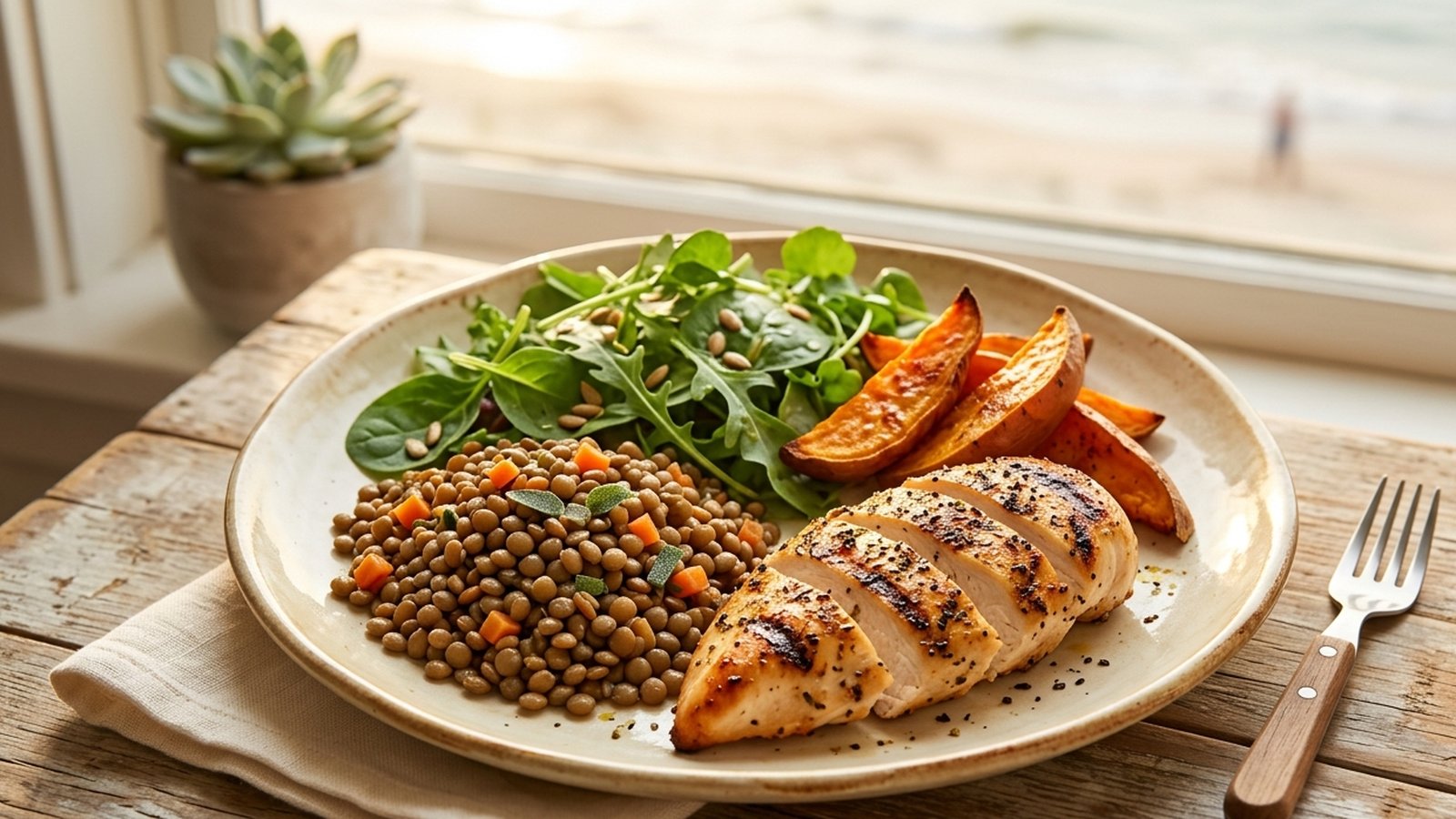
| Chicken breast | 130 g (4.5 oz) | 35 g | 2.7 g |
| Salmon | 130 g (4.5 oz) | 28 g | 2.2 g |
| Cottage cheese | 1.5 cups | 36 g | 3.5 g |
| Eggs | 5 large | 30 g | 2.5 g |
The breakfast lever
The biggest practical change for most older adults is breakfast. A typical North American breakfast — toast and coffee or a bowl of cereal — contains 5 to 12 g of protein. This fails to cross the leucine threshold and produces minimal MPS response. Three fixes:
- Greek yogurt + berries. 1.5 cups of 2% Greek yogurt provides ~28 g of protein.
- Eggs. Four to five large eggs provide ~28 to 30 g. For older adults, eggs are no longer considered the primary cardiovascular concern they once were.
- Whey protein shake. One scoop in milk provides about 30 g and is the fastest option for those with low morning appetite.
The training multiplier
Protein without resistance training produces small effects; resistance training without adequate protein produces moderate effects; the combination produces large effects. For older adults, 2 to 3 resistance training sessions per week focusing on compound patterns (sit-to-stand, hinge, push, pull) is the dose consistently supported by the literature to preserve independence and strength.
Practical takeaways
- Aim for 1.2 g of protein per kg of body weight daily. This is about 50% higher than the standard RDA.
- Distribute protein across 3 to 4 meals. Aim for 25 to 35 g per meal to hit the leucine trigger.
- Prioritize the breakfast protein. Don’t let the first 8 hours of your day be a missed opportunity for muscle preservation.
- Pair nutrition with 2–3 resistance sessions weekly. Use the nutrition to convert the training stimulus into real muscle quality.
Frequently asked questions
Is too much protein hard on older kidneys?
In healthy older adults without pre-existing kidney disease, multiple long-term studies show no adverse impact at intakes up to 1.6 g/kg/day. If kidney disease is present, consult your nephrologist.
Can I just take a leucine supplement?
For most healthy adults, whole protein sources are better. Leucine supplements are most useful during hospitalization, post-surgery recovery, or on strict plant-based diets where leucine density is lower.
Is collagen useful for muscle?
No. Collagen is very low in leucine and is not an effective trigger for muscle protein synthesis. It is useful for tendon and skin health, but it should not replace high-leucine proteins like whey, eggs, or meat in your muscle-preservation plan.
Is it ever too late to start?
No. Sarcopenia is partially reversible at every age. Strength gains have been measured in 80- and 90-year-olds within 12 weeks of starting a combined protein and resistance training protocol.
References
Bauer 2013Bauer J, Biolo G, Cederholm T, et al. Evidence-based recommendations for optimal dietary protein intake in older people: a position paper from the PROT-AGE Study Group. J Am Med Dir Assoc. 2013;14(8):542-559. View source →Symons 2009Symons TB, Sheffield-Moore M, Wolfe RR, Paddon-Jones D. A moderate serving of high-quality protein maximally stimulates skeletal muscle protein synthesis in young and elderly subjects. J Am Diet Assoc. 2009;109(9):1582-1586. View source →EWGSOP2 2019Cruz-Jentoft AJ, Bahat G, Bauer J, et al. Sarcopenia: revised European consensus on definition and diagnosis. Age Ageing. 2019;48(1):16-31. View source →