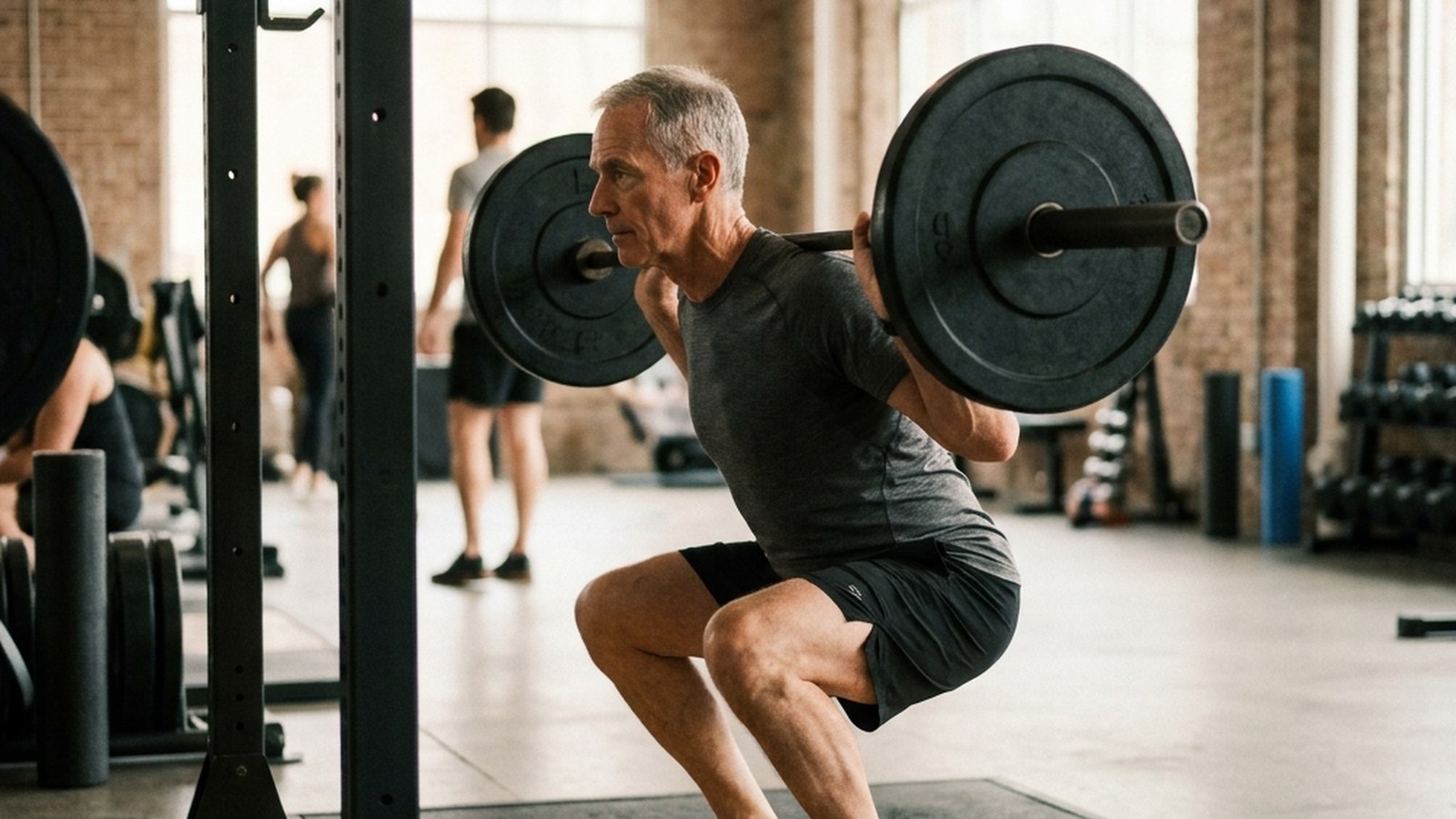
The 60-second version
Adults aged 65+ should aim for: 2–3 days per week of resistance training (the single highest-impact intervention against age-related decline) Fragala 2019, 150+ minutes/week of moderate aerobic activity, balance work 3+ days/week (Cochrane evidence: 24% reduction in fall rate) Sherrington 2019, and 1.0–1.2 g protein per kg of bodyweight per day (1.2–1.5 if recovering from illness or undergoing structured training) Bauer 2013. The earliest research on this. Fiatarone’s 1990 JAMA trial in nonagenarians. Showed strength gains of 174% over 8 weeks in adults aged 86–96, replicated dozens of times since Fiatarone 1990. It is essentially never too late to start.
The default story most adults are told about aging — that strength, balance, energy, and cognition decline inexorably from middle age onward — is wrong in one critical sense. Most of what we call "aging" is actually detraining. Untreated, the loss compounds. Treated, with the dose of exercise the literature now strongly supports, much of it slows dramatically and some of it reverses. The evidence on this point is one of the most settled findings in modern medicine.
Educational journalism, not medical advice. Every claim here is checked against its cited sources by editor Timothy Bunce — a health writer, not a physician. It isn’t specific to your situation: for health decisions, talk to your own clinician. How we work →
Some links in this article are affiliate links. If you buy through one, The Beachside Reader earns a commission at no extra cost to you. It never changes which products we pick, or what we say about them. Full affiliate disclosure →
What aging actually does — and what training does to it
The European Working Group on Sarcopenia in Older People (EWGSOP) revised its consensus definition in 2019 Cruz-Jentoft 2019. Untreated, average aging produces:
- ~0.5–1% of skeletal muscle lost per year after age 30
- 1–3% of strength lost per year after 60
- 3% of power lost per year after 60 (fast-twitch fibres atrophy preferentially — this is why elderly adults can’t catch themselves when they trip)
- VO₂max declines ~10% per decade in untrained adults; ~5% per decade in those who maintain regular cardiovascular exercise
- Balance and proprioception degrade due to reduced neural input from feet, vestibular sensitivity loss, and visual/oculomotor changes
- Bone density drops 0.5–1.5% per year in postmenopausal women, 0.3–0.5% in men past 50, accelerating with prolonged immobility
Compounded across 30 years, this is the late-life frailty phenotype: a 75-year-old who can’t carry groceries up a flight of stairs, who can’t rise from a low chair without using their hands, who falls when they trip and can’t recover.
The good news, showed repeatedly: most of these declines are reversible by 30–60% with consistent training, even when training begins in the eighth or ninth decade Fragala 2019 Fiatarone 1990.
"Resistance training is the single most effective intervention to combat the loss of muscle mass and strength associated with aging. The evidence is now overwhelming." — per Fragala 2019, NSCA Position Statement on Resistance Training for Older Adults
The strength-mortality link
The single most important finding in geriatric exercise science of the past two decades: muscular strength independently predicts how long you live, even after adjusting for cardiovascular fitness. García-Hermoso’s 2018 meta-analysis of about 2 million adults showed those in the highest quartile of grip strength had a 31% lower all-cause mortality than those in the lowest quartile, after adjusting for VO₂max, BMI, age, and smoking (knee-extension strength showed a smaller, roughly 14%, risk reduction) García-Hermoso 2018. Strength is not just "useful for daily life" — it is a vital sign.
The mechanism is partly causal (stronger people fall less, recover faster from illness, maintain independence longer) and partly a marker (strength loss reflects underlying frailty). Either way, treating strength as a clinical metric is now standard in geriatric medicine.
The recommended dose for adults 65+
The 2021 ICFSR International Exercise Recommendations for Older Adults consolidates the current consensus across NSCA, ACSM, WHO, and major geriatrics societies Izquierdo 2021:
| Modality | Frequency | Intensity | Volume |
|---|---|---|---|
| Resistance training | 2–3 days/week | RPE 5–7 (60–80% 1RM equivalent) | 6–10 sets/muscle/week |
| Aerobic exercise | 5+ days/week | Moderate (RPE 4–6, can talk) | 150+ min/week |
| Balance training | 3+ days/week | Challenging stance (single-leg, tandem) | 10–20 min/session |
| Flexibility/mobility | Daily ideal, 2+ days/week min | To mild stretch only | 10–15 min |
| Power training | 1–2 days/week | Light load, fast intent | 2–3 sets × 6–10 reps |
Power training matters more than people realise. Power = strength × speed. Fast-twitch fibres atrophy preferentially with age, and power is what allows you to catch yourself when you trip, climb stairs efficiently, and rise from a chair quickly. Most older-adult resistance programs neglect this dimension; the better ones include 1–2 sessions/week of light-load fast-intent work (e.g., quick step-ups, medicine-ball throws, resistance-band fast-pull patterns).
Falls prevention: the highest-impact single intervention
Falls are the leading cause of injury-related death and hospital admission in adults over 65. The 2019 Cochrane review by Sherrington and colleagues pooled 108 randomised trials of fall-prevention exercise programs (23,407 participants) and found Sherrington 2019:
- Exercise programs reduced fall rate by 23–24% on average
- Multicomponent programs (balance + functional + resistance) had the largest effect
- Tai chi reduced falls by 19% — a noteworthy single-modality finding
- The dose mattered: programs with 3+ hours/week showed a lot larger effects than < 2 hours
Cadore et al.’s earlier review of 20 trials with frail older adults specifically — the highest-risk population — showed multicomponent programs reduced falls and improved gait, balance, and lower-body strength meaningfully Cadore 2014. The take-home: exercise is one of the most cost-effective public-health interventions available, and it works in even the highest-risk groups.
The brain benefit
Erickson and colleagues’ landmark 2011 PNAS study randomised 120 older adults (ages 55–80) to either a one-year walking program or a stretching control. The walking group increased anterior hippocampal volume by 2% — effectively reversing 1–2 years of age-related shrinkage — while the stretching group lost 1.4% over the same period Erickson 2011. Memory function improved in both, but the walking group’s gains correlated with hippocampal change.
Liu-Ambrose’s 12-month RCT in 155 women aged 65–75 randomised to once-weekly resistance training, twice-weekly resistance training, or balance/tone control found: both once-weekly and twice-weekly resistance training improved selective attention and conflict resolution vs the control group (roughly 13% and 11% respectively on the Stroop test) — with once-weekly training producing the numerically larger gain, so more frequent sessions did not add extra cognitive benefit Liu-Ambrose 2010. Buchman’s prospective group followed 716 older adults with detailed accelerometer-measured activity and found that the most-active 10% had 50% lower risk of developing Alzheimer’s over the follow-up period than the least-active 10% Buchman 2012.
The mechanism is multi-modal: improved cerebral blood flow, BDNF (brain-derived neurotrophic factor) release with exercise, anti-inflammatory effects, improved sleep, and direct hippocampal neuroplasticity.
Protein: more than the RDA
The standard RDA of 0.8 g/kg/day was derived in the 1970s from younger-adult nitrogen-balance studies. Older adults are anabolically resistant — they need more dietary protein to drive the same muscle-protein-synthesis response Bauer 2013. The 2013 PROT-AGE consensus from the European Society of Clinical Nutrition recommends:
- 1.0–1.2 g protein/kg/day for healthy older adults
- 1.2–1.5 g/kg/day for those with acute or chronic illness
- 1.2–1.5 g/kg/day for older adults engaged in resistance training
- Distribute across meals: 25–30 g protein per meal triggers maximal MPS response in older adults
Practically, for a 70-kg adult: 80–100 g protein per day across 3 meals + a snack. That’s achievable with an egg-and-yogurt breakfast (~25 g), a protein-rich lunch (~30 g), a 100-g portion of fish or chicken at dinner (~25 g), plus dairy or legumes as snacks Morley 2010. We covered this in detail in our protein article.
A simple weekly framework
For a generally healthy adult 65+ cleared by their physician for moderate exercise:
- Monday: Resistance training (45 min) — 5–6 compound movements: squat to chair, dumbbell row, dumbbell press, hip hinge with light dumbbells, plank, wall push-ups. 3 sets of 8–12 reps at RPE 6–7.
- Tuesday: Walking (30–45 min) — outdoor where possible; include 5–10 minutes of brisk pace.
- Wednesday: Balance + mobility (30–40 min) — tai chi class, single-leg stance work, ankle mobility, hip openers. Or a Mat Pilates class.
- Thursday: Resistance training + power (45 min) — same lifts as Monday, plus 2–3 power-style moves: quick step-ups onto a low box, fast band rows, medicine-ball chest passes. Light load, fast intent.
- Friday: Walking + intervals (30–40 min) — warm up 10 minutes, then 5× 1-minute brisk walking with 2-minute easy recovery, cool-down.
- Saturday: Rest or low-impact activity — gardening, social walking, recreational swimming.
- Sunday: Mobility + recovery (20–30 min) — gentle stretching, breath work, foam rolling.
Total weekly load: ~3.5–4 hours of structured movement, distributed as 2 strength sessions, 3 aerobic sessions, 1 balance/mobility session, 1 recovery session. This corresponds to the high end of the 2019 ICFSR consensus and reliably produces functional gains within 8–12 weeks.
Common myths
"Lifting weights at my age will hurt me." Resistance training in older adults has one of the strongest safety records in geriatric medicine. Adverse events in published trials are rare and usually minor (DOMS, transient pulls). Risks of not lifting — sarcopenia, falls, loss of independence — vastly exceed the risks of lifting Fragala 2019.
"I’m too old to start." Fiatarone’s 1990 JAMA trial in nonagenarians (mean age 90, oldest 96) showed 174% strength gains in 8 weeks of progressive resistance training. The relative gains in elderly adults are often larger than in younger adults because the starting baseline is lower Fiatarone 1990.
"Walking is enough." Walking is excellent and necessary — but does not preserve muscle mass or strength to the degree resistance training does. Paterson and Warburton's 2010 systematic review supporting Canada's Physical Activity Guidelines specifically concluded that aerobic activity alone is insufficient for preventing functional limitations in older adults; combined aerobic + resistance training is required Paterson 2010. The Fragala/NSCA position is unambiguous: aerobic exercise alone is insufficient for older-adult strength preservation.
"I should avoid heavy weights." "Heavy" relative to your current capacity is what drives adaptation. The same principle applies as in any age group: progressive overload, RPE 6–7 on most working sets, supervision when learning new lifts.
Safety notes
- Get medical clearance before starting if you have cardiovascular disease, uncontrolled hypertension, severe osteoporosis with prior compression fracture, or recent surgery. The Canadian PAR-Q+ takes 5 minutes and triages this question.
- Consider supervision for the first 4–12 weeks — supervised group classes (like Beachside’s Men’s Core & Mobility, or many community-centre programs) a lot reduce injury risk while you’re learning movement patterns.
- Avoid Valsalva manoeuvre (breath-holding during max effort) if you have hypertension. Breathe steadily through reps.
- Watch for joint pain distinct from muscle soreness — see our soreness vs injury article.
- Hydrate generously — thirst sensitivity declines with age; drink to schedule, not just to thirst.
Beachside note
Beachside runs a dedicated Fitness Program for Over Age 65 that addresses exactly this evidence base — resistance training scaled to ability, balance work, and aerobic conditioning. If you’re a Wasaga Beach local 65+ and unsure where to start, the program is designed for first-timers and lifelong movers alike. (My family runs the gym; disclosure.)
The bottom line
- Most of what we call "aging" is detraining. The literature on this is settled.
- Strength is a vital sign. Higher muscular strength independently predicts lower mortality across more than 2 million pooled adults.
- The dose: 2–3 days resistance training, 150+ min/week aerobic, 3+ days balance work, daily mobility.
- Add power training 1–2 days/week. Light load, fast intent. This is the dimension most older-adult programs neglect.
- Hit 1.0–1.2 g protein per kg per day — or 1.2–1.5 if recovering or training intensely. Distribute across meals.
- Falls drop by ~24% with structured exercise. Cochrane evidence; this is one of the most cost-effective public-health interventions in geriatrics.
- Cognitive benefits are real. Hippocampal volume, executive function, dementia risk all improve with consistent activity.
- It is essentially never too late. 90-year-olds gain meaningful strength in 8 weeks. Start where you are.
Frequently asked questions
I'm 70 and never lifted weights — should I start now?
Yes. The Fiatarone 1990 JAMA trial in nonagenarians showed 174% strength gains in 8 weeks of progressive resistance training, and that finding has been replicated dozens of times. Start with 2-3 supervised sessions per week using bodyweight or light dumbbells. Get medical clearance first if you have cardiovascular disease, uncontrolled hypertension, or recent surgery.
How is exercise different for adults over 65?
The dose is the same in principle (2-3 strength sessions, 150+ min aerobic, plus balance work) but the priority order is different. For older adults: resistance training is the highest-impact intervention (sarcopenia/falls/mortality). Power training (light loads, fast intent) is critical and often missed. Balance work earns its own slot in the weekly plan. Protein needs are higher than the RDA suggests.
How much protein do older adults actually need?
The 0.8 g/kg (for a 70 kg / 154 lb adult, that's about 56 g)/day RDA is too low for older adults. The 2013 PROT-AGE consensus recommends 1.0-1.2 g/kg/day for healthy older adults, and 1.2-1.5 g/kg/day for those with chronic illness or engaged in resistance training. Distribute across meals (25-30 g per meal) for maximal muscle-protein-synthesis response.
What's the single most effective intervention against aging-related decline?
Resistance training. The Fragala 2019 NSCA Position Statement and the 2021 ICFSR International Recommendations both identify it as the single most-impactful intervention. It addresses sarcopenia, bone density, balance, falls, metabolic health, and (per Liu-Ambrose 2010) cognitive function in a way no other modality can match.
Will exercise help prevent dementia?
It substantially reduces risk. Buchman 2012 found the most-active 10% of older adults had 50% lower Alzheimer's incidence than the least-active 10%. Erickson 2011 showed walking can increase hippocampal volume in older adults. The effect is not curative — exercise is one factor among many — but the mechanism is well-established and the effect size is meaningful.
How do I avoid falling?
Multicomponent exercise (balance + functional + resistance) reduces fall rate by 23-24% per the Sherrington 2019 Cochrane review. Tai chi specifically reduces falls by ~19%. Single-leg stance work, gait training, and resistance training together are more effective than any one alone. Aim for 3+ hours/week of dedicated balance/strength work for the largest effect.
References
Fragala 2019Fragala MS, Cadore EL, Dorgo S, et al. (2019) Resistance Training for Older Adults: Position Statement From the National Strength and Conditioning Association. J Strength Cond Res. 33(8):2019-2052. View source →Cruz-Jentoft 2019Cruz-Jentoft AJ, Bahat G, Bauer J, et al. (2019) Sarcopenia: revised European consensus on definition and diagnosis. Age Ageing. 48(1):16-31. View source →Cadore 2014Cadore EL, Rodríguez-Mañas L, Sinclair A, Izquierdo M. (2013) Effects of different exercise interventions on risk of falls, gait ability, and balance in physically frail older adults: a study that pools many studies. Rejuvenation Res. 16(2):105-114. View source →Sherrington 2019Sherrington C, Fairhall NJ, Wallbank GK, et al. (2019) Exercise for preventing falls in older people living in the community. Cochrane Database Syst Rev. 1(1):CD012424. View source →Bauer 2013Bauer J, Biolo G, Cederholm T, et al. (2013) Evidence-based recommendations for best dietary protein intake in older people: a position paper from the PROT-AGE Study Group. J Am Med Dir Assoc. 14(8):542-559. View source →Liu-Ambrose 2010Liu-Ambrose T, Nagamatsu LS, Graf P, Beattie BL, Ashe MC, Handy TC. (2010) Resistance training and executive functions: a 12-month randomized controlled trial. Arch Intern Med. 170(2):170-178. View source →Erickson 2011Erickson KI, Voss MW, Prakash RS, et al. (2011) Exercise training increases size of hippocampus and improves memory. Proc Natl Acad Sci USA. 108(7):3017-3022. View source →García-Hermoso 2018García-Hermoso A, Cavero-Redondo I, Ramírez-Vélez R, et al. (2018) Muscular Strength as a Predictor of All-Cause Mortality in an Apparently Healthy Population: a study that pools many studies and Meta-Analysis of Data From about 2 Million Men and Women. Arch Phys Med Rehabil. 99(10):2100-2113.e5. View source →Fiatarone 1990Fiatarone MA, Marks EC, Ryan ND, Meredith CN, Lipsitz LA, Evans WJ. (1990) High-intensity strength training in nonagenarians. Effects on skeletal muscle. JAMA. 263(22):3029-3034. View source →Izquierdo 2021Izquierdo M, Merchant RA, Morley JE, et al. (2021) International Exercise Recommendations in Older Adults (ICFSR): Expert Consensus Guidelines. J Nutr Health Aging. 25(7):824-853. View source →Paterson 2010Paterson DH, Warburton DE. (2010) Physical activity and functional limitations in older adults: a study that pools many studies related to Canada's Physical Activity Guidelines. Int J Behav Nutr Phys Act. 7:38. View source →Buchman 2012Buchman AS, Boyle PA, Yu L, Shah RC, Wilson RS, Bennett DA. (2012) Total daily physical activity and the risk of AD and cognitive decline in older adults. Neurology. 78(17):1323-1329. View source →Morley 2010Morley JE, Argiles JM, Evans WJ, et al. (2010) Nutritional recommendations for the management of sarcopenia. J Am Med Dir Assoc. 11(6):391-396. View source →