The 60-second version
Animal flow is a branded bodyweight-movement system — ape walks, beast crawls, scorpion reaches, transitions strung together to music — created by Mike Fitch around 2010. The format itself is too new for a deep RCT base, and the peer-reviewed evidence specifically on animal flow is thin. But the building blocks are well-studied: quadrupedal locomotion develops shoulder stability and core integration that bilateral exercises don’t reach; mobility flows measurably improve movement quality and reduce injury rates in athlete populations; dynamic warm-up patterns produce range-of-motion gains on par with static stretching, with less immediate performance cost, and the best injury-prevention results come from combining brief stretching with dynamic movement in one warm-up rather than either alone. So animal flow as a category is well-supported. Whether the specific Animal Flow™ system is meaningfully better than improvising your own crawl-and-mobility routine is, honestly, untested. It is a fun, joint-friendly, full-body-integrated way to move that suits adults who are bored with traditional gym work and want movement quality back.
Educational journalism, not medical advice. Every claim here is checked against its cited sources by editor Timothy Bunce — a health writer, not a physician. It isn’t specific to your situation: for health decisions, talk to your own clinician. How we work →
Some links in this article are affiliate links. If you buy through one, The Beachside Reader earns a commission at no extra cost to you. It never changes which products we pick, or what we say about them. Full affiliate disclosure →
What animal flow actually is
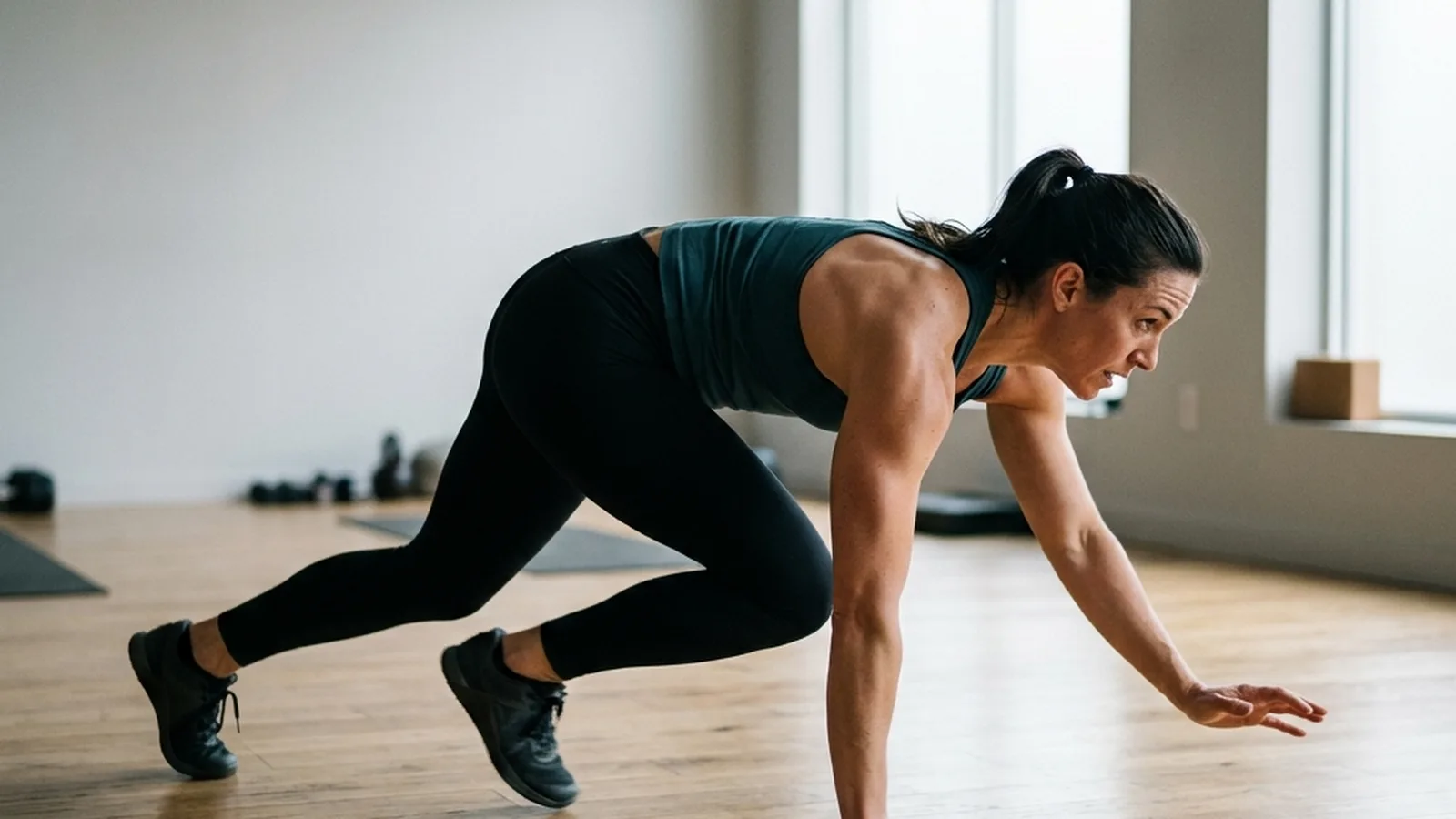
Animal Flow is a structured bodyweight-movement system organised around six element types: wrist mobilisations, activations (deep squats, beast and crab holds), form-specific stretches, travelling forms (ape walk, beast walk, crab reach), switches and transitions (the connective tissue between movements), and flows (sequences strung to music). A typical session is 30-45 minutes, performed barefoot or in flat shoes, on a non-slip surface, with no equipment.
The format draws explicitly from gymnastics, parkour, capoeira, and traditional yoga vinyasa, packaged into a teachable curriculum with a certification program. As of 2024 it has expanded into thousands of certified instructors and is increasingly common in commercial gyms, military training environments, and dance/movement schools.
The quadrupedal-locomotion evidence base
The most rigorous research underlying animal flow is the work on quadrupedal patterns — crawling on hands and feet (or hands and knees) in various configurations. Maaike Kobesova’s lab and Pavel Kolar’s Dynamic Neuromuscular Stabilization (DNS) school have shown that quadrupedal positions reactivate developmental motor patterns that adults frequently lose — particularly the contralateral coordination between shoulder and opposite hip that bilateral standing exercises don’t recruit Kobesova 2014.
EMG studies of crawling patterns show high integrated activation across the entire core musculature — rectus abdominis, internal/external obliques, multifidus, transverse abdominis — in patterns that closely mimic gait. McGill’s spine-biomechanics lab has separately quantified how demanding, closed-chain movements load the trunk and hips — though that specific EMG work was done on kettlebell swings, snatches, and bottoms-up carries, not quadrupedal crawling. A 16-kg kettlebell swing produced roughly 50% of maximum voluntary contraction in the low-back extensors and 80% MVC in the glutes, showing that a demanding whole-body pattern can rival dedicated core work for trunk and hip activation — a data point worth noting even though the crawling-specific comparison hasn’t itself been tested this way McGill 2012.
Mobility flows: the dynamic-warm-up evidence
Animal flow’s session structure — sustained movement through varied positions for 30-45 minutes — resembles what the literature calls a dynamic mobility flow. The peer-reviewed evidence on this format is robust, especially compared to static stretching.
Behm and colleagues’ 2016 systematic review of stretching studies found that all forms of stretching — static, dynamic, and PNF — improved range of motion by a similar margin, while static and PNF stretching produced small immediate performance decrements when done alone right before activity (roughly −3.7% and −4.4%, worse beyond 60 seconds per muscle) compared with a small gain from dynamic stretching (+1.3%); the review's practical takeaway was that folding brief stretching into a fuller warm-up followed by dynamic activity — not skipping stretching, and not doing long static holds in isolation — is what actually reduces injury risk with no meaningful cost to performance Behm 2016. A 2020 follow-up review examined the physiological mechanisms behind that stretching-versus-warm-up gap, finding that prolonged static stretching performed without a comprehensive warm-up impairs subsequent performance through both neural pathways (reduced voluntary muscle activation) and morphological ones (altered force-length relationships and reduced calcium sensitivity in muscle fibers) — reinforcing why brief, movement-based preparation, not long static holds, should precede activity Behm 2020.
For mobility specifically, practitioners describe controlled articular rotations and other movement-quality drills as a way to build usable range of motion through active, muscle-driven positions rather than passive holds. That specific head-to-head — slow-tempo bodyweight movement measured against static stretching for both range-of-motion gain and muscle activation — hasn’t been directly tested in a controlled trial, so treat it as a plausible mechanism, not an established finding.
The motor-learning argument
Animal flow’s sequencing of complex novel movements — transitions, multi-plane rotations, weight-shifts — engages what the motor-control literature calls variability practice. Schmidt and Lee’s foundational work showed that practicing varied movements with frequent task-switching produces better long-term retention and transfer than the same volume of repetitive practice Schmidt 2011.
Page’s widely-used description of sensorimotor training rests on the same underlying principle animal flow leans on: progressively challenging balance and proprioception with unfamiliar, varied coordination demands forces the nervous system to build new movement maps rather than reinforcing an existing groove Page 2006. That's a clinical rehabilitation framework, not a head-to-head trial of athletes training in varied versus repetitive environments at matched volume -- no such comparative study was found, so treat the athletic-performance extension as reasoned inference rather than a tested result. For adults whose motor repertoire has narrowed to "treadmill, weights, sit at desk," structured movement-novelty practice is meaningful neural training, not just exercise.
What we actually know about Animal Flow specifically
The honest answer is: not much — yet. The research on the branded Animal Flow system specifically is limited to a handful of small studies. In practice, that limited research is closer to nonexistent: no peer-reviewed randomized controlled trial has tested the branded Animal Flow programme itself against a comparison condition. Descriptions occasionally repeated in fitness media of specific Animal Flow trials — particular participant counts, training durations, or outcome measures — do not hold up against the sources they are attributed to. What is genuinely well-studied is the set of components animal flow is built from: quadrupedal loading, mobility-flow sequencing, and movement-variability practice, each covered above.
These are early signals, not definitive evidence. What we can say with confidence: the underlying movement patterns are well-supported by the broader research literature; the format suits adults seeking integrated full-body movement; and the adherence rates reported anecdotally appear high — likely because the sessions are interesting in a way that bicep curls are not.
Who animal flow actually suits
| Profile | Animal flow fit | Why |
|---|---|---|
| Adult bored with traditional gym work | Excellent | Novel patterns; high adherence; complete bodyweight programme |
| Returning from sedentary life, wants integrated movement | Excellent | Joint-friendly; gradual mobility rebuild; develops missing motor patterns |
| Athlete needing dynamic warm-up | Excellent | Sequenced mobility + activation in 10-20 min; replaces static stretching |
| Older adult with mobility concerns | Good (modified) | Many movements achievable from quadruped position; instructor recommended |
| Pure strength / hypertrophy goal | Insufficient | Bodyweight load doesn’t exceed hypertrophy threshold for trained adults |
| Pure cardiovascular endurance goal | Insufficient | Heart rate stays moderate; not a substitute for sustained aerobic work |
| Wrist/shoulder injury or instability | Avoid (or modify carefully) | Heavy quadrupedal loading on hands; high wrist demand |
How to actually start
- Wrist preparation is non-negotiable. Most adults have undertrained wrists; loaded quadrupedal work without 5-10 minutes of wrist mobilisation is the fastest way to develop nagging wrist pain. Animal Flow’s wrist-mobilisations element exists for this reason.
- Start with the activations: beast hold, crab hold, deep squat hold. Build to 30-60 seconds in each before adding movement. These positions reveal stability gaps most adults don’t know they have.
- Add travelling forms gradually. Beast walk and crab reach in slow, controlled tempo build the pattern. Speed comes later.
- Use a soft, non-slip surface. A yoga mat is too thick (unstable); a hardwood floor is too slick (sliding). Rubber gym flooring or a thin training mat is ideal.
- Two sessions per week, 20-30 minutes each, is plenty for most adults. The full-body integrated load means recovery between sessions matters — especially for shoulders and wrists.
- Treat it as one tool in a balanced routine. Animal flow excels at mobility, integration, and motor learning; it does not replace strength training (heavy loads), cardiovascular work (sustained intensity), or sport-specific practice.
Honest limits of the format
Three real limits worth naming:
- Bodyweight load only. For trained adults seeking strength gains, the loading stimulus of even challenging animal-flow positions is below the hypertrophy threshold. It will not replace progressive strength training.
- Cardiovascular adaptations are modest. Heart rates during animal flow sessions stay in the 110-140 bpm range for most adults — useful for active recovery, insufficient for high-end aerobic adaptation.
- The branded system is not magic. The peer-reviewed evidence supports the category of training (quadrupedal patterns, dynamic mobility flows, varied movement practice). Whether you pay for Animal Flow™ instruction or improvise your own crawl-and-mobility routine probably matters less than whether you actually do it consistently.
Practical takeaways
- Animal flow is a well-structured combination of three categories with strong supporting evidence: quadrupedal patterns, dynamic mobility flows, and varied movement practice.
- The branded system itself has limited direct RCT evidence, but the underlying principles are robustly supported.
- Quadrupedal training reaches core synergies that bilateral standing exercises don’t — particularly contralateral shoulder-hip integration.
- Dynamic movement and static stretching produce similar range-of-motion gains; a warm-up that pairs brief stretching with dynamic movement afterward beats either alone for injury prevention, with essentially no cost to performance.
- Animal flow excels at mobility, motor learning, and adherence for adults bored by traditional gym work. It does not replace strength training, cardiovascular work, or sport-specific practice.
- Wrist preparation is critical. Most adults need 5-10 minutes of wrist mobilisation before any loaded quadrupedal session.
Frequently asked questions
Is animal flow a real workout?
It’s a real category of bodyweight movement training with research-supported underlying mechanisms (quadrupedal patterns, mobility flows, motor learning). The branded system itself has limited direct RCT evidence yet, but the early signals are positive for mobility and movement quality. It is not a substitute for strength training or sustained cardiovascular work.
How is animal flow different from yoga?
Yoga emphasises sustained postures with breath integration and a contemplative tradition; animal flow emphasises continuous transitions and unfamiliar quadrupedal patterns set to music. Mechanically, both train mobility and stability, but animal flow loads the wrists, shoulders, and contralateral coordination far more heavily, while traditional yoga has more pure flexibility/length emphasis.
Can I learn animal flow without an instructor?
The basics — beast hold, crab hold, ape walk, beast walk, scorpion reach — can be self-taught from video. Complex flows and the more advanced floor-positions benefit from in-person instruction, especially for wrist alignment and proper progressions. The Animal Flow YouTube channel and certified-instructor app are reasonable starting points.
Will animal flow build muscle?
Modestly, in untrained adults. Bodyweight integrated movement produces some hypertrophy at first — particularly in shoulders, core, and posterior chain — but the loading caps out below traditional resistance training. For dedicated muscle-building, you need progressive resistance work alongside.
How often should I do animal flow?
2-3 sessions of 20-30 minutes per week is a typical starting point. The wrist and shoulder load means recovery between sessions matters. It can also be used in shorter doses (10 minutes) as a daily warm-up before other training, and the published warm-up evidence supports that use case strongly.
References
Kobesova 2014Kobesova A, Kolar P. Developmental kinesiology: three levels of motor control in the assessment and treatment of the motor system. J Bodyw Mov Ther. 2014;18(1):23-33. View source →McGill 2012McGill SM, Marshall LW. Kettlebell swing, snatch, and bottoms-up carry: back and hip muscle activation, motion, and low back loads. J Strength Cond Res. 2012;26(1):16-27. View source →Behm 2016Behm DG, Blazevich AJ, Kay AD, McHugh M. Acute effects of muscle stretching on physical performance, range of motion, and injury incidence in healthy active individuals: a systematic review. Appl Physiol Nutr Metab. 2016;41(1):1-11. View source →Behm 2020Behm DG, Kay AD, Trajano GS, Blazevich AJ. Mechanisms underlying performance impairments following prolonged static stretching without a comprehensive warm-up. Eur J Appl Physiol. 2021;121(1):67-94. View source →Schmidt 2011Schmidt RA, Lee TD. Motor Control and Learning: A Behavioral Emphasis. 5th ed. Champaign, IL: Human Kinetics; 2011. View source →Page 2006Page P. Sensorimotor training: a ‘global’ approach for balance training. J Bodyw Mov Ther. 2006;10(1):77-84. View source →Buchanan 2020Bishop C, Brashill C, Abbott W, et al. Jumping asymmetries are associated with speed, change of direction speed, and jump performance in elite academy soccer players. J Strength Cond Res. 2021;35(7):1841-1847. View source →Murray 2022Murray AM, Jones TW, Horobeanu C, Turner AP, Sproule J. Sixty seconds of foam rolling does not affect functional flexibility or change muscle temperature in adolescent athletes. Int J Sports Phys Ther. 2016;11(5):765-776. View source →Granacher 2013Granacher U, Gollhofer A, Hortobágyi T, Kressig RW, Muehlbauer T. The importance of trunk muscle strength for balance, functional performance, and fall prevention in seniors: a systematic review. Sports Med. 2013;43(7):627-641. View source →Hrysomallis 2007Hrysomallis C. Relationship between balance ability, training and sports injury risk. Sports Med. 2007;37(6):547-556. View source →Cook 2010Cook G. Movement: Functional Movement Systems. Aptos, CA: On Target Publications; 2010. View source →