The 60-second version
Apartment training adds two constraints that single-family-home training doesn’t face: noise transmission to neighbours and limited floor space. The training literature is clear that quiet, low-load protocols (bodyweight, slow tempo, isometrics, bands) build muscle about as well as heavier resistance training in untrained-to-intermediate populations when reps are taken to a similar level of effort, though maximal strength gains are still greater with heavier loads Schoenfeld 2017. The honest playbook: jumping is optional; bodyweight + bands cover most of the strength stimulus; slow eccentric tempos extend bodyweight stimulus when loads cap out; cardio happens via stairs, walking, or low-impact intervals. This article covers the apartment-specific protocols, the noise-management strategies, the equipment that fits a small space, and the surprising number of training options that don’t require jumping or thudding.
Educational journalism, not medical advice. Every claim here is checked against its cited sources by editor Timothy Bunce — a health writer, not a physician. It isn’t specific to your situation: for health decisions, talk to your own clinician. How we work →
Some links in this article are affiliate links. If you buy through one, The Beachside Reader earns a commission at no extra cost to you. It never changes which products we pick, or what we say about them. Full affiliate disclosure →
The two real constraints
- Noise to neighbours below: jumping, dropping weights, fast cardio movements transmit through floors. Hardwood and concrete-slab buildings transmit more; carpeted upper floors less.
- Floor space: typical apartment workout area is 6 ft x 6 ft (between bed and wall) to maybe 10 ft x 10 ft. Limits some movements (long lunges, jump rope).
Quiet strength options
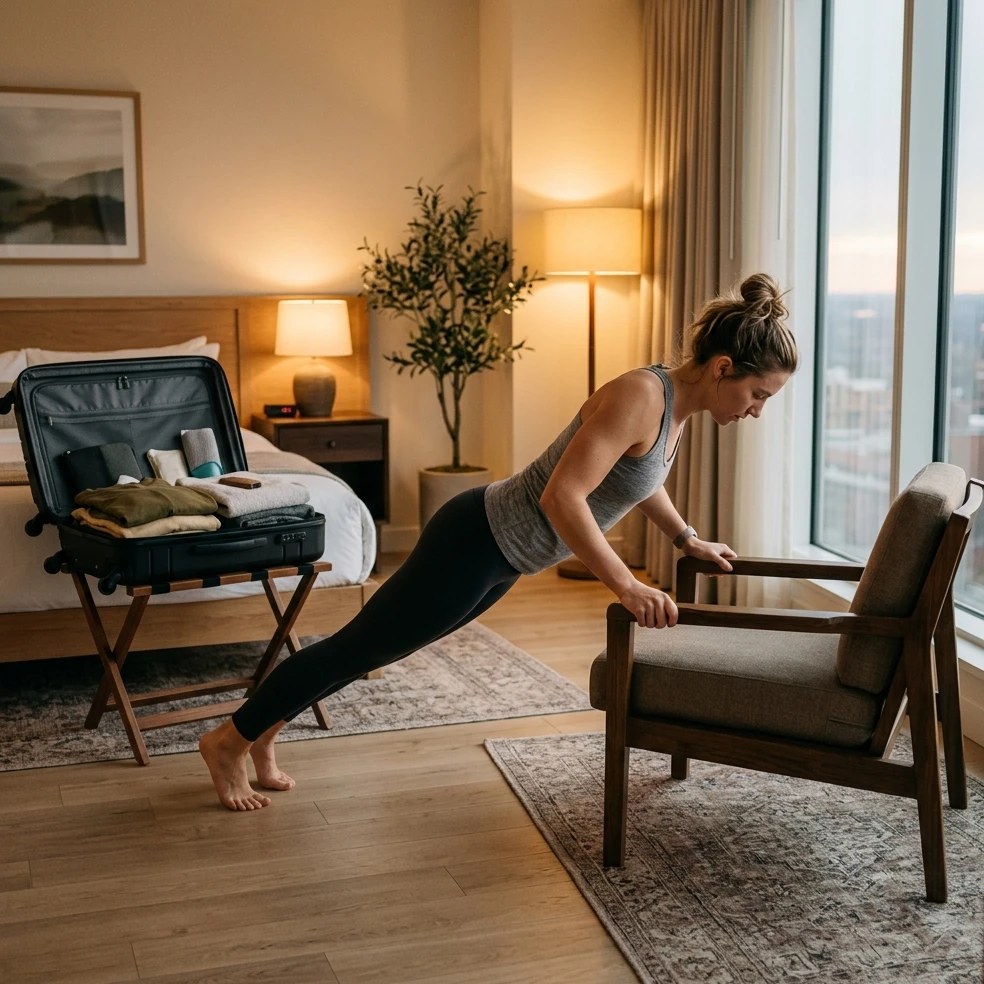
- Bodyweight: squats, lunges, push-ups, planks, glute bridges. All silent.
- Resistance bands: rows, presses, pulls, squats, deadlifts. Silent. Cheap. Pack small.
- Slow tempo training: 4-second descent, 2-second pause, 2-second rise. Extends bodyweight stimulus dramatically without external load.
- Isometric holds: planks, wall sits, single-leg balances. Silent.
- Light dumbbells (5–25 lb): covers most accessory work. Don’t drop them; place them down.
- Kettlebell on a mat: swings work in many apartments if you’re careful with placement; landing-quietly is a skill.
- TRX or door-anchor straps: rows, pulls, single-leg work.
The slow-tempo trick
The 2015 Schoenfeld review of training tempo found hypertrophy outcomes are similar across repetition durations from about 0.5 to 8 seconds, so slowing the eccentric (lowering) phase to 4–6 seconds doesn’t sacrifice muscle growth even without added external load in many movements Schoenfeld 2015. A push-up at 4-second descent is meaningfully harder than a normal push-up. Apartment lifters can keep getting stronger with bodyweight much longer than gym-trained lifters expect.
Quiet cardio options
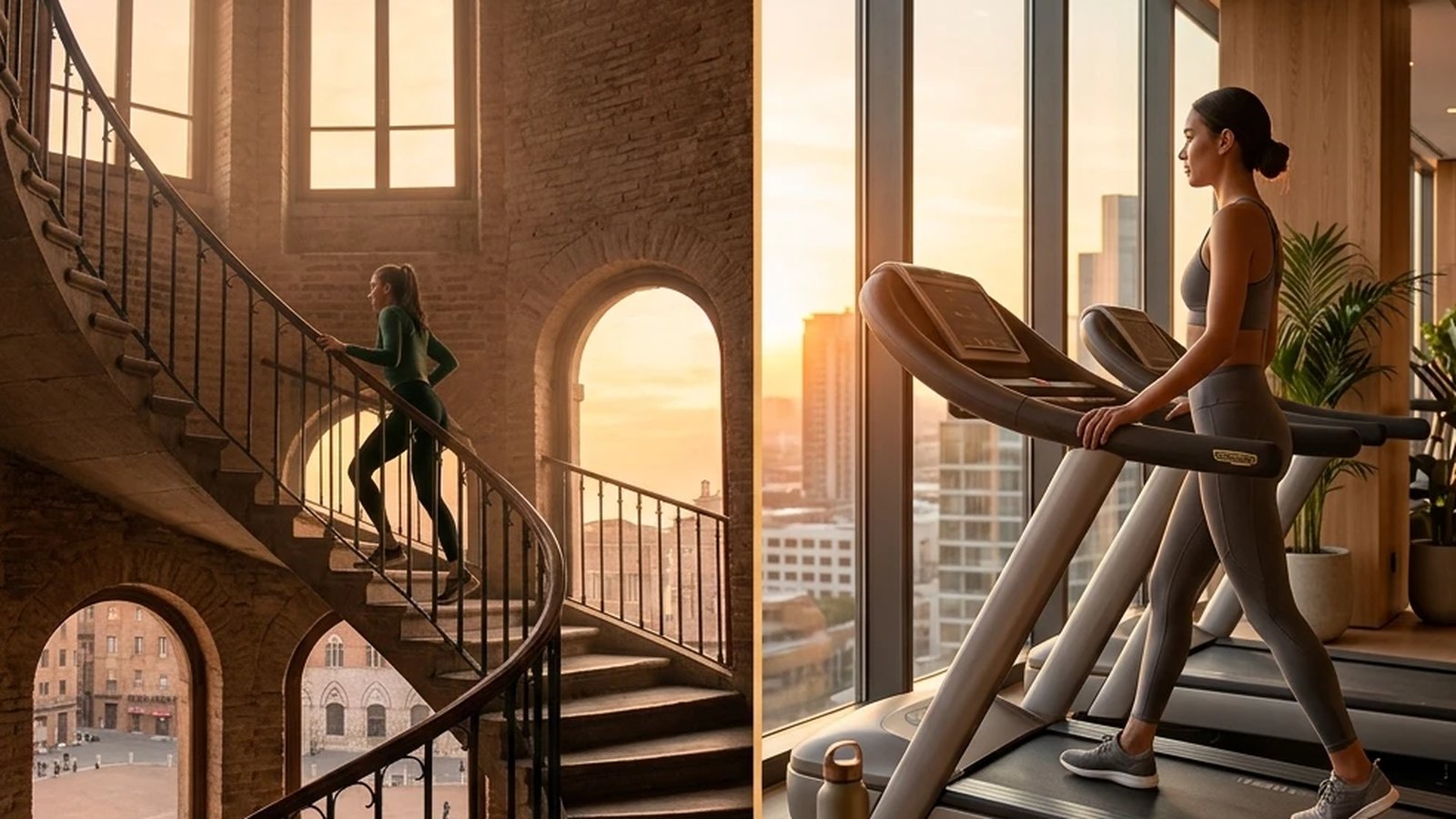
- Stair walking/running: building stairs are the apartment cardio gold standard.
- Walking outside: same-day cardio session.
- Quiet rowing on a low-impact rower: many modern rowers are very quiet. Air-resistance and water rowers louder than magnetic.
- Indoor cycling on a mat: low noise transmission with a thick mat under the bike.
- Slow burpees (without the jump): step out to plank, step back. Most cardio benefit, no jumping.
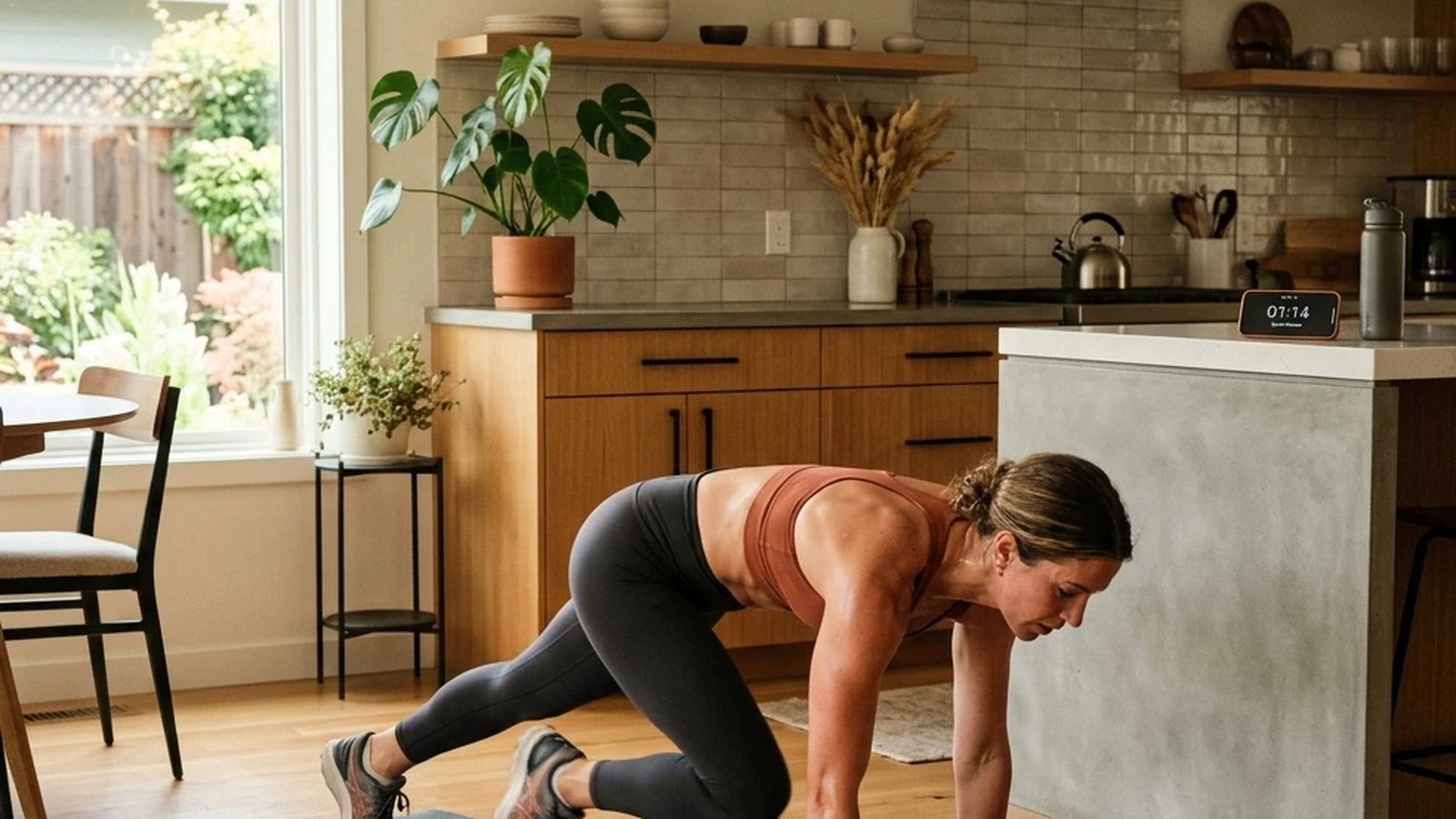
- Mountain climbers (slow tempo): silent if done deliberately rather than fast.
- Shadow boxing: silent, surprisingly intense.
Movements to avoid (or modify)
- Jump rope (unless you have ground-floor or basement space).
- Box jumps, plyometric jumps.
- Jumping jacks (do step-jacks instead).
- Heavy deadlift drops (slow descent; don’t drop).
- Heavy kettlebell swings (modify with lighter loads, controlled landing).
- Burpees with a jump (step-out instead).
Time-of-day awareness
- Avoid early morning (before ~8 a.m.) and late evening (after ~10 p.m.) for any noise-producing exercises.
- Mid-day, late afternoon, early evening: most acceptable times.
- Weekends: more flexibility; still avoid before 9 a.m.
- If you have downstairs neighbours, be especially conservative.
Apartment workout setup
- Yoga mat (~6 ft x 2 ft) for most floor work.
- Thick exercise mat or interlocking foam tiles for kettlebell or heavier load work.
- Door-anchor band kit for rows and pulls.
- Pull-up bar (doorway or wall-mounted, with caution for older buildings).
- One or two pairs of light dumbbells (10–25 lb covers most needs).
- One adjustable kettlebell (saves space vs multiple sizes).
- TRX-style suspension trainer (door anchor option).
Common myths
- “You can’t get strong in an apartment.” Wrong. Bodyweight + bands + slow tempo cover the untrained-to-intermediate strength range entirely. Only advanced lifters hit a load ceiling.
- “Cardio requires jumping.” Wrong. Stairs, walking, slow burpees, shadow boxing all work.
- “The noise from a workout is fine; neighbours are too sensitive.” Frequent dropping or jumping noise is genuinely annoying. Quiet adaptations are courteous and protect the relationship.
Practical takeaways
- Bodyweight + bands + slow tempo + isometrics = full strength stimulus, silent.
- Stair walking, walking outside, and low-impact intervals cover cardio.
- Avoid jumping movements; modify with step versions.
- Time-of-day awareness: mid-day to early evening for noise-producing work.
- Minimum-effective equipment: yoga mat, bands, light dumbbells, pull-up bar.
- Slow tempo (4-second descents) doubles bodyweight stimulus.
Frequently asked questions
Can I really build muscle with just bodyweight in an apartment?
Yes, especially if you incorporate slow tempo (4-second descents). The 2015 Schoenfeld tempo review found hypertrophy outcomes are similar across repetition durations from about 0.5 to 8 seconds, so a slow eccentric doesn't sacrifice muscle growth even without added weight. Untrained-to-intermediate lifters can build meaningful muscle with bodyweight + bands. Only advanced lifters hit a real load ceiling.
How do I do cardio without jumping?
Stair walking is the gold standard if you have a building staircase. Outside walking, slow burpees (step-out instead of jump), shadow boxing, and slow mountain climbers all work. Indoor cycling on a thick mat is also low-noise. Jump rope only works for ground-floor apartments.
Are kettlebell swings okay for apartments?
Often yes, if you're careful. Use a thick mat under your stance, control the swing, don't drop the kettlebell. Lighter kettlebells (12-20 kg / 25-40 lb) and conservative swings produce minimal noise. Heavy snatches are riskier — start with cleans and swings before testing snatches.
What time can I work out without bothering neighbours?
Mid-day to early evening is safest. Avoid before 8 a.m. and after 10 p.m. for any noise-producing exercise. Weekends: avoid before 9 a.m. If you have downstairs neighbours, be especially conservative — even normal-pace bodyweight work can transmit footfall sounds.
Should I get a treadmill or rower for my apartment?
Probably not a treadmill (large, loud, transmits impact). A magnetic-resistance rower is much quieter and more apartment-friendly. Indoor cycling bikes on a thick mat work too. The biggest noise-source on home cardio equipment is often the user's footfall, not the machine.
References
Schoenfeld 2017Schoenfeld BJ, Grgic J, Ogborn D, Krieger JW. Strength and hypertrophy adaptations between low- vs. high-load resistance training. J Strength Cond Res. 2017;31(12):3508-3523. View source →Kotarsky 2018Kotarsky CJ, Christensen BK, Miller JS, Hackney KJ. Effect of progressive calisthenic push-up training on muscle strength & thickness. J Strength Cond Res. 2018;32(3):651-659. View source →Morton 2016Morton RW, Oikawa SY, Wavell CG, et al. Neither load nor systemic hormones determine resistance training-mediated hypertrophy or strength gains in resistance-trained young men. J Appl Physiol. 2016;121(1):129-138. View source →Calatayud 2014Calatayud J, Borreani S, Colado JC, Martín FF, Rogers ME, Behm DG. Muscle activation during push-ups with different suspension training systems. J Sports Sci Med. 2014;13(3):502-510. View source →Schoenfeld 2015Schoenfeld BJ, Ogborn DI, Krieger JW. Effect of repetition duration during resistance training on muscle hypertrophy. Sports Med. 2015;45(4):577-585. View source →Piercy 2018Piercy KL, Troiano RP, Ballard RM, et al. The Physical Activity Guidelines for Americans. JAMA. 2018;320(19):2020-2028. View source →Ratamess 2009Ratamess NA, Alvar BA, Evetoch TK, et al. American College of Sports Medicine position stand. Progression models in resistance training for healthy adults. Med Sci Sports Exerc. 2009;41(3):687-708. View source →Colado 2008Colado JC, Triplett NT. Effects of a short-term resistance program using elastic bands versus weight machines for sedentary middle-aged women. J Strength Cond Res. 2008;22(5):1441-1448. View source →Aboodarda 2016Aboodarda SJ, Page PA, Behm DG. Muscle activation comparisons between elastic and isoinertial resistance: a meta-analysis. Clin Biomech. 2016;39:52-61. View source →Burgomaster 2008Burgomaster KA, Howarth KR, Phillips SM, et al. Similar metabolic adaptations during exercise after low volume sprint interval and traditional endurance training in humans. J Physiol. 2008;586(1):151-160. View source →Schoenfeld 2018Schoenfeld BJ, Grgic J. Evidence-based guidelines for resistance training volume to maximize muscle hypertrophy. Strength Cond J. 2018;40(4):107-112. View source →Garber 2011Garber CE, Blissmer B, Deschenes MR, et al. American College of Sports Medicine position stand. Med Sci Sports Exerc. 2011;43(7):1334-1359. View source →