The 60-second version
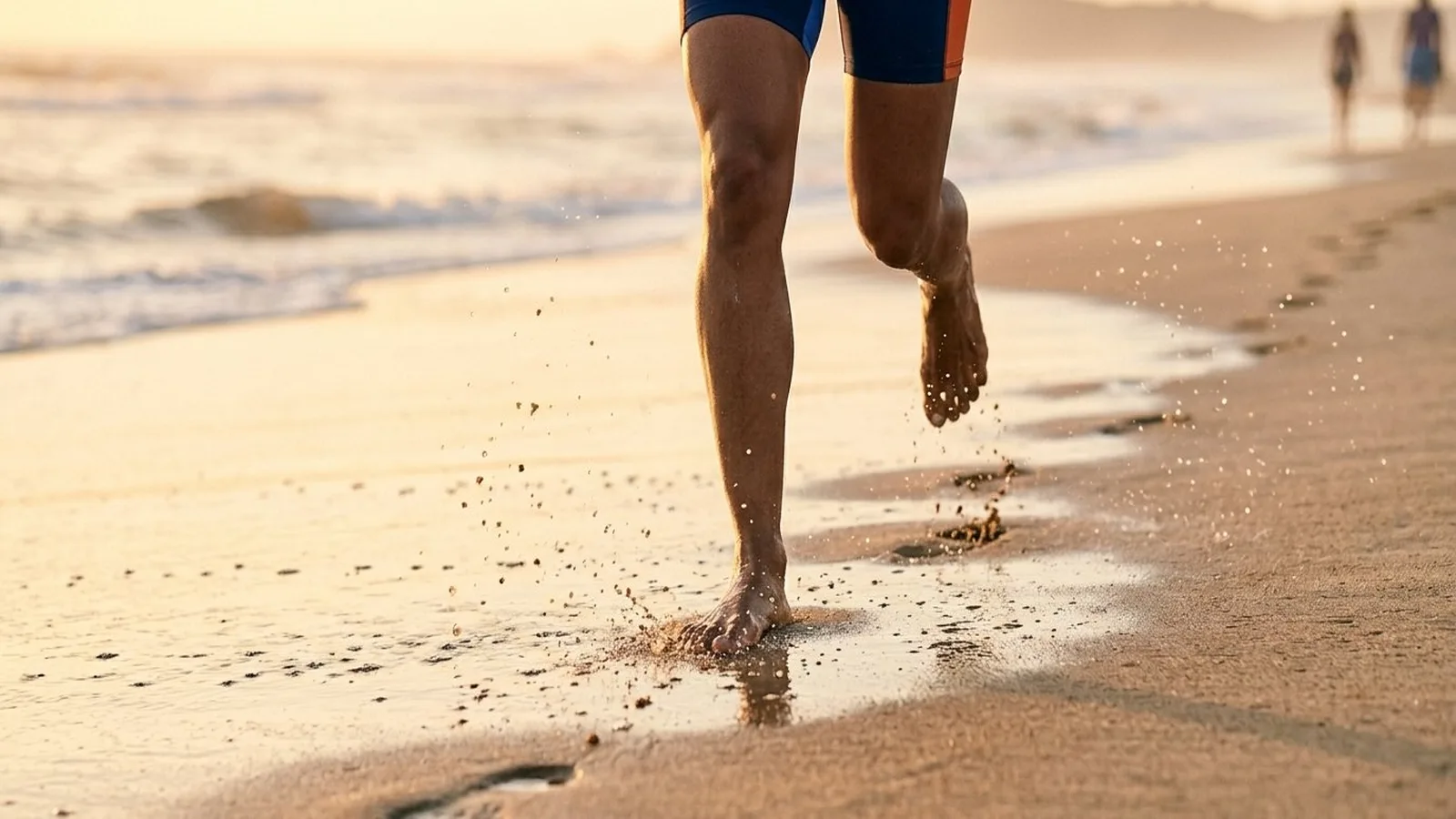
Running barefoot on damp, firm sand near the waterline is the safest possible introduction to barefoot running. The surface is soft enough to forgive the heel-strike pattern most shod runners default to, firm enough to feel close to natural ground, and the lapping water keeps it cool. The published transition-to-barefoot literature is consistent: people who switch abruptly from cushioned shoes to fully barefoot running on hard surfaces are at substantially elevated risk of metatarsal stress fractures and calf strain in the first 8-12 weeks. The shore is the natural transition surface — it forces a forefoot-strike pattern but absorbs enough impact to spare the bones. The catch is dose: most shore runners do too much too soon. The published rule of thumb is to add no more than 10% barefoot exposure per week.
Educational journalism, not medical advice. Every claim here is checked against its cited sources by editor Timothy Bunce — a health writer, not a physician. It isn’t specific to your situation: for health decisions, talk to your own clinician. How we work →
Some links in this article are affiliate links. If you buy through one, The Beachside Reader earns a commission at no extra cost to you. It never changes which products we pick, or what we say about them. Full affiliate disclosure →
Why barefoot running has a research base
Most adults grew up running in cushioned shoes, and the cushioned-shoe footstrike pattern is heel-first. The 2010 Lieberman Nature paper that ignited the barefoot-running conversation measured this directly: Kenyan adolescents who had never worn shoes landed forefoot-first 66% of the time barefoot, self-identified adult barefoot/minimalist runners landed forefoot-first 75% of the time, and habitually shod adults landed heel-first 100% of the time in running shoes (83% even barefoot; 97% for habitually shod Kenyan adolescents in shoes). The oft-quoted "75-80% heel-strike" figure is the paper’s own background citation to earlier studies of ordinary shod runners, not a result from its own barefoot subjects. The biomechanical consequence is large: heel-strike running on a hard surface produces a sharp impact transient spike that forefoot-strike running does not Lieberman 2010.
The follow-up literature on adult barefoot transition is more cautious. Ryan and colleagues ran a 12-week randomised trial that assigned 103 recreational runners to a neutral cushioned shoe, a partial-minimalist shoe, or a full-minimalist (five-toe) shoe and tracked self-reported injury events and pain; the partial-minimalist group logged the most injuries (12, versus 4 in the neutral-shoe group), and the full-minimalist group reported more shin and calf pain Ryan 2014. The adaptation to forefoot striking is real but takes the bones months to catch up with the muscle and tendon changes.
Why damp firm sand is the ideal transition surface
The shore at low tide produces a sand surface that is:
- Firmer than dry sand — the water content packs the grains, so the surface gives less underfoot and the foot doesn’t have to lift as high on each stride. Running on (dry) beach sand carries a measurably higher energy cost than running on grass Pinnington 2001, and compacted wet sand is firmer still than the loose dry sand that study measured.
- Softer than pavement — the surface still gives enough to forgive the impact transient that heel-strike runners produce when they make mistakes during transition.
- Naturally cool — even on hot days, the waterline sand is 5-15°C below sand higher up the beach, which spares the bottom of the feet from burn risk.
- Smooth enough to be safe — broken shells and driftwood are concentrated at the high-tide line, not at the waterline. Walk a quick reconnaissance lap before running.
- Bias toward forefoot striking — soft, uneven surfaces naturally shorten stride and encourage a flatter, more midfoot-oriented landing than pavement does, which is part of why sand is a common test-drive surface for the barefoot-curious.
Lieberman’s 2012 review makes a far more modest point than a specific sand endorsement: barefoot or minimally-shod running may be reasonably safe on a soft, forgiving surface like a beach or lawn, but is considerably more hazardous on hard or rough ground Lieberman 2012. Damp waterline sand fits that safer, softer category — that's an inference this article is drawing, not a claim the paper itself makes about sand specifically.
A safe transition protocol
The published transition-to-barefoot literature converges on a clear progression. Here it is adapted for shore running:
- Week 1-2: Walk barefoot on the shore for 15-20 minutes, 3-4 times. The foot intrinsic muscles and the plantar fascia need to wake up. Walking is sufficient stimulus to start the adaptation.
- Week 3-4: Add short barefoot runs. Start with 5 minutes of easy running at the end of a normal shod walk. Build to 10 minutes.
- Week 5-8: Build to 15-20 minute barefoot runs. Use a 10% rule — no more than 10% more barefoot time per week than the previous week. Run the same paces you would shod.
- Week 9-12: Add modest shore intervals. Short pickups of 30-60 seconds at quicker-than-cruise pace. The forefoot-strike pattern is much easier to maintain at higher cadences.
- Beyond week 12: Treat shore barefoot running as a regular but supplemental modality. Even experienced barefoot runners typically use the shore for one or two runs per week and shod runs for the rest.
What can go wrong
- Metatarsal stress reactions. A well-documented bone-stress injury during adult barefoot/minimalist transition, especially if training load increases too quickly. Symptoms: pain on the top of the foot over a single metatarsal, particularly the 2nd or 3rd. Pain that worsens through a run is the diagnostic flag. Stop running and rest for 2-4 weeks, layering in foot-intrinsic strengthening as you rebuild Warden 2014.
- Calf and Achilles overload. Forefoot-striking shifts load from the knee to the calf and Achilles. Calf strain or Achilles tendinopathy in the first 6 weeks is a sign of too-fast transition. The fix is patience — the tendon takes months to remodel Warden 2014.
- Plantar fascia strain. The arch is a working spring during forefoot strike. New barefoot runners can over-stress the plantar fascia in the first few weeks. Cap the early sessions short.
- Cuts and punctures. Less common at the waterline but real if the beach has glass, fish hooks, or sharp shells. Always walk a recon lap first; never run barefoot on an unscouted shore.
- Cold injury. Wet sand below 10°C plus a wind chill can produce mild frostnip on bare feet within 20-30 minutes. Shoe up below that threshold.
Who shore barefoot running suits
| Profile | Fit | Why |
|---|---|---|
| Shod runner exploring forefoot strike | Excellent | Safest transition surface available |
| Runner with chronic knee complaints | Good | Forefoot strike shifts load away from the knee |
| Beach-dweller adding a few minimal-shoe sessions | Excellent | Convenient access to the right surface |
| Runner with active metatarsal/Achilles symptoms | Skip | Forefoot strike loads exactly the wrong tissues |
| Marathoner adding cross-training | Good | Low-impact aerobic work that complements training |
| Beginner with no running base | Caution | Build a shod base first; layer barefoot on top later |
Practical takeaways
- Damp, firm sand at the waterline is the most forgiving running surface available outdoors — biases the gait toward midfoot striking, blunts impact, naturally cool.
- Adult transition from cushioned shoes to barefoot carries a real metatarsal-stress-reaction risk. Move slowly: 10-20 minute walking, then 5-10 minute jogs, never more than 10% added per week.
- The first signal of too-fast transition is dorsal foot pain over a single metatarsal. Stop and rest if you feel it.
- Always recon the beach for sharp objects before running. Most cuts happen because the runner didn’t look first.
- Below 10°C wet-sand temperature, shoe up. Cold injury on bare feet is real and easy to acquire.
- Treat shore barefoot running as a supplemental modality, not a primary one. One or two sessions weekly is the dose in most published programmes.
Frequently asked questions
Is barefoot running better than running in shoes?
Different, not better. Barefoot running biases the gait toward forefoot striking, which shifts impact away from the knee but onto the calf and forefoot. The published evidence shows it works for some runners and produces injuries in others. The transition risk is the dominant factor — a randomised trial found injury rates were highest among runners transitioning to partial-minimalist shoes, with full-minimalist users reporting more shin and calf pain, compared with a neutral cushioned shoe.
Is wet sand or dry sand better for barefoot running?
Wet sand near the waterline. It’s firmer (foot sinks 1-2 cm vs. 5-10 cm), less energy-costly, naturally cool, and free of most sharp debris. Dry sand higher up the beach is an unstable-surface workout, not a barefoot-running surface for beginners.
How long should my first barefoot run be?
Start with 15-20 minutes of barefoot walking before any running. Once walking feels comfortable, add 5 minutes of easy barefoot jogging at the end of a shod walk. Build by 10% per week. The transition rate is the dominant injury-prevention variable in the published literature.
What if I get cut?
Walk a quick reconnaissance lap of your beach before running. Sharp objects concentrate at the high-tide line, not at the waterline. If you do get cut, stop running — minor cuts on wet sand are an infection risk because the wound is exposed to seawater bacteria.
Can I run barefoot in cold weather?
Below 10°C wet-sand temperature, shoe up. Cold injury on bare feet (frostnip) can develop within 20-30 minutes of wet exposure plus wind. The bare foot has a much smaller blood-flow buffer than the rest of the body.
Should I do this if I have flat feet or plantar fasciitis?
Skip it during an active flare. Once symptoms are quiet, very gradual barefoot work on damp sand can be a useful foot-intrinsic-strengthening exercise, but the dose has to be small — 5-10 minutes per session, 2-3 sessions weekly. Build slowly and stop at the first sign of recurrence.
References
Lieberman 2010Lieberman DE, Venkadesan M, Werbel WA, et al. Foot strike patterns and collision forces in habitually barefoot versus shod runners. Nature. 2010;463(7280):531-535. View source →Lieberman 2012Lieberman DE. What we can learn about running from barefoot running: an evolutionary medical perspective. Exerc Sport Sci Rev. 2012;40(2):63-72. View source →Ryan 2014Ryan M, Elashi M, Newsham-West R, Taunton J. Examining injury risk and pain perception in runners using minimalist footwear. Br J Sports Med. 2014;48(16):1257-1262. View source →Warden 2014Warden SJ, Davis IS, Fredericson M. Management and prevention of bone stress injuries in long-distance runners. J Orthop Sports Phys Ther. 2014;44(10):749-765. View source →Pinnington 2001Pinnington HC, Dawson B. The energy cost of running on grass compared to soft dry beach sand. J Sci Med Sport. 2001;4(4):416-430. View source →