The 60-second version
The shade question on a beach day is rarely about whether to use shade — UV exposure at the shoreline is enhanced by sand and water reflection by 15–25% over an open field. The question is which form of shade. A traditional parasol or umbrella casts a cone of shade that drops UV irradiance by roughly 50% directly underneath but lets in scattered ultraviolet from the open sides; a four-walled pop-up tent built from UPF-rated fabric blocks the large majority of direct UV and traps the side-scatter as well — a shade structure is only as protective as its fabric, and tightly-woven, UPF-rated fabric is what does the blocking (Hatch 2006 Hatch 2006) — but at the cost of airflow and a measurably warmer micro-environment. The honest framing: the parasol is the better default for short, breezy stays where heat-stress risk dominates; the UPF-rated tent is the better default for fair-skinned beachgoers, infants, and stays over two hours where cumulative dose dominates. Krutmann 2017 Krutmann 2017 documents that long-wave UVA drives photoaging, and it passes through many ordinary fabrics at clinically meaningful levels (Hatch 2006 Hatch 2006), which is why the UPF rating matters more than the visual opacity of the canopy. Neither device replaces sunscreen; both reduce the dose the sunscreen has to handle.
Educational journalism, not medical advice. Every claim here is checked against its cited sources by editor Timothy Bunce — a health writer, not a physician. It isn’t specific to your situation: for health decisions, talk to your own clinician. How we work →
Some links in this article are affiliate links. If you buy through one, The Beachside Reader earns a commission at no extra cost to you. It never changes which products we pick, or what we say about them. Full affiliate disclosure →
Why shade at the beach is different
Open-field UV measurements understate the dose at a typical Canadian shoreline. Dry sand reflects 10–25% of incident UV back upward; wet sand reflects less but still meaningfully; open water reflects 5–10% of UV at low sun angles and over 20% at high sun angles when the surface is rippled. The result is that a beachgoer sitting under a partial shade structure receives a substantial dose from below and from the side that an open-field measurement would miss entirely. This is the part the marketing copy on most umbrellas omits.
The second issue is duration. A typical beach day in July or August at Canadian latitudes delivers 5–9 standard erythema doses (SEDs) of UV between 10 AM and 4 PM under clear skies. The minimal erythema dose for fair-skinned (Fitzpatrick II) adults is around 2.5 SEDs; for very fair-skinned (Fitzpatrick I) adults, around 1.5 SEDs. A parasol that reduces direct UV by 50% but admits side-scatter still allows a Fitzpatrick II adult to accumulate a sunburn dose in 2–4 hours. The tent, whose UPF-rated fabric blocks the large majority of that UV, reduces the same exposure to a fraction of the burn threshold, but the tent traps heat the parasol does not.
The third issue is what the canopy is made of. The UPF rating that appears on outdoor-fabric labels is the textile equivalent of SPF: a UPF 50+ canopy admits less than 1/50th of the incident UV; a UPF 30 admits less than 1/30th. Ordinary polyester beach umbrella fabric without a UPF rating can be loosely woven enough to transmit a meaningful fraction of incident UV — fabric-level testing shows non-UPF, loosely-woven textiles transmit substantially more UV than tightly-woven, UPF-rated fabric (Hatch 2006 Hatch 2006). The visual cue most shoppers use — how dark the underside looks — is a poor proxy. Black polyester admits less UV than white cotton at the same weave density, but a tight white synthetic outperforms loose black cotton. The label is the reliable signal.
Where the parasol wins
The traditional beach parasol or umbrella has three real advantages. Airflow is the largest. A tilted parasol with open sides allows continuous airflow that keeps the under-shade air close to ambient temperature, while a closed pop-up tent blocks that airflow and typically runs noticeably warmer than the surrounding air on the same day with the same canopy fabric. For beachgoers in their seventies, for pregnant women, and for anyone with poor heat tolerance, that delta matters — heat exhaustion is a more immediate medical risk than a sunburn for several at-risk groups.
Setup time is the second. A beach parasol opens in 10 seconds; a four-walled pop-up tent takes 1–3 minutes for a single user and is unforgiving in moderate wind. For families with toddlers who want shade for a 90-minute window, the parasol’s simpler setup is practically meaningful.
Visual openness is the third. Some beachgoers who use closed tents report lower satisfaction with the ‘beach experience’ itself: the panoramic view is what most people came for. The parasol preserves the view; the tent restricts it. This is not a health endpoint, but it can affect whether the shade structure actually gets used on the next visit.
Where the UPF-rated tent wins
Cumulative dose dominates the picture for high-risk users. A child under five at a Canadian beach for a full day under a parasol that admits 50% UV will accumulate roughly the same UV dose as an unshaded adult sitting outside for 90 minutes — a dose that exceeds the minimal erythema threshold for fair-skinned children, who have less melanin density and thinner stratum corneum than adults. The same arithmetic holds for adults on photosensitising medications (tetracyclines, certain diuretics, retinoids) and for those with histories of basal cell or squamous cell carcinoma. For these groups, the tent’s much higher fabric-level UV block, including the side-scatter the parasol admits, is not a marginal benefit.
The lifetime UVA dose matters even when the day’s exposure does not produce a visible sunburn. UVA penetrates deeper into the dermis than UVB and drives the dermal-elastin breakdown that shows up clinically as photoaging (Krutmann 2017 Krutmann 2017). A summer of weekly beach days under a parasol versus a UPF-rated tent represents a meaningful annual UVA dose difference. Over a decade of family beach habits, the cumulative difference is large.
Wind protection is a secondary benefit that becomes primary at certain shorelines. Lake Huron and the Atlantic coast both produce sustained 20–30 km/h afternoon winds in summer; a four-walled tent stays anchored, while a parasol — even sand-anchored — becomes a projectile risk above roughly 25 km/h. Runaway beach umbrellas are a recognized wind-hazard at exposed shorelines; the same caution applies on Georgian Bay.
The heat-stress tradeoff is real
The unspoken cost of the high-UPF tent is the micro-climate inside it. Enclosed pop-up tents can trap significant heat on hot summer days: interior air runs measurably warmer than ambient, and surface temperatures on dark-coloured canopy fabric climb well above ambient in direct sun. For an infant lying inside such a tent for two hours without active ventilation, the heat exposure is non-trivial — the same age group that benefits most from the UV protection is also the most vulnerable to heat illness. The mitigation is straightforward: open the tent’s rear flap and front door for cross-ventilation, accept a small UV-protection penalty (typically 5–10%), and gain the airflow back. Most pop-up tents are designed to support this configuration; many users do not use it.
The fabric colour matters more than the inside marketing suggests. Light-coloured outer canopies (silver, sand, light blue) reflect more visible and infrared radiation than dark ones, lowering the interior temperature by 2–4 degrees at the same UPF rating. The convention of dark-coloured undersides is partly a visual-comfort and glare choice; the primary UV blocking comes from weave density and fibre treatment, with colour a secondary contributor. Hatch 2006 does address colour, but not the way the marketing implies: within a given fabric, a darker or deeper shade does raise UPF, yet colour is not a reliable guide across different fabrics — weave density and UPF rating matter more, so a light, tightly-woven UPF-rated canopy still out-protects a dark but loosely-woven one.
For older adults and people with cardiovascular conditions, the heat side of the tradeoff dominates. The same tent interior that a healthy 30-year-old barely notices is potentially dangerous for a 75-year-old on beta-blockers (which blunt the cardiac response to heat) or diuretics (which reduce the volume reserve for sweat). The shorthand: tent for the children, parasol for the grandparents, both for the family in between.
The practical shade protocol
The decision that fits most Canadian beach families is a hybrid kit: a UPF 50+ pop-up tent for the primary base where small children, infants, and high-risk adults sit; a tilted, ventilated parasol or umbrella for adults who want airflow and view; sunscreen on every exposed surface regardless of which structure is overhead. No shade structure replaces the sunscreen requirement — side-scatter and ground-reflected UV still reach the skin even under a high-UPF canopy. The shade structure reduces the dose the sunscreen has to handle; it does not eliminate the requirement.
The placement decision matters. A parasol angled into the sun (rather than straight overhead) blocks 70–85% of direct UV at typical Canadian afternoon sun angles, versus the 50% it blocks when held vertical. The tilt is free; most beachgoers do not use it. Tent orientation is similarly under-used: facing the open door away from the sun and toward the prevailing wind delivers shade plus airflow at the cost of one minute of pre-setup planning.
Replacement matters too. UV-blocking fabrics can lose protective performance with cumulative sun exposure, laundering, and mechanical wear, so a UPF rating printed on a tag is not necessarily what an aging tent still delivers. The honest practical advice is to inspect heavily-used UV-protective gear each season, retire it once the fabric looks faded, thinned, or stretched, or test it with a pocket UV meter before relying on it for high-risk users. The marketing copy will not warn the consumer about this; general textile-care guidance does.
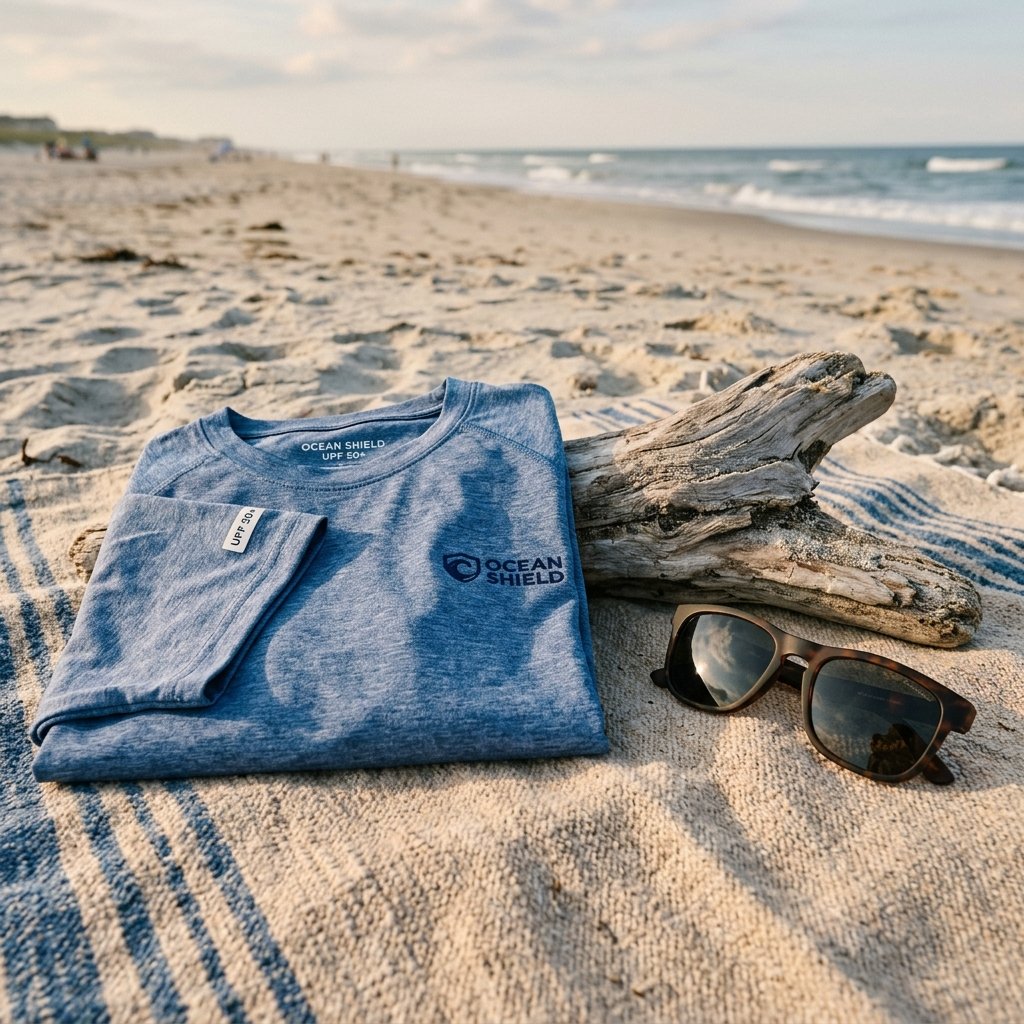
Two final cues. The shadow rule of thumb: if a person’s shadow is shorter than they are tall, the sun angle is producing peak UV irradiance; both shade structures should be used together, sunscreen reapplied within the previous two hours. The hat-and-shirt rule: a wide-brimmed hat blocks UV to face and ears that no overhead structure can cover at oblique sun angles, and a UPF-rated long-sleeve top is the most reliable single garment for the high-risk users; combine with either shade structure rather than relying on the structure alone.
Practical takeaways
- Parasols admit 30–50% UV from side-scatter; UPF-rated tents block the large majority of UV via their fabric but trap noticeably more heat than an open parasol.
- The choice is use-case driven: tent for fair-skinned children, infants, photosensitive adults, and stays over 2 hours; parasol for short, breezy visits and heat-vulnerable older adults.
- Tilt the parasol into the sun (not vertical) for 70–85% UV blocking; ventilate the tent (open flap and door) to lower interior temperature 3–5°C with minimal UV cost.
- UPF rating and weave density are the reliable cross-fabric predictors of UV blocking; colour is a secondary factor — within the same fabric a darker shade raises UPF, but a light, tightly-woven UPF-rated canopy still out-protects a dark, loosely-woven one.
- UV-protective fabric loses performance with cumulative sun exposure, laundering, and wear; inspect gear each season and retire it once it looks faded, thinned, or stretched.
- Neither structure replaces sunscreen: ground- and water-reflection contribute 20–40% of open-field dose even under a high-UPF canopy.
Frequently asked questions
Does an ordinary beach umbrella protect against sunburn?
Partially. A traditional non-UPF beach umbrella reduces direct overhead UV by roughly 50%, but admits side-scatter and ground-reflected UV that can still produce a sunburn dose for fair-skinned adults in 2-4 hours. A UPF-rated parasol or tent blocks substantially more; sunscreen on exposed skin remains required regardless.
Why does the inside of my pop-up beach tent feel so hot?
Closed pop-up tents run noticeably warmer than open air on summer days because the high-UPF fabric that blocks UV also blocks airflow and traps infrared radiation. Open the rear flap and front door for cross-ventilation; this brings the interior temperature back down with minimal UV penalty.
Are beach tents safer than umbrellas for toddlers?
Generally yes for UV exposure: high-UPF tents block the large majority of UV including side-scatter (the fabric's weave density and UPF rating are what do the blocking), which matters for the cumulative-dose pathway in fair-skinned children. Heat is the offsetting risk - never leave an infant in a closed tent without ventilation, and keep tent interior cool with cross-flow and a wet towel on the inside surface.
How long does a UV-blocking beach tent last before the protection degrades?
UV-protective fabrics can lose protective performance with cumulative sun exposure, laundering, and wear, so an aging tent may not deliver the UPF printed on its original label. Heavy users should inspect gear for fading, thinning, or stretching each season, retire it once it looks worn, or verify it with a pocket UV meter before relying on it for high-risk family members.
References
Hatch 2006Hatch KL, Osterwalder U. Garments as solar ultraviolet radiation screening materials. Dermatologic Clinics. 2006;24(1):85-100. View source →Sliney 2005Sliney DH. Exposure geometry and spectral environment determine photobiological effects on the human eye. Photochemistry and Photobiology. 2005;81(3):483-489. View source →Diffey 2016Diffey BL, Cadars B. An appraisal of the need for infrared radiation protection in sunscreens. Photochemical & Photobiological Sciences. 2016;15(3):361-364. View source →Krutmann 2017Krutmann J, Bouloc A, Sore G, Bernard BA, Passeron T. The skin aging exposome. Journal of Dermatological Science. 2017;85(3):152-161. View source →