The 60-second version
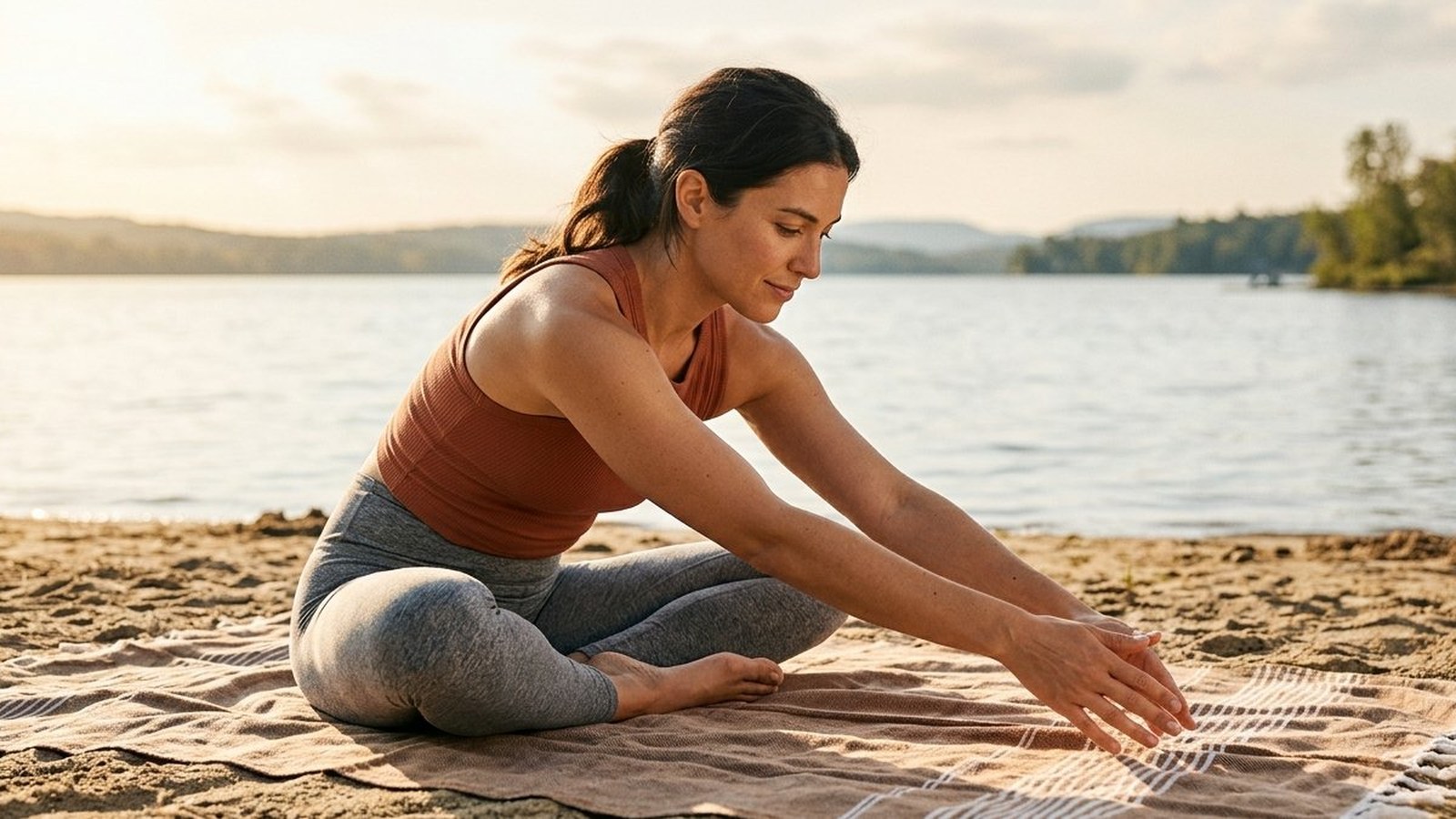
A folded towel rolls a hamstring, supports a shoulder stretch, and stands in for a foam roller when you travel. The evidence is modest but real: solo PNF stretching with a strap improves range of motion, and foam rolling produces small, consistent gains in flexibility and how recovered you feel. A beach towel can carry both jobs — so the mobility work that would otherwise be skipped on a summer of beach days still gets done.
Educational journalism, not medical advice. Every claim here is checked against its cited sources by editor Timothy Bunce — a health writer, not a physician. It isn’t specific to your situation: for health decisions, talk to your own clinician. How we work →
Some links in this article are affiliate links. If you buy through one, The Beachside Reader earns a commission at no extra cost to you. It never changes which products we pick, or what we say about them. Full affiliate disclosure →
Recovery tools that work at the beach
The mobility-equipment industry sells foam rollers, lacrosse balls, vibrating massage tools, percussive devices, and PVC sticks. Several of these do something useful. But two of the things they do — provide a firm surface for self-myofascial release, and provide something to grip and pull against for stretching — can be approximated by a folded beach towel, if you understand what each tool is actually for.
This matters at the beach because nobody packs a foam roller for a Saturday at the lakeshore. They pack a towel because they need one anyway. If the towel can carry the mobility work, that work is far more likely to actually happen.
The idea behind self-myofascial release tools is simple: a firm object applies sustained pressure to a soft-tissue region while the user relaxes into it. The object can be a foam cylinder, a ball, or a tightly rolled towel; the shape and firmness change how deep and how focused the pressure is. A towel is softer and less stable than a dedicated roller, so treat the substitution as a practical workaround, not a like-for-like swap.
The second use is as a strap. Many therapist-prescribed stretches — including PNF and contract-relax patterns — need something to grip and pull against. A long towel stands in for a stretching strap in those drills.
The PNF stretch evidence
Proprioceptive neuromuscular facilitation, abbreviated PNF, is one of the better-studied stretching approaches. The classic contract-relax pattern asks the user to lengthen a muscle to a comfortable end-range, isometrically contract against resistance for several seconds, relax, and then ease deeper into the stretch.
A review by Sharman, Cresswell and Riek (2006) concluded that PNF protocols produce greater range-of-motion gains than static stretching, with the clearest advantage in the short term.1 It is worth being honest about why: the traditional textbook explanation — that reflexes such as autogenic and reciprocal inhibition let the muscle relax further — is not well supported by the evidence. The same review favours a simpler explanation: PNF increases your tolerance to the stretch rather than changing the muscle's mechanical properties.1
The practical catch is that PNF traditionally requires a partner to provide resistance during the isometric phase, which makes it inconvenient for solo training. A towel solves that: the hands grip one end, the foot loops through the other, and the user's own arms supply the resistance. This is not just a convenient hack — self-administered PNF using a strap has been shown to improve range of motion much as the partner-assisted version does.2 That is the central reason a towel earns its place: it removes the partner requirement without giving up the benefit.
This is also why physical therapists routinely send patients home with a strap or towel and a printed protocol — the patient can repeat the clinic work between visits.
Hamstring rolls with a rolled towel
A beach towel rolled tightly along its long axis produces a soft cylinder you can use much like a foam roller, though it is softer and less stable. For a first-timer that softness can be more comfortable on bony areas; for deep, focused pressure it falls short of a real roller. Treat the dimensions and firmness as approximate — this is practical guidance, not a tested equivalence.
The hamstring drill is straightforward. Sit with the cylinder across one hamstring near the sit-bone, lift the opposite leg, press down through the heel of the rolling leg, and slowly travel the towel from sit-bone to the back of the knee. A few unhurried passes per side, roughly half a minute each, is a reasonable starting dose — adjust to what feels useful rather than chasing a specific number.
On outcomes, the honest picture is more modest than the marketing. A meta-analysis by Wiewelhove and colleagues (2019) found that foam rolling produces small but consistent improvements in flexibility and range of motion, and in perceived recovery such as muscle soreness; the effect on actual performance is smaller than the effect on how recovered you feel.3 That perceived-recovery benefit still matters, because feeling recovered helps you stick with a training plan.
Where the towel cylinder clearly falls short is trigger-point work that needs deep, focused pressure. There, a ball wrapped in the corner of the towel restores specificity, and the corner becomes a handle to position it.
Shoulder mobility — the towel-strap series
Shoulder mobility is often the limiting factor in overhead pressing, swimming, and simply reaching an overhead shelf. The following are standard physiotherapy stretches that a towel can stand in for; treat them as practical instruction rather than as drills with their own efficacy data quoted here.
For a pec/front-of-shoulder stretch, grip the towel behind the lower back and slowly draw the shoulders down and back; the stretch is felt across the front of the shoulder and chest. This targets the rounded-shoulder posture that builds up from desk work, driving, and phone use.
For a lat stretch, grip the towel overhead at shoulder width, extend the arms long, and lean sideways at the waist. The towel keeps the hands the right distance apart and gives you something to pull against; the stretch crosses from the lower rib to the armpit on the lengthened side.
For a posterior-shoulder (sleeper) stretch, lie on the affected side with the elbow bent, and use the opposite hand to ease the towel-wrapped wrist gently toward the floor. The stretch is felt deep behind the shoulder. Each of these is normally prescribed with a strap or band; the towel substitutes directly.
Lower-back work on uneven sand
Sand is a poor surface for direct ground contact: it shifts under load, holds heat in midsummer, and gets into everything. A beach towel folded three or four times creates a stable, level surface that supports floor-based mobility drills without a yoga mat.
The supine knee-to-chest, the figure-four hip stretch, the prone press-up, and child's pose all work fine on a thickly folded towel. For a supported bridge, a towel rolled along its short axis can prop the sacrum at roughly the right height; hold times here are personal comfort, not a prescribed dose.
There is a real reason this kind of gentle extension and movement is worth the few minutes. Prolonged sitting measurably reduces spinal mobility,4 and most adults spend the bulk of the day seated and flexed. A short bout that takes the spine through positions it rarely occupies during a normal day is a sensible counterweight — not a cure, but a reasonable habit.
A 5-minute beach routine
A practical sequence that uses only a beach towel and takes about five minutes:
- Hamstring roll with the rolled towel, a few passes per side.
- Solo PNF hamstring stretch using the towel as a strap, two contract-relax cycles per side.
- Supine knee-to-chest, a brief hold per side.
- Pec/front-of-shoulder stretch using the towel behind the back.
- Child's pose on the folded towel, breathing slowly.
The doses above are practical suggestions, not study-derived numbers — ease in gradually and adjust to how you feel. Done regularly across a summer, a routine like this is a low-friction way to keep mobility work in your week when the gym tools are out of reach. It can be done after a swim, between beach activities, or before driving home. For a longer sit-down sequence that needs nothing but a towel, see our 10-minute seated beach-stretch routine.
When you actually want a foam roller
A dedicated foam roller is firmer and more stable than a towel cylinder, which makes it the better choice when you want deeper, more focused pressure — for example along the upper back, the outer leg, or dense calf tissue. A travel-sized roller, roughly a foot long, packs into a beach bag without much fuss, which is why some runners and triathletes carry one alongside their towel.
The decision is practical. For hamstrings, shoulders, hips, and lower-back work, a towel handles the job. When you specifically want firm, deep pressure, the small roller is worth the pack space. Most beach-goers will find the towel-only approach enough — see our head-to-head on massage guns vs. foam rollers for how the dedicated tools compare to each other.
Travelling without losing your mobility gains
Travel and summer breaks are common reasons mobility work disappears, simply because the usual tools are at home. The appeal of the towel approach is behavioural: the towel is already in the bag, the routine is short, and the barrier drops from "find a foam roller in a vacation rental" to "use what you brought for swimming."
The same logic applies to hotel rooms — a bath towel rolls into much the same cylinder, and a folded towel on the floor gives a workable surface. None of this builds dramatic new range of motion; the realistic goal is to keep an easily-skipped habit alive while you are away from your normal setup.
Extended takeaways
The clinical and physiotherapy literature is more measured than the equipment marketing. Self-administered PNF with a strap improves range of motion,2 PNF tends to beat static stretching on range gains (most clearly short-term),1 and foam rolling delivers small but consistent gains in flexibility and perceived recovery.3 A folded beach towel can carry the strap-and-pressure roles in many of these drills.
The deeper point is about friction. Mobility work is high-value but easily skipped because the equipment lives somewhere other than the rest of your day. Moving the work onto a tool that is already in the beach bag lowers the barrier to doing it. Range of motion is maintained not by elaborate routines but by the simplest one you will actually do.
Frequently asked questions
How tightly should I roll the towel for a foam-roller substitute?
As tightly as you can. A loose roll compresses too much under body weight and loses its shape; a tight roll holds for several minutes of work. A hair tie at each end helps it keep its shape.
Can a sandy towel really be used for PNF stretching?
Yes. The towel's job is to connect your hand to your foot and give you a leverage point; sand on it doesn't change the stretch. Brush off the sand before pulling the towel against bare skin.
What's the difference between PNF and static stretching for mobility gains?
In published comparisons, PNF tends to produce larger range-of-motion gains than static stretching, most clearly in the short term.1 The likely reason is increased tolerance to the stretch rather than a reflex trick, and the traditional reflex-based explanation is not well supported.1 Static stretching still works — it is just generally less effective for range gains in these comparisons.
Should mobility work happen before or after beach activities?
Light mobility work is fine beforehand. Deeper stretching and longer holds are generally more comfortable afterward, when tissues are warm. The short routine here is suitable either time. This is general practice guidance rather than a finding from the cited studies.
Is mobility work different for older adults?
The same drills apply, with sensible caution: ease in, and keep the contract phase of any PNF stretch moderate rather than maximal. If you have a medical condition or a history of injury, check with a clinician first. This is general guidance, not a research-backed prescription.
References
Sharman 2006Sharman MJ, Cresswell AG, Riek S. Proprioceptive neuromuscular facilitation stretching: mechanisms and clinical implications. Sports Medicine. 2006;36(11):929-939. View source →Wicke 2014Wicke J, Gainey K, Figueroa M. A comparison of self-administered proprioceptive neuromuscular facilitation to static stretching on range of motion and flexibility. Journal of Strength and Conditioning Research. 2014;28(1):168-172. View source →Wiewelhove 2019Wiewelhove T, Doeweling A, Schneider C, Hottenrott L, Meyer T, Kellmann M, Pfeiffer M, Ferrauti A. A Meta-Analysis of the Effects of Foam Rolling on Performance and Recovery. Frontiers in Physiology. 2019;10:376. View source →Heneghan 2018Heneghan NR, Baker G, Thomas K, Falla D, Rushton A. What is the effect of prolonged sitting and physical activity on thoracic spine mobility? An observational study of young adults in a UK university setting. BMJ Open. 2018;8(5):e019371. View source →