The 60-second version
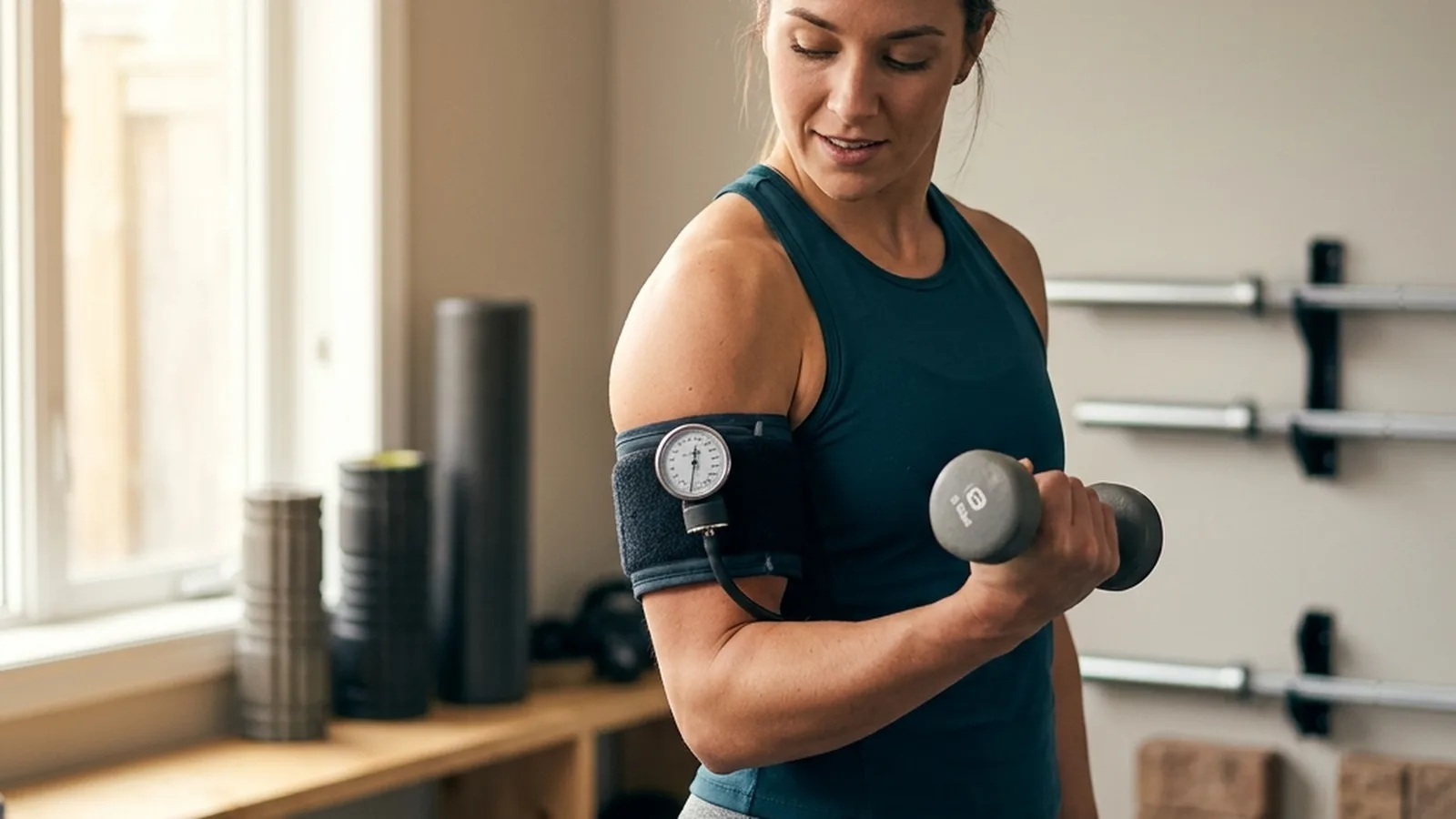
Blood flow restriction (BFR) training — using inflatable cuffs on the upper limbs or upper thighs to partially restrict venous return during light-load exercise — has accumulated substantial trial evidence in the past decade. The mechanism: BFR with 20-30% of one-rep-max produces hypertrophy comparable to traditional 70%+ training. The applications that actually matter: injury rehabilitation, periods when heavy loading isn’t available (post-surgical, joint pain), and supplementation of normal training for additional volume without joint stress. The protocol that emerged from the published trials: 4 sets of 30-15-15-15 reps with 30-60 seconds rest between sets, cuff inflated to roughly 50-80% of arterial occlusion pressure, performed 2-3 times weekly. Properly applied, BFR is safer than the equipment looks — the published safety data through 20+ years of use is reassuring. But there are real contraindications (vascular disease, clotting disorders, pregnancy) and a wrong-equipment risk that matters.
Educational journalism, not medical advice. Every claim here is checked against its cited sources by editor Timothy Bunce — a health writer, not a physician. It isn’t specific to your situation: for health decisions, talk to your own clinician. How we work →
Some links in this article are affiliate links. If you buy through one, The Beachside Reader earns a commission at no extra cost to you. It never changes which products we pick, or what we say about them. Full affiliate disclosure →
How BFR produces hypertrophy at light loads
The mechanism is multifactorial:
- Metabolic stress accumulation: restricted venous return traps metabolites (lactate, hydrogen ions, inorganic phosphate) in the working muscle. These metabolites signal the same growth pathways heavy loading does.
- Cellular swelling: blood pooling produces edema in the muscle — another signal for the hypertrophy response.
- Higher motor unit recruitment: hypoxia in the working muscle forces recruitment of high-threshold motor units that ordinarily activate only with heavy loads.
- Growth hormone and IGF-1 surges: short-term hormonal responses are larger than from equivalent light-load training without restriction.
The result: light-load (20-30% 1RM) BFR produces hypertrophy effects comparable to traditional 70-80% 1RM training, per a meta-analysis directly comparing high-load and BFR training head-to-head Lixandrão 2018; the same analysis found strength gains still favour heavy loading.
When BFR earns its keep
- Post-surgical rehab: after ACL reconstruction, rotator cuff repair, etc., heavy loading isn’t safe for weeks-to-months. BFR allows hypertrophy training during the window when conventional training would produce only minimal stimulus.
- Joint pain that limits heavy loading: tendinopathy, osteoarthritis, chronic injuries where 70%+ loading produces unacceptable pain.
- Supplementary volume: after a heavy training session, BFR work on the same muscles adds hypertrophy stimulus without the joint stress of a second heavy session.
- Bone health in older adults: BFR walking has shown small but consistent benefits for bone density in postmenopausal women who can’t tolerate heavy loading.
- Training around an injury in an asymptomatic limb or muscle group while the injured area heals (the limb being restricted, not the injured one).
Loenneke and colleagues’ meta-analysis found that low-intensity training (20-30% 1RM) combined with blood flow restriction produced significantly greater strength and hypertrophy gains than the same low-intensity exercise performed without restriction — the effect that makes BFR valuable when heavy loading isn’t an option, such as in rehabilitation.
— Loenneke et al., Eur J Appl Physiol, 2012 view source
The protocol that emerged from trials
- Load: 20-30% of 1-rep-max. Anything below 20% produces minimal effect; anything above 40% defeats the purpose (you might as well train conventionally).
- Rep scheme: 30-15-15-15. First set 30 reps, subsequent sets 15 reps. Total 75 reps per exercise.
- Rest: 30-60 seconds between sets, cuff stays inflated. The metabolic stress accumulation depends on the cuff remaining inflated through the full session.
- Cuff pressure: 50-80% of arterial occlusion pressure. Trained users can self-titrate based on perceived discomfort and visible cuff-distal swelling.
- Frequency: 2-3 sessions weekly per muscle group. More than that produces accumulating fatigue without proportional benefit.
- Total time per limb: under 10 minutes of inflation. Longer inflation increases risk and produces no additional benefit.
Equipment matters — don’t use voodoo bands
- Proper BFR cuffs are wide (5-10cm), use pneumatic inflation, and have a pressure gauge. Cost: $150-$400 for a pair.
- Pneumatic devices with personalised occlusion measurement (e.g., Delfi, Smart Cuffs) are the gold standard. They calculate your individual arterial occlusion pressure and set training pressures from that.
- Don’t use elastic exercise bands as a cheap substitute. Pressure is uncontrolled, often too high, and the risk profile is worse than with proper cuffs.
- Narrow cuffs (less than 5cm) require much higher pressures to occlude flow and have more documented adverse events.
Safety and contraindications
- Generally well-tolerated. Published adverse events through 20+ years of use are uncommon and usually mild (bruising, transient numbness).
- Contraindications: active deep vein thrombosis or history of DVT, peripheral vascular disease, sickle cell disease, pregnancy, uncontrolled hypertension, varicose veins of significant severity.
- Don’t use BFR with Valsalva (breath-holding under load) — the combined pressure surges are unnecessary stress.
- Stop immediately if distal numbness persists, severe pain develops, or the limb turns blue/white rather than the expected pink-red.
Practical takeaways
- BFR with 20-30% 1RM produces hypertrophy comparable to traditional 70%+ training.
- The high-value applications: injury rehabilitation, joint pain, supplementary volume, post-surgical training.
- Protocol: 4 sets of 30-15-15-15, 30-60s rest, 50-80% occlusion pressure, 2-3 sessions weekly.
- Use proper pneumatic cuffs with pressure measurement. Skip elastic bands — uncontrolled pressure with worse risk.
- Real contraindications exist (vascular disease, clotting disorders, pregnancy). Properly applied, BFR is safer than the equipment looks.
Frequently asked questions
Is BFR safe?
Generally yes when properly applied. Published adverse events through 20+ years of use are uncommon. Real contraindications exist (vascular disease, clotting disorders, pregnancy). Use proper pneumatic cuffs with pressure measurement, not elastic bands.
How much pressure should the cuff have?
50-80% of arterial occlusion pressure. Pneumatic devices with personalised measurement (Delfi, Smart Cuffs) calculate this individually. Without that, target a pressure that produces visible but not severe distal swelling and 6-8/10 perceived discomfort during the set.
Can I just use elastic bands?
Better to use proper cuffs. Elastic bands produce uncontrolled (often too high) pressure and have a worse risk profile in published reports. Pneumatic cuffs with measurement cost $150-$400 — worth it for the safety margin.
How often should I do BFR training?
2-3 sessions weekly per muscle group. More than that produces accumulating fatigue without proportional benefit. Keep cuff-inflation time under 10 minutes per limb per session.
Will BFR replace heavy training?
Not for most outcomes. Strength gains from BFR are smaller than from heavy training; hypertrophy is comparable. Heavy training also produces tendon and bone adaptations BFR doesn’t replicate well. BFR is best as a supplement to traditional training or as a substitute when heavy loading isn’t available.
References
Loenneke 2012Loenneke JP, Wilson JM, Marín PJ, Zourdos MC, Bemben MG. Low intensity blood flow restriction training: a meta-analysis. Eur J Appl Physiol. 2012;112(5):1849-1859. View source →Lixandrão 2018Lixandrão ME, Ugrinowitsch C, Berton R, Vechin FC, Conceição MS, Damas F, Libardi CA, Roschel H. Magnitude of Muscle Strength and Mass Adaptations Between High-Load Resistance Training Versus Low-Load Resistance Training Associated with Blood-Flow Restriction: A Systematic Review and Meta-Analysis. Sports Med. 2018;48(2):361-378. View source →