The 60-second version
Body Mass Index (BMI) is the single most-mentioned and least-understood metric in health writing. Most of the criticism it gets — that it can't see muscle mass, ignores fat distribution, and fails the "rugby player test" — is correct. However, most of the criticism also misses the point: BMI was designed as a population-level screening proxy, not a definitive individual diagnosis. For average-built adults, it tracks body fat with reasonable correlation (r ≈ 0.6 to 0.8). Treat it as one input among many, not as a verdict. Use it alongside waist-to-height ratio and strength metrics for a true picture of your health.
Try the BMI Calculator — it’s the companion utility to this article.
Educational journalism, not medical advice. Every claim here is checked against its cited sources by editor Timothy Bunce — a health writer, not a physician. It isn’t specific to your situation: for health decisions, talk to your own clinician. How we work →
Some links in this article are affiliate links. If you buy through one, The Beachside Reader earns a commission at no extra cost to you. It never changes which products we pick, or what we say about them. Full affiliate disclosure →
What BMI actually is
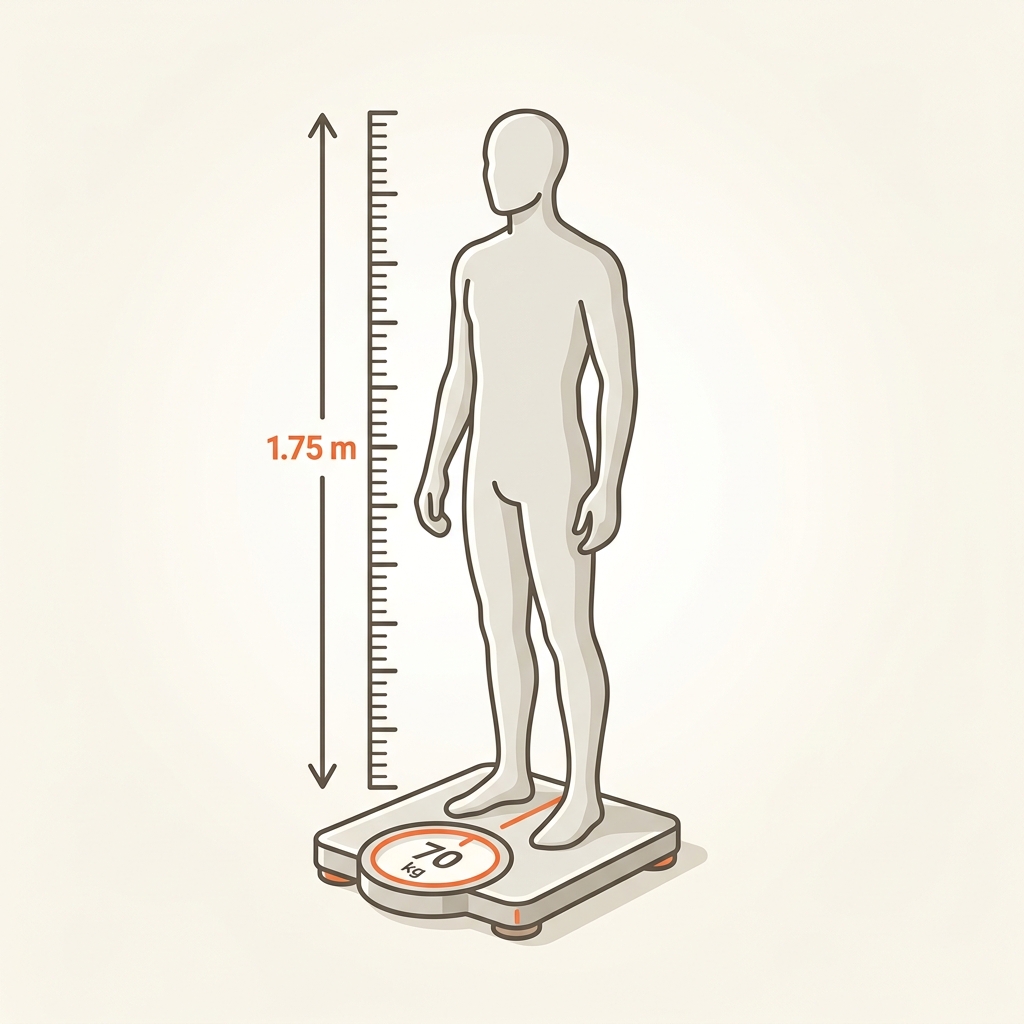
BMI is your weight in kilograms divided by the square of your height in metres. The formula was published by Belgian astronomer Adolphe Quetelet in 1832 as a way to describe the "average man" in a population. It was never intended as an individual health assessment. Its current ubiquity in clinical practice is a cultural drift from its original design as an epidemiological tool Keys 1972.
The standard categories
The standard cut-offs, set by the World Health Organization (WHO), were chosen to predict mortality risk in large samples:
| BMI | Category |
|---|---|
| < 18.5 | Underweight |
| 18.5 – 24.9 | Healthy weight |
| 25.0 – 29.9 | Overweight |
| 30.0 – 34.9 | Obesity (Class I) |
| 35.0 – 39.9 | Obesity (Class II) |
| ≥ 40.0 | Obesity (Class III) |
Where BMI works
BMI is at its most accurate for sedentary or moderately active adults of average build. Used as a screening tool, it efficiently flags individuals who may benefit from closer clinical attention without requiring expensive scans. It is also exceptionally useful for tracking your personal trajectory over time; a BMI change of 2 points over a year is a significant signal regardless of your absolute number.
Where BMI fails
BMI’s most famous failure is the muscular outlier. A 100 kg, 180 cm rugby player or bodybuilder often classifies as "obese" despite having very low body fat. Conversely, it fails in the frail outlier: an older adult with sarcopenia (muscle loss) can have a "healthy" BMI of 22 while carrying dangerously low muscle mass and high visceral fat.
Other groups where BMI is unreliable:
- Very tall (>6'5") or very short (<5'0") adults — the height-squared formula distorts at the extremes.
- Pregnant/postpartum women — the ratio is meaningless during the dramatic composition shifts of pregnancy.
- Specific ethnic backgrounds — South Asian populations carry significantly more cardiovascular risk at lower BMIs than Europeans; the WHO Asian-specific cut-offs reflect this (overweight ≥ 23, obese ≥ 27.5) WHO 2004.
What to use alongside BMI
If BMI is one input, these are the cross-checks that provide the rest of the picture:
- Waist-to-height ratio (WHtR). Aim for < 0.5. Some researchers argue this single ratio is a more reliable universal screening tool for cardiovascular risk than BMI because it captures abdominal fat distribution Ashwell 2012.
- Grip strength. In older adults, grip strength predicts all-cause mortality more reliably than weight. It is a direct proxy for muscle quality.
- Body fat estimation. Caliper measurements or DEXA scans provide the composition data BMI lacks.
How to read your BMI sensibly
- Starting point, not a verdict. You know if you are a powerlifter or a sedentary office worker. Adjust your interpretation accordingly.
- Track the trend. Your BMI change over two years is more informative than your current number.
- Pair it with a second metric. If your BMI is "overweight" but your waist-to-height ratio is 0.48 and you train twice a week, the BMI reading is likely a false positive.
Frequently asked questions
Is BMI more accurate for women or men?
Roughly equal for average body types, with the same caveats for very muscular or very frail outliers in both sexes.
Does BMI work for children?
No. Children use a completely different system called "BMI-for-age percentiles." The adult cut-offs do not apply to anyone under 20.
Why does my doctor still use it?
Because it is free, fast, and remarkably effective as a population-level screening tool when paired with clinical observation. It is a useful first conversation, not the final word.
References
Keys 1972Keys A, Fidanza F, Karvonen MJ, et al. Indices of relative weight and adiposity. J Chronic Dis. 1972;25(6-7):329-343. View source →Ashwell 2012Ashwell M, Gunn P, Gibson S. Waist-to-height ratio is a better screening tool than waist circumference and BMI for adult cardiometabolic risk factors: a systematic review and meta-analysis. Obesity Reviews. 2012;13(3):275-286. View source →WHO 2004WHO Expert Consultation. Appropriate body-mass index for Asian populations and its implications for policy and intervention strategies. The Lancet. 2004;363(9403):157-163. View source →