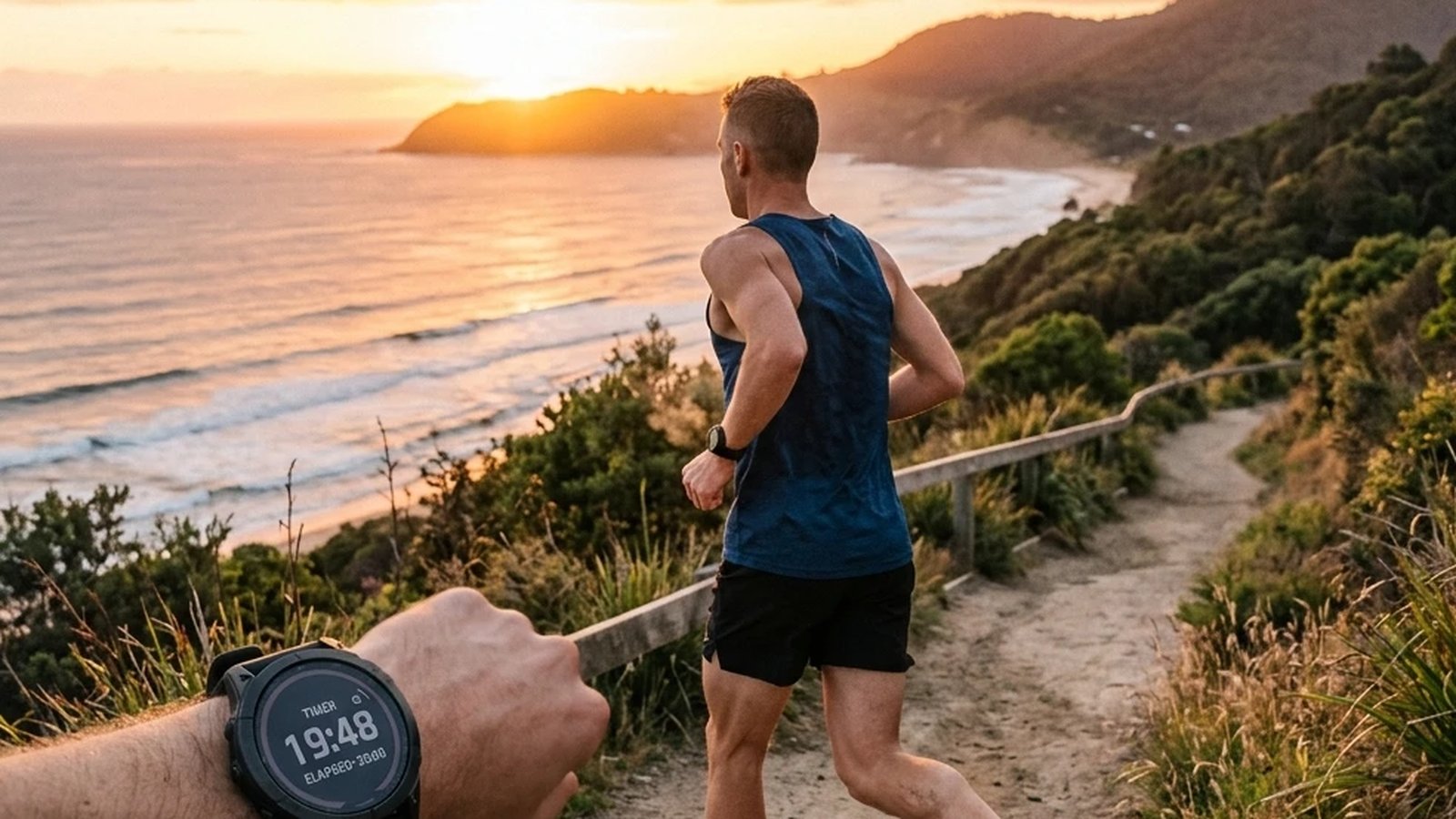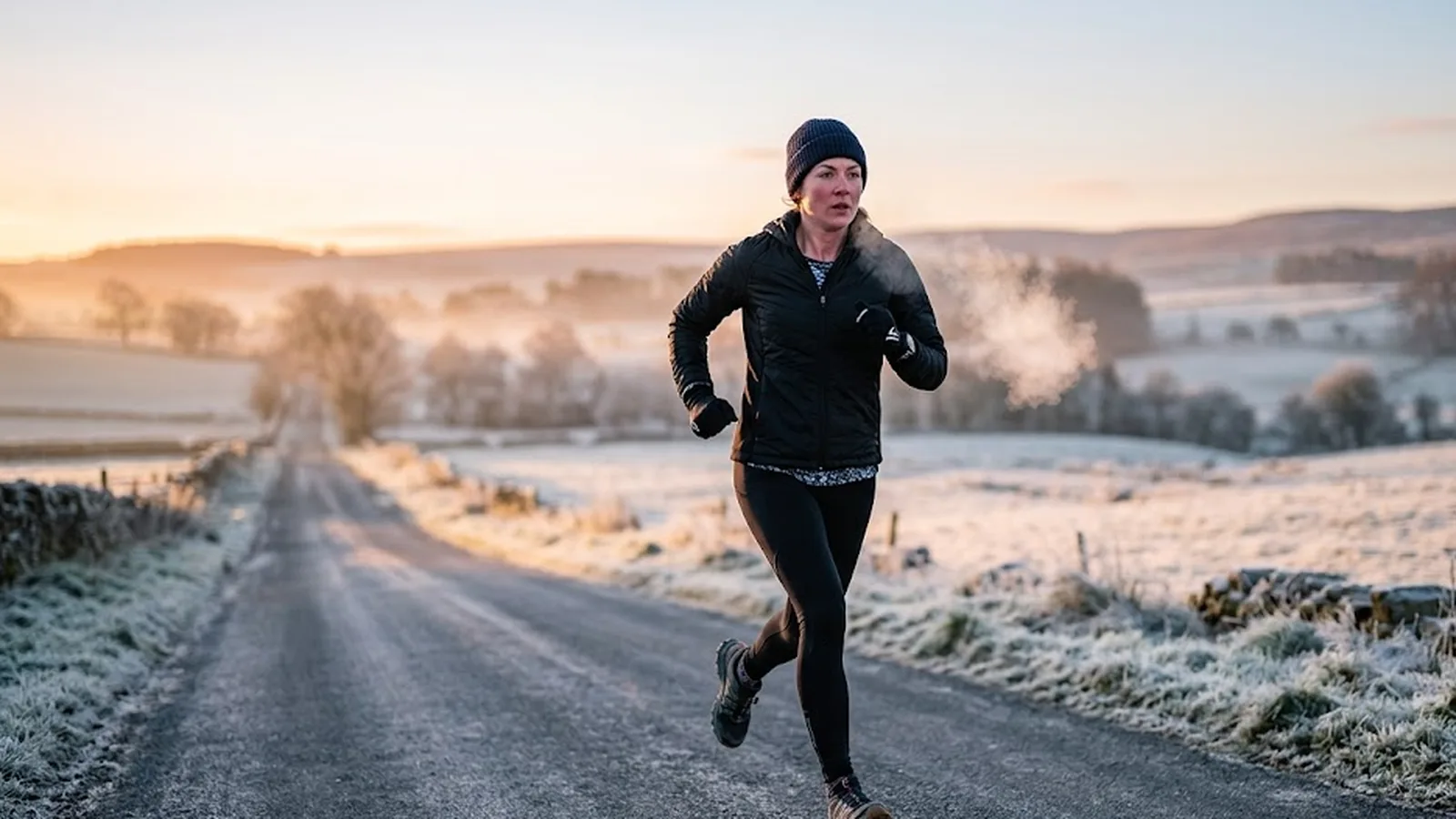
The 60-second version
Running in cold weather is reasonably well-tolerated by most healthy adults with appropriate clothing; there's no single research-backed temperature cutoff, but ACSM's cold-injury guidance calls for heightened frostbite surveillance once wind-chill drops below −27 °C. The published thermal-regulation research shows cold exposure activates brown adipose tissue and produces measurable improvements in cardiovascular efficiency and glucose handling, but the magnitude is modest — not a substitute for the run itself. Three caveats matter: hypothermia risk rises sharply if pace drops or clothing gets wet; airway sensitivity (cold-induced bronchoconstriction) affects roughly 1 in 3 cold-weather runners and warrants a warm-up protocol; cardiovascular strain at the start of a cold session is real for adults with hypertension or known coronary disease. This article walks through the published evidence, the realistic temperature thresholds, and a sensible protocol for someone training through Canadian winters.
Educational journalism, not medical advice. Every claim here is checked against its cited sources by editor Timothy Bunce — a health writer, not a physician. It isn’t specific to your situation: for health decisions, talk to your own clinician. How we work →
Some links in this article are affiliate links. If you buy through one, The Beachside Reader earns a commission at no extra cost to you. It never changes which products we pick, or what we say about them. Full affiliate disclosure →
What the evidence says about cold-weather cardio
The American College of Sports Medicine's (ACSM) position stand on cold-injury prevention is a qualitative risk-management framework, not a single temperature cutoff Castellani 2006 — as explained below, its one specific quantitative threshold is a wind-chill figure, not an air-temperature decrement point. Cold-weather running still carries real, well-documented risks as conditions worsen: upper-airway irritation, frostbite on exposed skin, and acute cardiovascular strain in vulnerable populations.
The brown-adipose-tissue (BAT) story has gotten more popular recently. Repeated cold exposure activates BAT and improves cold-induced thermogenesis — but the metabolic benefits are smaller than wellness marketing suggests. Lichtenbelt's 2014 review of human BAT activation found a non-shivering thermogenic effect on the order of 50–150 kcal/day with daily cold exposure — useful, not transformative Lichtenbelt 2014.
Caveat 1: hypothermia risk if pace drops or clothing gets wet
The dangerous transition isn't the cold itself; it's the moment when heat production drops below heat loss. Hayward's classic cold-water immersion work showed that individual variation in subcutaneous fat and thermoregulatory reflexes is what determines how long someone can hold core temperature stable in cold water Hayward 1981. Separately, standard hypothermia staging holds that once core temperature drops to ~35 °C, exercise tolerance collapses, decision-making degrades, and shivering becomes inefficient. The cold-running translation: any combination of (a) wet clothing from sweat or precipitation, (b) wind exposure on exposed skin, and (c) a pace drop below ~6:00 min/km on a long out-and-back will steepen the heat-loss curve faster than most runners expect. Plan turn-around points where you have shelter access if the day moves on you.
The ACSM position stand itself isn't built around a single temperature cutoff — it's a risk-management framework. It recommends using the wind-chill index to estimate frostbite risk and calls for heightened surveillance of exercisers once wind-chill drops below −27 °C, alongside a broader process of identifying the cold hazard, assessing contributing factors like wet clothing, wind, and pace, building in controls, and using administrative oversight to enforce them Castellani 2006.
Caveat 2: cold-induced bronchoconstriction
Roughly one-third of cold-weather endurance athletes experience some degree of cold-induced airway narrowing — chest tightness, dry cough, and reduced peak expiratory flow that resolves within 30 minutes of returning to warmth Koskela 2007. The proximal trigger is the rapid cooling and dehydration of bronchial epithelium when minute ventilation rises in cold dry air. The protective protocols with the strongest published evidence are simple: use a buff or thin neck gaiter pulled over the mouth and nose for the first 10 minutes (warms and humidifies inhaled air), start at conversational pace and ramp up over 15 minutes, and avoid maximal efforts on the coldest single days. For people with diagnosed exercise-induced bronchoconstriction, pre-medication with a short-acting bronchodilator 15 minutes pre-run is the established intervention.
Caveat 3: cardiovascular strain at session start
The first 5–10 minutes of any cold-weather cardio session put a transient additional load on the heart: cold-induced peripheral vasoconstriction raises blood pressure, increases afterload, and shifts the rate-pressure product upward at any given workload Manou-Stathopoulou 2015. For most healthy adults this is unremarkable. For adults with established hypertension, known coronary disease, or new chest-pain symptoms during exertion, cold-weather running deserves a conversation with a doctor before becoming a habit. The acute-MI epidemiology shows a real (though small) excess winter-morning event rate.
A reasonable protocol
- −5 °C and warmer: Standard running gear plus gloves and a hat. No special precautions. The session is essentially a warm-weather session with extra layers.
- −5 to −15 °C: Add a merino or technical base layer, a wind-resistant outer layer, a buff for the airways during the first 10 minutes, and traction shoes if there's ice. Plan a 20-minute warm-up before raising intensity.
- −15 to −25 °C: Cover all exposed skin (frostbite at the −25 threshold is real), reduce session duration to ~45 minutes, avoid intervals or fasted efforts, and tell someone your route.
- Below −25 °C or with significant wind chill: Move the session indoors. Treadmills, stationary bikes, and indoor stair-climbing are reasonable substitutes; the published thermal-regulation literature does not support continuing outdoor running at these temperatures for general fitness purposes.
Cold-air dehydration is real
One frequently overlooked element: cold dry air dehydrates you faster than the cold makes you feel. Respiratory water loss in −10 °C air at running ventilation rates approaches 200–300 ml per hour in addition to sweat losses Freund 1991. You won't feel thirsty — cold suppresses the thirst response — but plan to drink before, during (if >60 minutes), and after.
Practical takeaways
- For healthy adults, cold-morning runs down to ~−15 °C are safe with proper clothing. The thermal-regulation evidence is robust on this point.
- Use a buff over the mouth for the first 10 minutes, especially below −5 °C — this is the single highest-leverage intervention for airway protection.
- Extend your warm-up by 5–10 minutes versus warm-weather norms; the cardiovascular ramp is steeper.
- Drink before and after, even when not thirsty. Cold dry air drives respiratory water loss the runner doesn't notice.
- Have a talk with your doctor first if you have hypertension, coronary disease, or new exertional symptoms. The risk is small but real.
- Below −25 °C, train indoors. The evidence does not support pushing through these conditions for ordinary fitness purposes.
Frequently asked questions
How cold is too cold to run outside?
There's no single research-backed temperature at which running becomes unsafe for healthy adults — ACSM's cold-injury guidance is a risk-management framework, not a specific safe/unsafe cutoff. The one concrete number in that guidance is a wind-chill threshold: it recommends heightened frostbite surveillance once wind-chill drops below −27 °C. Below that, and especially with exposed skin or high wind, move the session indoors.
Do I need a special winter running jacket?
Not necessarily. A merino or technical base layer plus a wind-resistant shell handles most conditions down to −15 °C. The published thermoregulation research consistently shows merino wool outperforms equivalent-weight synthetics across a wide temperature range.
Why does my chest feel tight when I run in the cold?
Cold-induced bronchoconstriction affects roughly one in three cold-weather runners. The proximal cause is rapid cooling and drying of bronchial epithelium. A buff over the mouth and nose for the first 10 minutes is the highest-leverage protective intervention; for diagnosed exercise-induced bronchoconstriction, pre-medication is the established next step.
Can cold morning runs really boost metabolism?
There's a real but modest brown-adipose-tissue activation effect from regular cold exposure — roughly 50–150 kcal/day of additional non-shivering thermogenesis with daily exposure. It's not a weight-loss intervention. The case for cold-morning runs rests on the run, not on the cold.
Should I drink water during cold runs?
Yes — cold dry air drives respiratory water loss faster than people expect, and the cold suppresses thirst response. For runs over an hour, plan to drink during. For shorter runs, drinking 250–500 ml beforehand and rehydrating after is sufficient.
References
Castellani 2006Castellani JW, Young AJ, Ducharme MB, et al. American College of Sports Medicine position stand: prevention of cold injuries during exercise. Med Sci Sports Exerc. 2006;38(11):2012-2029. View source →Lichtenbelt 2014van Marken Lichtenbelt W, Kingma B, van der Lans A, Schellen L. Cold exposure — an approach to increasing energy expenditure in humans. Trends Endocrinol Metab. 2014;25(4):165-167. View source →Hayward 1981Hayward MG, Keatinge WR. Roles of subcutaneous fat and thermoregulatory reflexes in determining ability to stabilize body temperature in water. J Physiol. 1981;320:229-251. View source →Koskela 2007Koskela HO. Cold air-provoked respiratory symptoms: the mechanisms and management. Int J Circumpolar Health. 2007;66(2):91-100. View source →Manou-Stathopoulou 2015Manou-Stathopoulou V, Goodwin CD, Patterson T, Redwood SR, Marber MS, Williams RP. The effects of cold and exercise on the cardiovascular system. Heart. 2015;101(10):808-820. View source →Freund 1991Freund BJ, Sawka MN. Influence of cold stress on human fluid balance. In: Nutritional Needs in Cold and in High-Altitude Environments. Washington (DC): National Academies Press; 1996. ch.10. View source →