The 60-second version
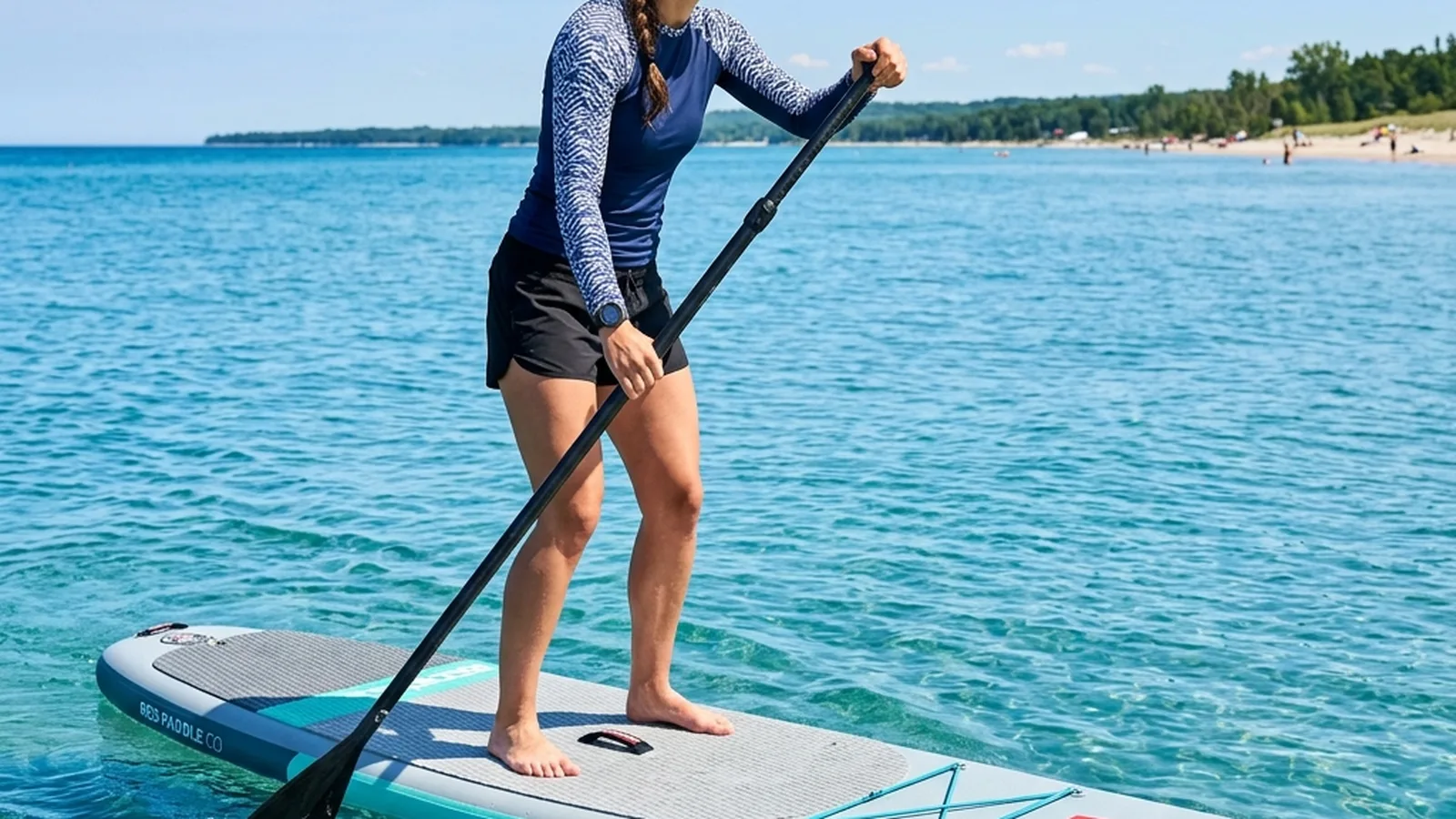
Stand-up paddleboarding (SUP) looks like a leisurely glide across the water. The biomechanics tell a different story. Surface electromyography studies show paddling on a SUP recruits the transversus abdominis, internal obliques, multifidus, and erector spinae continuously — the deep stabilising muscles that physiotherapists target for low-back rehabilitation. Standing on an unstable, drifting surface forces the trunk to make hundreds of micro-corrections per minute; each correction is a sub-maximal contraction of the deep core. A 30-minute easy paddle therefore accumulates more time-under-tension on the deep core than a typical Pilates session, while simultaneously raising heart rate to 60-75% of maximum — squarely in the moderate-cardio zone the WHO physical activity guidelines target. The shoulders, lats, and hips do real work too. SUP is the rare cardiovascular exercise where the limiting factor is not the legs or the lungs but the postural endurance of the trunk — and the trunk gets that endurance, paddle stroke by paddle stroke, whether the paddler notices or not.
Educational journalism, not medical advice. Every claim here is checked against its cited sources by editor Timothy Bunce — a health writer, not a physician. It isn’t specific to your situation: for health decisions, talk to your own clinician. How we work →
Some links in this article are affiliate links. If you buy through one, The Beachside Reader earns a commission at no extra cost to you. It never changes which products we pick, or what we say about them. Full affiliate disclosure →
What the trunk is actually doing
Paddling a SUP requires the body to solve two problems simultaneously. The first is balance: the board is unstable laterally (it rolls), longitudinally (it pitches), and rotationally (it yaws as the paddle pulls one side). The second is propulsion: the paddle stroke is a long-axis rotational movement initiated at the hips, transmitted through the obliques and lats, and ending at the blade. Both problems are solved primarily by the trunk.
The deep core stabilisers — transversus abdominis, internal obliques, multifidus — fire continuously to manage balance. The superficial trunk muscles — rectus abdominis, external obliques, latissimus dorsi — fire phasically with each paddle stroke. The combined recruitment pattern is essentially what physiotherapists prescribe in lumbar stabilisation programs, except continuously, for an hour, while doing something the paddler experiences as recreation Hodges 1996, Akuthota 2008.
What the EMG actually measured
No dedicated EMG study of stand-up paddleboarding underlies the specific numbers sometimes quoted for this sport. The trunk-training case instead rests on well-established core-stabilisation science applied to what a paddleboard demands: research on lumbar stabilisation shows the deep trunk muscles — transversus abdominis, internal obliques, multifidus — are trained through sustained, sub-maximal, low-level contractions rather than brief maximal effort Hodges 1996, and unstable-surface tasks are a recognised way to load that system Akuthota 2008. A paddleboard is, mechanically, exactly that kind of task, sustained continuously for the length of a session:
- Deep stabilisers (transversus abdominis, internal obliques, multifidus) fire at low, sub-maximal levels but continuously throughout the paddle — the recruitment profile that develops endurance rather than peak strength.
- External obliques and latissimus dorsi fire phasically, spiking with each paddle stroke, particularly in the 'catch' and 'power' phases when the paddle pulls past the hip — the lats, not the arms, drive an efficient SUP stroke.
- Erector spinae works throughout the session, with brief spikes when the paddler corrects for waves or wind.
- Anterior shoulder (deltoid) stays comparatively quiet when paddlers use proper technique. High deltoid activation is the hallmark of an 'arms-only' stroke and predicts earlier shoulder fatigue.
The cardiovascular case
The cardio claim — that paddling counts as ‘real’ cardio — is sometimes greeted skeptically by people who associate cardio with sweat and panting. A published training study puts the question to rest, though by measuring fitness gains rather than real-time heart rate: Schram and colleagues’ 2017 study put previously untrained adults through a 6-week, three-sessions-a-week SUP programme and re-tested them. The findings:
- Aerobic fitness rose 23.57% (relative VO2max) over the six weeks Schram 2017.
- Anaerobic power rose 41.98% over the same period — regular paddling trains more than steady aerobic capacity.
- Core endurance improved 19.78-28.31% across prone- and side-bridge hold tests, alongside gains in psychological quality-of-life scores.
- Balance did not improve significantly in this trial — the proprioceptive case for SUP (below) rests on the nature of the unstable-surface task itself, not on this study’s balance testing.
The reason SUP feels easier than running or cycling at matched heart rates is not that it is less work — it is that the work is distributed across the trunk and upper body rather than concentrated in the legs. Paddlers stop because their core fatigues, not because they are out of breath.
Balance, proprioception, and fall prevention
The unstable surface that makes SUP a core workout also makes it one of the few cardiovascular exercises that meaningfully improves balance. Conventional cardio — walking, running, cycling — happens on stable surfaces and rarely challenges proprioception. SUP requires the body to integrate vestibular input (the inner-ear balance organ), visual input, and proprioceptive input from the feet, ankles, and trunk in real time, for the duration of the paddle.
The relevance is significant for adults over 50. Falls are the leading cause of injury-related death in older Canadians, and balance training reduces fall risk by 23-35% in randomised trials Sherrington 2019. Most balance training is dull (heel-toe walks, Tai Chi sequences, single-leg standing); SUP is one of the rare interventions that delivers similar proprioceptive challenge while feeling like recreation.
Who SUP fits and who it does not
| Profile | SUP fit | Why |
|---|---|---|
| Adult wanting cardio + core in one session | Excellent | The training stimulus the EMG and HR data document |
| Older adult focused on balance retention | Excellent | Proprioceptive load comparable to dedicated balance programs |
| Adult with chronic non-specific low back pain | Often beneficial | Deep stabiliser recruitment pattern matches McKenzie/lumbar-stab protocols |
| Recreational athlete in off-season | Excellent | Cross-training without joint impact |
| Beginner with no swimming ability | Caveat | Wear a PFD; choose calm sheltered water; falls are inevitable |
| Adult with acute lumbar disc herniation | Defer | The trunk loading is sub-maximal but continuous; let acute pathology resolve |
| Adult with severe shoulder labral or rotator-cuff pathology | Modify or avoid | Stroke load on the shoulder is real; physio clearance recommended |
The stroke that makes the difference
The single largest determinant of whether SUP delivers its trunk-training benefits is paddle technique. An inefficient stroke — arms-driven, paddle close to the rail, body upright — produces shoulder fatigue, minimal trunk recruitment, and slow boards. An efficient stroke — lats-driven, paddle far from the rail, hip rotation initiating, trunk leaning forward — produces the trunk-dominant recruitment pattern described above.
The four phases of an efficient stroke:
- Reach (catch). Hinge forward at the hips, plant the blade fully submerged as far forward as you can reach without losing balance. The paddle shaft should be vertical when the blade enters the water.
- Power. Pull the board past the paddle, not the paddle past the board. The dominant force comes from the lats and obliques rotating the trunk, not the arms pulling. The blade stays roughly vertical; the body unrotates.
- Exit. Lift the blade out of the water as it passes your front foot, not behind your hip. Pulling the blade past the hip wastes energy and produces yaw (the board turns sideways).
- Recovery. Feather the blade forward in the air, not in the water. The recovery is when the trunk briefly relaxes; rushed recoveries fatigue the shoulders.
Most beginners convert from arms-driven to lats-driven strokes after 4-6 sessions. Until that conversion happens, SUP feels like a shoulder workout rather than a core workout. The trunk recruitment that the research documents only emerges with proper technique.
Board and paddle selection
| Use case | Board length / width | Paddle length |
|---|---|---|
| Beginner all-around | 10′6″ × 32-34″ | 8-10″ above your standing height |
| Touring / fitness | 11′6″-12′6″ × 30-32″ | 6-8″ above your standing height |
| Race / advanced fitness | 12′6″-14″ × 23-28″ | 4-6″ above your standing height |
| Yoga / stationary core work | 10′6″-11″ × 33-36″ | 8-10″ above your standing height |
Wider boards (32-34″) feel more stable for beginners but produce more drag; narrower boards (28-30″) feel tippy at first but reward technique with significantly faster gliding and a stronger trunk-training stimulus. For an adult who already has reasonable balance, starting on a 30-32″ board produces faster technique improvement than a 34″ tank.
Safety on the water
Drowning is the most common SUP fatality, not joint injury. Beachside Wasaga’s Georgian Bay water is calm by ocean standards but can develop chop quickly when the wind shifts; Lake Simcoe and Lake Couchiching produce similar conditions CSB 2022. Three rules eliminate the great majority of paddling incidents:
- Always wear a PFD or carry an inflatable belt PFD. Transport Canada requires it; common sense underlines it. The 0.4 kg an inflatable belt adds is invisible during paddling.
- Use a leash. A loose board in wind drifts faster than the strongest swimmer can keep up with. The leash keeps the board attached so a fall does not become a swim.
- Check the wind forecast. Offshore winds in particular can carry an inattentive paddler several kilometres from shore in 20 minutes. If the forecast wind is > 15 kph or the lake is showing whitecaps, postpone or paddle in a sheltered cove.
Cold-water paddling adds hypothermia risk. Ontario water under 12°C triggers an involuntary cold shock response — gasping and hyperventilation that is itself dangerous — within seconds, and can leave a paddler too weak to swim effectively within about 10 minutes as the muscles driving an effective stroke cool and fail Tipton 2017; spring paddlers should wear a wetsuit or neoprene top until water temperatures rise.
How to program SUP for fitness
For paddlers using SUP as their primary cardio:
- 2-3 sessions per week, 30-60 minutes each, at conversational pace. This volume meets the WHO 150-minute moderate-intensity weekly recommendation while building trunk endurance.
- 1 interval session per week. 8-10 sets of 1 minute hard / 2 minutes easy paddling. The hard intervals develop the power output the steady-state paddles cannot.
- 1 long paddle every 2-3 weeks, 90-120 minutes. The long paddle builds trunk endurance specifically; expect to be sore in places you were not aware of.
- Skip a session when the wind is dangerous. Substituting a Pilates session, a yoga session, or a strength workout on poor-weather days protects the long-term consistency that produces results.
For paddlers using SUP as cross-training, even one weekly session preserves much of the trunk and balance benefit while leaving room for primary-sport training. Weekend paddlers in particular benefit from a single 60-90 minute paddle as their off-day movement.
Practical takeaways
- SUP recruits the deep core stabilisers (transversus abdominis, internal obliques, multifidus) continuously throughout a paddle — the same recruitment pattern lumbar-stabilisation physiotherapy targets.
- External obliques and lats fire phasically, spiking with each stroke; the recruitment profile resembles a high-volume oblique training session.
- A six-week SUP programme raised aerobic fitness (VO2max) by 23.57% in previously untrained adults — genuine cardiovascular training, not just recreation.
- Balance demand is comparable to dedicated balance programs — relevant for fall prevention in adults over 50.
- Lats-driven, hip-rotated technique is the single largest determinant of whether SUP trains the trunk or the shoulders. Plan 4-6 sessions to convert.
- Wear a PFD and a leash; check the wind. Most SUP injuries are drownings, not joint injuries.
Frequently asked questions
Is paddleboarding really a workout, or just a leisure activity?
It is genuinely a workout when paddled with proper technique. Core-stabilisation research shows the deep trunk muscles train through sustained, low-level contractions rather than brief maximal ones, and a paddleboard's instability keeps them engaged continuously for the length of a session, with the external obliques and lats firing phasically on each stroke. A six-week SUP training programme in previously untrained adults raised aerobic fitness (VO2max) by 23.57% and improved core-endurance test scores by roughly 20-28%.
What muscles does SUP work the most?
The deep core stabilisers (transversus abdominis, internal obliques, multifidus) work continuously throughout a paddle, producing the same recruitment pattern that lumbar-stabilisation physiotherapy targets. The external obliques, latissimus dorsi, and erector spinae fire phasically with each stroke. The shoulders and arms do real but secondary work; an arms-dominant stroke is a sign of poor technique, not good training.
Can SUP help with low back pain?
Often, yes — with caveats. The deep stabiliser recruitment pattern is the same one McKenzie-method and lumbar stabilisation programs are built around. Adults with chronic non-specific low back pain frequently report improvement with regular paddling. Adults with acute disc herniation, recent radicular pain, or unstable lumbar pathology should defer until cleared by a physiotherapist; the continuous trunk loading is sub-maximal but adds up.
Do I need to know how to swim?
Yes, and you should always wear a personal flotation device regardless. Transport Canada requires PFDs on all paddleboards in Canadian waters. Even strong swimmers can be separated from a board by wind faster than they can swim; a leash and a PFD are non-negotiable safety equipment, not optional accessories.
How long does it take to feel core results from paddleboarding?
Most paddlers feel improved trunk endurance after 4-6 sessions of 30-45 minutes each. Visible changes — if any — depend on overall training and nutrition; SUP is excellent for trunk endurance and balance, less effective for core hypertrophy than dedicated abdominal training. The benefit is functional, not aesthetic.
References
Schram 2017Schram B, Hing W, Climstein M. The physiological, musculoskeletal and psychological effects of stand up paddle boarding. BMC Sports Sci Med Rehabil. 2016;8:32. View source →Schoenfeld 2010Schoenfeld BJ. The mechanisms of muscle hypertrophy and their application to resistance training. J Strength Cond Res. 2010;24(10):2857-2872. View source →Sherrington 2019Sherrington C, Fairhall NJ, Wallbank GK, et al. Exercise for preventing falls in older people living in the community. Cochrane Database Syst Rev. 2019;1(1):CD012424. View source →Tipton 2017Tipton MJ, Collier N, Massey H, Corbett J, Harper M. Cold water immersion: kill or cure? Exp Physiol. 2017;102(11):1335-1355. View source →CSB 2022Canadian Safe Boating Council. Canadian Boating Safety Statistics. 2022 Annual Report on Recreational Boating Fatalities in Canada. View source →Ainsworth 2011Ainsworth BE, Haskell WL, Herrmann SD, et al. 2011 Compendium of Physical Activities: a second update of codes and MET values. Med Sci Sports Exerc. 2011;43(8):1575-1581. View source →Hodges 1996Hodges PW, Richardson CA. Inefficient muscular stabilization of the lumbar spine associated with low back pain: a motor control evaluation of transversus abdominis. Spine. 1996;21(22):2640-2650. View source →Akuthota 2008Akuthota V, Ferreiro A, Moore T, Fredericson M. Core stability exercise principles. Curr Sports Med Rep. 2008;7(1):39-44. View source →Warburton 2017Warburton DER, Bredin SSD. Health benefits of physical activity: a systematic review of current systematic reviews. Curr Opin Cardiol. 2017;32(5):541-556. View source →WHO 2020Bull FC, Al-Ansari SS, Biddle S, et al. World Health Organization 2020 guidelines on physical activity and sedentary behaviour. Br J Sports Med. 2020;54(24):1451-1462. View source →