The 60-second version
Plain curcumin powder is one of the worst-absorbed supplements on the market — less than 1% of an oral dose reaches the bloodstream unchanged. The bioavailability problem is the entire reason curcumin’s clinical effects are weaker than the laboratory effects: at standard doses, almost nothing gets in. The published pharmacokinetic literature identifies three strategies that change this: (1) piperine (black-pepper extract) added at ~5 mg per gram of curcumin increases absorption 20× by blocking the liver enzyme that breaks curcumin down; (2) phospholipid formulations like Meriva increase absorption 7-30× by packaging curcumin in a fat-soluble complex; (3) taking curcumin with a fat-containing meal increases absorption 3-5× on its own. Without one of these strategies, most clinical-trial doses of curcumin reach blood levels too low to do anything.
Educational journalism, not medical advice. Every claim here is checked against its cited sources by editor Timothy Bunce — a health writer, not a physician. It isn’t specific to your situation: for health decisions, talk to your own clinician. How we work →
Some links in this article are affiliate links. If you buy through one, The Beachside Reader earns a commission at no extra cost to you. It never changes which products we pick, or what we say about them. Full affiliate disclosure →
Why curcumin absorption is so bad
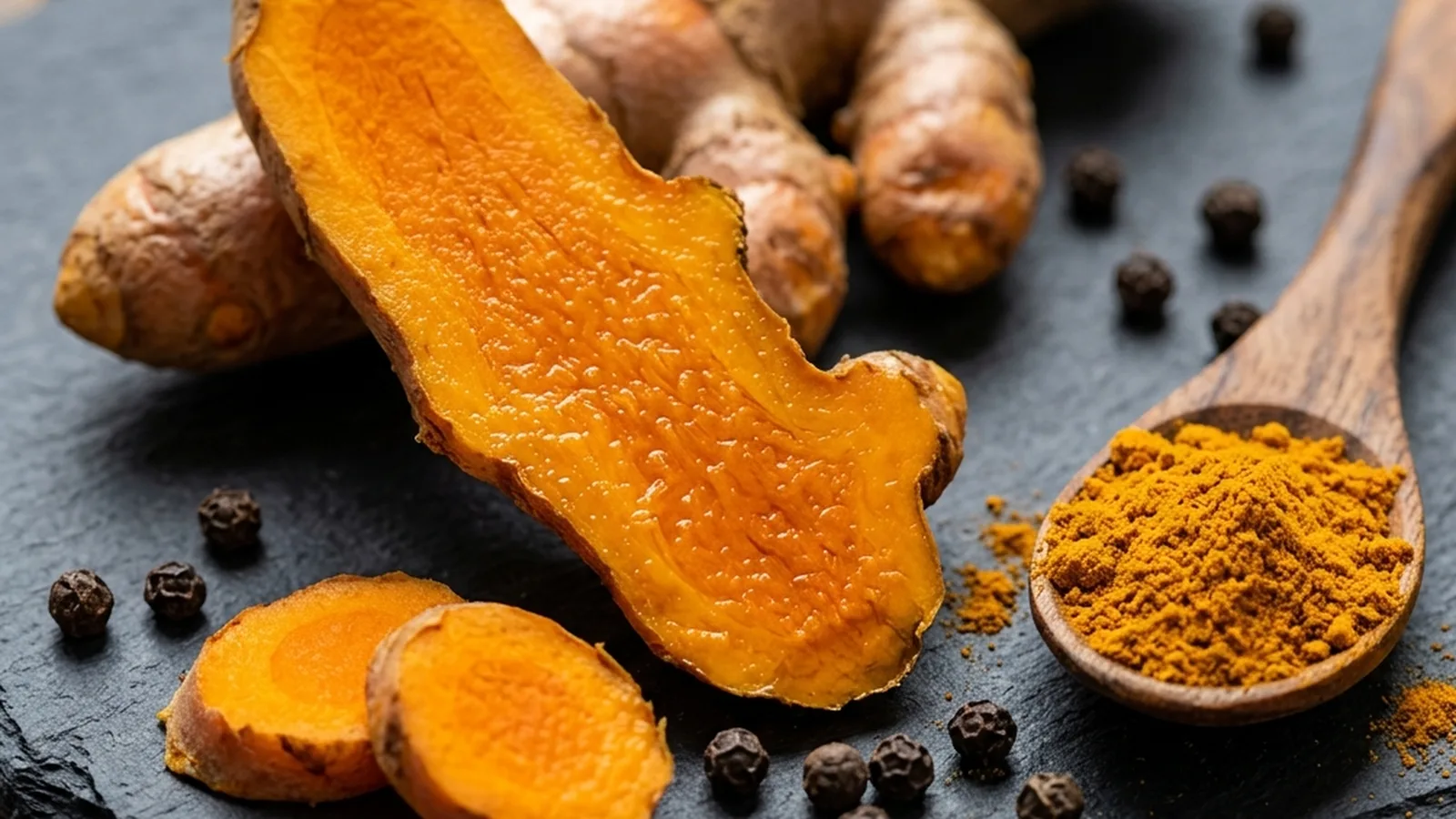
Curcumin is the active polyphenol in turmeric. In test tubes and animal models it does impressive things — anti-inflammatory, antioxidant, modulator of multiple immune-system pathways. The clinical-trial evidence in humans has been more mixed, and the gap is almost entirely a pharmacokinetic problem.
Plain oral curcumin is extensively glucuronidated and sulphated in the liver and intestinal wall before reaching systemic circulation — a first-pass metabolism so aggressive that less than 1% of an oral dose appears in plasma as unchanged curcumin. The peak plasma concentration after a 4-gram dose of plain curcumin is typically 50-100 ng/mL, well below the levels at which curcumin produces anti-inflammatory effects in cell culture Prasad 2014.
The implication: most of the negative human trials of plain curcumin are measuring “does this thing work at the dose that reaches the blood?” The answer for plain powder is “mostly no.” The relevant question is whether absorption-enhanced formulations work, and there the picture is much friendlier.
The piperine multiplier
Black pepper’s active alkaloid, piperine, inhibits hepatic and intestinal glucuronidation — the same enzyme system that destroys most oral curcumin. The classic 1998 Shoba study measured curcumin plasma concentrations with and without piperine in healthy volunteers and found piperine co-administration increased curcumin bioavailability 20× (2000% increase), with peak concentrations reached faster Shoba 1998.
The amounts of piperine used are small: roughly 5-10 mg per gram of curcumin. Most curcumin-with-bioperine supplements use ~5 mg piperine per 500 mg curcumin capsule. The black pepper you eat at dinner contains piperine but at variable, generally lower concentrations.
In Shoba and colleagues’ human volunteers, 2 g of curcumin taken alone produced serum levels that were undetectable or very low; taken with 20 mg of piperine, levels were much higher in the first hour, and the authors reported that “the increase in bioavailability was 2000%” Shoba 1998.
The trade-off: piperine also enhances absorption of many prescription medications. People on blood-thinners, certain anti-seizure drugs, or chemotherapy should not start piperine-containing curcumin supplements without checking with their doctor or pharmacist Bhardwaj 2002.
Phospholipid formulations
The second-generation absorption strategy packages curcumin in a phosphatidylcholine complex — essentially wrapping the curcumin in a fat-soluble carrier that’s already structured to cross intestinal membranes. The commercial product Meriva is the most-studied; generic phytosomal curcumin products use the same principle.
The pharmacokinetic studies on Meriva show 7-30× higher plasma curcumin levels compared to equivalent doses of plain curcumin Cuomo 2011. The variability in the multiplier comes from individual differences in absorption and the specific formulation. The clinical trials that have used phospholipid curcumin have reported more consistent benefit for osteoarthritis joint pain than plain curcumin trials Belcaro 2010.
The fat-meal strategy
Curcumin is fat-soluble. Taking it with a fat-containing meal increases absorption 3-5× compared to taking it on an empty stomach or with a fat-free meal Anand 2007. The mechanism is the same as for fat-soluble vitamins: bile-acid secretion in response to dietary fat creates the micelles that solubilise lipid-soluble compounds for intestinal uptake.
The practical implication: a curcumin supplement taken with a meal that contains some fat will absorb better than the same supplement taken with water on an empty stomach.
Stacking the strategies
In principle the strategies combine, although the individual multipliers above come from separate studies and shouldn’t simply be multiplied together. The clinical-trial work that has used this combination (Meriva or piperine-curcumin + meals) has produced the most consistent results across studies Hewlings 2017.
What the clinical trials actually show
Benefits have been reported for absorption-enhanced curcumin in the areas below. None of them makes curcumin a treatment to use in place of medical care, and anyone with these conditions should involve their clinician:
- Osteoarthritis joint pain. A meta-analysis of small randomised trials found turmeric/curcumin extracts reduced arthritis pain symptoms, but the authors judged the trials too few, too small and too variable in quality to be conclusive Daily 2016. Arthritis pain is worth managing with your clinician, and a pharmacist can check curcumin against any painkillers or other medication you take.
- Inflammatory bowel disease (ulcerative colitis). Small trials have tested curcumin as an add-on to standard medication. This is strictly a conversation for your gastroenterologist — never a replacement for prescribed treatment.
- Depression (add-on). A few small trials have tested curcumin alongside standard antidepressants, with modest and preliminary results. Depression needs a clinician’s care; do not change or stop medication on the strength of a supplement.
- Exercise-induced muscle soreness. Some small trials report a modest reduction in DOMS in the days after exercise.
There is no good evidence — despite marketing claims — that curcumin prevents or treats cancer or COVID-19, or that it does any general “detox.”
Before you buy: forms, doses studied and safety
- Doses studied: trials of absorption-enhanced formulations have commonly used 500-1000 mg of curcumin twice daily, with piperine or as a phospholipid complex, taken with meals. That describes the research, not a dose for you — your pharmacist or clinician can advise whether any amount is appropriate.
- Check the form on the label: piperine-containing products carry the medication-interaction issue described above; phospholipid products (Meriva or a generic phytosome) are the other well-studied form.
- Skip plain curcumin powder. At the doses sold, the bioavailability is so low that it’s unlikely to produce meaningful blood levels regardless of dose.
- Ask first if you take medication or have a health condition. That includes blood thinners and other prescription drugs, gallbladder problems, liver disease, and pregnancy. Rare cases of liver injury have been linked to turmeric and curcumin supplements; stop and seek medical care if jaundice or dark urine appear.
- Be patient and realistic: trials measuring joint pain ran for weeks to months, and curcumin is not a painkiller for acute pain.
Practical takeaways
- Plain curcumin powder is under 1% bioavailable — almost nothing gets in. Most negative trials of plain curcumin are measuring a non-dose.
- Three absorption strategies raise blood levels: piperine (20×), phospholipid formulation (7-30×), fat-containing meal (3-5×).
- If buying: the studied forms are piperine-enhanced or phospholipid curcumin, taken with meals — check with a pharmacist first.
- Evidence so far: small trials in arthritis pain and exercise soreness; early add-on trials in IBD and depression. Not a substitute for treatment.
- Check with a pharmacist first if you take blood thinners or other prescription medications — piperine boosts absorption of many drugs too.
Frequently asked questions
Does turmeric really do anything?
Possibly, but only at adequate bioavailability. Plain turmeric powder has under 1% absorption, so most of the dose is excreted unchanged. With piperine or phospholipid formulations blood levels rise substantially, and there are reports of modest benefits for arthritis pain with these forms; evidence for other conditions is early. It is not a replacement for medical treatment.
Is curcumin-with-piperine safe?
For most people, yes. The piperine dose in standard supplements (5-10 mg) is small. The concern is medication interactions: piperine boosts absorption of many prescription drugs, including blood-thinners, certain anti-seizure medications, and some chemotherapy agents. Check with a pharmacist before starting if you take prescription medications.
How much curcumin should I take?
That is a question for your pharmacist or clinician, who can check it against your medications and health. For context, most clinical trials with adequate-absorption formulations used 500-1000 mg of curcumin twice daily, usually with meals; higher doses weren’t clearly better and can cause stomach upset.
How long until I notice effects?
Outcomes like joint pain were typically measured over 6-12 weeks, so day-one effects are unlikely; curcumin is not a painkiller for acute pain. Persistent joint pain or bowel symptoms need a clinician’s assessment — curcumin isn’t a substitute.
Can I just eat more turmeric?
Realistic dietary turmeric doses produce trivial blood curcumin levels. The absorption-enhancement strategies in supplements aren’t replicated by cooking. Adding black pepper helps, but you’d need to eat several grams of turmeric daily to approach the amounts used in the research — impractical for most people.
What’s the difference between Meriva and regular curcumin?
Meriva is curcumin pre-packaged in a phosphatidylcholine complex that’s already fat-soluble. It absorbs 7-30× better than plain curcumin per equivalent dose. Generic phytosomal curcumin products use the same principle. They cost more per capsule but you need less curcumin per dose.
References
Prasad 2014Prasad S, Tyagi AK, Aggarwal BB. Recent developments in delivery, bioavailability, absorption and metabolism of curcumin: the golden pigment from golden spice. Cancer Res Treat. 2014;46(1):2-18. View source →Shoba 1998Shoba G, Joy D, Joseph T, Majeed M, Rajendran R, Srinivas PS. Influence of piperine on the pharmacokinetics of curcumin in animals and human volunteers. Planta Med. 1998;64(4):353-356. View source →Bhardwaj 2002Bhardwaj RK, Glaeser H, Becquemont L, Klotz U, Gupta SK, Fromm MF. Piperine, a major constituent of black pepper, inhibits human P-glycoprotein and CYP3A4. J Pharmacol Exp Ther. 2002;302(2):645-650. View source →Cuomo 2011Cuomo J, Appendino G, Dern AS, et al. Comparative absorption of a standardized curcuminoid mixture and its lecithin formulation. J Nat Prod. 2011;74(4):664-669. View source →Belcaro 2010Belcaro G, Cesarone MR, Dugall M, et al. Product-evaluation registry of Meriva, a curcumin-phosphatidylcholine complex, for the complementary management of osteoarthritis. Panminerva Med. 2010;52(2 Suppl 1):55-62. View source →Anand 2007Anand P, Kunnumakkara AB, Newman RA, Aggarwal BB. Bioavailability of curcumin: problems and promises. Mol Pharm. 2007;4(6):807-818. View source →Hewlings 2017Hewlings SJ, Kalman DS. Curcumin: a review of its effects on human health. Foods. 2017;6(10):92. View source →Daily 2016Daily JW, Yang M, Park S. Efficacy of turmeric extracts and curcumin for alleviating the symptoms of joint arthritis: a systematic review and meta-analysis of randomized clinical trials. J Med Food. 2016;19(8):717-729. View source →