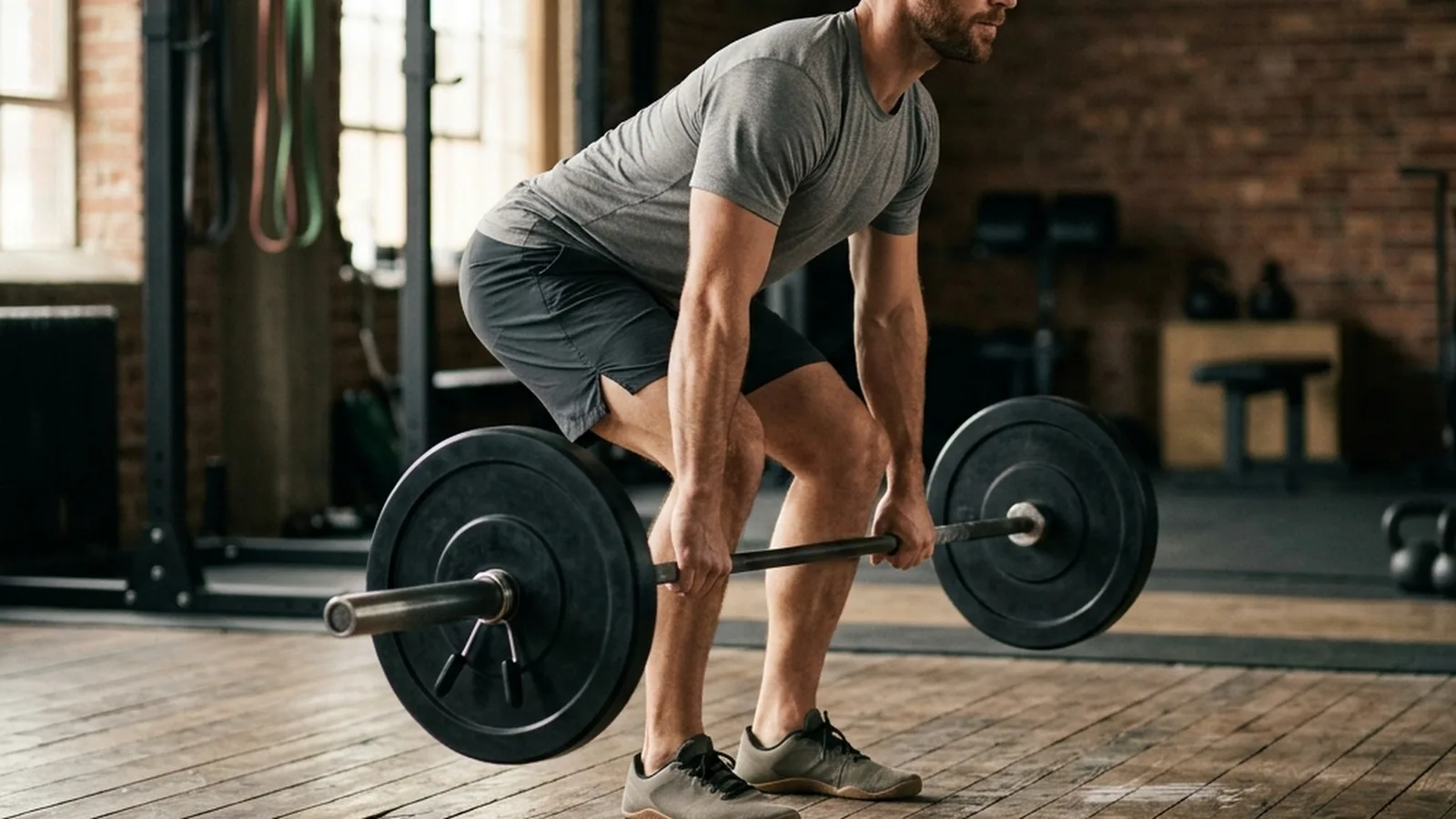
The 60-second version
Lifters call the deadlift a “back exercise” or a “leg exercise” depending on which corner of the gym they came from. The EMG and motion-capture evidence says it’s neither, exactly — it’s a full posterior-chain lift that recruits roughly twelve major muscle groups at meaningful loads. The eight you should know are: gluteus maximus, hamstrings (semitendinosus, semimembranosus, biceps femoris), erector spinae, latissimus dorsi, trapezius, rhomboids, forearm flexors, and quadriceps. Each one has a specific role at a specific phase of the lift, and form errors show up as one of those muscles either under- or over-recruiting. This piece walks through who does what, when, and what the typical adult lifter is missing.
Educational journalism, not medical advice. Every claim here is checked against its cited sources by editor Timothy Bunce — a health writer, not a physician. It isn’t specific to your situation: for health decisions, talk to your own clinician. How we work →
Some links in this article are affiliate links. If you buy through one, The Beachside Reader earns a commission at no extra cost to you. It never changes which products we pick, or what we say about them. Full affiliate disclosure →
The three phases of the lift
The conventional deadlift has three biomechanical phases, each with a different muscle-recruitment pattern Escamilla 2002:
- Setup and break — the bar is on the floor, you’re hinged, ready to pull. This is an isometric pre-tension phase where the lats, traps, and erectors all engage to set the spine.
- Floor to mid-thigh — the heaviest portion. Quads extend the knee; glutes and hamstrings extend the hip; erectors fight to keep the lumbar neutral.
- Lockout — mid-thigh to standing. Glutes finish hip extension; traps and rhomboids stabilise the shoulder girdle; the lift is “over.”
Most form errors are phase-specific. A lifter who pulls with a rounded back is mostly erring at the break; one who hitches with the hips at lockout is mostly erring at lockout. The fix is usually re-cueing the muscle that should be working in that phase.
The eight muscles that matter most
1. Gluteus maximus
The prime mover of hip extension — the muscle that finishes the lift. EMG studies show gluteus maximus activity is highest during the first half of a heavy deadlift, when the knees are most flexed near the floor Escamilla 2002. The classic adult-lifter problem: weak or under-recruited glutes mean the lockout looks like a hip-thrust against a stiff spine, with the lumbar erectors compensating. The cue that fixes most cases: “squeeze the glutes hard to finish the lift,” not “pull with your back.”
2. Hamstrings (semitendinosus, semimembranosus, biceps femoris)
The hamstrings do dual work in the deadlift: hip extension (alongside glutes) and knee stabilisation. EMG shows hamstring activity is highest during the top portion of the lift, when the knee is more extended — the opposite pattern from the glutes, which peak lower near the floor Escamilla 2002. The cue that fixes hamstring under-recruitment: push the floor away with the legs while pulling the bar back into your body. Don’t just “stand up” — actively use the legs to drive.
3. Erector spinae (longissimus, iliocostalis, spinalis)
The lumbar erectors hold the spine neutral against the bending moment of the load. Their job is isometric — they should fire at moderate-to-high intensity for the entire lift without changing length. When you see a lifter’s back round during a heavy pull, the erectors lost the battle. The cue: brace the trunk like you’re bracing for a punch before the pull starts, and maintain that brace throughout.
4. Latissimus dorsi
The lats are the often-missed muscle in adult deadlifting. Their job is to pull the bar against the body, keeping it close to the centre of gravity. A bar that drifts forward 5 cm from the body at lockout produces 30-50% more moment arm at the lumbar spine — the difference between a clean lift and a back tweak. The cue: imagine squeezing oranges in your armpits, or bend the bar around your legs. Both produce the same lat-engaged pattern McGill 2007.
5 & 6. Trapezius and rhomboids
Upper-back muscles that hold the shoulders down and back against the pulling weight. EMG shows the middle and lower traps firing throughout the entire lift. When a lifter rounds their upper back, the traps and rhomboids have failed to set position before the pull. The cue: set the upper back hard before the bar moves — pull the shoulders down and back, “put your chest into the bar.”
7. Forearm flexors (grip)
Grip is the rate-limiting step for most adults pulling near their max. The forearm flexors hold the bar against gravity; weak grip means the bar slips, the lift fails, or the lifter compensates with a hook grip that beats up the thumbs. The deadlift trains grip strength directly, but lifters who pull heavy without straps often find grip plateaus before their hips do. Heavy farmer’s carries and dedicated grip work close this gap Cronin 2017.
8. Quadriceps (rectus femoris, vastus lateralis, vastus medialis, vastus intermedius)
The neglected muscle group in “deadlifts are a back exercise” talk. The quads extend the knee during the floor-to-mid-thigh phase — without them, the lifter would be stuck. EMG shows substantial quad activation in conventional deadlifts and especially in sumo-style deadlifts. The cue: push the floor away with the legs in the first half of the lift.
Conventional vs. sumo recruitment differences
The sumo stance (feet wider, hands inside the legs, more upright torso) shifts recruitment in a few important ways Escamilla 2002:
- Quad recruitment is higher in sumo because the knee starts more flexed.
- Lumbar erector activity shows no significant difference between sumo and conventional, despite the more vertical torso in sumo.
- Hamstring recruitment is broadly similar across stances.
Practical: neither stance is “better.” Lifters with long femurs tend to find sumo more comfortable; lifters with strong backs tend to find conventional more efficient. For lifters with chronic lower-back complaints, sumo is usually the safer starting point.
Form errors mapped to under-recruited muscles
| What you see | What’s under-recruited | The cue |
|---|---|---|
| Bar drifts away from body | Lats | “Squeeze oranges in armpits” |
| Hips shoot up first; bar drags | Quads + glutes | “Push the floor away” |
| Lumbar rounds at the floor | Erectors | “Brace for a punch” |
| Upper back rounds | Traps + rhomboids | “Set chest into the bar” |
| Hyperextends at lockout | Glutes (over-compensation) | “Stand tall, don’t lean back” |
| Bar slips, hook fails | Forearm flexors | Add dedicated grip work |
| Hitches at mid-thigh | Glutes finishing extension | “Squeeze glutes to finish” |
Practical takeaways
- The deadlift recruits at least 8 major muscle groups at meaningful intensity — it’s neither a “back lift” nor a “leg lift,” it’s a full posterior-chain integration drill.
- Most form errors map to one specific muscle group under-recruiting. Identify the muscle, find the cue, fix the lift.
- The most-commonly missed muscle in adult lifters is the lats. “Bar drifting away from the body” is the leading mechanism for lumbar tweaks.
- Conventional vs. sumo isn’t better-or-worse — they recruit slightly differently. Pick the stance that fits your build, not the one that’s fashionable.
- Grip is the rate-limiting step for most adults pulling near max. Heavy farmer’s carries and dedicated grip work prevent grip from capping your hip-extension strength.
Frequently asked questions
Is the deadlift a back exercise or a leg exercise?
Neither, exactly. EMG analyses show meaningful activation in at least 8 major muscle groups: gluteus maximus, hamstrings (three heads), erectors, lats, traps, rhomboids, forearm flexors, and quads. The lift is a full posterior-chain integration drill, with quads contributing significantly in the floor-to-mid-thigh phase.
Why does my back round when I pull heavy?
Either the erectors gave out (need stronger trunk bracing) or the lats disengaged (bar drifts away from the body, multiplying the moment arm at the lumbar spine). The two cues that fix most cases: “brace for a punch” before the pull, and “squeeze oranges in your armpits” throughout.
Should I do conventional or sumo deadlifts?
Whichever fits your build. Lifters with long femurs tend to find sumo more comfortable (more upright torso, similar lumbar load). Lifters with strong backs and shorter limbs often prefer conventional. Neither is inherently better. For chronic lower-back complaints, sumo is the safer starting point.
Why is my grip failing before my legs?
It’s the rate-limiting step for most adults pulling near max. The forearm flexors hold the bar against gravity, and they fatigue faster than the hip-extension chain. Heavy farmer’s carries 1-2× weekly close the gap. Lifting straps in training are fine for hypertrophy work, but compete without them.
What does “bend the bar around your legs” mean?
It’s a lat-engagement cue. Imagine you’re trying to bend the barbell so the ends curve down around your legs. The mental image forces lat contraction, which pulls the bar closer to your body — reducing the moment arm at the lumbar spine. One of the most useful single cues in deadlift coaching.
Do I need to hyperextend at the top?
No. Standing tall with the hips fully extended is the lockout. Leaning back beyond vertical loads the lumbar facets and contributes to back pain. The cue: “stand up tall, don’t lean back.” If the judge in a competition fails you for incomplete lockout, that’s a judging issue, not a technique target.
References
Escamilla 2002Escamilla RF, Francisco AC, Kayes AV, Speer KP, Moorman CT 3rd. An electromyographic analysis of sumo and conventional style deadlifts. Med Sci Sports Exerc. 2002;34(4):682-688. View source →McGill 2007McGill SM. Low Back Disorders: Evidence-Based Prevention and Rehabilitation. 2nd ed. Human Kinetics; 2007. View source →Cronin 2017Cronin J, Lawton T, Harris N, Kilding A, McMaster DT. A brief review of handgrip strength and sport performance. J Strength Cond Res. 2017;31(11):3187-3217. View source →