The 60-second version
Eccentric loading — deliberately lengthening a muscle under load — is the most-validated rehabilitation approach for chronic tendinopathy (Achilles, patellar, lateral epicondyle, rotator cuff). The mechanism is concrete: slow eccentric contractions activate tendon collagen synthesis and remodelling that other loading patterns don’t. The published trial evidence consistently shows 60-80% improvement in symptoms over 12 weeks of structured eccentric programmes, comparable or superior to other conservative treatments. The catch: eccentric loading is uncomfortable — the protocols deliberately load the painful tendon at modest pain levels, which patients often interpret as “making it worse.” The expected pain (3-5/10 during loading, baseline pain by next day) is part of the protocol, not a contraindication. Stick with the dose, expect 6-12 weeks before meaningful improvement.
Educational journalism, not medical advice. Every claim here is checked against its cited sources by editor Timothy Bunce — a health writer, not a physician. It isn’t specific to your situation: for health decisions, talk to your own clinician. How we work →
Some links in this article are affiliate links. If you buy through one, The Beachside Reader earns a commission at no extra cost to you. It never changes which products we pick, or what we say about them. Full affiliate disclosure →
Why eccentric specifically
Tendinopathy involves disorganised collagen and impaired tendon remodelling. The Alfredson 1998 paper, a 15-patient case series on chronic Achilles tendinosis, pioneered the eccentric loading approach, showing that every patient returned to full pre-injury running activity after 12 weeks where other conservative treatments had failed Alfredson 1998. Eccentric contractions are thought to generate a specific tendon-loading pattern — the slow lengthening under load producing a mechanotransduction signal that may drive collagen repair and remodelling — a mechanism explored in later tendon-biology research rather than in the original clinical trial.
The effect appears specific to eccentric loading. Concentric-only training, isometric holds, and stretching alone don’t produce the same outcomes. Heavy slow resistance training (a variation that includes both concentric and eccentric at slow tempos) performs comparably to pure eccentric in some trials Beyer 2015.
What the trial evidence shows
- Achilles mid-substance tendinopathy: in the original 15-patient trial, every patient returned to full pre-injury running activity at 12 weeks of structured eccentric heel drops Alfredson 1998.
- Patellar tendinopathy: Eccentric single-leg squats on decline board produce 60-75% improvement at 12 weeks.
- Lateral epicondyle (tennis elbow): Eccentric wrist-extension protocols produce 60-80% improvement at 6-8 weeks.
- Rotator cuff tendinopathy: Eccentric external-rotation work effective; heavy slow resistance often equivalent.
- Insertional Achilles tendinopathy responds less reliably to standard eccentric protocols than mid-substance. Modified protocols (avoiding dorsiflexion past neutral) work better.
In the original 15-patient trial, every participant with chronic Achilles tendinosis who had failed conventional conservative treatment returned to full pre-injury running activity after 12 weeks of heavy-load eccentric calf training, with significant reductions in pain and increases in calf strength. The loading must be sustained at the prescribed intensity despite discomfort, which is the dominant barrier to patient adherence.
— Alfredson et al., Am J Sports Med, 1998 view source
The Achilles protocol (Alfredson)
The original validated protocol:
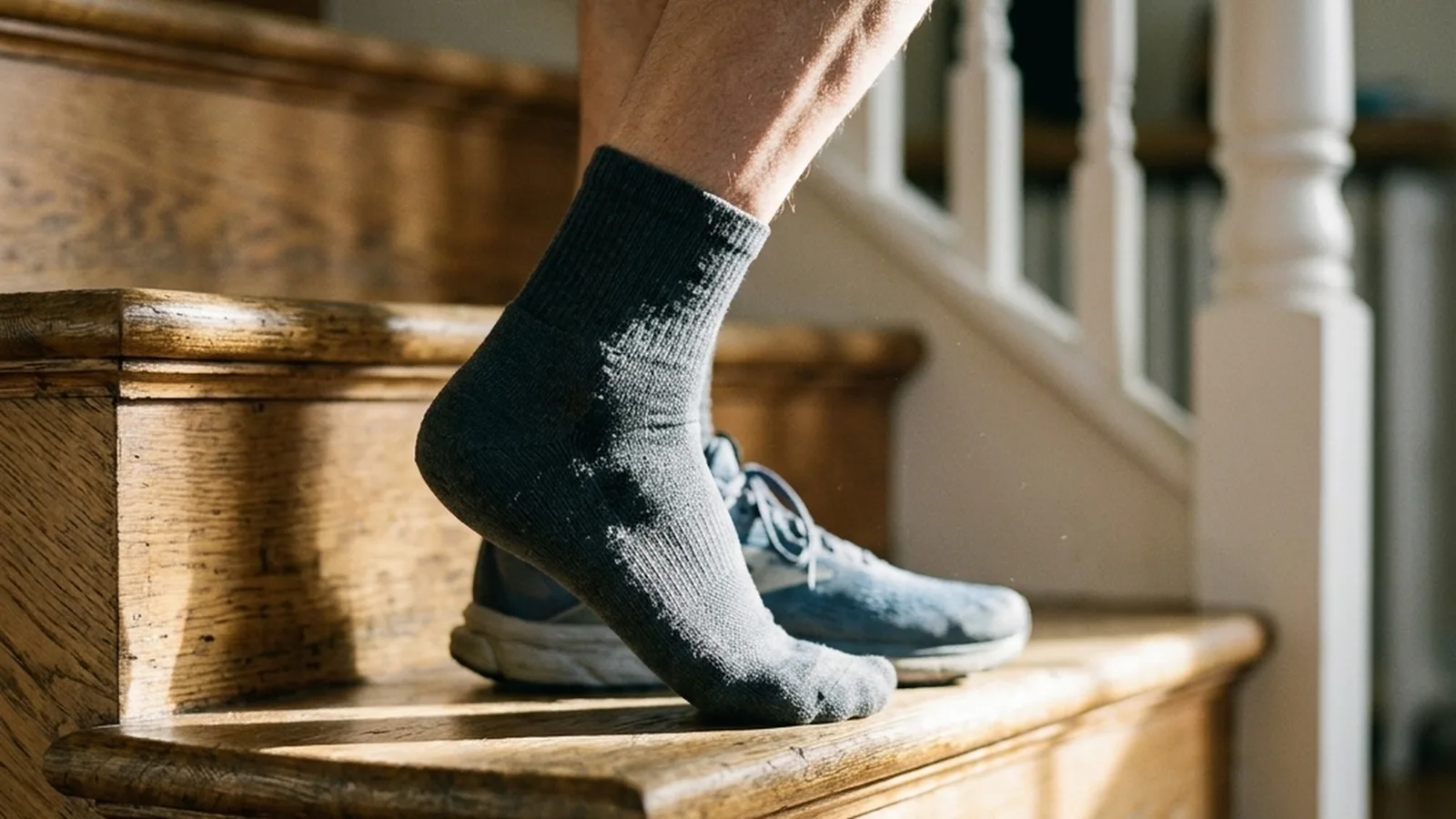
- Stand on a step with the ball of the foot on the edge, heel hanging off.
- Use both legs to rise up to full plantarflexion (heels up).
- Transfer weight to affected leg only.
- Slowly lower the affected heel below the step level over 3-5 seconds. This is the eccentric phase.
- Use the other leg to return to the top. Don’t do the concentric portion on the affected side.
- 3 sets of 15 reps with knee straight + 3 sets of 15 with knee bent (targets soleus separately from gastrocnemius).
- Twice daily, 7 days per week, for 12 weeks.
- Add load when pain at the planned reps drops below 5/10: backpack with weights, weighted vest.
- Expected pain: 3-5/10 during the loading phase. Pain that returns to baseline by next morning is fine; worsening pain across days suggests the dose is too high.
The patellar tendon protocol
- 25° decline board for the affected leg. Stand on it with the affected leg only.
- Slow single-leg squat down to ~70° knee flexion over 3-5 seconds. The decline angle increases patellar tendon loading.
- Use the other leg or hands to return up.
- 3 sets of 15 reps, twice daily, 12 weeks.
- Add load progressively with weighted vest or dumbbells as pain at planned reps drops.
The lateral epicondyle protocol
- Sit with forearm on knee, hand off the edge, palm down. Hold a 1-2 kg dumbbell.
- Use the opposite hand to lift the wrist up to extension.
- Slowly lower the wrist into flexion over 3-5 seconds.
- 3 sets of 15 reps, daily, 6-8 weeks.
- Progress load as pain at planned reps drops.
Common pitfalls
- Stopping because it hurts. The expected pain (3-5/10) is part of the protocol. Patients who stop at the first discomfort don’t complete the dose and don’t get the outcome.
- Going too fast. The slow eccentric (3-5 seconds) is critical. Fast lowering doesn’t produce the same effect.
- Not loading progressively. Adults often stop adding weight when symptoms improve. The progression matters — finishing the protocol at bodyweight only doesn’t produce the same tendon adaptation as adding 15-25% bodyweight over the 12 weeks.
- Skipping days. The published trials use daily or twice-daily dosing. Three sessions weekly produces inferior outcomes.
- Expecting fast results. Most adults notice meaningful improvement at 6-8 weeks. Faster results suggest the underlying pathology wasn’t tendinopathy.
Practical takeaways
- Eccentric loading is the best-validated rehabilitation approach for chronic tendinopathy: 60-80% symptom improvement at 12 weeks across Achilles, patellar, and lateral epicondyle protocols.
- The protocols are uncomfortable by design. 3-5/10 pain during loading is expected, not a contraindication.
- Critical details: slow tempo (3-5 seconds), high frequency (daily or twice daily), progressive load.
- Expect 6-12 weeks before meaningful improvement.
- Insertional Achilles tendinopathy needs modified protocol (avoid dorsiflexion past neutral); see a physiotherapist for individualised adjustment.
Frequently asked questions
Should it hurt to do these exercises?
Yes — 3-5/10 pain during the eccentric phase is expected and part of the protocol. The published trials specifically allow this level of pain. Pain that returns to baseline by next morning is fine; pain that worsens across multiple days suggests the dose is too high.
How long until it works?
Most adults notice meaningful improvement at 6-8 weeks; full benefit at 12 weeks. Faster improvement (under 4 weeks) suggests the underlying pathology wasn’t tendinopathy. Slower improvement may mean the dose isn’t high enough or the protocol isn’t being followed consistently.
Do I need a physical therapist?
For uncomplicated mid-Achilles or patellar tendinopathy, the protocols are simple enough to self-administer with diligent attention to form and progressive loading. For insertional Achilles, rotator cuff, or any case not improving at 6 weeks, see a physiotherapist.
Can I keep running/training during rehab?
Usually yes at reduced volume and pain-monitored. Cap training mileage at 50-70% of normal during the rehab block. If symptoms worsen with activity, reduce further. Cycling and swimming usually stay pain-free.
What if eccentric doesn’t work?
Trial extracorporeal shockwave therapy or PRP injection under specialist guidance. Surgery (e.g., paratenon stripping) is a last resort for chronic cases that haven’t responded to 6-12 months of conservative care.
References
Alfredson 1998Alfredson H, Pietilä T, Jonsson P, Lorentzon R. Heavy-load eccentric calf muscle training for the treatment of chronic Achilles tendinosis. Am J Sports Med. 1998;26(3):360-366. View source →Beyer 2015Beyer R, Kongsgaard M, Hougs Kjær B, Øhlenschlæger T, Kjær M, Magnusson SP. Heavy slow resistance versus eccentric training as treatment for Achilles tendinopathy: a randomized controlled trial. Am J Sports Med. 2015;43(7):1704-1711. View source →