The 60-second version
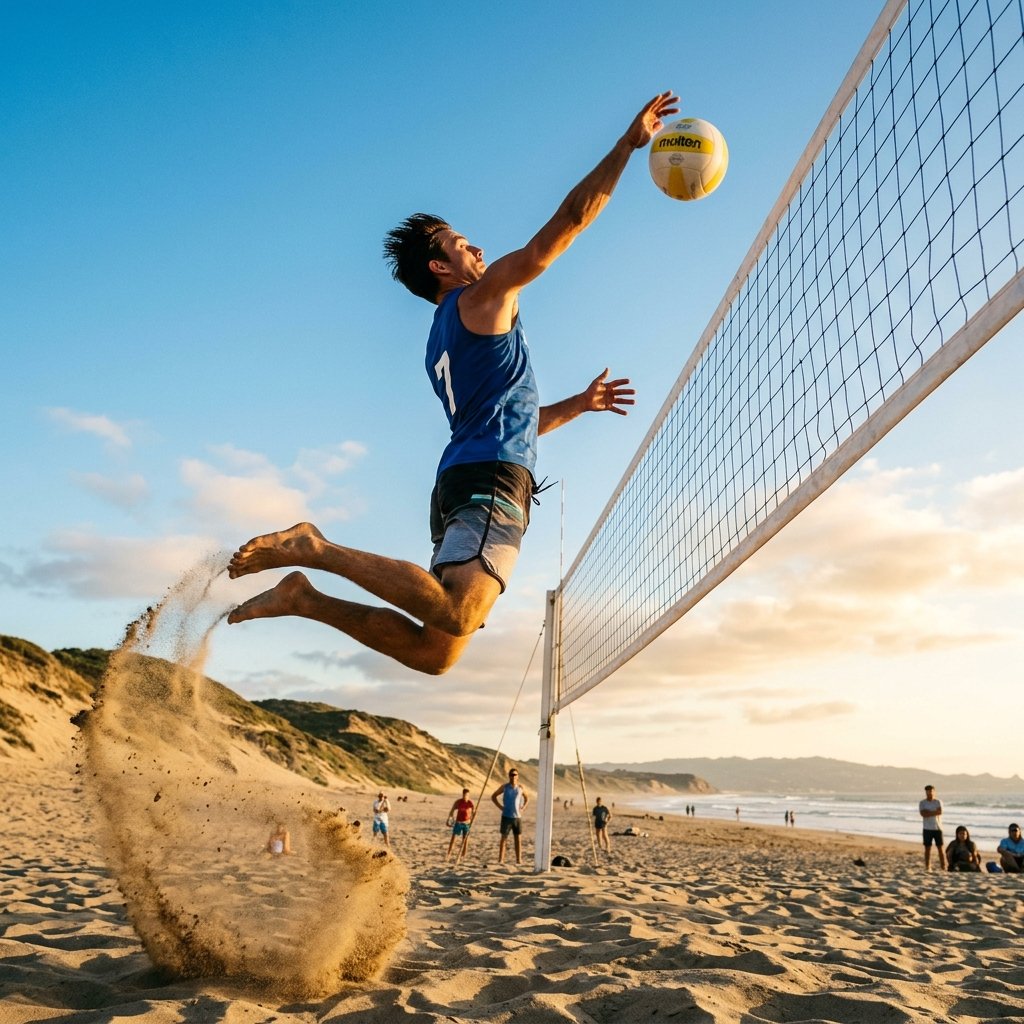
Frisbee on the beach is a surprisingly precise simulator for the change-of-direction (COD) demands the court-sport research has spent thirty years quantifying. The disc’s flight time (typically 2–5 seconds) and unpredictable trajectory force exactly the read-and-react cutting that Sheppard 2006’s agility framework identifies as the rate-limiting step for sport-transfer performance (Sheppard 2006 Sheppard 2006). The cutting, decelerating, and re-accelerating loads on the lower body are broadly the same ones the change-of-direction literature has measured in soccer, basketball, and rugby. A 30-minute beach session can deliver a real COD training stimulus — without a court, a coach, or any equipment beyond the disc — if the drills are structured and repeated over time. Asadi 2016’s meta-analysis of plyometric (jump) training found that structured programs of about seven weeks, at two sessions per week, reliably improved COD performance (Asadi 2016 Asadi 2016); frisbee cutting drills aren’t a plyometric protocol, but the same underlying principle — consistent structured exposure across weeks, not a single outing — is what actually builds the adaptation.
Educational journalism, not medical advice. Every claim here is checked against its cited sources by editor Timothy Bunce — a health writer, not a physician. It isn’t specific to your situation: for health decisions, talk to your own clinician. How we work →
Some links in this article are affiliate links. If you buy through one, The Beachside Reader earns a commission at no extra cost to you. It never changes which products we pick, or what we say about them. Full affiliate disclosure →
What change-of-direction training actually trains
Change-of-direction is the umbrella term for sport movements that require deceleration, direction change, and re-acceleration under temporal pressure. Sheppard 2006’s influential review distinguished planned COD (where the cut is pre-rehearsed) from reactive agility (where the cut depends on a live perceptual cue) and showed that the two trained different attributes (Sheppard 2006 Sheppard 2006). Planned COD trains the mechanical movement quality — the deceleration angles, the foot placement, the re-acceleration force production. Reactive agility trains the perceptual-decision component — reading a cue and triggering the right cut at the right time.
The literature has been clear that generic strength training is not a shortcut for either half. Brughelli 2008’s review of resistance-training studies found that traditional bilateral, vertical strength and power work — Olympic-style lifts, squats, deadlifts, vertical jumps — mostly failed to improve COD performance on its own, while more COD-specific training such as horizontal and lateral jump work and sport-specific cutting drills produced better results (Brughelli 2008 Brughelli 2008).
Frisbee, almost by accident, structures both halves at once. The chase-the-disc cut is reactive (you don’t know the trajectory until the disc is in flight); the throw-and-go pattern is planned (you know where you intend to be). A casual game cycles between the two every 30–90 seconds.
Why a frisbee is a near-ideal reactive-agility cue
The flight characteristics of a frisbee are what make it useful as a training tool. A standard 175 g ultimate disc thrown at game speed travels at 50–90 km/h with a flight time of 2–5 seconds. The trajectory is influenced by spin axis, throw angle, and wind in ways the receiver can’t fully predict at release; the disc bends, dips, and floats over the flight in a way a baseball or football does not. Receiving the disc therefore requires sustained perceptual tracking through the entire flight, with constant micro-adjustment of the cutting line.
This is exactly the perceptual demand Sheppard 2006 identifies as the active ingredient in agility training (Sheppard 2006 Sheppard 2006). The receiver’s eyes track the disc; the brain processes spin-axis and current trajectory; the body executes the cut and the catch. The perception-action loop is forced through the whole movement. A predictable trajectory (a thrown ball in a straight line) trains the cut once; an unpredictable trajectory trains the cut continuously through the flight.
Sheppard 2006 noted that the most-transferred reactive-agility drills are those with a perceptual cue that closely matches sport demands (Sheppard 2006 Sheppard 2006). For court and field sports where ball flight is the primary perceptual cue, a flight-tracking cue is the closest possible analogue. Frisbee delivers it cheaply.
What the sand surface adds (and subtracts)
Beach sand is a meaningful modifier of the COD stimulus. The energy-cost research on sand running consistently shows 1.6–2.5 times higher metabolic cost than the same speed on a hard surface; deceleration mechanics shift toward a softer-foot, longer-deceleration pattern as the sand absorbs braking force; re-acceleration loses some of the elastic-rebound benefit firm ground provides. Surface characteristics like these plausibly affect both the injury-safety profile and the training transfer of COD work, independent of any single study — softer footing changes both the loading on joints and how much of a firm-ground stimulus actually carries over.
The trade-offs for beach frisbee. Sand reduces peak impact loads at the ankle and knee — a positive for healthy adults wanting volume without joint stress, and the reason masters athletes routinely choose sand for COD work. Sand reduces top-end speed by 30–50%, which means the absolute speed component of training transfer to a hard-court sport is limited — an athlete preparing for a hard-court season needs hard-court work as well. The perceptual-cognitive component (the read-and-react half Sheppard 2006 emphasised) transfers fully regardless of surface; the mechanical component (the elastic-rebound deceleration and re-acceleration) does not.
The honest framing: beach frisbee is a strong reactive-agility stimulus and a moderate mechanical-COD stimulus. For the recreational adult or the in-season athlete looking for a low-stress training option, the trade is favourable. For the athlete in pre-season preparing for hard-court demands, beach frisbee complements but doesn’t replace court work.
A 30-minute beach drill protocol
The protocol is structured around a basic training principle: a genuine stimulus needs enough high-quality repetitions with rest long enough to keep each one high-intensity. Asadi 2016’s data on structured COD-training gains comes from multi-week plyometric (jump) training, not a single session of cutting and catching (Asadi 2016 Asadi 2016), so this single 30-minute session is a starting dose, not a validated protocol in its own right. The needed dose: roughly 30–60 high-intensity cuts plus 30–60 catches over 30 minutes, with rest intervals long enough to maintain quality (5–15 seconds between reps, 60–90 seconds between sets).
Block 1: warm-up (5 min). Light jogging, 2 sets of 5 progressive cuts at 60% effort, 5 throws and catches at slow speed.
Block 2: throw-and-go drill, 2 partners (8 min). Partner A throws to space ahead; partner B sprints, cuts, catches, throws back. Trade roles every catch. Targets: 25–35 cuts per partner, distance 8–15 m per cut. Rest 5 seconds between cuts; this is the planned-COD-with-reactive-catch block.
Block 3: chase-the-bad-throw drill (8 min). Partner deliberately throws slightly off-target (high, low, hooking). Receiver reads the flight and adjusts. The drill trains the live perceptual cue Sheppard 2006 identified as the rate-limiting agility component (Sheppard 2006 Sheppard 2006). Targets: 15–20 cuts per partner with full perceptual demand.
Block 4: small-sided game (8 min). 2-vs-1 or 3-vs-2 keep-away on a 15×15 m sand area. The game format integrates everything — planned cuts, reactive cuts, throws, defensive movement — and applies it under the time pressure that Sheppard 2006 identified as the closest analogue to game demands (Sheppard 2006 Sheppard 2006).
Block 5: cool-down (1 min). Walk it out. The whole protocol takes 30 minutes and delivers a genuine single-session stimulus — though, as Asadi 2016’s plyometric-training data suggests, real adaptation comes from repeating a structured session like this across several weeks, not from one sitting (Asadi 2016 Asadi 2016).
Injury patterns and the safety brief
The injury literature on cutting sports identifies the same two recurring patterns: ankle inversion sprains (most common, generally low-severity, often recoverable in 1–3 weeks) and non-contact ACL ruptures (less common, high-severity, often season-ending). The broader injury-biomechanics literature on cutting sports has identified the movements associated with the highest ACL load: planted-foot cuts at high speed with the trunk leaned away from the cutting direction. Sand reduces both injury patterns substantially — the softer surface increases ground contact time and reduces peak loading at the planted foot. The trade is one of the reasons masters athletes routinely choose beach venues for return-to-play cutting work.
The technique cues for safety transfer cleanly. Cut with the trunk over the cutting foot rather than leaning away; absorb the cut through the hip and knee rather than locking out; alternate cutting directions through the session to limit one-sided load. Wear no shoes (the sand prevents the friction that causes most cutting injuries) or barefoot-style minimal footwear; full athletic shoes on dry sand can produce a higher-friction cut than the sand otherwise allows, occasionally producing the higher-risk planted-foot cutting pattern described above.
What this transfers to (and what it doesn’t)
The transfer to other sport contexts depends on the target. For an ultimate frisbee or beach volleyball player, the transfer is direct and substantial. For a soccer or basketball player, the perceptual-cognitive transfer is strong; the mechanical-COD transfer is partial (the surface differences limit the elastic-rebound component). For a non-cutting endurance athlete (runner, cyclist) the COD-training transfer is incidental, but the broader benefits — multi-plane movement, reactive perception, dynamic balance — are part of the ‘movement portfolio’ the masters-athlete literature has begun to advocate as a hedge against age-related neural decline.
For the recreational adult who plays no organised sport, the transfer question is broader. The agility-and-balance gains from regular reactive training are part of the falls-prevention and active-aging literature; reactive cutting in particular is one of the few movement patterns that exercises the rapid-response postural reflexes that decay fastest with age. Sheppard 2006 made the point that reactive agility is largely trainable but not naturally maintained without exposure (Sheppard 2006 Sheppard 2006); a 30-minute beach frisbee session every couple of weeks is a low-friction way to maintain the exposure.
What the protocol does not do
Three honest caveats. First: the COD gains Asadi 2016 documented come from plyometric (jump) training studies, not frisbee-style cutting and catching — and even there, the clearest adaptation came from programs of about seven weeks at two sessions per week, not a loose 6–12 week range (Asadi 2016 Asadi 2016). A single beach session contributes a training stimulus; visible adaptation requires repetition. Second: the perceptual-cognitive transfer the disc trains (read-and-react cutting based on a flight cue) is one of several agility components; basketball or soccer players who play their sport regularly are getting most of the transfer they need from sport itself. Third: the surface trade-offs are real. Hard-court agility cannot be fully developed on sand alone.
The case for beach frisbee as agility training is narrow but well-evidenced: it is an unusually high-quality reactive-agility stimulus available without equipment or facility access, with a favourable injury profile for adult recreational use, and with a perceptual-cognitive demand that matches the read-and-react component of court and field sport. The 30-minute protocol is enough to deliver a meaningful single-session dose; repetition delivers the adaptations the COD literature documents.
Practical takeaways
- Frisbee approximates the read-and-react cutting demands the COD-training literature identifies as the rate-limiting agility component (Sheppard 2006).
- Disc flight time (2–5 sec) and unpredictable trajectory force sustained perceptual tracking — closer to court-sport demands than predictable ball flight.
- Sand reduces peak impact loads at ankle and knee; reduces top-end speed; perceptual transfer is full, mechanical transfer is partial.
- 30-minute structured protocol: warm-up, throw-and-go, chase-the-bad-throw, small-sided game, cool-down. Delivers a genuine single-session stimulus; lasting adaptation takes weeks of repetition, not one session.
- Cut with trunk over cutting foot, absorb through hip and knee, alternate directions — the technique cues associated with lower ACL-injury risk in cutting movements.
- Barefoot or minimal shoes on sand; full athletic shoes can produce a higher-friction cut that increases planted-foot risk.
- Useful as a training adjunct, not a replacement for sport-specific work; pairs well with court-sport training in season.
Frequently asked questions
Does playing frisbee actually train agility?
For the reactive-agility component, yes, with strong literature support. Sheppard 2006 identifies the read-and-react cut on a live perceptual cue as the highest-transfer agility training; frisbee's flight characteristics make it an unusually clean version of that cue.
Is sand a problem or a feature for COD training?
Both. Sand reduces peak impact loads at ankle and knee (good for healthy adults wanting volume without joint stress), reduces top-end speed by 30-50% (limits the elastic-rebound mechanical training), and preserves the perceptual demand fully (good for the read-and-react component).
How often does it need to be done to see adaptation?
Asadi 2016's meta-analysis of plyometric (jump) training found the clearest change-of-direction adaptation from programs of about seven weeks, at two sessions per week -- not frisbee-style cutting drills specifically. A single beach session contributes a training stimulus; visible adaptation requires repetition. For maintenance in already-active adults, weekly is enough.
Should I wear shoes on the beach?
Generally no, or minimal/barefoot-style only. Full athletic shoes on dry sand can produce a higher-friction cut than the sand otherwise allows, occasionally producing a higher-friction planted-foot cut than the sand allows on its own -- the cutting pattern associated with elevated ACL risk. The sand's natural friction reduction is part of the safety profile.
Will this transfer to my regular sport?
Depends on the sport. For ultimate or beach volleyball, transfer is direct and substantial. For soccer or basketball, the perceptual-cognitive transfer is strong; the mechanical-COD transfer is partial. For runners and cyclists, the transfer is incidental but the broader movement-portfolio benefits remain.
References
[1]Sheppard JM, Young WB. Agility literature review: classifications, training and testing. Journal of Sports Sciences. 2006;24(9):919-932. View source →[2]Brughelli M, Cronin J, Levin G, Chaouachi A. Understanding change of direction ability in sport: a review of resistance training studies. Sports Medicine. 2008;38(12):1045-1063. View source →[3]Asadi A, Arazi H, Young WB, Saez de Villarreal E. The effects of plyometric training on change-of-direction ability: a meta-analysis. International Journal of Sports Physiology and Performance. 2016;11(5):563-573. View source →