The 60-second version
Grip strength is one of the cheapest, most reliable, and best-validated biomarkers in clinical medicine. Across multiple large prospective cohorts, each 5 kg reduction in grip strength is associated with roughly 16% higher all-cause mortality, independent of age, smoking, exercise, and other obvious confounders. The biological reason: grip strength is a proxy for whole-body muscular function, which in turn reflects skeletal muscle mass, neurological function, and metabolic health. The clinical implications are increasingly being used: grip is now part of standard sarcopenia diagnosis, frailty screening in older adults, and pre-operative risk assessment. The practical implication for active adults: grip strength is trainable, and the biomarker effect appears causal (not just predictive) — resistance training that includes loaded carrying and hanging work appears to improve outcomes the grip biomarker correlates with.
Educational journalism, not medical advice. Every claim here is checked against its cited sources by editor Timothy Bunce — a health writer, not a physician. It isn’t specific to your situation: for health decisions, talk to your own clinician. How we work →
Some links in this article are affiliate links. If you buy through one, The Beachside Reader earns a commission at no extra cost to you. It never changes which products we pick, or what we say about them. Full affiliate disclosure →
The mortality data
The strongest single dataset is the PURE cohort — nearly 140,000 adults across 17 countries, followed for 4 years. The findings:
- Each 5 kg lower grip strength was associated with 16% higher all-cause mortality and 17% higher cardiovascular mortality.
- The relationship held after adjustment for age, sex, education, employment, smoking, drinking, exercise, and country.
- Grip was a better predictor of all-cause mortality than systolic blood pressure — meaning a poor grip is worse news than hypertension, statistically Leong 2015.
Follow-up data from PURE and from independent cohorts (UK Biobank, NHANES) has consistently replicated the finding. The dose-response curve is roughly linear — there’s no single “cliff” threshold; lower grip is uniformly worse Celis-Morales 2018.
“Grip strength was a stronger predictor of all-cause and cardiovascular mortality than systolic blood pressure… This study suggests that measurement of grip strength is a simple, inexpensive risk-stratifying method for all-cause death, cardiovascular death, and cardiovascular disease.”
— Leong et al., Lancet, 2015 view source
Why grip predicts so much
Grip isn’t magical — it’s a proxy for several underlying capacities that all matter for health:
- Skeletal muscle mass and quality. Forearm strength tracks with whole-body muscle mass and with muscle protein turnover.
- Neurological function. Producing a maximal grip requires intact motor units, peripheral nerves, and central drive. Decline often shows up first in grip before other measures.
- Cardiovascular reserve. Maximal grip briefly raises blood pressure and heart rate; the response correlates with cardiovascular fitness.
- Metabolic health. Grip is inversely correlated with HbA1c, insulin resistance, and inflammatory markers in cross-sectional studies.
- Frailty and falls risk. Adults with weak grip have higher fall rates, more fractures, and worse post-surgical outcomes.
What “weak grip” means
The clinical thresholds for sarcopenia (age- and sex-adjusted):
- Adult men: <26-27 kg suggests reduced muscular function; <20 kg meets clinical sarcopenia threshold.
- Adult women: <16-17 kg suggests reduced function; <12-13 kg meets clinical threshold.
- These are minimums. Healthy adults typically register 35-50 kg (women) and 50-70+ kg (men). Elite athletes substantially higher.
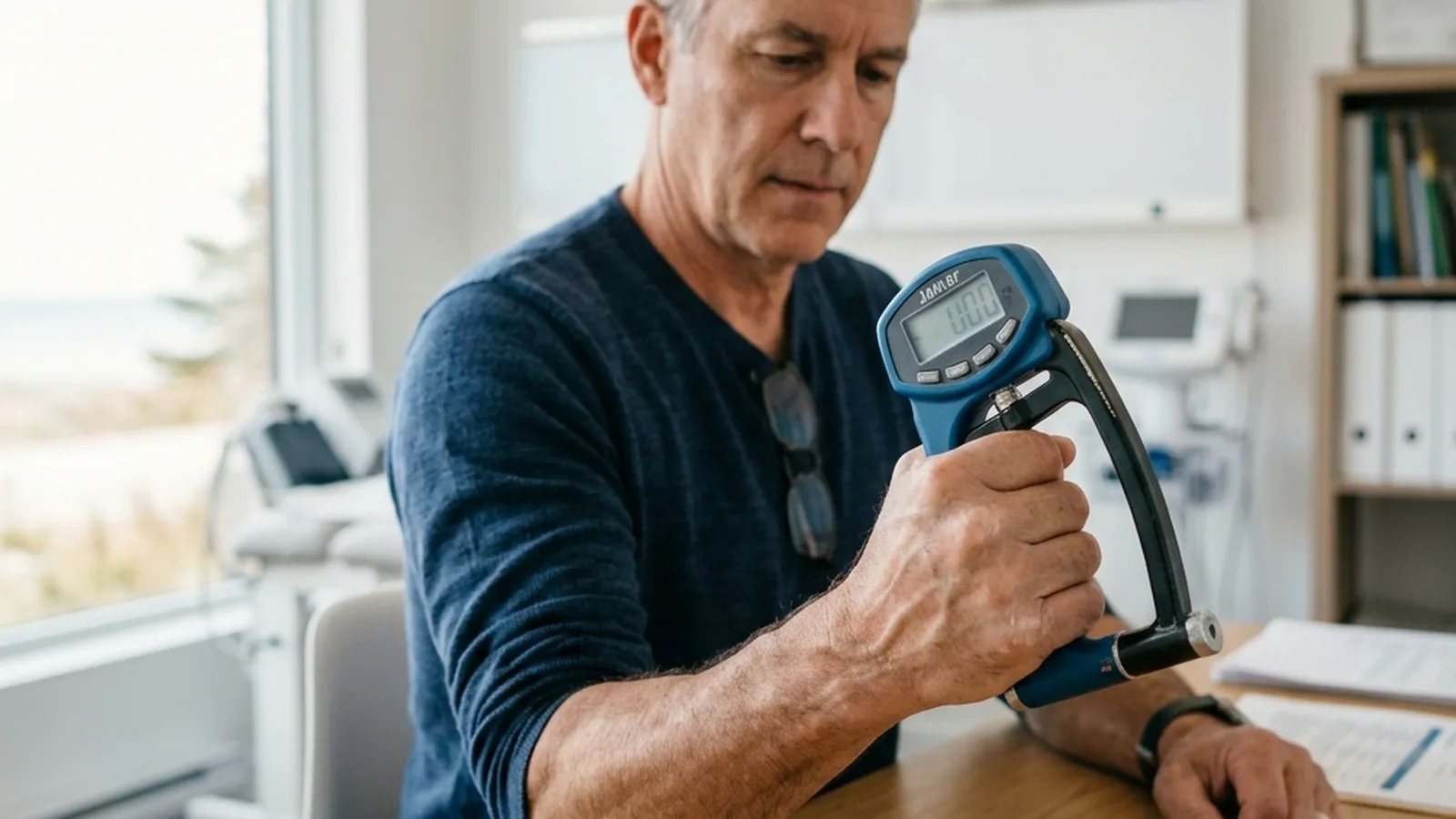
- Test with a hand dynamometer: available in most physiotherapy offices, gyms, and as inexpensive home devices ($30-100).
Grip is trainable
Unlike some biomarkers (chronological age, genetic markers), grip strength responds to training:
- Farmer’s carries — walking with heavy weights in each hand — produce the largest grip gains per unit time. 2-3 sets weekly of 20-30 m carries with progressively heavier weights.
- Dead hangs from a pull-up bar — pure isometric grip endurance. Build to 60-second holds.
- Heavy deadlifts without straps train grip directly through the pull. Most adults plateau in grip before their hip-extension strength does, providing a natural training stimulus.
- Hand grippers — cheap dedicated devices — produce modest gains. Less effective than loaded carries per unit time but convenient.
- Avoid lifting straps for sets where grip isn’t the limiting factor — straps offload the forearms and reduce the grip training stimulus.
Is the effect causal?
The big remaining question in grip-mortality research is whether improving grip improves outcomes, or whether grip is just a marker of something else that improves outcomes. The trial evidence is suggestive but not definitive:
- Resistance-training interventions in older adults improve both grip and clinical outcomes (falls, fractures, mortality).
- Improvements in grip predict improvements in functional capacity at the individual level.
- The mechanism (whole-body muscle function) is plausible.
The current clinical consensus: train grip as part of general resistance training, not because grip-training in isolation extends life, but because the underlying capacity it reflects matters Celis-Morales 2018.
Practical takeaways
- Grip strength is one of the best-validated mortality biomarkers in clinical medicine. Each 5 kg reduction is associated with 16% higher all-cause mortality.
- Grip is a proxy for skeletal muscle function, neurological status, cardiovascular reserve, and metabolic health — not a single isolated capacity.
- Test with a hand dynamometer. Clinical sarcopenia thresholds: <20 kg (men), <13 kg (women).
- Grip is trainable: farmer’s carries, dead hangs, heavy deadlifts without straps, hand grippers. 2-3 sessions weekly.
- Effect appears causal (training improves outcomes), but the practical answer is the same regardless: build grip as part of general resistance training.
Frequently asked questions
Is grip strength really that predictive of health?
Yes — better than blood pressure in the PURE cohort of nearly 140,000 adults. The association is graded (linearly worse at lower grip), persistent after adjusting for major covariates, and replicated across independent cohorts. Grip is now a recommended biomarker in clinical sarcopenia and frailty screening.
What’s a normal grip strength?
Adult men typically register 50-70+ kg, women 35-50 kg. Clinical sarcopenia thresholds (the diagnostic floor): <20 kg for men, <13 kg for women. Healthy active adults are usually well above these floors.
How do I test grip at home?
A hand dynamometer ($30-100 for a decent home device) is the standard tool. Use the strongest hand, average of two attempts, with the elbow bent at 90° and forearm neutral. Test once monthly to track trends.
How fast can I improve grip?
Beginners can add 5-10 kg in 8-12 weeks of structured training. The biggest gains come from farmer’s carries with progressively heavier weights, supplemented by heavy deadlifts without straps. Adults with established gym training usually need targeted grip work to break plateaus.
Will hand grippers replace heavy lifting for grip?
Marginally. Cheap hand grippers (the spring-loaded kind) produce modest grip endurance gains. They’re less effective than loaded carries per unit time but convenient. Best use: as a daily 5-minute addition, not a replacement for the carries.
References
Leong 2015Leong DP, Teo KK, Rangarajan S, et al. Prognostic value of grip strength: findings from the Prospective Urban Rural Epidemiology (PURE) study. Lancet. 2015;386(9990):266-273. View source →Celis-Morales 2018Celis-Morales CA, Welsh P, Lyall DM, et al. Associations of grip strength with cardiovascular, respiratory, and cancer outcomes and all cause mortality: prospective cohort study of half a million UK Biobank participants. BMJ. 2018;361:k1651. View source →