Educational journalism, not medical advice. Every claim here is checked against its cited sources by editor Tim Bunce — a health writer, not a physician. It isn’t specific to your situation: for health decisions, talk to your own clinician. How we work →
The 60-second version
Heart-rate variability is a solid proxy for recovery — but only against your own 7-day rolling average, never against anyone else’s numbers. Population norms are nearly useless because individual variation is enormous. Expect six to eight weeks of consistent morning readings before the data is actually actionable, and remember alcohol, travel, illness and heat all move it.
What HRV actually measures
HRV is the variation in the time interval between heartbeats. Counter-intuitively, more variability is better — a healthy autonomic nervous system constantly adjusts heart rate in response to breathing, blood pressure, and other inputs. A heart that beats with metronomic regularity is usually a stressed or fatigued one. The standard morning HRV measurement — typically the rMSSD metric, taken supine for 2-3 minutes — reflects parasympathetic (recovery-side) nervous system activity Shaffer 2017.
The published athletic-monitoring research, mostly from endurance-sport teams, finds rMSSD correlates with training load, recovery state, and performance readiness. The correlation is strong enough that elite cycling and rowing programmes now use morning HRV to adjust planned training in real time Plews 2013.
How to actually use it
The practical protocol for recreational and competitive athletes:
- Measure first thing in the morning, before getting out of bed. Sleep, posture, food, caffeine, and stress all confound the reading. Same time, same posture, same equipment, every day.
- Build a 4-8 week baseline before interpreting daily readings. Your personal range is what matters; population norms are nearly useless because individual variation is so large.
- Use the 7-day rolling average as the comparison. Daily readings bounce around for many reasons (sleep, hydration, alcohol, late meals). The 7-day rolling average smooths the noise.
- Decision rules:
- Today’s HRV within ±5% of 7-day average → train as planned
- Today >5% below average → consider a lighter session
- Today >10-15% below average → switch to easy work or rest
- Today significantly above average → train hard if planned
- Long-term trends matter more than single days. A 7-day average that falls below the 28-day average for two weeks running is a stronger signal of overtraining than any single day.
“The strongest predictor of next-day performance in trained endurance athletes was the deviation of morning HRV from the individual’s rolling 7-day baseline. Absolute values were weakly predictive; relative-to-baseline values were strongly predictive.”
— Plews et al., Sports Med, 2013 view source
What can throw off the reading
- Alcohol the night before. Even moderate alcohol (2 drinks) lowers next-morning HRV substantially, regardless of training load.
- Late or large meals. Eating within 3 hours of bed elevates sympathetic activity overnight.
- Travel and time-zone shifts. Expect a multi-day disruption.
- Illness onset. HRV often drops 24-48 hours before symptoms appear — a useful early-warning signal.
- Hot weather or dehydration. Both depress HRV. Hot training environments need their own baseline.
- Caffeine before measurement. Don’t have coffee before the morning reading.
What devices work
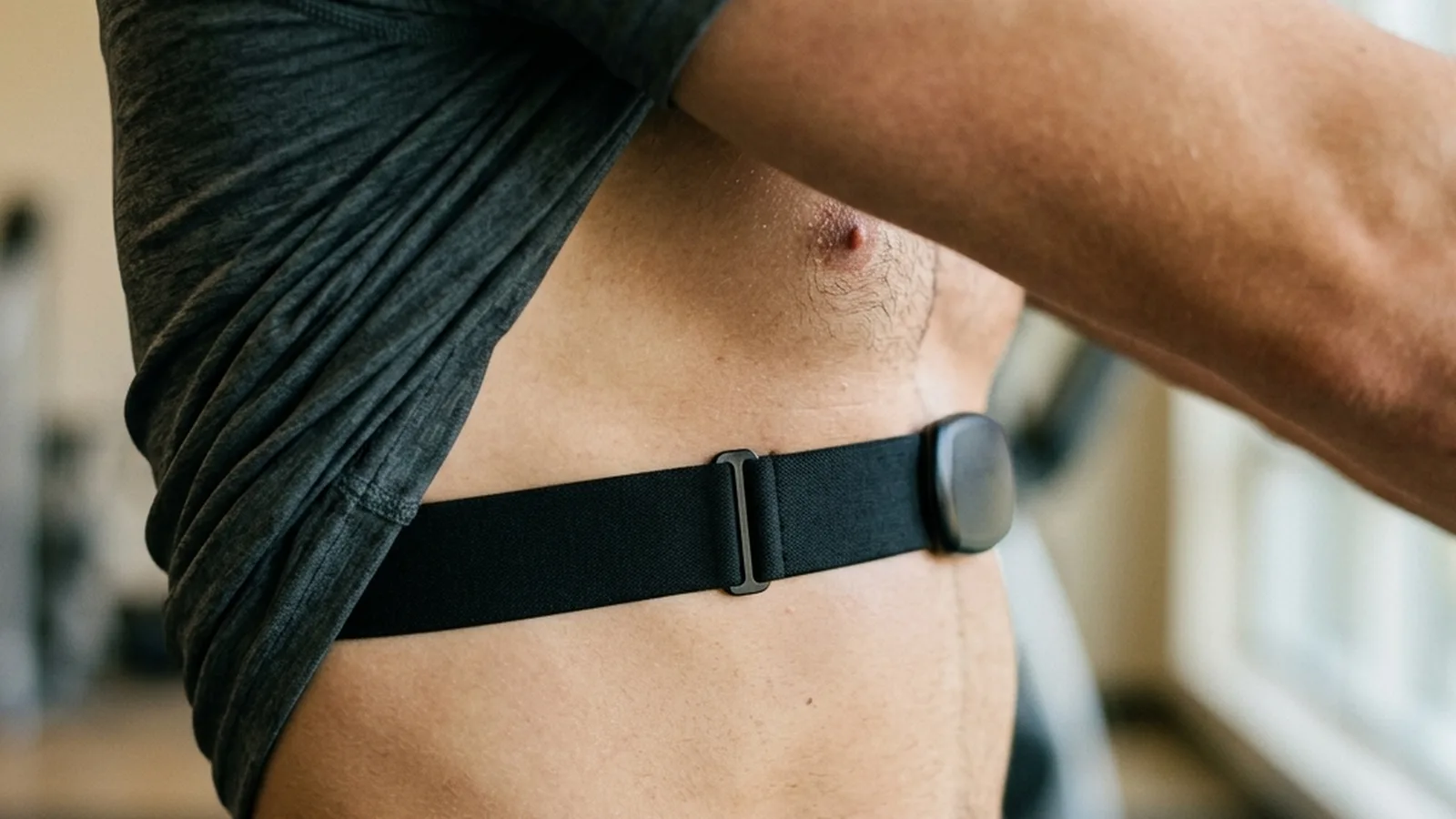
- Dedicated chest straps (Polar, Garmin H10): The gold standard for HRV measurement. Most accurate; the published research uses these. Highest cost-benefit for serious users.
- Wrist-based wearables (Apple Watch, Garmin watches, Whoop): Less accurate than chest straps but adequate for tracking personal trends. Watch for differences between brands — HRV between two devices isn’t comparable.
- Ring devices (Oura): Convenient overnight measurement. Tends to capture longer-term trends well.
- Smartphone apps with finger-on-camera (HRV4Training, EliteHRV): Reasonable accuracy if the protocol is followed consistently. Cheapest entry point.
Practical takeaways
- HRV is a reliable proxy for autonomic recovery state when measured consistently at the same time, posture, and conditions.
- Personal baseline matters more than absolute values. Build a 4-8 week baseline before acting on daily readings.
- The actionable signal is today’s reading vs. 7-day rolling average. Below 5% → consider lighter. Below 10-15% → switch to easy or rest.
- Long-term trends (7-day avg vs 28-day avg) matter more than single days — that’s where overtraining shows up.
- HRV often drops 24-48 hours before illness symptoms — a useful early-warning signal.
Does HRV-guided training actually beat a fixed plan?
It is one thing to say elite programs adjust training by morning HRV; it is another to show that doing so produces fitter athletes than simply following a sensible written plan. A small but genuine body of randomized trials has tested exactly that, and the honest answer is "modestly, and mostly for the timing of hard sessions" rather than "dramatically."
The most-cited trial randomized 40 recreational endurance runners into an HRV-guided group and a traditional predefined group for eight weeks. Both improved their maximal oxygen uptake (VO2max, the ceiling on how much oxygen you can use during hard exercise) by similar amounts — about 3.7% in the HRV-guided group versus 5.0% in the fixed-plan group — but the HRV-guided runners improved their 3000-metre time more (2.1% vs 1.1%) while doing fewer high-intensity sessions, because hard days were scheduled only when the morning reading said the body was ready Vesterinen 2016. A separate trial in 17 well-trained cyclists found a clearer separation: over eight experimental weeks the HRV-guided group raised peak power output by 5.1%, power at the second ventilatory threshold (a marker of sustainable race pace) by 13.9%, and 40-minute time-trial power by 7.3%, while the block-periodization group showed no significant change Javaloyes 2019.
Those are encouraging single studies, but pooling them deflates the headline. A 2021 systematic review with meta-analysis combined eight studies (199 participants) comparing HRV-guided against predefined training and found the differences in VO2max, maximal aerobic capacity, threshold power, and endurance performance were all small and not statistically significant; only vagal HRV itself rose more in the guided groups Manresa-Rocamora 2021. The reviewers' own conclusion is worth keeping in mind: if HRV-guided training beats a good predefined plan for group-level fitness, current data suggest it does so only by a small margin Manresa-Rocamora 2021. The practical reading is that the value of a morning reading lies in rescheduling a planned hard day to a better day — not in promising a bigger engine than a well-designed program would build anyway. These trials were also short (most eight weeks or less) and run in motivated runners and cyclists, so they say little about beginners, lifters, or general health.
How much of your reading is signal, and how much is noise?
The single biggest mistake readers make is treating one morning number as a verdict. Healthy day-to-day fluctuation in resting HRV is large — large enough that an isolated low reading usually reflects normal biological scatter, a restless night, or a sensor artifact rather than genuine fatigue. This is precisely why the research literature converged on the same fix the lead section describes: do not interpret a daily value in isolation. Specialists who monitor elite athletes recommend tracking a seven-day rolling average of the log-transformed RMSSD (LnRMSSD) instead of daily numbers, because the rolling average lifts the signal-to-noise ratio and makes the trend reproducible enough to act on Schmitt 2015.
It also matters how consistently you measure: because any single day carries so much noise, the recommendation is to take readings on most days under the same conditions and judge the weekly trend rather than reading meaning into any one morning Schmitt 2015. The same source is candid about RMSSD's ceiling as a tool: even a clean seven-day average cannot separate different kinds of fatigue and carries no direct information about the sympathetic ("fight-or-flight") branch of the nervous system, so a normal HRV does not guarantee you are fully recovered Schmitt 2015. HRV is a coarse, one-dimensional readiness gauge, not a diagnosis — and it is not a substitute for medical assessment. A persistent, unexplained change, or any reading accompanied by chest pain, palpitations, fainting, or breathlessness, is a reason to see a clinician, not to skip a workout.
One more interpretation trap is worth naming: a high reading is not automatically a green light. During very heavy training blocks, the parasympathetic system can become "saturated," so HRV stays flat or even falls slightly while parasympathetic drive is actually high — and conversely, athletes pushed into functional overreaching (a deliberate short-term overload) can show elevated resting HRV even as their performance is temporarily impaired Le Meur 2013. In other words, an unusually high morning number after a brutal week is not proof you are fresh. This is another argument for watching the trend and the context (how hard the recent block was) rather than chasing a single high or low value Le Meur 2013.
How accurate is your wearable, really?
The metric these decisions hinge on — RMSSD, the root mean square of successive differences between heartbeats — is only as good as the device timing your beats. The reference standard is the electrocardiogram (ECG), which reads the heart's electrical signal directly. Chest straps approximate it closely: in a validation study of 29 adults, a Polar H7 chest strap and even a smartphone camera using photoplethysmography (PPG — the optical method that reads pulsing blood flow rather than electrical activity) both correlated almost perfectly with ECG for RMSSD (r ≈ 1.00), with a technical error of roughly 6% Plews 2017. That is why a chest strap, or a fingertip/face-camera reading taken under controlled morning conditions, is trustworthy enough for trend tracking.
Wrist and ring sensors are more convenient but noisier, because motion and looser optical contact degrade the beat-to-beat timing PPG depends on. A validation of a popular wrist band against ECG found heart rate was excellent (bias under half a percent), but its derived LnRMSSD carried limits of agreement of roughly 6% — large enough that the error approached or exceeded the smallest worthwhile change for that metric, leading the authors to caution that the device's HRV must be interpreted against its own level of imprecision Bellenger 2021. Two practical rules follow: never compare a number from one device against a baseline built on another, because their systematic offsets differ; and the noisier the sensor, the more you should lean on the multi-day trend rather than any single morning value.
Two confounders the apps rarely flag
The lead section lists alcohol, travel, illness, and heat as things that ruin a reading. Two of these confounders deserve a closer, evidence-based look because they are common and frequently misread as "poor recovery."
Alcohol. Even a moderate evening drink measurably suppresses vagal tone into the next morning, and the effect scales with dose. In a real-world study of 4,098 working adults wearing continuous heart-rate monitors, RMSSD during the first hours of sleep fell by about 2 ms after a low dose, 5.7 ms after a moderate dose, and 12.9 ms after a high dose of alcohol; the suppression was larger in younger people Pietilä 2018. So a low reading the morning after drinking is a genuine autonomic effect — but it reflects alcohol, not training fatigue, and the correct response is usually rest and rehydration, not a panicked change to your training block.
The menstrual cycle. For people who menstruate, HRV is not expected to be flat across the month. A systematic review and meta-analysis of 37 studies (1,004 participants) found that cardiac vagal activity — the parasympathetic input RMSSD reflects — declines significantly from the follicular phase (the first half of the cycle) to the luteal phase (the second half, after ovulation), with the largest drops in the days before menstruation Schmalenberger 2019. A predictable late-cycle dip is therefore physiology, not a red flag, and reading it as "overtrained" can lead to unnecessarily backing off hard training for a week every month. The cleaner approach is to interpret the trend against where you are in your own cycle — one more reason a personal, context-aware baseline beats any population norm.
How to take a reading you can actually trust
Most of the disagreement people have with their HRV apps comes down to inconsistent measurement, not a misbehaving nervous system. RMSSD, the index almost every consumer device reports under the hood, is extremely sensitive to when, how, and in what posture you record. Take it standing one morning and lying down the next, and the difference can easily swamp any real change in your recovery. The foundational standards document for HRV measurement stresses exactly this point: position, time of day, and recording conditions must be held constant for readings to be comparable Task Force 1996. The single most useful habit is to measure at the same time every day, ideally within a few minutes of waking, before caffeine, before scrolling the news, and in the same body position each time.
The good news is that a trustworthy reading does not take long. A large validation study comparing brief recordings against the laboratory standard found that RMSSD from a single ten-second strip already tracked the gold-standard value closely, that averaging three short strips pushed agreement higher still, and that anything beyond roughly two minutes added almost nothing Munoz 2015. In other words, the one-to-three-minute readings that phone-camera and chest-strap apps use are scientifically defensible, provided you take them consistently. Longer is not meaningfully better; consistent is. That same study also showed RMSSD holds up far better than other HRV indices in these short windows, which is part of why it became the consumer standard Munoz 2015.
One protocol detail trips up even experienced users: breathing. It is tempting to take slow, deep, deliberate breaths during a reading because it feels calming and tends to push the number up. But a controlled study found that RMSSD is not a valid measure of parasympathetic reactivity during slow deep breathing, because the index can actually fall even as true vagal activity rises during paced breathing Ali 2023. The practical lesson is not to game your reading with breathwork. Breathe normally and naturally. If you choose to use slow-paced breathing, do it every single time so it is at least a constant, never on some mornings and not others, or your trend line will track your breathing habits rather than your recovery.
What actually moves your number from day to day
Understanding the major confounders is what separates a useful HRV practice from anxious number-watching. The biggest single-day mover for many people is alcohol. In a controlled crossover study of healthy adults, one standard drink had essentially no effect on heart rate or HRV, but two drinks raised heart rate by roughly five to six beats per minute and cut vagally mediated HRV by around a third, with red wine and plain ethanol producing the same suppression Spaak 2010. That is why a single late dinner with two glasses of wine can tank the next morning's reading even though nothing is wrong with your training. The number is doing its job; it is reporting a real autonomic cost, and the effect is dose-dependent, so the gap between one drink and three is not trivial.
Age is the other large, often-overlooked factor, and it is the clearest reason comparing your number to a friend's is meaningless. In a cross-sectional analysis of more than eight million wearable users, HRV declined steadily with age, with parasympathetic indices falling faster than sympathetic ones across adulthood Natarajan 2020. The same dataset found a strong time-of-day rhythm in HRV and showed that people with more daily physical activity had higher HRV in a clear dose-dependent pattern Natarajan 2020. Three honest takeaways follow. First, a forty-five-year-old should expect a lower absolute number than a twenty-five-year-old, and that is normal physiology, not a deficit. Second, because HRV swings across the day, comparing a morning reading to an afternoon one tells you almost nothing. Third, the lever you actually control, regular physical activity, nudges the trend in the right direction over months, which is exactly why the rolling average matters more than any single morning Plews 2013.
What a crash during illness looks like
Illness is one of the few inputs that moves HRV more than anything in your training plan. HRV typically drops sharply at the onset of a viral infection — often 24 to 48 hours before subjective symptoms appear — and the drop is large, on the order of 30 to 50% below baseline, far bigger than any training-load effect. If your reading crashes overnight with no obvious training or lifestyle cause, treat it as an early-warning sign of incoming illness and pull back rather than pushing through. The recovery slope afterward is just as informative: a slow climb back to baseline (more than 10 to 14 days) suggests the immune system is still working, and aggressive training during that window tends to set recovery back further. As with every other use of HRV, this is a signal to interpret alongside how you actually feel, not a diagnosis.
Three myths worth retiring
The first myth is that higher is always better. Within one person, a falling trend is a meaningful warning, but an unusually high reading is not automatically a sign of fitness, and chasing an ever-larger number can become its own source of stress. Because HRV declines with age and varies enormously between individuals, the only fair comparison is you versus your own recent baseline, never you versus a leaderboard or a population average Natarajan 2020.
The second myth is that one bad morning means you should skip training. A single suppressed reading is mostly noise; it could be last night's two drinks, a short sleep, a different measurement time, or simply a different posture Spaak 2010. The sound approach, consistent with the device standards and this article's own decision rules, is to act on multi-day trends in the rolling average rather than on isolated dips Task Force 1996.
The third myth is that you can make yourself more recovered by breathing slowly during the measurement. As the deep-breathing validation work showed, manipulating your breath distorts the very index you are trying to read; it changes the number without changing your underlying recovery Ali 2023.
Who should be cautious, and when to involve a clinician
HRV is a training and lifestyle feedback tool, not a diagnostic test, and a few groups should treat it with extra care. People with atrial fibrillation or frequent irregular beats will get unreliable readings, because the beat-to-beat algorithm assumes a roughly regular rhythm; the standards document is explicit that HRV analysis presumes a stable sinus rhythm and is distorted by ectopic beats and arrhythmia Task Force 1996. Anyone with a known heart condition, or on medications that act on heart rate such as beta-blockers, should interpret their numbers alongside their clinician rather than in isolation, since those drugs blunt the very autonomic signals HRV is built to read.
The broader caution applies to everyone: do not let a recovery score override your own symptoms. A reassuringly normal HRV reading does not rule out illness, and it should never be used to talk yourself out of seeing a doctor. Conversely, a persistently falling trend with no obvious explanation, or any warning symptom such as chest pain, palpitations, breathlessness, fainting, or unexplained and lasting fatigue, deserves medical attention regardless of what the app says. Used the way the evidence supports, watching your own multi-day trend and respecting the confounders, HRV is a genuinely useful nudge toward smarter recovery. Treated as a verdict on your health, it is neither accurate enough nor specific enough for the job.
References
Shaffer 2017Shaffer F, Ginsberg JP. An overview of heart rate variability metrics and norms. Front Public Health. 2017;5:258. View source →Plews 2013Plews DJ, Laursen PB, Stanley J, Kilding AE, Buchheit M. Training adaptation and heart rate variability in elite endurance athletes. Sports Med. 2013;43(9):773-781. View source →Vesterinen 2016Vesterinen V, Nummela A, Heikura I, Laine T, Hynynen E, Botella J, Häkkinen K. Individual Endurance Training Prescription with Heart Rate Variability. Med Sci Sports Exerc. 2016;48(7):1347-1354. doi:10.1249/MSS.0000000000000910. PMID:26909534. View source →Javaloyes 2019Javaloyes A, Sarabia JM, Lamberts RP, Moya-Ramon M. Training Prescription Guided by Heart-Rate Variability in Cycling. Int J Sports Physiol Perform. 2019;14(1):23-32. doi:10.1123/ijspp.2018-0122. PMID:29809080. View source →Manresa-Rocamora 2021Manresa-Rocamora A, Sarabia JM, Javaloyes A, Flatt AA, Moya-Ramón M. Heart Rate Variability-Guided Training for Enhancing Cardiac-Vagal Modulation, Aerobic Fitness, and Endurance Performance: A Methodological Systematic Review with Meta-Analysis. Int J Environ Res Public Health. 2021;18(19):10299. doi:10.3390/ijerph181910299. PMID:34639599. View source →Schmitt 2015Schmitt L, Regnard J, Millet GP. Monitoring Fatigue Status with HRV Measures in Elite Athletes: An Avenue Beyond RMSSD? Front Physiol. 2015;6:343. doi:10.3389/fphys.2015.00343. PMID:26635627. View source →Le Meur 2013Le Meur Y, Pichon A, Schaal K, Schmitt L, Louis J, Gueneron J, Vidal PP, Hausswirth C. Evidence of Parasympathetic Hyperactivity in Functionally Overreached Athletes. Med Sci Sports Exerc. 2013;45(11):2061-2071. doi:10.1249/MSS.0b013e3182980125. PMID:24136138. View source →Plews 2017Plews DJ, Scott B, Altini M, Wood M, Kilding AE, Laursen PB. Comparison of Heart-Rate-Variability Recording With Smartphone Photoplethysmography, Polar H7 Chest Strap, and Electrocardiography. Int J Sports Physiol Perform. 2017;12(10):1324-1328. doi:10.1123/ijspp.2016-0668. PMID:28290720. View source →Bellenger 2021Bellenger CR, Miller DJ, Halson SL, Roach GD, Sargent C. Wrist-Based Photoplethysmography Assessment of Heart Rate and Heart Rate Variability: Validation of WHOOP. Sensors (Basel). 2021;21(10):3571. doi:10.3390/s21103571. PMID:34065516. View source →Pietilä 2018Pietilä J, Helander E, Korhonen I, Myllymäki T, Kujala UM, Lindholm H. Acute Effect of Alcohol Intake on Cardiovascular Autonomic Regulation During the First Hours of Sleep in a Large Real-World Sample of Finnish Employees: Observational Study. JMIR Ment Health. 2018;5(1):e23. doi:10.2196/mental.9519. PMID:29549064. View source →Schmalenberger 2019Schmalenberger KM, Eisenlohr-Moul TA, Würth L, Schneider E, Thayer JF, Ditzen B, Jarczok MN. A Systematic Review and Meta-Analysis of Within-Person Changes in Cardiac Vagal Activity across the Menstrual Cycle: Implications for Female Health and Future Studies. J Clin Med. 2019;8(11):1946. doi:10.3390/jcm8111946. PMID:31726666. View source →ESC 1996Task Force of the European Society of Cardiology and the North American Society of Pacing and Electrophysiology. Heart rate variability: standards of measurement, physiological interpretation, and clinical use. European Heart Journal. 1996;17:354-381. View source →Munoz 2015Munoz ML, van Roon A, Riese H, et al. Validity of (Ultra-)Short Recordings for Heart Rate Variability Measurements. PLoS One. 2015;10(9):e0138921. doi:10.1371/journal.pone.0138921. PMID:26414314. View source →Ali 2023Ali MK, Liu L, Hussain A, et al. Root mean square of successive differences is not a valid measure of parasympathetic reactivity during slow deep breathing. American Journal of Physiology-Regulatory, Integrative and Comparative Physiology. 2023;324(4):R446-R456. doi:10.1152/ajpregu.00272.2022. PMID:36717167. View source →Spaak 2010Spaak J, Tomlinson G, McGowan CL, et al. Dose-related effects of red wine and alcohol on heart rate variability. American Journal of Physiology-Heart and Circulatory Physiology. 2010;298(6):H2226-H2231. doi:10.1152/ajpheart.00700.2009. PMID:20418480. View source →Natarajan 2020Natarajan A, Pantelopoulos A, Emir-Farinas H, Natarajan P. Heart rate variability with photoplethysmography in 8 million individuals: a cross-sectional study. The Lancet Digital Health. 2020;2(12):e650-e657. doi:10.1016/S2589-7500(20)30246-6. PMID:33328029. View source →