The 60-second version
Isometric exercise — producing force against an immovable load with no joint motion — is one of the most underrated and misunderstood training methods in modern fitness. The evidence base is unusually consistent. Isometrics produce real strength gains comparable to dynamic resistance training (within 15-20% across 12-week trials), require minimal equipment, are exceptionally joint-friendly, and have a particularly strong effect on resting blood pressure — with meta-analyses showing isometric handgrip training reduces systolic blood pressure by approximately 5 mmHg, comparable to what aerobic exercise produces. The catches: isometric strength gains are partially angle-specific (you get strongest at the joint angle you train), they don’t fully replicate the eccentric and connective-tissue demands of dynamic lifting, and they are not a hypertrophy primary stimulus. As a complement to dynamic training — or as a complete alternative for adults with chronic joint issues — the published evidence is unusually strong.
Educational journalism, not medical advice. Every claim here is checked against its cited sources by editor Timothy Bunce — a health writer, not a physician. It isn’t specific to your situation: for health decisions, talk to your own clinician. How we work →
Some links in this article are affiliate links. If you buy through one, The Beachside Reader earns a commission at no extra cost to you. It never changes which products we pick, or what we say about them. Full affiliate disclosure →
What isometrics actually are
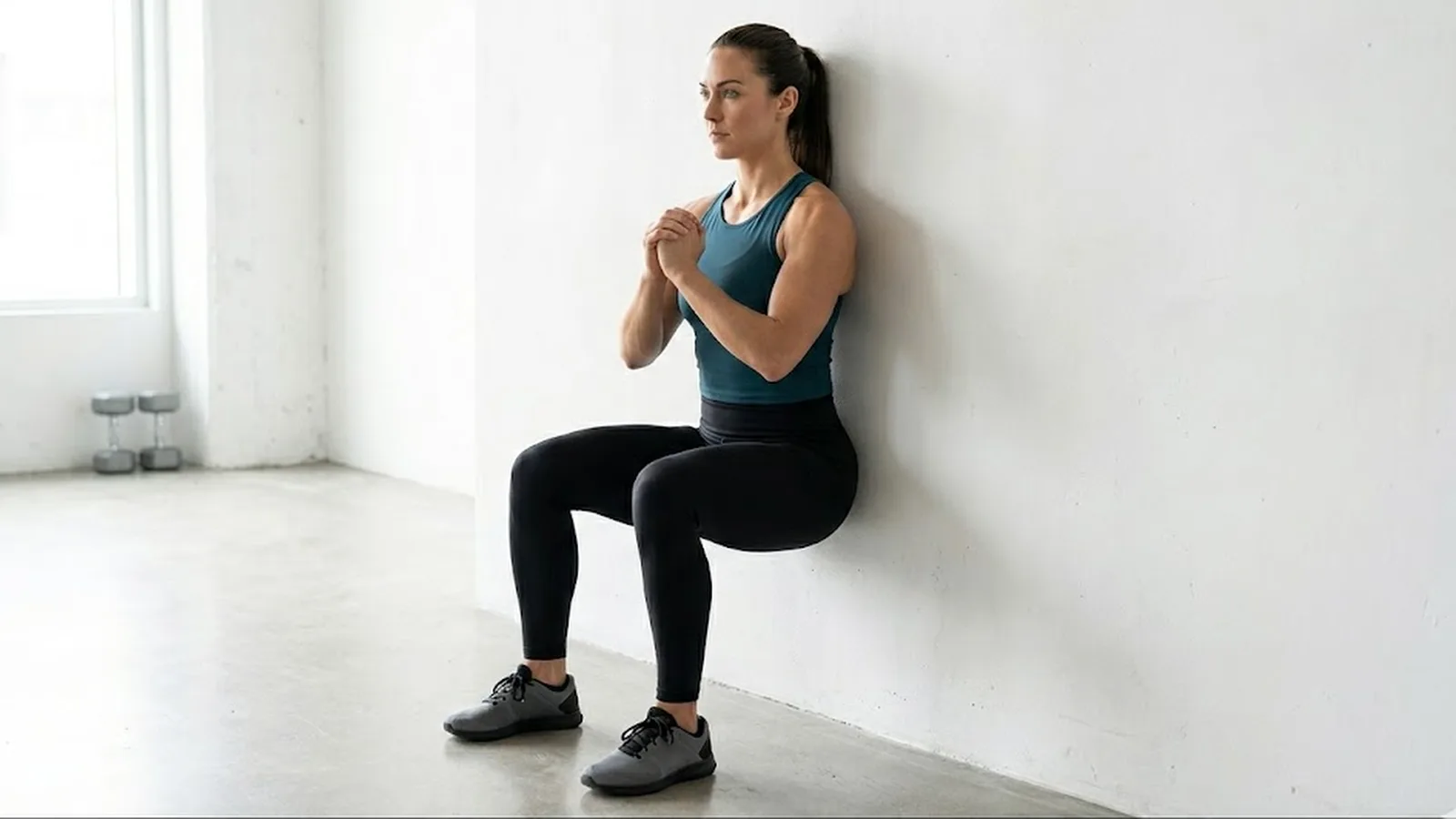
An isometric contraction is one in which the muscle generates force without changing length. The classic examples: a wall-sit (quadriceps generating force against an immovable wall), a plank (entire core resisting gravity), a yielding handgrip squeeze, a paused mid-pull on a deadlift bar that won’t move, a static lunge held at the bottom. The defining feature is that force is high but joint motion is zero.
The category splits into two sub-types that the literature treats differently. Yielding isometrics (resisting being moved — e.g., a plank, holding a heavy bar at lockout) primarily train neural recruitment and connective-tissue stiffness. Overcoming isometrics (pushing maximally against an immovable resistance — e.g., pushing against an unmovable bar, hand-grip squeezes) primarily train rate of force development and peak voluntary contraction. Both produce strength gains; they overlap but have distinct adaptations Oranchuk 2019.
Strength adaptations are real
Oranchuk and colleagues’ 2019 systematic review pooled 26 isometric-training studies and concluded that strength gains from isometric protocols (12-15% increase over 8-12 weeks) are comparable to dynamic resistance training (15-20%) when training volume is matched Oranchuk 2019. The strength carryover, however, is angle-specific: gains are largest within ~20 degrees of the trained joint angle, with diminishing transfer at angles further away. This is why most evidence-based protocols use multiple holding angles or pair isometrics with dynamic work.
Lum and Barbosa’s 2019 meta-analysis of isometric training in athletes showed similar findings: 9-15% improvements in maximal voluntary contraction across 6-12 week protocols, with rate-of-force-development gains particularly pronounced when overcoming-style isometrics were used Lum 2019. For sports-performance applications, isometrics produce some of the cleanest improvements in early-phase force production — the first 50-100 ms of a contraction, which is the relevant window for sprinting and jumping.
The blood-pressure data are remarkable
The most striking isometric finding is on resting blood pressure. Inder and colleagues’ 2016 systematic review and meta-analysis pooled 11 RCTs of isometric handgrip training and found systolic blood pressure reductions of approximately 5 mmHg (pooled mean difference -5.2 mmHg, 95% CI -6.08 to -4.33) and diastolic reductions of approximately 4 mmHg after 4-10 weeks of training (3 sessions/week, 4 sets of 2-minute squeezes at 30% maximum) Inder 2016.
For context: a 5 mmHg systolic reduction is the threshold typically cited for clinically meaningful cardiovascular risk reduction, and the ~5 mmHg drop from isometrics sits right at that threshold and is comparable to typical aerobic-exercise effects (~3-5 mmHg) and to first-line antihypertensive medications Cornelissen 2013.
“Isometric handgrip training produces blood-pressure reductions that meet or exceed those of aerobic exercise, in time periods of as little as 4 weeks, with sessions lasting under 15 minutes. The cost-benefit profile is exceptional.”
— Inder et al., Hypertension Research, 2016 view source
Why isometrics are unusually joint-friendly
Two features of isometric loading make them particularly safe in adults with arthritis, tendinopathy, or post-surgical recovery:
- No eccentric component. Eccentric loading — lengthening under tension — is the primary driver of exercise-induced muscle damage and post-workout soreness. Pure isometric work eliminates it entirely. Adults can perform isometrics consecutively across days without the recovery cost of dynamic lifting Cook 2016.
- No joint range of motion. A wall-sit at 60-degree knee flexion does not stress the patellofemoral joint through the range that aggravates patellar tendinopathy. For chronic patellar or Achilles tendon issues, heavy slow isometric loading is now first-line treatment in published rehab protocols, with effect sizes that match or exceed eccentric-loading protocols Rio 2017.
Rio’s 2015 study was a single-session, randomized crossover trial in just 6 volleyball players with patellar tendinopathy, comparing one bout of 5×45-second isometric leg-extension-machine contractions at 70% maximal effort to one bout of isotonic leg-extension exercise (4×8 reps, 100% 8RM). The isometric bout produced significantly greater immediate pain reduction, with the effect still present 45 minutes later, and a significant 18.7% increase in maximal voluntary contraction strength at that same 45-minute mark — versus a small, non-significant strength decrease after the isotonic bout Rio 2015. This single-bout finding was one of the studies that helped drive the later shift toward isometric-based tendinopathy rehabilitation protocols.
Where isometrics fall short: hypertrophy
One area where isometrics consistently underperform: muscle hypertrophy. While neural strength adaptations are robust, the muscle-protein-synthesis response to isometric work appears smaller and less sustained than to dynamic resistance training of equivalent total effort Schoenfeld 2020. This reflects two mechanistic differences: dynamic exercise produces both concentric and eccentric loading (the latter strongly anabolic), and the metabolic-byproduct accumulation that drives growth-factor signalling is less pronounced in isometric contractions.
For adults whose primary goal is muscle mass, isometrics should supplement rather than replace dynamic resistance training. For all other goals — strength, blood pressure, joint-friendly conditioning, sport-specific force production — the evidence supports them as primary or co-primary modalities.
Protocols the trials actually use
Across the published evidence, three protocol patterns produce the most consistent results:
| Protocol | Application | Dose |
|---|---|---|
| Heavy isometrics (Oranchuk pattern) | Strength & sports performance | 3-5 sets × 3-5s holds at 80-100% effort, 2-3 sessions/week |
| Long-duration isometrics (Rio pattern) | Tendinopathy rehab | 5 sets × 45s holds at ~70% effort, daily |
| Handgrip protocol (Inder pattern) | Blood pressure | 4 sets × 2-min squeezes at 30% maximum, 3 sessions/week |
| Yielding isometrics (general fitness) | Core / postural endurance | 1-3 sets × 30-60s holds, varied positions, 2-3 sessions/week |
The total session time is unusually small. Even the strength-focused protocols complete in 10-15 minutes; the handgrip BP protocol is under 10 minutes including rest periods. Adherence rates in the published trials are correspondingly high — one of the cleanest examples of a low-time-cost intervention with significant outcome data behind it.
Who isometrics actually suit
| Profile | Isometric fit | Why |
|---|---|---|
| Adult with hypertension or pre-hypertension | Excellent | ~5 mmHg systolic reduction in 4-10 weeks — comparable to first-line meds |
| Athlete with patellar or Achilles tendinopathy | Excellent | Pain reduction is immediate; rehab effect equals eccentric protocols |
| Adult with arthritis or post-injury joint pain | Excellent | No eccentric loading; joint angle controllable |
| Time-pressed adult wanting strength gains | Good supplement | 10-15 min sessions; easy to layer onto a workday |
| Sports athlete wanting rate-of-force-development | Excellent supplement | Overcoming isometrics show clean RFD improvements |
| Adult primarily wanting hypertrophy | Insufficient as primary | Use to complement dynamic resistance training, not replace it |
| Adult with cardiovascular instability or recent cardiac event | Caution | Brief BP spikes during max-effort holds; medical clearance recommended |
How to actually use them
- For blood pressure: get a handgrip dynamometer or even a tennis ball. The Inder protocol (4×2-min at 30% of maximum, 3×/week) is genuinely the lowest-effort effective hypertension intervention in the published literature. Effects appear in 4 weeks.
- For tendon pain: 5×45 seconds at ~70% effort, isolated to the affected joint. Rio’s wall-sit protocol for patellar tendinopathy and the equivalent for Achilles, glute medius, or rotator cuff produces immediate pain relief and longer-term rehab effects equivalent to traditional eccentric work.
- For strength: 3-5 sets of 3-5 second maximal-effort holds at multiple joint angles. The angle-specificity of isometric strength gains means training only at one angle (e.g., only at lockout) leaves gains on the table at other angles. Vary the position.
- For core endurance: focus on time under tension, not volume. Plank and side-plank holds of 30-90 seconds with proper bracing are a well-established rehabilitation and strength-and-conditioning tool for building the spinal-stiffness endurance that helps protect against low-back injury — in a fraction of the time of high-rep crunch work.
- Breathe normally, not through Valsalva. The brief BP spike during heavy isometric holds with breath-holding is meaningfully larger than with normal breathing — relevant for adults with cardiovascular concerns. Inhale and exhale across the hold; don’t hold your breath.
- Two to three sessions weekly is plenty. Unlike dynamic resistance training, where higher frequencies still pay returns, isometric strength benefits saturate at 2-3 weekly sessions in most published trials.
Practical takeaways
- Strength gains from isometric training are comparable to dynamic training (12-20% over 8-12 weeks) when volume is matched.
- The blood-pressure effect is exceptional. Isometric handgrip training reduces systolic BP by ~5 mmHg in 4-10 weeks — comparable to first-line antihypertensive medications.
- Strength gains are angle-specific (largest within ~20° of trained position). Train multiple angles or pair with dynamic work.
- For patellar and Achilles tendinopathy, isometric loading is now first-line treatment. Pain reduction is immediate; rehab outcomes match eccentric protocols.
- Hypertrophy adaptations are smaller than for dynamic training. Use isometrics to complement, not replace, traditional resistance work for muscle-building goals.
- Most effective protocols are 10-15 minute sessions, 2-3 times per week. The cost-benefit ratio is unusually favourable.
Frequently asked questions
Are isometric holds as good as regular weight training?
For strength gains, surprisingly close — meta-analyses pool 12-20% gains over 8-12 weeks for isometric training, comparable to dynamic resistance training when matched for volume. For hypertrophy, dynamic training wins; isometrics produce smaller and less sustained muscle-protein-synthesis responses. The honest answer: isometrics are excellent for strength and rehab, secondary for muscle building.
Why does isometric exercise lower blood pressure so much?
The mechanism is incompletely understood but appears to involve sustained baroreceptor adaptation and improved endothelial function. Whatever the cause, the meta-analytic data are robust: 4-10 weeks of isometric handgrip training (4 × 2 minutes at 30% maximum, 3 sessions/week) reduces systolic blood pressure by approximately 5 mmHg — comparable to first-line antihypertensive medications.
Can isometric exercise really help my tendon pain?
Yes — and the effect is unusually fast. Rio’s 2015 RCT in patellar tendinopathy showed immediate pain reduction lasting 45 minutes after a 5×45-second isometric hold protocol. The mechanism appears to involve descending pain inhibition, not just mechanical loading. For chronic patellar, Achilles, gluteal, or rotator cuff tendinopathy, heavy slow isometric loading is now first-line treatment in many published rehab protocols.
How long should I hold the position?
Depends on the goal. For strength: 3-5 second maximal-effort holds, repeated 3-5 times per set. For tendon rehab: 45-second holds at 70% effort, 5 sets. For blood pressure: 2-minute squeezes at 30% effort. For core endurance: 30-90 second yielding holds. The protocols are different because the adaptations are different.
Do I need special equipment?
Almost none. Handgrip dynamometers are about CAD$30-40 but not strictly necessary — a tennis ball or stress ball works for the BP protocol. Wall-sits, planks, and bodyweight isometric squats need nothing. Heavy strength isometrics benefit from a barbell or sturdy frame to push against, but creative gym use of doors, walls, and immovable objects covers most use cases.
References
Oranchuk 2019Oranchuk DJ, Storey AG, Nelson AR, Cronin JB. Isometric training and long-term adaptations: effects of muscle length, intensity, and intent: a systematic review. Scand J Med Sci Sports. 2019;29(4):484-503. View source →Lum 2019Lum D, Barbosa TM. Brief review: effects of isometric strength training on strength and dynamic performance. Int J Sports Med. 2019;40(6):363-375. View source →Inder 2016Inder JD, Carlson DJ, Dieberg G, McFarlane JR, Hess NC, Smart NA. Isometric exercise training for blood pressure management: a systematic review and meta-analysis to optimize benefit. Hypertens Res. 2016;39(2):88-94. View source →Cornelissen 2013Cornelissen VA, Smart NA. Exercise training for blood pressure: a systematic review and meta-analysis. J Am Heart Assoc. 2013;2(1):e004473. View source →Rio 2015Rio E, Kidgell D, Purdam C, et al. Isometric exercise induces analgesia and reduces inhibition in patellar tendinopathy. Br J Sports Med. 2015;49(19):1277-1283. View source →Rio 2017Rio E, van Ark M, Docking S, et al. Isometric contractions are more analgesic than isotonic contractions for patellar tendon pain. Clin J Sport Med. 2017;27(3):253-259. View source →Cook 2016Cook JL, Rio E, Purdam CR, Docking SI. Revisiting the continuum model of tendon pathology: what is its merit in clinical practice and research? Br J Sports Med. 2016;50(19):1187-1191. View source →Schoenfeld 2020Schoenfeld BJ, Grgic J, Van Every DW, Plotkin DL. Loading recommendations for muscle strength, hypertrophy, and local endurance: a re-examination of the repetition continuum. Sports (Basel). 2021;9(2):32. View source →Tyler 2010Tyler TF, Silvers HJ, Gerhardt MB, Nicholas SJ. Groin injuries in sports medicine. Sports Health. 2010;2(3):231-236. View source →Wiles 2010Wiles JD, Coleman DA, Swaine IL. The effects of performing isometric training at two exercise intensities in healthy young males. Eur J Appl Physiol. 2010;108(3):419-428. View source →Schoenfeld 2017Schoenfeld BJ, Ogborn D, Krieger JW. Dose-response relationship between weekly resistance training volume and increases in muscle mass: A systematic review and meta-analysis. J Sports Sci. 2017;35(11):1073-1082. View source →