The 60-second version
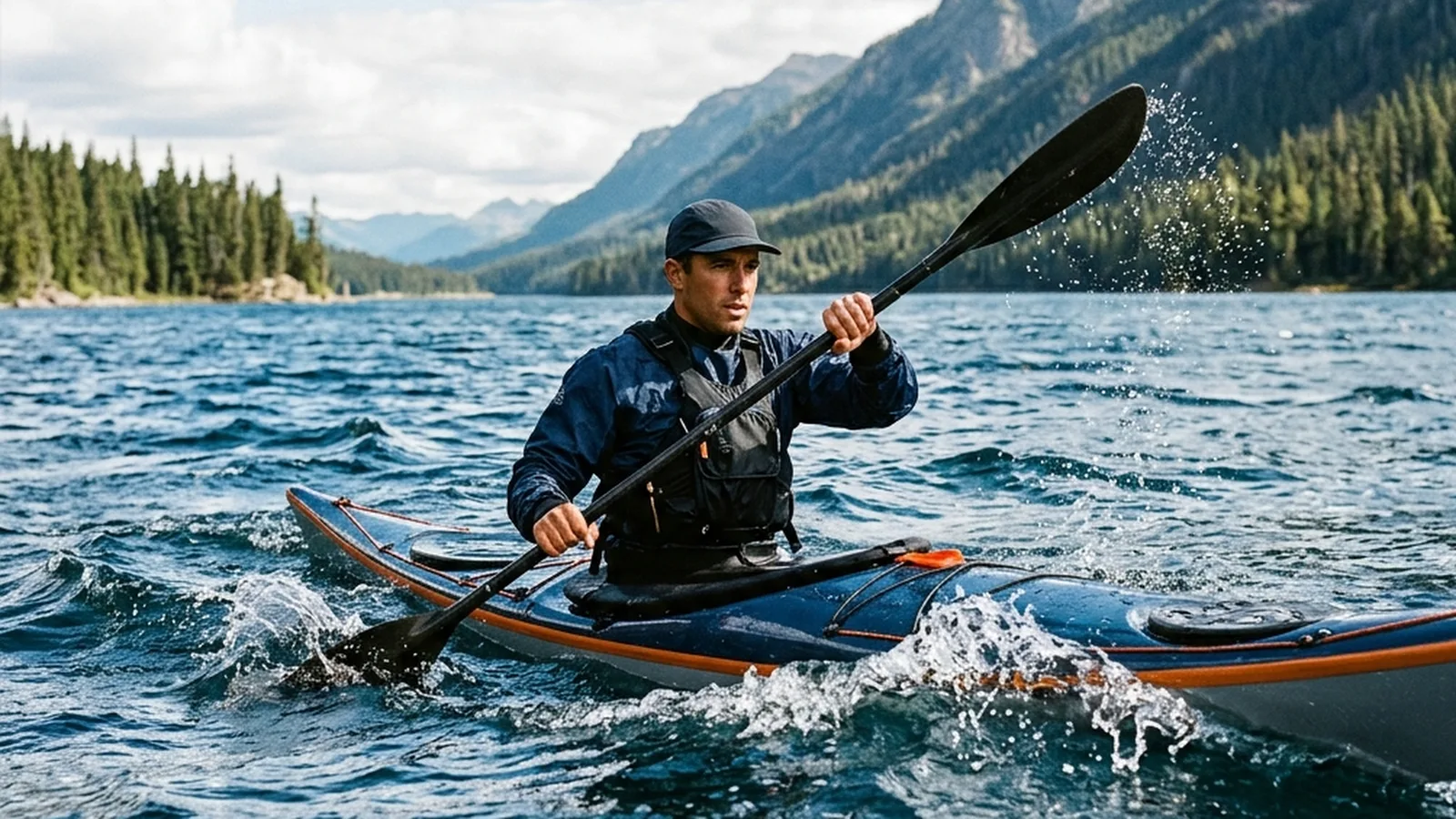
Most kayak shoulder injuries don’t come from one bad stroke — they come from thousands of repetitions of a slightly-off pattern, often executed while paddling against wind and chop. The published kayak biomechanics literature is consistent on a few corrections that dramatically reduce shoulder load: keep the lead arm extended (not bent), drive the stroke from the trunk rotation rather than the arms, and respect the recovery phase — the lifted blade should travel low and forward, not high and lateral. In small waves and chop, the same technical issues that produce mild discomfort on flat water produce overuse injuries within a season. Plus practical: paddle slightly diagonally to wave direction (5-15° off the wind), not directly into it. The diagonal angle reduces both bow slam and the asymmetric shoulder load that comes from constantly correcting course.
Educational journalism, not medical advice. Every claim here is checked against its cited sources by editor Timothy Bunce — a health writer, not a physician. It isn’t specific to your situation: for health decisions, talk to your own clinician. How we work →
Some links in this article are affiliate links. If you buy through one, The Beachside Reader earns a commission at no extra cost to you. It never changes which products we pick, or what we say about them. Full affiliate disclosure →
Why kayak paddling hurts shoulders
The shoulder is a shallow ball-and-socket joint, very mobile but inherently unstable. Kayak paddling repeatedly takes the shoulder through:
- Forward flexion (catching the blade out ahead)
- Some abduction (depending on stroke style)
- External rotation during the catch
- Internal rotation during the pull
- Extension into the exit phase
Done with good technique, the rotator cuff handles this fine. Done with the typical adult error pattern — arms-dominant pulling, lead arm bent, exits taken too high — the supraspinatus tendon gets pinched between the humeral head and the acromion on every stroke. Over thousands of repetitions per session and tens of sessions per year, that’s subacromial impingement and rotator cuff tendinopathy — the same overuse pattern seen in any sport built on repetitive overhead-ish shoulder loading.
What a good stroke looks like
The published kayak-biomechanics work identifies four phases per stroke and the technical cue for each:
- Reach (catch): Rotate the trunk to plant the blade as far forward as comfortable, with the lead arm extended, not bent. Most adults default to a bent lead arm — this shortens the stroke and dumps load onto the shoulder. The cue: imagine your top hand is on a track in front of your eyes.
- Pull: Drive the stroke with trunk un-rotation, not biceps flexion. The arms are levers; the trunk is the engine. Most recreational paddlers reverse this and pull with the arms, fatiguing the shoulders in 30-60 minutes.
- Exit: Lift the blade out near the hip, not behind it. A blade that exits behind the hip means you’ve been pulling well past the productive zone — the stroke gets less powerful and the shoulder loads asymmetrically.
- Recovery: The lifted blade should travel low and forward, not high and lateral. A high, lateral recovery moves the humeral head into positions that narrow the subacromial space — the same mechanism described above.
What changes in waves and chop
Small waves (under 30 cm) change the stroke in subtle but important ways:
- The bow slams. Paddling directly into oncoming chop produces a repetitive bow-slam pattern that’s tiring and can produce wrist strain from the impact transmitted up the paddle shaft. Angle the kayak 5-15° off the wind direction to reduce slam and let the boat ride over the chop instead of through it.
- Sighting becomes harder. Like open-water swimming, paddling in chop benefits from periodic landmark checks — every 8-10 strokes is a reasonable cadence. Pick a fixed shore feature, not another paddler.
- Stroke rate goes up. Most paddlers instinctively quicken their stroke in chop, which usually means shortening it. The published evidence supports the opposite: keep the stroke long, let the rate slow slightly, and use trunk rotation to power through. Kayak-propulsion modelling shows that longer, sustained strokes generate thrust more efficiently than short, rushed ones Jackson 1995, and a shortened, rushed cadence means more total strokes — and more total shoulder repetitions — to cover the same distance.
- Bracing strokes become necessary. The low brace (paddle flat to the water, hand braced) restores stability when chop tips the boat unexpectedly. Recreational paddlers should practise this drill on flat water 4-6 times before paddling in chop.
Practical injury-prevention
- Cap session length at 90 minutes for the first 4-6 weeks of a paddling habit. The shoulder takes weeks to adapt to repeated overhead-ish work.
- Warm up the shoulders before launching. 30 seconds of arm circles, 30 seconds of crossbody stretches, 30 seconds of internal/external rotation. Not optional for paddlers over 40.
- Use a quality wing or asymmetric paddle appropriate to your height. A paddle that’s too long forces a high catch and bad exits; one that’s too short shortens the stroke. Most paddle shops can size you.
- Take 2-3 minute rests every 20-30 minutes. Drink, look around, let the shoulders unload. Continuous paddling for 2+ hours straight is the most common context for overuse injuries.
- Stop at the first sign of shoulder pain. A “just twinged” shoulder during a paddle is the prodrome of a season-ending overuse injury. Get off the water and rest 2-3 days; resume slow with technique focus.
- Off-water shoulder strengthening — band-resisted external rotation, prone Ts and Ys — targets the same posterior-shoulder and scapular imbalances addressed in the corrective-exercise literature, and is a reasonable general strengthening approach for paddlers with prior shoulder issues Page 2010.
When to skip kayaking
- Active rotator cuff symptoms. The repetitive overhead-ish pattern is exactly the wrong load.
- Recent shoulder surgery. Get medical clearance and start with very short calm-water sessions.
- Cold water below 10°C without a drysuit or wetsuit. A wet-exit in cold water carries serious hypothermia risk.
- Solo paddling beyond swim distance from shore. Even strong swimmers can be defeated by a sudden squall.
Practical takeaways
- Most kayak shoulder injuries come from arm-dominant stroking + high recovery + high blade exit. All three are correctable with technique.
- The good-stroke checklist: extended lead arm, trunk-driven pull, hip-line exit, low forward recovery.
- In chop: angle 5-15° off the wind, keep strokes long, slow the rate slightly, practise the low brace before you need it.
- Warm up the shoulders before launching. Cap session length at 90 minutes for the first 4-6 weeks.
- Stop at the first hint of shoulder pain. A twinge in session 1 becomes a tear by session 30.
Frequently asked questions
Why does kayaking hurt my shoulders?
Most often it comes down to stroke technique rather than how much you paddle, though training volume plays a role too. The common technique errors: arm-dominant pulling (instead of trunk-rotation driven), high blade recovery, and exiting the blade behind the hip. All three can contribute to subacromial impingement over thousands of repetitions per session.
Should I paddle into the wind or with it?
Neither, ideally — angle 5-15° off the wind direction. Paddling directly into wind produces bow slam (uncomfortable, fatiguing, hard on wrists). Paddling exactly with wind feels easy but the boat is hard to steer. The angled approach is what most experienced paddlers use without thinking about it.
Is bilateral paddling like bilateral swimming?
Kayak strokes are inherently bilateral — alternating left and right with every stroke. The asymmetric load comes from one side being more powerful or from the paddler favouring one side when correcting course. The fix is balanced technique, not changing the alternation.
How long until shoulders adapt to paddling?
4-6 weeks of 2-3 sessions weekly for most adults. The shoulder responds to gradual load increases the same way the rotator cuff in throwing athletes does. Trying to do 3-hour paddles in the first week is the most common precursor to first-season overuse injuries.
What stretches help before paddling?
Arm circles (30s each direction), crossbody shoulder stretches (30s/side), and external rotation drills with a light band. Cumulative 2-3 minute warm-up. Not optional for paddlers over 40 or anyone with prior shoulder complaints.
Is whitewater kayaking the same skill?
Different skill, different injury profile. Whitewater paddling involves more rotation, more bracing, and more sudden load — the injury pattern shifts toward acute strains and wrist injuries from rolls. The flat-water technique cues in this article apply, but whitewater needs sport-specific coaching.
References
Jackson 1995Jackson PS. Performance prediction for Olympic kayaks. J Sports Sci. 1995;13(3):239-245. View source →Page 2010Page P, Frank C, Lardner R. Assessment and Treatment of Muscle Imbalance: The Janda Approach. Human Kinetics; 2010. View source →