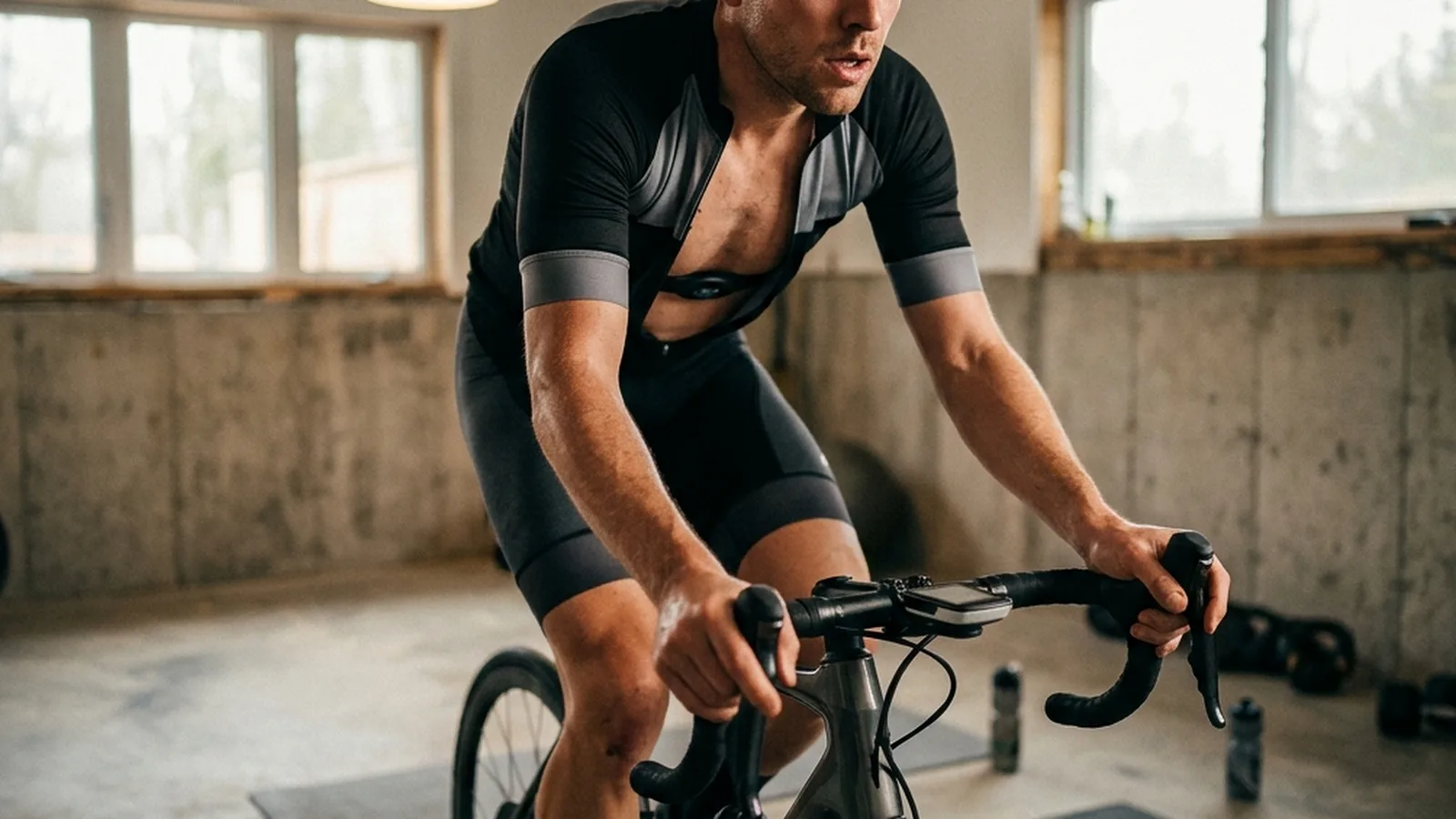
The 60-second version
“Lactate threshold” is the most important benchmark in endurance training — more useful than V̇O2max for predicting how fast you can race a 5k, 10k, or marathon. It’s the intensity at which blood lactate begins accumulating faster than your muscles can clear it — the line between “sustainable for hours” and “tolerable for minutes.” The published evidence is unambiguous: threshold pace improves more reliably with structured training than V̇O2max does, threshold improvement directly translates to race performance, and the most effective threshold workouts are tempo runs at the upper end of conversational pace, or interval sessions at slightly faster than threshold pace with short rests. The Norwegian polarised model that’s now standard in elite endurance training spends 80% of weekly volume below threshold (easy) and 20% at or above threshold (hard).
Educational journalism, not medical advice. Every claim here is checked against its cited sources by editor Timothy Bunce — a health writer, not a physician. It isn’t specific to your situation: for health decisions, talk to your own clinician. How we work →
Some links in this article are affiliate links. If you buy through one, The Beachside Reader earns a commission at no extra cost to you. It never changes which products we pick, or what we say about them. Full affiliate disclosure →
What lactate threshold actually means
Blood lactate is produced continuously during exercise — not just at high intensities. At rest and during easy effort, the body clears lactate as fast as it produces it. As intensity rises, production climbs but clearance also climbs; blood lactate stays steady-state at 2-4 mmol/L through moderate intensities. At some point — the lactate threshold — production exceeds clearance and blood lactate begins to accumulate. From that point on, the exercise becomes time-limited Faude 2009.
The threshold is what limits race pace at distances from 5k through marathon. Race pace at 5k is approximately at threshold; race pace at marathon is approximately 80-85% of threshold pace. Improving threshold pace improves both ends.
Why threshold matters more than V̇O2max
V̇O2max gets the press, but its training-response curve is harder for adults to move. Most adults plateau in V̇O2max after 12-18 months of consistent endurance training and see only marginal gains thereafter. Threshold, by contrast, continues to improve for years with the right training stimulus. Two athletes with the same V̇O2max can have substantially different race times — the threshold difference explains it.
Practical implication: if you’re past your first year of endurance training, focus on threshold work, not V̇O2max intervals.
Faude and colleagues’ review evaluated roughly two dozen different lactate-threshold determination methods against maximal lactate steady state (MLSS) and endurance-race performance across distances from 800m to 16km — it is a methodological validity review of threshold concepts, not a head-to-head comparison of lactate threshold against V̇O2max, and it does not address marathon distance specifically Faude 2009.
How to find your threshold without a lab
- Talk test: threshold pace is the upper end of where you can speak in short phrases but not full sentences.
- 30-minute time trial: after a thorough warm-up, run/cycle as hard as you can sustain for 30 minutes. Your average heart rate during the last 20 minutes is approximately your threshold heart rate.
- Heart-rate-based prescription: threshold heart rate is approximately 85-90% of maximum heart rate for most adults.
The workouts that move threshold
- Tempo runs (continuous at threshold): 20-40 minutes at threshold pace after a thorough warm-up. The single most-effective threshold session. Once weekly.
- Cruise intervals: 4-6 × 5-8 minutes at threshold pace with 1-2 minute jog recoveries. Once weekly.
- Long intervals: 2-3 × 10-15 minutes at threshold pace with 3-5 minute recoveries. Best for marathon training.
Why the 80/20 polarised model wins
The training-distribution evidence converges on a polarised model: 80% of weekly volume at conversational/easy pace (below threshold) and 20% at threshold or above. The “tempo zone” just above conversational pace — the no-man’s-land most recreational athletes accidentally live in — is hard enough to feel like training but easy enough to produce minimal adaptation. Polarised distribution produces better adaptation per total training hour Seiler 2010.
Practical takeaways
- Lactate threshold predicts race performance at 5k-marathon distances better than V̇O2max.
- Adults past their first year should focus on threshold work, not V̇O2max intervals.
- Find threshold with a 30-minute time trial: average heart rate during last 20 minutes.
- Workouts that move threshold: 20-40 min tempos, 4-6 × 5-8 min cruise intervals, 2-3 × 10-15 min long intervals.
- Weekly distribution: 80% easy, 20% threshold-or-above. Avoid the moderate-pace middle.
Frequently asked questions
Should I worry about V̇O2max or lactate threshold?
Both matter, but threshold is more trainable for adults past their first year. V̇O2max plateaus relatively early; threshold continues to improve for years. Threshold-pace improvement also translates more directly to race times.
How often should I do threshold workouts?
Once weekly for most recreational athletes; twice weekly for trained competitive athletes. Threshold sessions are demanding enough that recovery between them matters more than frequency.
What heart rate is my threshold?
Approximately 85-90% of maximum heart rate, but the range is wide. Accurate method: 30-minute time trial after a warm-up, then take the average heart rate during the last 20 minutes. Avoid 220-minus-age formulas.
Is “moderate pace” the same as threshold?
No, and that’s the trap. Moderate pace (conversational comfort) is below threshold. Threshold is the upper end of where you can still speak in short phrases. Most recreational athletes accidentally train at moderate pace and get minimal improvement.
Does this apply to cycling and swimming?
Yes. The lactate-threshold framework is sport-general. Cycling threshold is often measured as FTP (functional threshold power), a 60-minute sustainable wattage.
References
Faude 2009Faude O, Kindermann W, Meyer T. Lactate threshold concepts: how valid are they? Sports Med. 2009;39(6):469-490. View source →Meyer 2005Meyer T, Lucia A, Earnest CP, Kindermann W. A conceptual framework for performance diagnosis and training prescription. Int J Sports Med. 2005;26 Suppl 1:S38-S48. View source →Seiler 2010Seiler S. What is best practice for training intensity and duration distribution in endurance athletes? Int J Sports Physiol Perform. 2010;5(3):276-291. View source →