The 60-second version
Sitting in a vehicle for 8+ hours a day combines two stressors that office sitting doesn’t: whole-body vibration and more confined posture with fewer micro-movements. The 2007 Robb & Mansfield survey of 192 UK truck drivers found 81% reported musculoskeletal pain and 60% reported low back pain in the previous year, with manual handling and seat discomfort — not vibration exposure itself — identified as the significant associated factors Robb 2007. The 2007 Lis et al. systematic review of 25 studies found sitting alone was not linked to higher low back pain risk, but combined with whole-body vibration and awkward posture — the exposure profile of professional driving — the risk of low back pain rose roughly fourfold Lis 2007. Practical playbook: break the drive every 90–120 minutes, with 3–5 minutes of specific movements (hip flexor opening, thoracic extension, neck mobility, glute activation); set up the cab to avoid sustained extreme positions; train hip mobility and posterior chain strength 2–3x/week. This article covers what driving specifically does to the body, the high-leverage interventions with reasonable evidence, and the truck-stop mobility flow that takes <5 minutes.
Educational journalism, not medical advice. Every claim here is checked against its cited sources by editor Timothy Bunce — a health writer, not a physician. It isn’t specific to your situation: for health decisions, talk to your own clinician. How we work →
Some links in this article are affiliate links. If you buy through one, The Beachside Reader earns a commission at no extra cost to you. It never changes which products we pick, or what we say about them. Full affiliate disclosure →
Why driving is harder on the body than office sitting
The professional-driver musculoskeletal literature consistently shows worse outcomes than office sedentary workers. The mechanisms:
- Whole-body vibration: chronic exposure to engine and road vibration accelerates spinal disc degeneration. The 2017 Bovenzi et al. review found strong associations between occupational whole-body-vibration exposure and low back pain in professional drivers, while explicitly noting that a precise vibration dose-response relationship is difficult to isolate from other risk factors Bovenzi 2017.
- Sustained extreme posture: feet on pedals, hands at 10-and-2, slight forward shoulder flexion. Less postural variation than office work.
- Fewer micro-movements: drivers can’t cross their legs, shift major posture, or stand temporarily during the work.
- Long unbroken bouts: 4–8 hours without breaks is typical in long-haul; office workers usually get 2–3 minute breaks at least hourly.
- Loading injuries during stops: getting out of the cab, loading/unloading, twisting. Drivers experience higher-than-average back-injury rates from these transition movements.
- Sleep disruption: irregular schedules, time-zone changes, sleeping in cabs — combine to undermine recovery.
The 90-minute break protocol
The single highest-leverage intervention for long-haul drivers is structured breaks. The dose-response evidence:
- Frequency: every 90–120 minutes. More frequent than typical office breaks because the postural constraints are tighter.
- Duration: 5 minutes minimum, 10 minutes ideal.
- Content: targeted movements that counteract the driving position.
- Cumulative effect: 30–40 break-minutes across an 8-hour driving day measurably reduces next-day pain ratings in occupational driver studies.
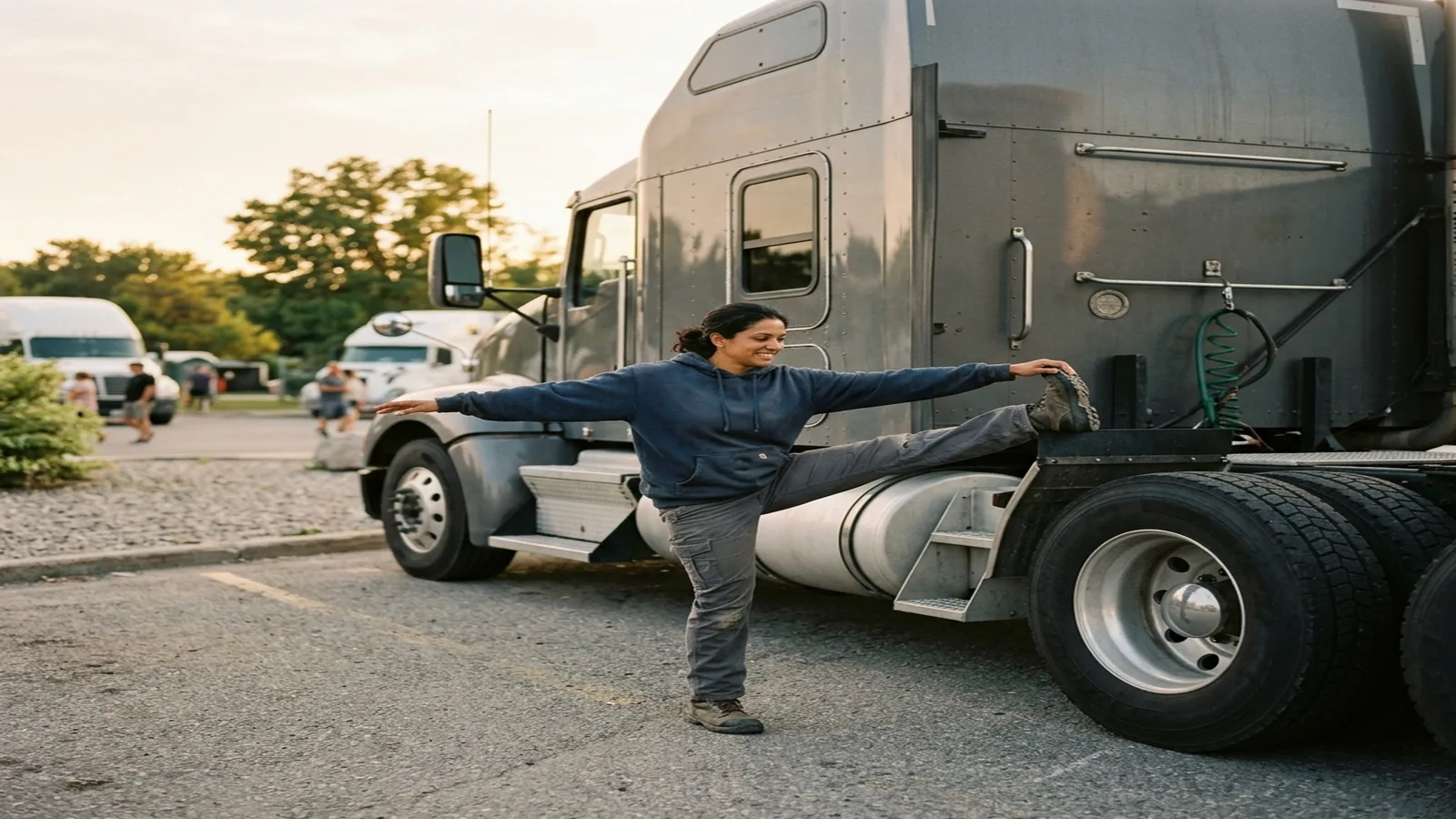
The truck-stop mobility flow with reasonable evidence (~5 minutes):
- Walk for 90 seconds. Anywhere — around the truck, into the rest stop, around the parking lot. Restore lower-extremity circulation and break the seated leg position.
- Hip flexor stretch (kneeling lunge): 30 seconds per side. Counters chronic hip flexor shortening from driving position.
- Standing thoracic extension over a railing or back of cab: 30–60 seconds. Counters thoracic flexion.
- Cervical retractions: 10 chin-tucks. Counters forward head posture.
- Glute activation (squeezes or 10 hip bridges if space allows): 30 seconds. Counters glute under-recruitment.
- Pec stretch in doorway/against railing: 30 seconds per side. Counters rounded shoulders.
- Trunk rotations (standing): 10 reps each side. Restores rotational mobility.
The cab-side flow
If you can’t leave the immediate vehicle area: stand next to the cab, brace one hand against it for support. Run through hip flexor lunge, thoracic extension over the cab edge, cervical retractions, pec stretch using the cab door frame, glute squeezes, and standing trunk rotations. The full sequence takes <3 minutes and addresses the major postural deficits driving creates.
Cab setup that actually matters
Ergonomic adjustments with the strongest evidence:
- Seat height: hips slightly higher than knees, feet comfortably reach pedals without leg fully extended.
- Backrest angle: ~100° (slightly reclined from upright). Pure-upright produces more sustained spinal load than slight recline.
- Lumbar support: gentle support filling the natural curve, not aggressive lordosis. Adjust by feel.
- Steering wheel position: arms slightly bent at ~120° elbow angle, not fully extended. Closer is generally better than further.
- Mirror positions: set so you can check them without large neck rotations.
- Suspension settings: where adjustable, suspension tuned to driver weight reduces vibration exposure substantially.
- Seat cushion: gel or memory-foam aftermarket cushions reduce ischial pressure during long drives, with modest reported reductions in driver fatigue in occupational-driver studies.
Off-the-road training
The training that protects drivers in their off-hours:
Mobility (3–4 sessions per week, 10–15 minutes)
- Hip flexor and quad stretching (couch stretch is excellent).
- Thoracic mobility on foam roller.
- Hip 90/90 internal/external rotation.
- Cat-cow and child’s pose for spinal mobility.
- Cervical flexion/extension/rotation drills.
Strength (2–3 sessions per week, 30–40 minutes)
- Hip hinge variations: deadlifts, kettlebell swings, hip thrusts. Strengthens the posterior chain that driving under-trains.
- Squats: any variation. Reinforces the hip-mobility pattern.
- Rows: counter the constant front-loading of driving posture.
- Carries (farmer carries, suitcase carries): reinforce trunk stability under load.
- Pallof press / anti-rotation: stabilises the trunk against the rotational stresses of getting in and out of the cab.
Cardiovascular (2–3 sessions per week, 20–40 minutes)
- Walking, cycling, swimming — whatever fits the schedule.
- Important for the cardiovascular risks elevated by long-haul work.
The transition-injury problem
A substantial fraction of driver back injuries happen not during driving but during the loading/unloading and getting-out-of-the-cab moments, when a spine that has sat static for hours is suddenly asked to bend, twist, and bear load. Occupational-driving research consistently flags these transition moments as a disproportionate source of low-back injury, with the after-driving body more vulnerable than baseline.
Practical adjustments:
- Don’t exit the cab quickly after long drives; pause, mobilise briefly, then step down.
- For high-step exit (commercial trucks), lower yourself with both hands, don’t jump.
- Don’t do heavy lifting in the first 10 minutes after exiting the cab. Spinal discs are at higher fluid content (more vulnerable to load) immediately after sustained sitting.
- For unavoidable lifting at delivery, pre-mobilise the back briefly first.
- Use proper lifting mechanics; the over-tired late-drive moment is when bad lifting habits produce injuries.
Symptoms requiring clinical attention
- Sharp pain radiating down the leg below the knee (potential nerve compression).
- Numbness or weakness in the legs or feet.
- Persistent neck pain with arm symptoms.
- Bowel or bladder changes accompanying back pain (medical emergency — possible cauda equina).
- Pain that wakes you from sleep.
- Pain following a specific lifting incident with sudden onset.
- Pain progressively worsening over weeks despite rest and conservative measures.
Most professional drivers benefit from a relationship with a physiotherapist who understands the occupational demands. Conservative management is highly effective for most musculoskeletal driver complaints when caught early.
Common myths
- “If you have back pain, stop driving.” Often impractical and not the right first answer. Conservative management (movement breaks, training, ergonomic adjustments) resolves most driver back pain. Stopping driving is a last resort.
- “Driving is just sitting; office sitters have it the same.” The vibration, postural constraint, and transition-loading make driving meaningfully worse than office sitting. Don’t treat them as equivalent.
- “A back brace will protect me.” Limited evidence. Braces produce short-term feedback but don’t build the active strength that’s actually protective. Better targeted at acute lifting tasks than chronic driving.
- “Sitting tall in the seat fixes everything.” Static perfect posture isn’t the answer. Movement breaks and varied positioning matter more than continuous “good” posture.
- “Truckers can’t train.” Wrong. Several truck-stop chains have basic gym facilities; many have showers; resistance bands and a few dumbbells fit in any sleeper berth. The constraints are real but not absolute.
Practical takeaways
- Long-haul driving has documented elevated musculoskeletal risk above office sitting due to vibration, postural constraint, and loading transitions.
- Break every 90–120 minutes for 5–10 minutes of targeted mobility work.
- Cab setup matters: seat height, backrest angle ~100°, lumbar support, suspension tuning, quality seat cushion.
- Off-the-road training: hip mobility 3–4x/week, posterior chain strength 2–3x/week, cardiovascular 2–3x/week.
- Be cautious during cab exit and loading transitions — injury data consistently flag this moment, not driving itself, as a major source of driver back injuries.
- Don’t lift heavy in the first 10 minutes after exiting; spinal discs are at higher injury vulnerability post-sitting.
- Conservative management resolves most driver back pain; clinical input is warranted for radiating symptoms or progressive deterioration.
Frequently asked questions
How often should I really stop on a long drive?
Every 90 to 120 minutes for 5 to 10 minutes of movement. The dose-response evidence in occupational-driver studies shows 30 to 40 break-minutes across an 8-hour day reduces next-day pain ratings substantially. More frequent breaks are better than longer infrequent ones; the postural constraint matters more than total time.
My back is sore after every drive. Should I stop driving?
Almost certainly not the first move. Conservative management — break protocol, ergonomic cab adjustments, off-road mobility and strength training, lifting mechanics during transitions — resolves most driver back pain. Stopping driving is the last resort, and even then only after physiotherapy hasn't helped. See a clinician for radiating leg pain, numbness, or progressive worsening.
Are seat cushions worth it?
Quality cushions (gel or memory-foam aftermarket products) modestly reduce ischial pressure and driver fatigue in occupational driver studies. The marginal benefit is real but not dramatic. Don't expect them to fix significant pain alone; bundle with break protocol and training.
What's the most important strength exercise for drivers?
Hip hinges (deadlift variations, kettlebell swings, hip thrusts). Driving puts the hips in chronic flexion with under-active glutes; hinge work directly counteracts this and builds the posterior chain that protects the lower back during exit and loading transitions.
Why do I get hurt loading or unloading more than during driving?
After hours of seated postural loading, spinal discs have higher fluid content and motor patterns are temporarily disrupted. The first 10 minutes after exiting the cab are when injury risk is elevated. Don't rush; mobilise briefly before lifting; for unavoidable heavy lifts, pre-mobilise specifically. This transition window is consistently flagged in occupational-driving research as a high-risk moment for low-back injury.
References
Robb 2007Robb MJ, Mansfield NJ. Self-reported musculoskeletal problems amongst professional truck drivers. Ergonomics. 2007;50(6):814-827. View source →Lis 2007Lis AM, Black KM, Korn H, Nordin M. Association between sitting and occupational LBP. Eur Spine J. 2007;16(2):283-298. View source →Bovenzi 2017Bovenzi M, Schust M, Mauro M. An overview of low back pain and occupational exposures to whole-body vibration and mechanical shocks. Med Lav. 2017;108(6):419-433. View source →Magnusson 1996Magnusson ML, Pope MH, Wilder DG, Areskoug B. Are occupational drivers at an increased risk for developing musculoskeletal disorders? Spine (Phila Pa 1976). 1996;21(6):710-717. View source →Kresal 2015Kresal F, Roblek V, Jerman A, Meško M. Lower back pain and absenteeism among professional public transport drivers. Int J Occup Saf Ergon. 2015;21(2):166-172. View source →Waongenngarm 2018Waongenngarm P, Areerak K, Janwantanakul P. The effects of breaks on low back pain, discomfort, and work productivity in office workers: a systematic review. Appl Ergon. 2018;68:230-239. View source →Alperovitch 2010Alperovitch-Najenson D, Santo Y, Masharawi Y, Katz-Leurer M, Ushvaev D, Kalichman L. Low back pain among professional bus drivers: ergonomic and occupational-psychosocial risk factors. Isr Med Assoc J. 2010;12(1):26-31. View source →