The 60-second version
Nordic walking is fitness walking with poles, and it is one of the highest-quality cardiovascular interventions available to adults over 60 — particularly those with knee, hip, or balance limitations. The poles convert walking from a primarily lower-body activity into a whole-body activity, increasing energy expenditure by roughly 18–22% over conventional walking at the same pace (Tschentscher et al. 2013). On knees, the evidence is more specific than the marketing: meaningful knee-load reductions with poles have been measured during steep descents (Schwameder et al. 1999), while on level ground like the beachfront, pole use does not meaningfully unload the knee joint (Jensen 2011) — the flat-ground case for poles rests on whole-body work, stability, and posture, not joint offloading. The Wasaga Beach beachfront is an unusually good Nordic walking surface: flat, paved or hard-packed boardwalk, scenic, and shaded by the prevailing summer breeze. The protocol that works for most healthy adults 60+: 3× weekly sessions of 30–45 minutes, technique-correct pole work, gradual progression. The published research is consistently supportive: improvements in cardiovascular fitness, body composition, blood pressure, and quality of life metrics within 8–12 weeks of consistent practice.
Educational journalism, not medical advice. Every claim here is checked against its cited sources by editor Timothy Bunce — a health writer, not a physician. It isn’t specific to your situation: for health decisions, talk to your own clinician. How we work →
Some links in this article are affiliate links. If you buy through one, The Beachside Reader earns a commission at no extra cost to you. It never changes which products we pick, or what we say about them. Full affiliate disclosure →
What Nordic walking actually is
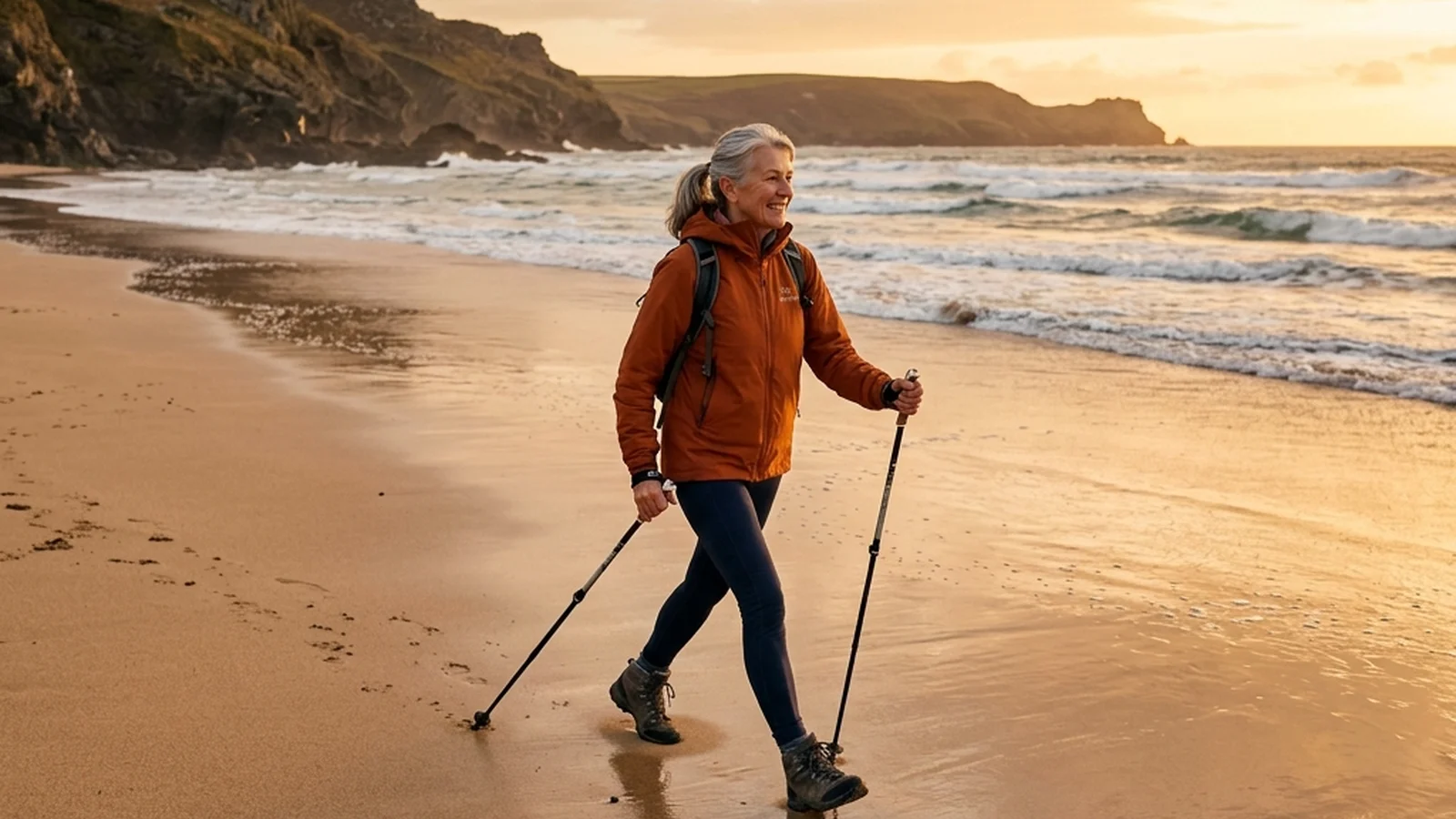
Nordic walking originated in Finland in the 1990s as off-season training for cross-country skiers. The principle: by adding poles and using them to actively push during the walking stride, the activity recruits the upper body in coordination with the lower body. The motion is similar to cross-country skiing without the snow; the rhythm is similar to walking, with the addition of a coordinated arm-swing-and-push pattern.
The key distinguishing features:
- Poles with rubber tips for paved/firm surfaces (or pointed tips for soft ground). The Nordic walking pole is purpose-designed; it is not the same as a trekking pole or ski pole.
- Wrist straps, not pole grips: the wrist strap design lets the walker open and close the hand at the end of each stroke, increasing forearm and grip relaxation.
- Active push-off: the pole is planted at roughly 45° behind the body and pushed back, propelling the walker forward.
- Diagonal arm-leg coordination: opposite arm and opposite leg, same as natural walking but exaggerated for the pole work.
- Slightly longer stride than casual walking, with more trunk rotation and a more upright posture.
The technique is learnable in 10–30 minutes of practice for most adults, with refinement happening over weeks. Many local Nordic walking groups offer beginner sessions; in Wasaga and Collingwood, walking clubs occasionally host introductory clinics.
Why this matters for adults 60+
The 60+ demographic faces several fitness constraints that Nordic walking addresses better than most alternatives:
- Knee and hip arthritis: poles measurably reduce knee loading on descents (Schwameder et al. 1999), but on level ground they do not meaningfully unload the knee (Jensen 2011). What poles reliably add on the flat beachfront is stability and confidence — two extra contact points that let many joint-sensitive walkers go longer and more often at a comfortable effort.
- Balance concerns: poles provide two additional points of contact, dramatically reducing fall risk on uneven terrain. For adults with mild balance issues, this enables outdoor walking that wouldn’t otherwise be safe.
- Cardiovascular conditioning: the upper-body engagement raises heart rate to a more cardio-conditioning zone (typically 110–140 bpm) at walking pace — squarely in the aerobic-base range discussed in this comparison of steady aerobic work and interval training. Conventional walking often stays below the cardiovascular training threshold.
- Postural improvement: the technique requires upright posture and active shoulder use. Daily Nordic walking improves the kyphotic forward-flex posture common in older adults.
- Whole-body activation: pole work recruits triceps, deltoids, latissimus dorsi, and trunk rotators. These muscles atrophy with age and are difficult to load during conventional walking.
- Bone density: weight-bearing activity supports bone health; the pole work adds upper-body weight-bearing component.
- Social context: Nordic walking lends itself to group settings, which provides social engagement that supports adherence.
The most-cited review of the evidence, Tschentscher et al. 2013, pooled 16 randomized controlled trials of Nordic walking across a range of clinical and older-adult populations (including COPD, peripheral artery disease, diabetes, and Parkinson’s). Across those trials, consistent practice was associated with improvements in cardiovascular fitness, blood pressure, body composition, and quality-of-life measures — generally at a lower joint-impact cost than comparable running or brisk-walking programs.
The Wasaga beachfront as a Nordic walking surface
Wasaga Beach’s waterfront infrastructure is unusually well-suited to Nordic walking:
Surface choice affects both energy cost and pole-plant mechanics in Nordic walking (Schiffer et al. 2009) — firmer surfaces like the paved boardwalk and hard-packed trail let the pole tip grip and push effectively, while soft dry sand blunts the push and increases effort without adding training benefit.
- The Beach Drive boardwalk and beachfront paths: boardwalk sections run along parts of the beachfront (confirmed at Beach Area 2), with paved and hard-packed multi-use paths connecting other beach areas. Wasaga Beach’s shoreline runs roughly 14 km along Georgian Bay, with Beach Areas 1–6 covering the main developed stretch (Town of Wasaga Beach) — see this east-to-west route breakdown for planning a longer walk. Largely flat and well suited to pole work.
- Wasaga Provincial Park day-use roads: paved roadways inside the park, lightly trafficked outside peak hours. Suitable for Nordic walking with attention at the few intersection points.
- Schoonertown park and surrounding trails: hard-packed crushed-stone surfaces with forest cover. Cooler in summer than the open beachfront.
- The Georgian Trail (a short drive away): this firm crushed-stone rail-trail does not reach Wasaga Beach — it runs roughly 34 km between Collingwood’s Harbourview Park and Meaford Harbour along Highway 26 (Great Lakes Waterfront Trail). It’s a legitimate destination for a longer Nordic walking outing — see this Wasaga-to-Collingwood route guide for access points — but plan to drive to a Collingwood or Thornbury trailhead first.
- The downtown Wasaga sidewalks: less scenic but useful in early spring or late fall when other surfaces are weather-affected. Part of the daily-routine walking pattern many local seniors develop.
The Wasaga environment has specific advantages over inland Nordic walking destinations:
- Cooling lake breeze in summer keeps walkers comfortable in 25–28°C heat that would be punishing inland.
- The beachfront views provide scenic motivation that compounds adherence.
- Multiple parking access points allow short-distance start-and-return walks suited to the senior demographic.
- Bench rest stops at intervals along the Beach Drive corridor allow rest without loss of momentum.
- Beach Drive is currently under construction: the Town is rebuilding and raising the roadway to reduce flood risk, and sections have been open to pedestrian traffic only during the work. This is a temporary construction condition, not a permanent car-free policy — check the Town’s current Beach Drive construction updates before planning a route.
Technique fundamentals
Correct Nordic walking technique is learnable but the wrong technique can produce shoulder discomfort and waste the benefit. The key elements:
- Pole sizing: the standard formula is your height (cm) × 0.68 = pole length. A 165 cm walker uses 110–115 cm poles; a 180 cm walker uses 120–125 cm poles. Most adjustable poles span this range.
- Standing posture: chest up, shoulders relaxed, eyes forward. The poles are an extension of the arms in their natural swing position.
- Hand position: through the wrist strap, with the hand relaxed. Don’t grip tightly; the strap does the work.
- The plant: pole tip touches ground at roughly the heel of the opposite (forward) foot. The pole is tilted backward (planted at ~60° from vertical, leaning back).
- The push: as the foot pushes off, the corresponding arm pushes the pole back, propelling the body forward. The pole exits the ground slightly behind the body.
- The release: at the end of the push, the hand opens, the pole pivots through the wrist strap. The arm swings forward to meet the next stride.
- Stride length: slightly longer than casual walking. The pole work facilitates this without forcing it.
- Cadence: 100–120 steps per minute is a typical target. Calibrate to the individual’s comfort.
Common technique errors to avoid:
- Poles too far forward (planted ahead of the body) — eliminates the push function.
- Gripping the pole tightly — produces forearm fatigue.
- Excessive shoulder shrugging — produces neck and shoulder fatigue.
- Poles too long — forces a forward lean.
- Poles too short — eliminates the push power.
- Hands held in front of the body throughout — eliminates the natural swing and push.
A 12-week beginner protocol for adults 60+
For an adult new to Nordic walking, in reasonable health (cleared by their physician for moderate-intensity exercise):
- Weeks 1–2: 3× weekly, 20–30 minutes per session. Focus on technique, not distance or pace. Walk on a flat surface. Stop and rest as needed.
- Weeks 3–4: 3× weekly, 30 minutes. Start adding gentle pace variation (5 minutes faster, 5 minutes easier).
- Weeks 5–6: 3× weekly, 35–40 minutes. Begin including light hills or modest gradient.
- Weeks 7–8: 3× weekly, 40 minutes. Consistent pace with intermittent harder bursts (1–2 minutes hard, 3–4 minutes easy).
- Weeks 9–12: 3× weekly, 45 minutes consistent pace. Perceived exertion should be moderate (you can talk in short sentences but not hold a long conversation).
- Beyond week 12: maintain 3–4 sessions per week of 30–60 minutes. Add longer Saturday sessions (60–90 minutes) as fitness allows.
Specific health benefits documented
The published research on Nordic walking is unusually large and consistent. Major findings:
- Cardiovascular fitness: Tschentscher et al. 2013 found Nordic walking produces 11–23% greater acute oxygen uptake (VO2) than conventional walking at a matched pace, and the RCTs in their review reported cardiovascular fitness gains comparable to running or cycling programs.
- Blood pressure: systolic BP reductions of 5–10 mmHg in hypertensive older adults across multiple studies.
- Body composition: 2–3% body fat reduction over 12 weeks of consistent practice (varies by intensity).
- Type 2 diabetes management: improved glucose control and HbA1c reductions in diabetic older adults; multiple studies show effects comparable to other moderate-intensity programs.
- Quality of life: SF-36 and similar quality-of-life measures consistently improve, particularly in physical function and social role domains.
- Depression and mood: Reuter et al. 2011 compared a flexibility/relaxation program, walking, and Nordic walking in Parkinson’s disease patients and found mood improvements; broader literature on outdoor exercise supports the depression-reduction effect.
- Knee osteoarthritis: Knee pain often reduces with consistent Nordic walking, with the pole-supported reduced loading combined with quadriceps strengthening producing the dual benefit.
- Bone density: small but measurable bone density improvements in postmenopausal women across studies, particularly at the hip.
Local Wasaga Nordic walking resources
- Town of Wasaga Beach Seniors Active Living Centre: runs a weekly Social Walking Club (Wednesday mornings, roughly 45–60 minutes), departing from the centre at 1621 Mosley Street near the Provincial Park and Beach Area 5. It’s a conventional walking group rather than pole-specific, but it’s a real local on-ramp and a good place to ask about Nordic walking interest — see the Seniors Active Living Centre page for the current schedule.
- Local fitness centres sometimes offer Nordic walking introductory classes; ask at Beachside Fitness or other regional gyms.
- Instructor certification: Urban Poling is Canada’s primary Nordic-walking certification body and maintains a directory of certified instructors — the most reliable way to find a qualified local instructor for a first technique session.
- Equipment: poles can be purchased online or at sports retailers in the Collingwood-Barrie area. Adjustable poles in the $80–200 range cover most beginners.
Combining Nordic walking with other senior activities
For senior adults building a comprehensive fitness routine, Nordic walking pairs well with other modalities:
- Aquatic exercise (water aerobics, lane swimming): complementary cardio with different joint loading. 1–2 sessions per week.
- Resistance training: 2 sessions per week of basic strength work (squats, hinges, rows, presses) supports muscle and bone preservation.
- Yoga or tai chi: balance, flexibility, and mind-body work that complements the cardiovascular training.
- Pickleball: agility and reactive movement training. Multiple times per week for the actively-playing senior.
- Gardening: incidental activity that contributes to weekly volume.
The 5-modality template (Nordic walking 3×, swim 1–2×, strength 2×, yoga/tai chi 1×, sport 1×) covers most senior fitness goals with sustainable volume.
Practical takeaways
- Nordic walking adds roughly 18–22% to walking energy cost; knee-load reductions with poles are documented on steep descents, not level ground, so the flat-beachfront case rests on whole-body work, stability, and posture.
- The Wasaga beachfront is an exceptional Nordic walking surface: flat, paved, scenic, with cooling lake breeze.
- Pole sizing: your height in cm × 0.68 = pole length. Most adjustable poles span this range.
- 3× weekly, 30–45 minute sessions, 12-week progression for most beginners.
- Documented benefits: 11–23% greater oxygen uptake than conventional walking, 5–10 mmHg BP reductions, body composition improvements, mood improvements, knee pain reduction.
- Pairs with aquatic exercise, light resistance training, and yoga for a comprehensive senior fitness routine.
Frequently asked questions
Are trekking poles the same as Nordic walking poles?
No. Trekking poles have grips designed for a closed-fist hold; Nordic walking poles have wrist straps that allow the hand to release at the end of the push. Trekking poles are designed primarily for descent support; Nordic walking poles are designed for active push during walking. They’re different tools for different purposes.
Is Nordic walking just walking with poles — can’t I just walk faster instead?
Walking faster is a different stimulus. Nordic walking specifically engages the upper body and trunk rotators in a way that fast walking can’t. The published research consistently shows different physiological adaptations from Nordic walking versus equivalent fast walking. Both are valuable; they’re complementary.
Will it look weird walking with poles around town?
In Wasaga and Collingwood, Nordic walking is common enough that you won’t stand out. In other Ontario contexts, it’s less common but increasingly recognised. The cultural barrier is small; the physical benefit is large. Most people who try it report adjusting to the social aspect within a few sessions.
Can I do this with a knee or hip replacement?
Often yes, with physician clearance. Nordic walking is among the lowest-impact cardio options for replaced joints, and the published research includes some post-surgical populations. A pre-start clearance from your orthopaedic physician and a session or two with a physical therapist familiar with the activity is sensible.
How does Nordic walking compare to elliptical or stationary bike?
Different profile. The elliptical is comfortable but lacks weight-bearing impact (so less bone-density benefit). The stationary bike is excellent cardio but doesn’t train balance or proprioception. Nordic walking combines weight-bearing impact, upper-body engagement, and outdoor exposure that the indoor alternatives can’t match. For a comprehensive program, all three have a role.
References
Tschentscher et al. 2013Tschentscher M, Niederseer D, Niebauer J. Health benefits of Nordic walking: a systematic review. Am J Prev Med. 2013;44(1):76-84. View source →Schiffer et al. 2009Schiffer T, Knicker A, Dannöhl R, Strüder HK. Energy cost and pole forces during Nordic walking under different surface conditions. Med Sci Sports Exerc. 2009;41(3):663-668. View source →Reuter et al. 2011Reuter I, Mehnert S, Leone P, et al. Effects of a flexibility and relaxation programme, walking, and Nordic walking on Parkinson’s disease. J Aging Res. 2011;2011:232473. View source →Schwameder et al. 1999Schwameder H, Roithner R, Müller E, Niessen W, Raschner C. Knee joint forces during downhill walking with hiking poles. J Sports Sci. 1999;17(12):969-978. View source →Jensen 2011Jensen, Henriksen, et al. Is it possible to reduce the knee joint compression force during level walking with hiking poles? Scand J Med Sci Sports. 2011. View source →