The 60-second version
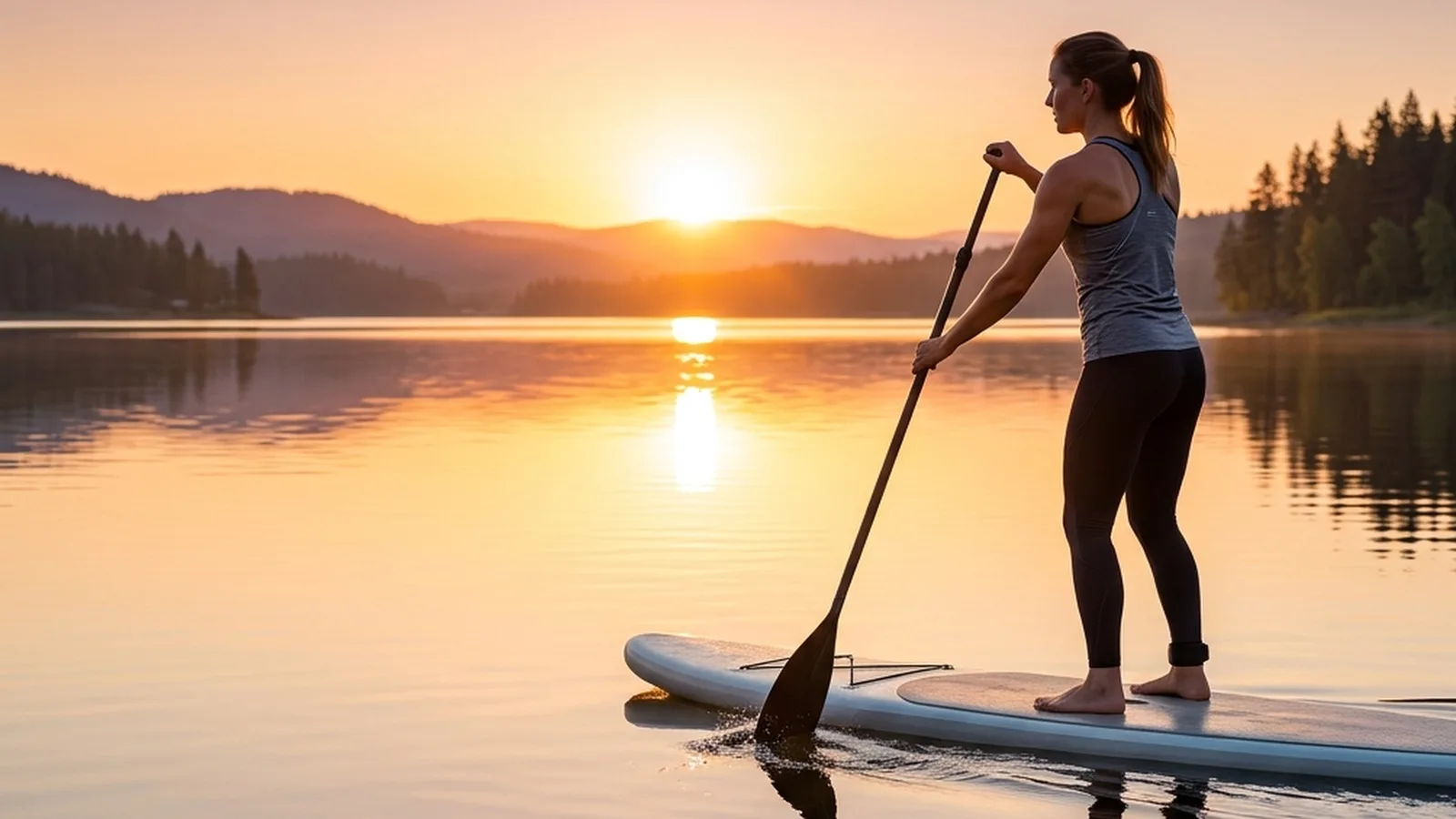
Stand-up paddleboarding looks like a lifestyle activity but is one of the better zone-2 cardio prescriptions available to non-runners. Recreational paddling pace sits at 40-60% of V̇O2max for most adults — right in the zone-2 sweet spot for mitochondrial development and fat oxidation. The upper-body and trunk recruitment patterns add a strength-and-stabilisation component that running cannot match, and the joint impact is essentially zero. The published SUP physiology work, mostly from Hawaiian and Australian sport-science groups, finds 60-90 minutes of recreational paddling produces metabolic responses comparable to slow jogging without any of the impact load. The catch: most people start by going too hard and finish with a sore lower back, because they paddle with the arms instead of rotating the trunk. Fix the stroke and SUP becomes a near-ideal zone-2 modality.
Educational journalism, not medical advice. Every claim here is checked against its cited sources by editor Timothy Bunce — a health writer, not a physician. It isn’t specific to your situation: for health decisions, talk to your own clinician. How we work →
Some links in this article are affiliate links. If you buy through one, The Beachside Reader earns a commission at no extra cost to you. It never changes which products we pick, or what we say about them. Full affiliate disclosure →
Why zone-2 matters and why SUP suits it
Zone-2 cardio — the steady, low-to-moderate-intensity work that builds aerobic base and mitochondrial density — has become a fashionable training prescription, but the underlying physiology is decades old. The signature adaptations are an increase in capillary density, mitochondrial biogenesis, and fat-oxidation capacity, all driven by sustained sub-threshold cardiovascular stimulus over 45-90 minute bouts Seiler 2010.
The practical problem with zone-2 is that most modalities make it hard to hit the right intensity. Run at zone-2 pace and you look slow. Cycle at zone-2 and the load is so low that posture and contact-point pain become the limiting factor before metabolic stimulus. SUP solves both problems: the resistance of water is high enough that recreational pace lands squarely in zone 2, and the standing posture distributes load comfortably across the body for hours Schram 2016.
What the metabolic work shows
Schram and colleagues at Bond University have produced the most-cited line of SUP physiology research. Their cross-sectional profiling study measured maximal oxygen uptake across three groups: elite paddlers averaged 43.7 ml·kg-1·min-1, recreational paddlers 31.9 ml·kg-1·min-1, and sedentary controls 20.4 ml·kg-1·min-1 — recreational paddlers already sit in a solid aerobic-fitness band relative to sedentary adults, consistent with a sport that defaults to zone-2 intensity Schram 2016. The findings collapse to three points worth remembering:
- Recreational fitness: both recreational and elite paddlers carried significantly lower body fat than sedentary controls, and the elite group had a notably healthier lipid profile (higher HDL, lower triglycerides) Schram 2016.
- Race intensity: in a national-level SUP marathon, elite competitors spent 89.3% of their race time at 80-100% of age-predicted max heart rate — sustained near-maximal effort, not a gentle cruise Schram 2017.
- Trainability: a 6-week, three-session-a-week SUP programme in previously untrained adults produced statistically significant isometric trunk-endurance gains across every direction tested (roughly +20% to +28%), though no measurable change in balance over that short window Schram 2016.
What it actually trains
There is no published muscle-by-muscle EMG breakdown of the SUP stroke, so treat any specific per-muscle activation percentage with suspicion. What the published research does establish is a broader mechanical and fitness picture.
- The stroke is a trunk-rotation task by design, not an arm-curl task. Paddling requires isometric contraction of the entire trunk, gluteal, and lower-leg musculature to counter the rotational forces produced during the pull phase of every stroke — the arms are meant to transmit force through the paddle shaft rather than generate it Schram 2016.
- That trunk demand is trainable quickly. A 6-week, three-session-a-week beginner programme produced statistically significant isometric trunk-endurance gains in every direction tested, even though static and dynamic balance did not measurably improve over that same short window Schram 2016.
- Balance and fitness track with accumulated experience, not a single session. In a cross-sectional comparison, SUP participants (recreational and elite alike) showed higher static and dynamic balance and greater isometric trunk endurance than sedentary controls, with the largest gap at the elite level Schram 2016.
Where it can go wrong
SUP injury surveillance is sparser than running or cycling but the patterns are consistent across the published case-series and survey work:
- Lumbar overload from arm-dominant paddling. Novices who pull with the biceps and stabilise with the lumbar erectors finish a long paddle with a deep, central lower-back ache. The fix is technique, not gear: drive the stroke with trunk rotation and let the arms transmit force, not generate it.
- Shoulder impingement from over-reaching. Paddlers who reach forward with the shoulder elevated risk repeated subacromial compression over a long session. The common coaching cue is to keep the lead shoulder packed down and let the hips rotate forward instead of reaching with the arm.
- UV exposure. Reflective water on a sunny day produces UV doses well above ground-level exposure. The skin-cancer dermatology literature treats open-water paddling as a high-risk recreational exposure on par with skiing and beach lifeguarding Narayanan 2010.
- Cold-water immersion if you fall. Most SUP physiology studies use warm-water settings. A spring or autumn paddle on Georgian Bay can drop ambient water temperature below 10°C, where cold-shock response becomes a real drowning risk Tipton 2017.
How to program SUP for cardio benefit
The published metabolic and recruitment work converges on a simple programme:
- Aim for 60-90 minute paddles, 2-3× weekly, at conversational pace. This is zone-2 prescription, and SUP’s steady cadence makes it easy to hit the right intensity by feel.
- Cap effort at “able to hold a conversation in full sentences.” Once you can’t talk in full sentences, you have left zone 2.
- Drive the stroke with hip rotation, not arm pull. Reach forward by rotating the hips, plant the paddle, then unwind. The arms transmit force; they don’t generate it.
- Add 5-10 minute HIIT blocks at the end of one weekly session. Short 30-60 second sprints alternating with 60-90 second recovery paddles deliver zone-4/5 work without compromising the zone-2 base.
- Wear technical sun-protective clothing or apply SPF 50+ to all exposed skin. The reflected UV is the most-underrated risk in the sport.
- Wear a PFD in cold water. Cold-shock response on falling off a board is the leading cause of SUP fatalities, and most happen close to shore in cool water.
Who SUP suits best
| Profile | Fit | Why |
|---|---|---|
| Adult who hates running | Excellent | Zone-2 cardio without impact load or boredom |
| Runner managing chronic injury | Excellent | Maintains aerobic base with zero joint impact |
| Strength athlete wanting cardio without conditioning conflict | Good | Recovery-pace work that doesn’t interfere with lifting |
| Time-pressed adult | Moderate | Setup and travel time can exceed paddle time |
| Returning from spinal injury | Caution | Trunk-rotation pattern can aggravate disc issues |
| Existing rotator-cuff issues | Caution | Repetitive overhead reach loads exactly the wrong tissue |
Practical takeaways
- Recreational SUP pace lands squarely in zone 2 (40-60% of V̇O2max) for most adults — the same prescription endurance coaches charge for, naturally produced.
- The dominant trained tissues are trunk rotators, lats, posterior delts, and balance stabilisers — not the arms.
- Joint impact is essentially zero, making SUP one of the best cardio modalities for runners managing chronic injury.
- Drive the stroke with hip rotation, not biceps flexion. Arm-dominant paddling is the leading cause of post-paddle lower-back pain.
- Programme 60-90 minute paddles at conversational pace, 2-3× weekly. Add short HIIT blocks to one session if you want top-end work.
- Sun protection, a PFD in cool water, and respect for cold-shock response are the three safety items the published literature flags repeatedly.
Frequently asked questions
Is paddleboarding really good cardio?
Yes — specifically zone-2 cardio. Recreational SUP pace produces 40-60% of V̇O2max and heart rates of 60-75% of max, which is the textbook zone-2 prescription. A 90-minute moderate paddle burns roughly 500-700 kcal for most adults.
Will paddleboarding build muscle?
Modestly. The trunk rotators, lats, and posterior deltoids work the hardest. Recruitment is moderate but very sustained, so SUP is closer to endurance training than to hypertrophy work. For visible muscle growth, lifting is much more efficient.
Why does my back hurt after paddleboarding?
Almost always because you paddled with arm-dominant technique. Pulling the blade with biceps and stabilising with the lumbar erectors fatigues the lower back fast. The fix: drive the stroke with hip rotation. Reach forward by rotating the hips; the arms just transmit force.
How long should I paddle for a good workout?
60-90 minutes at conversational pace is the sweet spot for zone-2 cardio. Below 45 minutes you don’t accumulate enough mitochondrial stimulus; above 120 minutes most paddlers fatigue and form breaks down.
Is paddleboarding safer than kayaking?
Different injury profile. SUP has lower shoulder-injury risk and higher fall-into-water risk. Both are very low-impact on joints. The cold-water drowning risk applies to both, and a personal flotation device is non-negotiable below 15°C water.
Do I need a special paddleboard for fitness use?
Any all-around inflatable or hard board works. Race boards are narrow and unstable for novices. Yoga-specific or fishing-specific boards are also fine. The board matters far less than the stroke technique.
References
Seiler 2010Seiler S. What is best practice for training intensity and duration distribution in endurance athletes? Int J Sports Physiol Perform. 2010;5(3):276-291. View source →Schram 2016Schram B, Hing W, Climstein M. The physiological, musculoskeletal and psychological effects of stand up paddle boarding. BMC Sports Sci Med Rehabil. 2016;8:32. View source →Schram 2017Schram B, Hing W, Climstein M, Furness J. A performance analysis of a stand-up paddle board marathon race. J Strength Cond Res. 2017;31(6):1552-1556. View source →Schram 2016Schram B, Hing W, Climstein M. Profiling the sport of stand-up paddle boarding. J Sports Sci. 2016;34(10):937-944. View source →Narayanan 2010Narayanan DL, Saladi RN, Fox JL. Ultraviolet radiation and skin cancer. Int J Dermatol. 2010;49(9):978-986. View source →Tipton 2017Tipton MJ, Collier N, Massey H, Corbett J, Harper M. Cold water immersion: kill or cure? Exp Physiol. 2017;102(11):1335-1355. View source →