The 60-second version
“Runner’s knee” (patellofemoral pain syndrome, PFPS) is one of the most common overuse injuries in active adults, and the conventional wisdom about it — “strengthen your VMO with leg extensions” — has been overtaken by 15+ years of better evidence. The current consensus: hip-abductor and hip-rotator weakness is the dominant driver of patellofemoral pain in most adults, not localised quad weakness. The mechanism: weak hip abductors let the femur rotate inward during single-leg loading, which changes the patellar tracking groove and irritates the kneecap. The fix is hip-abductor strengthening (clamshells, side-lying leg raises, banded lateral walks), not isolated quad work. The published RCT evidence is now extensive: hip-focused programmes consistently outperform knee-focused programmes for PFPS recovery and recurrence prevention.
Educational journalism, not medical advice. Every claim here is checked against its cited sources by editor Timothy Bunce — a health writer, not a physician. It isn’t specific to your situation: for health decisions, talk to your own clinician. How we work →
Some links in this article are affiliate links. If you buy through one, The Beachside Reader earns a commission at no extra cost to you. It never changes which products we pick, or what we say about them. Full affiliate disclosure →
The VMO myth
For decades, patellofemoral pain treatment focused on the vastus medialis obliquus (VMO), the medial quadriceps muscle responsible for the “tear drop” visible just above the kneecap. The theory: if the lateral quad (vastus lateralis) was relatively stronger than the VMO, the kneecap would track laterally, irritating the patellofemoral joint. The treatment: terminal-range leg extensions, “VMO activation” drills, taping.
The evidence stopped supporting this picture by the mid-2000s. EMG studies couldn’t reliably show selective VMO activation in any standard exercise; imaging studies couldn’t show consistent VMO atrophy in PFPS patients; and RCT comparisons of VMO-focused vs. general-quad programmes showed no advantage for VMO targeting Collins 2018.
Where the field landed: the hip
The study that changed treatment was Ireland and colleagues’ 2003 paper, which used a hand-held dynamometer to compare isometric hip strength in 15 adolescent girls with PFPS (mean age 15.7, range 12-21) against matched pain-free controls. On the affected side, the PFPS group showed:
- 26% weaker isometric hip abduction strength
- 36% weaker isometric hip external rotation strength Ireland 2003
The strength deficit matters because the kneecap doesn’t track in space — it tracks in the trochlear groove of the femur, so weak hip abductors and external rotators are thought to let the femur rotate inward under load and change that tracking groove. But the causal story is contested: Rabelo and Lucareli argue hip weakness may be more a consequence of patellofemoral pain than a cause, and note that hip-strengthening programmes can reduce pain without demonstrably correcting the underlying movement pattern Rabelo 2018.
“Combining hip-focused and knee-focused exercise is recommended to reduce pain and improve function in the short, medium and long term, and should be used in preference to knee-focused exercise alone.”
— Collins et al., Br J Sports Med, 2018 view source
The drills that actually work
The published rehabilitation trials use variations on a small set of hip-abductor and hip-rotator drills:
- Side-lying hip abduction. Lie on the non-affected side, lift the top leg straight up about 30-45°, keep the toe pointed forward (slight internal rotation activates gluteus medius rather than tensor fasciae latae). 3 sets of 15-20 per side.
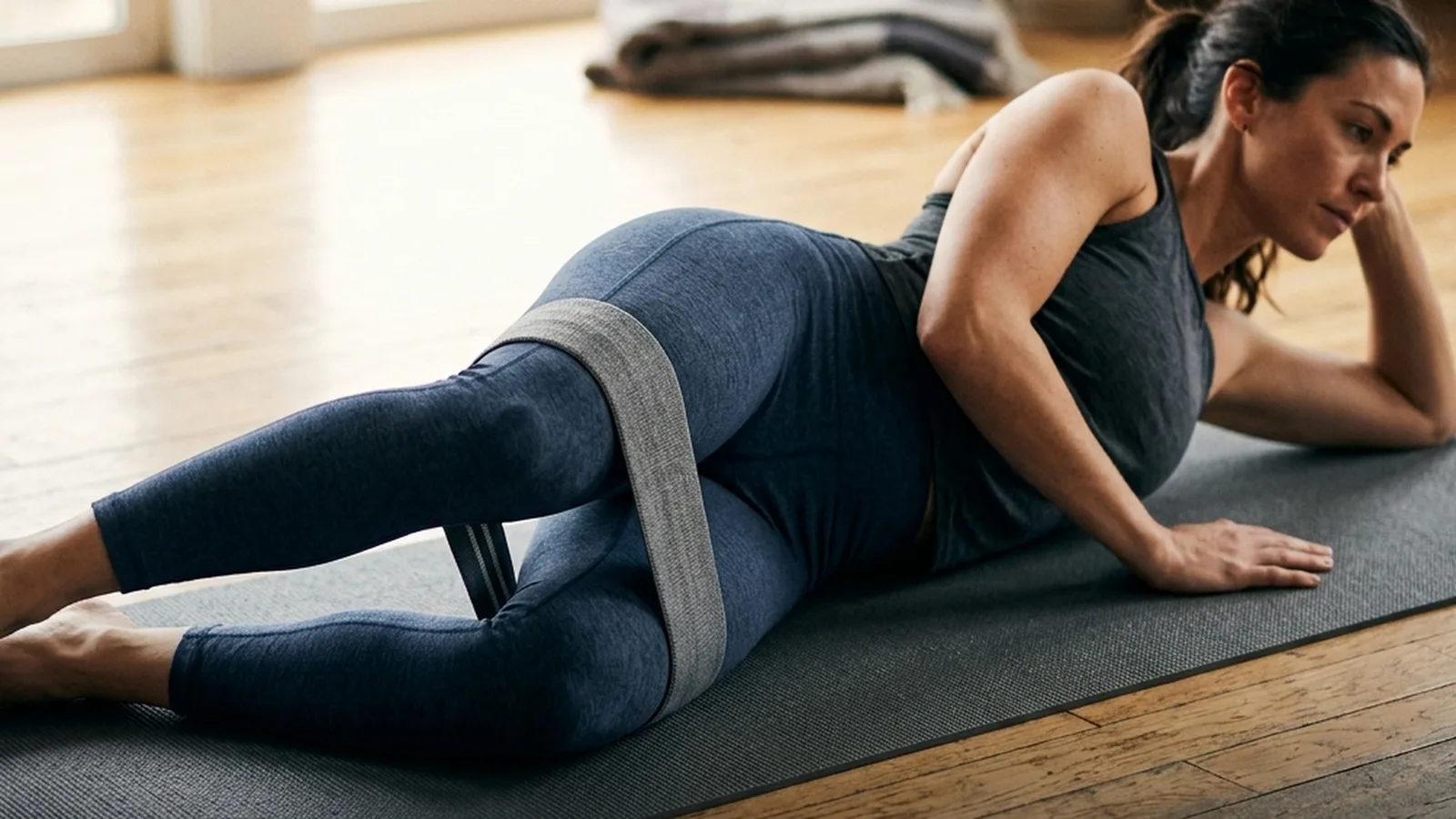
- Clamshells. Side-lying, knees bent at 45°, heels together. Lift the top knee while keeping the heels touching. Pelvis stable. 3 sets of 15-20 per side.
- Banded lateral walks. Resistance band around ankles or above knees, slight athletic squat, walk sideways 10-15 steps each direction. 2-3 sets.
- Single-leg deadlifts. Balance on one leg, hinge at the hip, opposite leg extends back as torso lowers. Trains hip stability + posterior chain in one movement. 2-3 sets of 8-10 per leg.
- Step-downs with control. Stand on a 15-20 cm step, slowly lower the opposite heel to the floor, return. Knee must track straight over the second toe — not collapse inward. 3 sets of 10 per leg.
Two 20-minute sessions weekly for 6-8 weeks is a common prescription in the rehabilitation trials, though response rates vary by trial and population. Rabelo and Lucareli caution that hip weakness may be more a consequence of patellofemoral pain than a proven cause — so consistent practice matters more than chasing a specific mechanical target Rabelo 2018.
What else matters
- Running form: cadence. Increasing step rate by 5-10% reduces the mechanical energy absorbed at the knee by roughly 20-34% without changing pace. Most runners with PFPS benefit from a metronome-paced 5-10% cadence increase during recovery Heiderscheit 2011.
- Volume management. Most PFPS is overuse. Cap weekly running volume at 70-80% of normal during recovery, then progress.
- Footwear. No single shoe type has been shown to prevent or treat PFPS. Comfort matters more than category.
- Pain-free activity. Cycling and swimming usually remain pain-free during PFPS recovery. Don’t stop conditioning — substitute the modality.
When to see a clinician
- Pain that doesn’t improve after 4-6 weeks of consistent hip-focused work
- Swelling, locking, or instability (not typical of PFPS; suggests intra-articular pathology)
- Night pain or rest pain
- Pain following a specific traumatic event
- Bilateral symptoms in someone who’s only training one side hard
Practical takeaways
- The dominant driver of patellofemoral pain in active adults is hip-abductor and hip-rotator weakness, not localised VMO weakness. The VMO theory is outdated.
- The drills that work: side-lying hip abduction, clamshells, banded lateral walks, single-leg deadlifts, controlled step-downs. 6-8 weeks of consistent practice produces meaningful pain reduction in published RCTs, though exact response rates vary by trial and population.
- For runners with PFPS, increase cadence 5-10% — reduces knee energy absorption by roughly 20-30% without changing pace.
- Substitute cycling or swimming during recovery. Don’t stop conditioning — the deconditioning prolongs recovery.
- See a clinician if pain doesn’t improve in 4-6 weeks, or if you have swelling, locking, night pain, or post-traumatic onset.
Frequently asked questions
Will leg extensions fix my runner’s knee?
Probably not. The VMO-isolated approach has been studied and doesn’t outperform general programmes. The current evidence supports hip-focused exercise as the highest-yield intervention. Leg extensions can be part of general strengthening but shouldn’t be the centrepiece.
How do I know if my hip is weak?
Single-leg squat: stand on one foot, descend slowly. If your knee collapses inward (toward the midline) at any point in the descent, hip abductor weakness is likely. A side-lying hip abduction with poor endurance (under 20 reps) on the affected side is another indicator.
How long until hip-focused exercise reduces my knee pain?
Meaningful pain reduction is typical with 8-12 weeks of consistent practice in published trials, though exact response rates vary by trial and population. Expect 3-4 weeks before noticeable improvement; full benefit at 8-12 weeks. The drills are simple but the consistency matters more than the complexity.
Can I keep running while doing this?
Usually yes, at reduced volume and increased cadence. Cap mileage at 70-80% of normal for the first 4-6 weeks. Increase step rate 5-10% (use a metronome app). If pain worsens with running, switch to cycling or swimming for 2 weeks and try again.
Should I get an MRI?
Usually not. Standard PFPS doesn’t have a structural lesion visible on MRI. An MRI is useful if you have swelling, locking, instability, or symptoms that don’t respond to 6+ weeks of conservative care — suggesting something else might be going on (meniscal tear, cartilage defect, plica syndrome).
Does taping help?
Marginally and transiently. The 2018 consensus statement found taping produces small, short-term pain reduction but doesn’t add long-term benefit over exercise alone. Use it for short-term pain control during a competition or hike if helpful; don’t rely on it as primary treatment.
References
Collins 2018Collins NJ, Barton CJ, van Middelkoop M, et al. 2018 Consensus statement on exercise therapy and physical interventions (orthoses, taping and manual therapy) to treat patellofemoral pain. Br J Sports Med. 2018;52(18):1170-1178. View source →Ireland 2003Ireland ML, Willson JD, Ballantyne BT, Davis IM. Hip strength in females with and without patellofemoral pain. J Orthop Sports Phys Ther. 2003;33(11):671-676. View source →Rabelo 2018Rabelo NDDA, Lucareli PRG. Do hip muscle weakness and dynamic knee valgus matter for the clinical evaluation and decision-making process in patellofemoral pain? Braz J Phys Ther. 2018;22(2):105-109. View source →Heiderscheit 2011Heiderscheit BC, Chumanov ES, Michalski MP, Wille CM, Ryan MB. Effects of step rate manipulation on joint mechanics during running. Med Sci Sports Exerc. 2011;43(2):296-302. View source →