The 60-second version
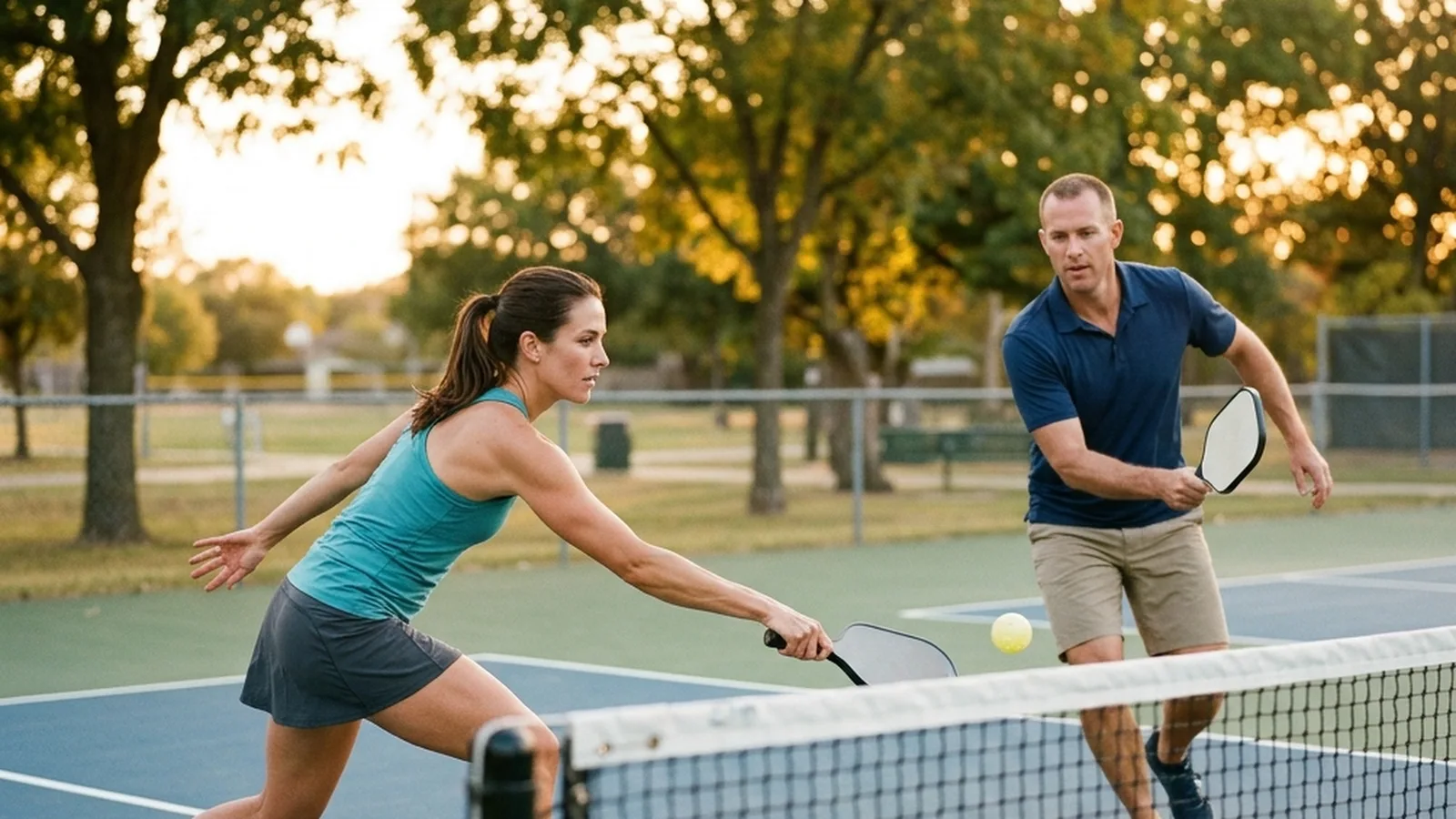
Pickleball is one of the fastest-growing sports in North America, and its growth pattern in Wasaga Beach mirrors the national trend. The sport combines tennis-like strokes with badminton-court geometry and a slower-moving plastic ball, producing comparable cardiovascular benefits to tennis with meaningfully lower joint impact. The published research on pickleball physiology is small but consistent (Smith 2018; Casper et al. 2023; Buzzelli & Draper 2020): heart rates of 110–150 bpm during active play, energy expenditure of 350–500 kcal per hour, and skill curves that experienced tennis players can translate in 2–3 sessions. For Wasaga residents, the Wasaga Beach Pickleball Club’s six outdoor courts at 425 River Road West (beside the decommissioned Wasaga Stars Arena) are the town’s main organised local option. The sport works particularly well as a tennis-substitute for adults whose knees, hips, or shoulders no longer tolerate tennis but who miss the racquet-sport social structure.
Educational journalism, not medical advice. Every claim here is checked against its cited sources by editor Timothy Bunce — a health writer, not a physician. It isn’t specific to your situation: for health decisions, talk to your own clinician. How we work →
Some links in this article are affiliate links. If you buy through one, The Beachside Reader earns a commission at no extra cost to you. It never changes which products we pick, or what we say about them. Full affiliate disclosure →
What pickleball is, in brief
Pickleball is a paddle sport invented in 1965 on Bainbridge Island, Washington. The court is the size of a doubles badminton court (13.4 metres long, 6.1 metres wide), with a low net (914 mm at the sidelines, 864 mm at the centre). The ball is a perforated plastic ball similar to a wiffle ball, lighter and slower than a tennis ball. Paddles are solid (no strings) and approximately the size of a large table tennis paddle.
The basic rules:
- Underhand serve: the serve is delivered underhand and below waist level, much gentler than a tennis serve.
- Two-bounce rule: the ball must bounce once on each side after the serve before volleys are permitted.
- Non-volley zone (“the kitchen”): a 2.13 metre zone in front of the net where players cannot volley (must let the ball bounce). This rule slows the game and changes the geometry significantly from tennis.
- Scoring: traditional pickleball uses side-out scoring (only the serving team scores), with games typically to 11. Some recreational variants use rally scoring.
- Doubles or singles: doubles is by far the more common format, particularly among recreational and senior players.
The sport scales remarkably well across skill levels: beginners can rally within 5–10 minutes of first picking up a paddle; advanced players develop sophisticated strategy and shot variety over years.
Why it’s growing among the 50+ demographic
Pickleball’s explosive growth among older adults has multiple causes that are visible in the local Wasaga and broader Simcoe County context:
- Lower joint impact than tennis: smaller court means less running; lighter ball means less arm load. Adults whose knees no longer tolerate tennis often play pickleball comfortably.
- Faster skill acquisition: the slower ball and smaller court make beginners competitive within a few sessions. Tennis takes months of beginner play to feel competent.
- Social structure: doubles play with frequent partner changes is the norm. The social benefit is integrated into the activity.
- Court availability: pickleball courts can be lined on existing tennis courts (1 tennis court fits 2–4 pickleball courts), making the sport cheap to install.
- Cost: paddles and balls are inexpensive; court fees are typically free at municipal facilities.
- Time efficiency: a meaningful pickleball game takes 20–40 minutes; a meaningful tennis match takes 60–120 minutes.
- Year-round playability: outdoor courts in summer, indoor courts in winter (community centres, repurposed gymnasiums).
The demographics: national participation data complicate the sport’s early reputation as strictly a retirees’ pastime. The Association of Pickleball Players’ 2023 nationwide survey put the average age of avid players at 34.8, with more than 70% between 18 and 44. Even so, the 55+ bracket remains a highly visible share of recreational and club play, and competitive senior divisions (50+, 60+, 70+, 80+) are well established through USA Pickleball and Pickleball Canada. For how a sport like this fits into a broader plan, see our guide to training well after 50.
The physiological profile of pickleball
The published research on pickleball physiology gives a clear picture:
- Heart rate: typical recreational doubles play produces heart rates of 110–150 bpm in 50–75-year-olds, equivalent to moderate-intensity exercise. Singles play and competitive doubles push higher, into 140–170 bpm in fit players.
- Energy expenditure: 350–500 kcal per hour for typical doubles play. Singles play exceeds this; competitive play can reach 600–700 kcal per hour.
- Movement patterns: short bursts of forward, lateral, and backward movement. Total distance covered is roughly 1.5–3 km per hour of doubles play, fragmented into short sprints with rest.
- Joint loading: qualitatively lower than tennis — a smaller court (less running) and a slower ball (less aggressive change-of-direction) reduce knee and hip stress, though no peer-reviewed study has yet quantified the exact size of the difference.
- Upper body: the volley-and-dink pattern uses shoulder, forearm, and grip muscles continuously. Less aggressive than tennis groundstrokes but with more sustained engagement.
- Reactive demands: hand-eye coordination, anticipation, and reaction time are loaded throughout. The cognitive engagement is part of the activity’s value for older adults.
The cumulative profile: comparable cardiovascular work to a brisk walk or moderate jog — see our breakdown of zone-2 versus interval training for how that intensity zone maps to training goals — plus reactive-cognitive work, plus social interaction, in a structure most participants find more engaging than treadmill or stationary bike.
The tennis-to-pickleball transition
For adults transitioning from tennis (because of joint limitations, time constraints, or simply curiosity), pickleball is a natural substitute. The transition mechanics:
- Stroke mechanics translate well: forehand, backhand, volleys all have direct equivalents. The grip is similar (continental for serve and volley; eastern for groundstrokes).
- Footwork translates with adjustment: the smaller court demands quicker, smaller steps. Big tennis sprints aren’t needed and are often counterproductive.
- Strategy is different: the non-volley zone (kitchen) creates a strategic dimension tennis lacks. Most points are won at the net through sustained dinking exchanges, not from the baseline.
- The serve is dramatically simpler: underhand only, no overhead serve. This eliminates a complex skill (and a common shoulder-stress pattern in older tennis players).
- Reflexes matter more: the small court and the non-volley zone produce frequent net-play exchanges that demand fast hands and anticipation.
- Pace control: the lighter ball means experienced pickleball players use angle and placement more than power. This rewards strategy over athleticism.
Most tennis players reach a competent recreational pickleball level within 2–5 sessions. The frequent failure mode is over-hitting the ball (tennis power applied to a light plastic ball produces unforced errors); the adjustment is mostly about restraint and ball control rather than learning new skills.
Where to play pickleball in the Wasaga area
The Wasaga Beach area has been adding pickleball capacity over the past several years, with both dedicated outdoor courts and tennis-court overlay. Verify current availability and conditions with the Town of Wasaga Beach Recreation department; the inventory shifts year to year:
- Wasaga Beach Pickleball Club: the town’s dedicated venue is six outdoor courts at 425 River Road West, beside the decommissioned Wasaga Stars Arena, run as a volunteer club (May–October season, weather-dependent). Rec-level play welcomes all skill levels; see the club’s Pickleball Canada listing or email wasagapc@gmail.com for current schedules and membership.
- Nearby municipalities: Collingwood, Stayner, and other Clearview Township / Simcoe County communities have their own courts, and availability (including indoor winter options) changes year to year — check each municipality’s recreation department directly.
- Private clubs: some Wasaga and Collingwood private fitness clubs include pickleball as a member amenity.
For first-time players, the most accessible entry is usually one of the open-play sessions organised by local clubs. These are typically welcoming to beginners and provide informal coaching from experienced members.
Getting started: a practical 30-day onboarding
For an adult new to pickleball:
- Days 1–3: borrow or buy a basic paddle ($30–80 for a starter paddle is fine). Watch 30–60 minutes of YouTube videos covering rules, basic strokes, and the non-volley zone strategy.
- Days 4–7: first court session. If possible, attend a beginner clinic or open-play night. Focus on rules and basic stroke mechanics, not winning.
- Week 2: 2–3 court sessions. Basic competence with serves, returns, and groundstroke rallies. Begin to feel the non-volley-zone strategy.
- Week 3: 3 court sessions per week. Add structured drills (dinking practice, third-shot drops) for 15–20 minutes before play.
- Week 4: 3 court sessions per week. Begin tournament-style scoring matches against players of similar level. Watch experienced doubles to absorb strategy.
- Beyond month 1: maintain 3 court sessions per week for steady development. Consider a few sessions with a coach for technique refinement.
Most beginners reach “3.0” recreational level (the standard pickleball rating system goes from 1.0 to 5.5+) within 2–3 months of consistent play. Many recreational players plateau at 3.0–3.5 and stay there indefinitely — which is fine for the social and fitness benefits. On rest days, the equipment-free bodyweight work at Wasaga’s outdoor park fitness stations complements the calf, ankle, and shoulder conditioning pickleball demands.
Injury prevention
Despite the lower joint impact than tennis, pickleball does produce specific injury patterns that are worth knowing:
- Calf strain (“pickleball calf”): the rapid forward starts produce acute calf strains, particularly in players new to the sport or returning from a break. Warm up properly; build conditioning gradually.
- Achilles tendinopathy: the same rapid starts that strain calves can stress Achilles. Calf flexibility work and progressive volume reduce risk.
- Lateral ankle sprains: cutting and stopping on the small court. Court shoes (not tennis shoes or running shoes) provide better lateral support; ankle bracing for predisposed players helps.
- Shoulder issues: the volley pattern can aggravate rotator cuff issues in players with prior shoulder problems. Modify technique; consider physical therapy for chronic issues.
- Eye injuries: protective eyewear prevents the rare-but-serious eye injury from a ball or paddle strike. Most experienced players wear sport glasses.
- Falls: the small court increases collision risk in doubles play; communicate with your partner to prevent collisions on cross-court balls.
The general injury-prevention pattern: warm up properly (5–10 minutes of dynamic mobility plus 5 minutes of light hitting), wear court shoes designed for lateral movement, build volume gradually, and respect persistent pain.
Equipment fundamentals
- Paddle: starter paddles ($30–80) are sufficient for the first few months. Better paddles ($100–200) provide more control and feel; serious players invest in higher-end paddles ($200+) but the marginal benefit at recreational level is small.
- Balls: standard outdoor balls (40 holes) and indoor balls (26 holes) differ. Use the right ball for the surface.
- Shoes: court shoes designed for tennis or pickleball, with lateral support and herringbone tread. Running shoes don’t provide lateral stability; the wrong shoes increase ankle injury risk.
- Eyewear: sport glasses with shatter-resistant lenses. Standard sunglasses or reading glasses are not sufficient for ball-strike protection.
- Clothing: athletic wear that allows full range of motion. Sun protection (hat, UPF shirt) for outdoor summer play.
- Bag: a small sport bag carries paddle, balls, water bottle, towel.
Practical takeaways
- Pickleball produces 110–150 bpm heart rates, 350–500 kcal/hour in recreational doubles play — comparable to a brisk walk or moderate jog.
- Joint loading is lower than tennis (the exact size of the difference hasn’t been quantified in peer-reviewed research); particularly suitable for adults transitioning from tennis due to joint limitations.
- Tennis-to-pickleball transition: most tennis players reach competent recreational level in 2–5 sessions. Restraint, not power, is the key adjustment.
- Wasaga and surrounding municipalities have growing pickleball capacity; check current municipal recreation programming.
- Calf and Achilles injuries are the dominant pickleball-specific injury patterns; gradual volume progression and proper warm-up reduce risk.
- Court shoes (lateral support) and eyewear are the essential safety equipment.
Frequently asked questions
Is pickleball really easier on the joints than tennis?
For most players, yes. The smaller court means less running; the lighter ball means less arm load; the strategy emphasises placement over power. The published research consistently shows lower joint loading. The exception: pickleball produces calf strains at higher rates than tennis (the rapid forward starts in a small space), so calf-and-Achilles conditioning matters.
What about beginners who don’t have any racquet-sport background?
Pickleball’s low barrier to entry makes it more accessible than tennis for absolute beginners. The slower ball gives more reaction time, the smaller court means easier movement, and the underhand serve is much simpler than tennis. Most non-racquet-sport beginners play recreational pickleball within 3–5 sessions.
How does pickleball compare to other racquet sports for fitness?
Tennis: similar cardiovascular work but higher joint impact. Squash and racquetball: higher cardiovascular intensity but with more joint stress. Badminton: similar smaller-court geometry but typically lower cardio intensity. Pickleball sits at a sweet spot of accessible cardiovascular work with relatively low joint impact.
Are there competitive levels for pickleball?
Yes — the rating system runs from 1.0 (beginner) to 5.5+ (professional level), with 3.0–4.0 covering most committed recreational players. Tournaments at all levels run regularly; USA Pickleball and Pickleball Canada both maintain tournament listings. Senior age-group competition (50+, 60+, 70+, 80+) is well-developed.
Can I play pickleball outdoors in the Wasaga winter?
Outdoor courts in Ontario typically close late October to early April due to snow and freeze-thaw cycles. Indoor pickleball is the winter option — community centres, repurposed gymnasiums, and dedicated indoor pickleball facilities have expanded substantially in the past 5 years. The Wasaga-Collingwood area has indoor options.
References
Smith 2018Smith LE, Buchanan CA, Dalleck LC. The acute and chronic physiological responses to pickleball in middle-aged and older adults. Int J Res Exerc Physiol. 2018;13(2):21-32. View source →Casper et al. 2023Casper JM, Bocarro JN, Drake NR. Physical activity associated with older adult pickleball participation: a pilot study. Recreat Sports J. 2023;47(1):49-56. View source →Buzzelli & Draper 2020Buzzelli AA, Draper JA. Examining the motivation and perceived benefits of pickleball participation in older adults. J Aging Phys Act. 2020;28(2):180-186. View source →USA PickleballUSA Pickleball Association — Official rules, equipment standards, and player resources. View source →Pickleball CanadaPickleball Canada — National governing body for pickleball in Canada. View source →