The 60-second version
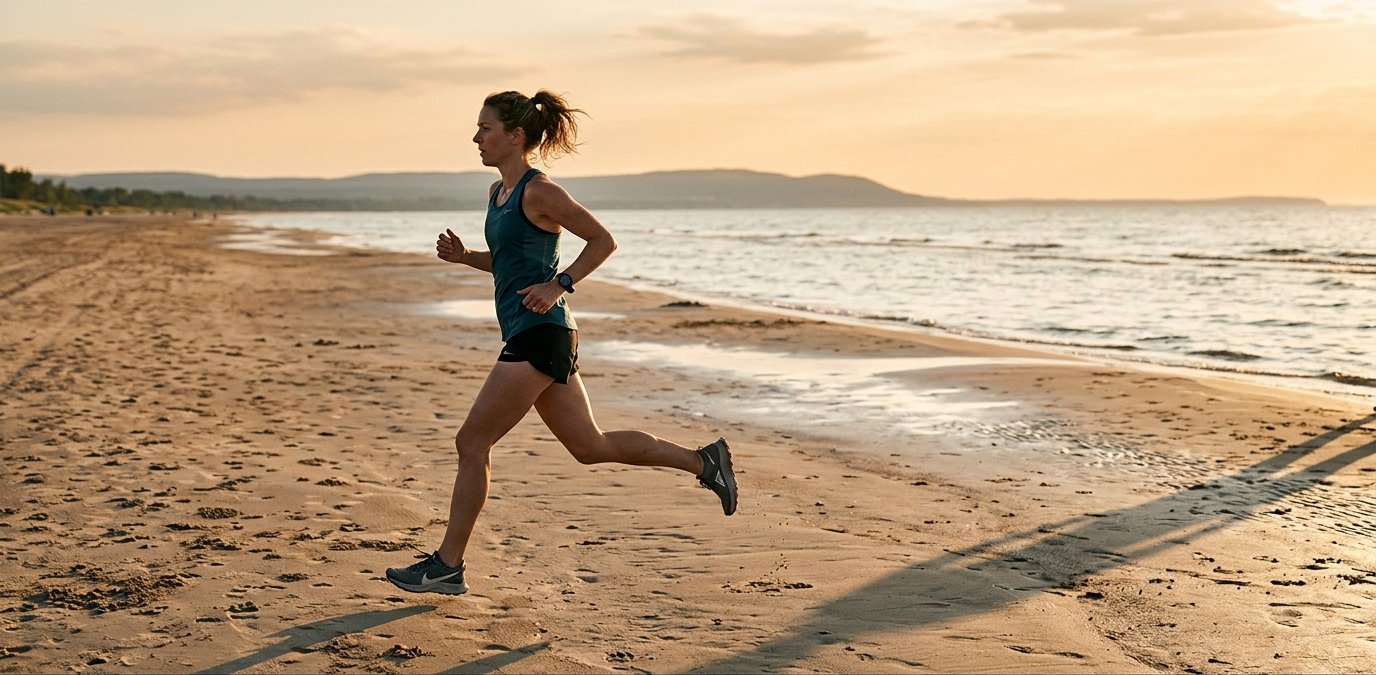
Jumping training (plyometrics) on sand reduces the impact on your knees and ankles by 25–50% — great for athletes returning from injury. The catch: the same softness dampens the “spring” that builds explosive power on hard surfaces. Sand-only training won’t make a basketball player jump higher.
Two trade-offs in one decision Impellizzeri 2008:
- Soft landings: protect the joints when chronic load is the concern
- But: the soft landing absorbs the spring-back energy that trains explosive power on a hardwood court
So the right choice depends on your sport:
- Beach volleyball — sand-only training works, because the sport is played on sand
- Court sports (basketball, volleyball, tennis): need a mix of sand and hard-surface plyometrics
- Returning from a knee or ankle injury: sand is the rehab tool; transition back to hard surfaces gradually
The honest protocol is dose-controlled, mixes surfaces, and trains the specific motor pattern your sport demands — not just “more reps.”
Educational journalism, not medical advice. Every claim here is checked against its cited sources by editor Timothy Bunce — a health writer, not a physician. It isn’t specific to your situation: for health decisions, talk to your own clinician. How we work →
Some links in this article are affiliate links. If you buy through one, The Beachside Reader earns a commission at no extra cost to you. It never changes which products we pick, or what we say about them. Full affiliate disclosure →
What the evidence actually says
Impellizzeri compared a 4-week sand-based plyometric program against an equivalent grass-based program in soccer players. Both groups improved jump height and sprint speed, but the sand group reported significantly less muscle soreness and quadriceps tenderness during the program Impellizzeri 2008. The lower delayed-onset soreness reflects the lower eccentric loading on the yielding surface. The trade-off shows up in performance specificity. Giatsis measured ground-reaction forces during identical jump tasks on hard ground vs sand. Sand substantially reduced peak forces — protective for the joints, but it also means the lower-limb is being trained at a different intensity than competition demands Giatsis 2004.
The clearest pattern across the surface-comparison studies above is on tissue loading, not raw performance: soreness and peak ground-reaction forces are reliably lower on sand, while jump-height and sprint gains vary depending on what's measured and where the athlete competes.
The data on transfer is mixed. Binnie’s review of the sand-training literature found evidence that sand-based conditioning can transfer to firm-ground performance, but no equivalent evidence that firm-ground training builds sand-specific performance — a one-way relationship that points to surface-specific motor recruitment Binnie 2014. The implication is straightforward: train where you compete for at least 50% of session time, regardless of how comfortable the alternate surface feels.
How it actually works
Plyometric training drives adaptation via the stretch-shortening cycle: a rapid eccentric (lengthening) muscle action immediately followed by a concentric (shortening) action. The fast eccentric pre-loads the elastic components of the muscle and tendon, and the later concentric action releases that stored energy Komi 2000. On hard ground, the ground reaction force during landing is high and brief, producing a strong stretch reflex. On sand, the ground deforms during the landing phase, dispersing some of the impact energy and slowing the transition between eccentric and concentric — a longer, gentler stretch-shortening cycle that develops different motor patterns.
The Achilles tendon and patellar tendon are the structures most affected by surface change. Both store and release elastic energy during the landing-takeoff cycle, and both adapt to the specific loading rate they encounter most often. Sand is generally understood to lower that loading rate and shift tissue adaptation toward a more compliant, distance-oriented profile — a reasonable fit for running on yielding surfaces but a poor substitute for the stiffer, faster stretch-shortening demands of sprinting on track. Coaches who use sand for everything end up training athletes whose tendons are not optimized for their competition surface.
The neuromuscular side adds nuance. Sand’s instability during single-leg landings demands continuous frontal-plane stabilization, and Binnie’s review likens habitual sand training to unstable-surface training methods shown to improve balance and lower-limb injury-risk profiles Binnie 2014. That added stabilization demand is one reason sand single-leg work may carry some value for landing mechanics, even in athletes whose sport is on grass or court.
“Sand training appears to be an effective alternative to grass training for plyometric exercises, with the additional benefit of less muscle soreness in the days after training.”
— Impellizzeri et al., British Journal of Sports Medicine, 2008 view source
Dose control: what most beach programs get wrong
The most common error in sand plyometric programming is excessive volume. Because perceived exertion per rep is lower (the soft landing feels easier), athletes often perform more total ground contacts than they would on hard ground. Davies’ plyometric dosage guidelines cap beginners at 80-100 total ground contacts per session, rising to 100-120 for intermediate and 120-140 for advanced athletes Davies 2015; exceeding the ceiling for your level is a common driver of calf and Achilles overuse symptoms. Counts include both single- and double-leg landings; box jumps with a sand landing count as one contact each, depth jumps as two.
The corrective protocol is straightforward: build over 4-6 weeks to a maximum of 120 contacts per session in beginners, 160 in intermediates, 200 in advanced. Sessions twice per week with 72 hours between them; never two consecutive plyometric days. The yielding-surface advantage in soreness can mask early Achilles symptoms; pay attention to morning stiffness as a more reliable signal than session-end pain.
Surface-mixing matters too. Because sand-only training does not reliably transfer to harder competition surfaces, alternating sand and hard-surface plyometrics within the same week is the more defensible approach for athletes who compete on hard ground. The mixed program teaches the nervous system to switch between elastic-loaded and dampened-loaded landings, which is closer to the variability of actual play.
Who should be careful
Four populations should approach sand plyometrics with extra caution. First, anyone with prior lateral ankle sprain or unrehabilitated chronic ankle instability. The yielding surface allows the foot to evert during landing, and the unstable single-leg landings that sand makes valuable are the same ones that re-injure compromised ankles Witchalls 2012. Rebuild proprioception on firm sand or grass before progressing to soft-sand single-leg work.
Second, runners with active or recent Achilles tendinopathy. The sand surface increases time-under-tension on the Achilles per landing, and the neural pattern that adapts — longer fascicles, lower stiffness — can prolong tendon recovery rather than help it. Wait for pain-free hopping on hard ground before adding sand plyometrics back to a return-to-run program.
Third, anyone over 50 starting plyometric training for the first time. Age-related tendon stiffness changes mean the elastic-energy contribution to the stretch-shortening cycle is already reduced; on sand, it is reduced further. Older adults benefit from plyometric work but should start on grass, not sand, and progress to sand only after the basic motor pattern is well-grooved.
Fourth, athletes returning from any lower-extremity surgery. The unpredictable foot orientation on landing can place valgus or varus loads on a healing knee or ankle that the surgical timeline does not anticipate. Surgical clearance for plyometrics generally assumes hard-surface progression; explicit clearance is needed before adding sand.
How to measure progress
Three field tests track plyometric adaptation reliably. First, the countermovement jump (CMJ) measured with a smartphone app or jump mat: a 5-10% improvement over 6 weeks is the typical responder range. CMJ height is worth tracking specifically because it correlates strongly with sprint speed and change-of-direction performance in athletic populations, not just isolated vertical power Pereira 2018.
Second, the drop jump from 30 cm: track contact time and jump height. The reactive strength index (jump height ÷ contact time) is a widely used single measure of explosive efficiency in plyometric training. A 10-15% improvement over 8 weeks indicates the program is working as designed.
Third, weekly soreness rating on a 0-10 scale, 24 and 48 hours after each session. Persistent ratings of 6+ at 48 hours are a volume signal — pull volume back 20% for two weeks, then progress again. Soreness that resolves within 24 hours, even at high session volumes, is generally a sign the program is in a manageable range.
The caveats people skip
The second underdiscussed point is rotational injury risk. The yielding surface allows the foot to twist slightly during landing, which most athletes adapt to, but anyone with previous lateral ankle sprains or unrehabilitated meniscal issues should not perform single-leg plyometrics on soft sand without a proprioceptive base. Build the base on hard sand or grass first.
The marketing claim that “sand plyometrics burn 50% more calories” is a different category of error. The metabolic cost is higher, but plyometric training is a neural and elastic-tissue stimulus, not a calorie-burn tool. Programming sand plyometrics for fat loss substitutes one trainable adaptation for another and produces neither well. If fat loss is the goal, walking the soft sand is more efficient and less injurious than jumping on it.
Practical takeaways
- Use sand plyometrics for introduction, recovery, or unstable-surface stimulus — not as a permanent replacement for hard-ground work. The reduced impact is great for managing chronic load but reduces the stretch-reflex stimulus over time.
- Cap beginner sessions at 60-80 ground contacts; build to 120 over 4-6 weeks; never two consecutive plyometric days. The lower per-rep stress is misleading; cumulative tissue load is similar.
- Mix surfaces 50/50 if you compete on hard ground. Pure-sand training does not reliably transfer to harder competition surfaces, so matching your training surface to your competition surface for at least half of sessions is the safer default.
- Skip single-leg plyometrics on soft sand if you have ankle-instability history. Rebuild proprioception on firm sand or grass first.
- Track CMJ height, drop-jump reactive strength index, and 48-hour soreness rating weekly. Stalled CMJ + persistent 48-h soreness means volume is too high.
- Land softly with hip flexion. The temptation on sand is to land flat-footed because it feels safe; flat landings rob the stretch-shortening cycle of its main benefit.
Frequently asked questions
Is sand plyometric training really safer?
Per ground contact, yes — peak force is substantially reduced on sand vs hard ground (Giatsis 2004). But athletes often do more contacts on sand because it feels easier, raising cumulative load. Track the contact count, not the perceived effort.
Can sand plyometrics replace hard-surface jumps?
For beach-volleyball athletes, yes, and mixing in sand work can help other sports too — Binnie 2014's review found sand-based training transfers to firm-ground performance, though the reverse (firm-ground training improving sand performance) isn't established. Mix 50/50.
How many ground contacts per session?
Beginners: 60-80, building to 120 over 4-6 weeks. Intermediate: 80-160. Advanced: 120-200. Counts include both single- and double-leg landings.
How long until adaptation shows up?
Countermovement jump improvements typically appear at 4-6 weeks of consistent training (2-3 sessions per week) in untrained subjects. Reactive strength index (jump height ÷ contact time) is the most sensitive single measure.
Should I land barefoot or in shoes?
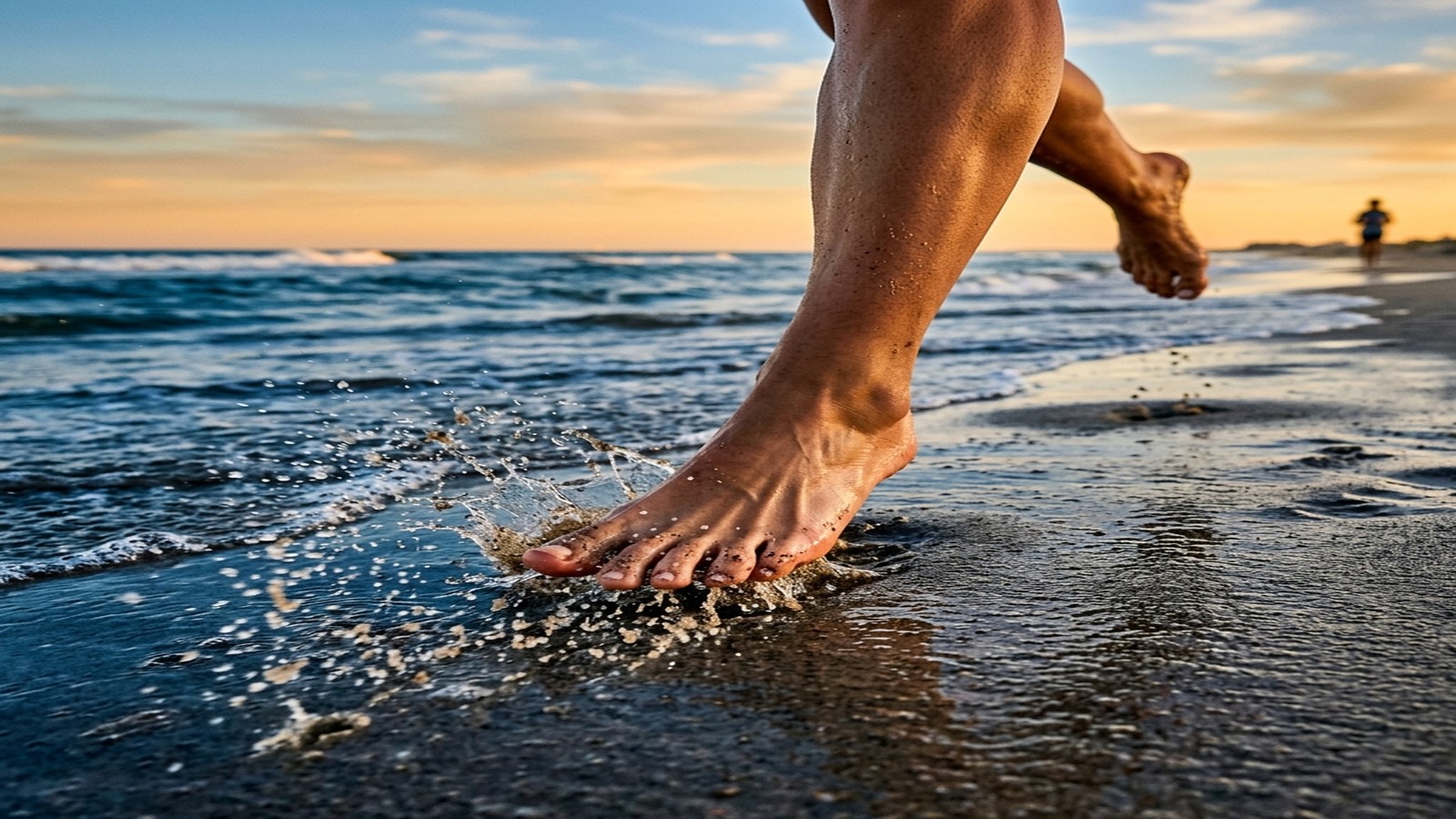
Shoes provide ankle-collar support that reduces eversion injury risk on sand. Barefoot is appropriate only after sustained conditioning of the intrinsic foot muscles.
Will sand plyometrics help with ACL prevention?
Possibly, indirectly — sand's instability during single-leg landings demands extra frontal-plane stabilization, which Binnie 2014's review likens to unstable-surface training shown to improve balance and lower-limb injury-risk profiles; that stabilization demand may carry some benefit for landing mechanics.
How do I know if I'm overdoing it?
Persistent soreness rating of 6+ at 48 hours, morning Achilles or calf stiffness that takes more than 5 minutes to resolve, or stalled jump-height progression after 4 weeks. Pull volume back 20% for two weeks, then progress.
References
Impellizzeri 2008Impellizzeri FM, Rampinini E, Castagna C, et al. Effect of plyometric training on sand versus grass on muscle soreness and jumping and sprinting ability in soccer players. British Journal of Sports Medicine. 2008;42(1):42-46. View source →Giatsis 2004Giatsis G, Kollias I, Panoutsakopoulos V, Papaiakovou G. Biomechanical differences in elite beach-volleyball players in vertical squat jump on rigid and sand surface. Sports Biomechanics. 2004;3(1):145-158. View source →Komi 2000Komi PV. Stretch-shortening cycle: a powerful model to study normal and fatigued muscle. Journal of Biomechanics. 2000;33(10):1197-1206. View source →Davies 2015Davies G, Riemann BL, Manske R. Current concepts of plyometric exercise. International Journal of Sports Physical Therapy. 2015;10(6):760-786. View source →Pereira 2018Pereira LA, Nimphius S, Kobal R, et al. Relationship between change of direction, speed, and power in male and female national olympic team handball athletes. Journal of Strength & Conditioning Research. 2018;32(10):2987-2994. View source →Binnie 2014Binnie MJ, Dawson B, Pinnington H, Landers G, Peeling P. Sand training: a review of current research and practical applications. Journal of Sports Sciences. 2014;32(1):8-15. View source →Witchalls 2012Witchalls J, Blanch P, Waddington G, Adams R. Intrinsic functional deficits associated with increased risk of ankle injuries: a systematic review with meta-analysis. British Journal of Sports Medicine. 2012;46(7):515-523. View source →