The 60-second version
Balance is a skill that declines steadily after age 50 and accelerates after 70, and the consequences (falls, fractures, hospitalisation, mortality) are large enough that balance training is one of the highest-leverage exercise interventions for older adults. The 2019 Sherrington et al. Cochrane meta-analysis pooled 108 trials (n=23,407 older adults) across all exercise types; within it, a 39-trial subgroup (n=7,920) found balance and functional exercise programs reduced fall rate by ~24% among community-dwelling adults Sherrington 2019. The 2015 Lesinski et al. meta-analysis showed clear dose-response: at least 11–12 weeks of training, with 3 or 6 sessions per week, ~11–15 minutes per session, produced the largest balance-performance outcomes in healthy young adults Lesinski 2015. The honest practical points: balance is more trainable than most assume; proprioception responds to specific challenge; combined balance + strength + endurance programs (e.g., Otago) beat balance work alone. This article covers the evidence, the protocols with reasonable data, and how to integrate balance work into existing routines for adults 50+ and athletes.
Educational journalism, not medical advice. Every claim here is checked against its cited sources by editor Timothy Bunce — a health writer, not a physician. It isn’t specific to your situation: for health decisions, talk to your own clinician. How we work →
Some links in this article are affiliate links. If you buy through one, The Beachside Reader earns a commission at no extra cost to you. It never changes which products we pick, or what we say about them. Full affiliate disclosure →
Why balance matters
- Falls are the leading cause of injury death in adults 65+ in most developed countries.
- ~30% of community-dwelling adults 65+ fall each year; ~50% of 80+.
- Hip fractures from falls have ~20% one-year mortality.
- Even non-injurious falls reduce confidence and physical activity, accelerating decline.
- For athletes, proprioception underlies sport-specific reactive ability and injury prevention (especially ankle and knee).
What the research supports
- Sherrington 2019 Cochrane review: 108 trials, n=23,407 across all exercise types; within it, a 39-trial/7,920-participant subgroup of balance-and-functional-exercise programs reduced fall rate by ~24% Sherrington 2019.
- Lesinski 2015 meta-analysis: identified dose-response thresholds for balance-performance gains in healthy young adults. ~11–12 weeks minimum, 3 or 6 sessions/week, ~11–15 min per session. Effects emerge below this dose but plateau in balance-performance improvement is reached at this level Lesinski 2015.
- Otago Exercise Program: home-based balance + strength program developed in New Zealand. Multiple trials show 35–40% reduction in falls in community-dwelling older adults.
- Tai chi: the 2017 Lomas-Vega et al. meta-analysis pooled 10 tai-chi-falls trials; ~43% reduction in fall rate in the first year, ~13% from the second year onward.
- For athletes: the 2011 Hrysomallis review found that balance training reduces the rate of ankle sprain recurrence, with the strongest evidence in soccer and volleyball populations with a prior sprain history.
Balance and functional exercise programs reduce the rate of falls among community-dwelling older adults by about 24%, with larger effects when balance work is combined with other exercise types.
— Sherrington et al., Cochrane Database, 2019 view source
Protocols with evidence
Otago Exercise Program (older adults)
- 3 sessions per week, ~30 minutes each.
- Strength: knee extension, knee flexion, hip abduction, ankle plantarflexion. Light loads (cuff weights or bodyweight).
- Balance: tandem stance, single-leg stance, tandem walking, sit-to-stand without hand support, heel and toe walking.
- Walking: 30 min/week added between sessions.
- Progressive: increase difficulty as positions become easy.
Tai chi
- 2–3 sessions per week, 60 minutes each, 12+ weeks.
- Yang-style or Sun-style most-studied for falls prevention.
- Slow, weight-shifting, single-leg-stance-heavy practice.
For younger adults / athletes
- Single-leg balance work (eyes open then closed, on stable then unstable surface).
- Bosu / wobble board / foam pad work for sports requiring reactive proprioception.
- Plyometrics with balance demands (single-leg landings).
- 10–15 minutes 2–3x/week is enough.
The 5-minute daily balance ladder
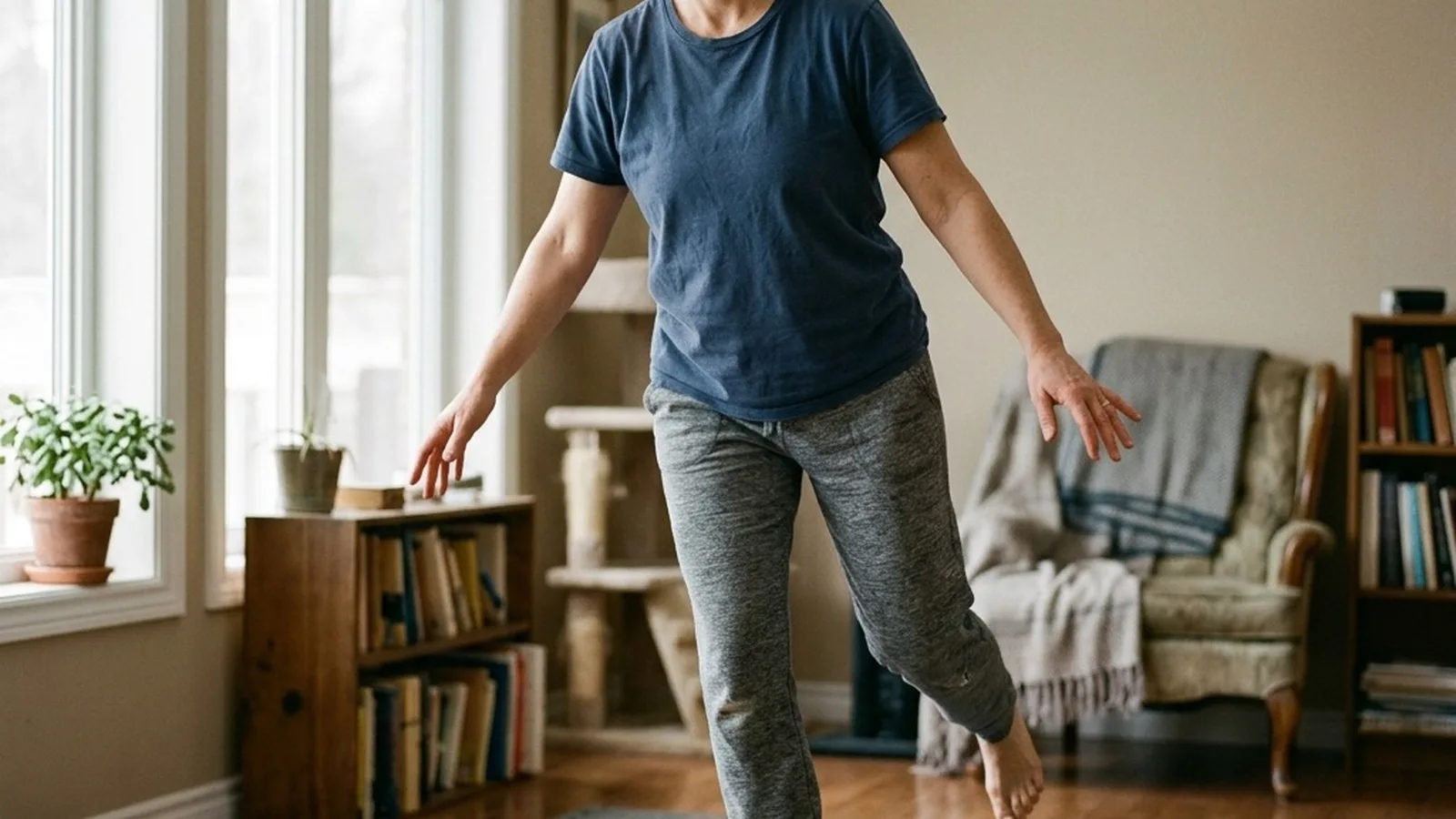
For most adults: spend 5 minutes daily working through a progression of single-leg stances. Level 1: stand on one leg for 30 seconds, eyes open, near a wall for safety. Level 2: 30 seconds with eyes closed. Level 3: 30 seconds on a folded towel. Level 4: 30 seconds on towel + eyes closed. Level 5: tandem walking, 10 steps each direction. Move up a level when current is comfortable. Most adults can progress through the ladder in 8–12 weeks.
Proprioception specifically
Proprioception (joint position sense and reactive balance) is trainable. Findings:
- Eyes-closed work specifically challenges proprioceptive systems by removing visual compensation.
- Unstable surfaces (foam pads, balance boards) increase proprioceptive demand for ankle and hip.
- Sport-specific drills (cutting, single-leg landings, reaction-based footwork) produce the most-transferable improvements.
- Weighted vest work during balance training adds modest stimulus but shouldn’t replace progression of difficulty.
- The 2015 Behm et al. review found that strength training on unstable surfaces improves strength, power, and balance performance across the lifespan; the review itself does not report an injury-rate reduction figure.
When to seek clinical input
- History of falls in the past year.
- Dizziness or vertigo.
- Diagnosed neurological condition (Parkinson’s, peripheral neuropathy, MS).
- Severe orthopaedic limitations.
- Medication-related dizziness (especially blood pressure medications).
- Cognitive impairment that affects judgment during balance work.
Physical therapists are the appropriate first stop for individuals with these factors. Otago and tai chi protocols are general; clinical balance programs target specific deficits.
Common myths
- “Balance is innate.” Wrong. Balance is highly trainable across age groups.
- “You only need balance work after 70.” Balance declines start at 50; prevention beats reactive treatment.
- “BOSU and wobble boards are gimmicks.” Mixed. Useful for sport-specific proprioception; less useful for general fall prevention than single-leg work on stable surfaces.
- “A few minutes of balance work isn’t worth it.” Wrong. The Lesinski 2015 dose-response work shows measurable effects from short, frequent sessions, with the largest balance-performance gains at 3 or 6 sessions per week of just 11–15 minutes each, sustained for 11–12 weeks.
Practical takeaways
- Balance training reduces falls in older adults by ~24%.
- Effective dose: 2–3 sessions per week, 30–60 min, 12+ weeks.
- Otago program and tai chi have strongest evidence for older adults.
- Single-leg stance progressions, eyes-closed work, and tandem walking cover most needs.
- For athletes: balance training is linked to reduced ankle-sprain recurrence, particularly in soccer and volleyball.
- Combined balance + strength + endurance programs beat balance work alone.
- Clinical input warranted for fall history, dizziness, or neurological conditions.
Frequently asked questions
How much balance training do I need?
About 11 to 15 minutes per session, 3 or 6 times per week, for at least 11 to 12 weeks. The 2015 Lesinski meta-analysis identified this as the dose at which balance-performance gains plateau in healthy young adults; older-adult fall-prevention programs like Otago and tai chi instead use longer sessions of about 30 to 60 minutes and are backed by their own separate falls-outcome trials. Below this dose effects exist but are smaller; above it, returns diminish.
Are BOSU balls and wobble boards useful?
For sport-specific proprioception in athletes, yes. For general fall prevention in older adults, less so — single-leg stance work on stable surfaces and tandem walking have stronger evidence per minute spent. Add unstable-surface work as a progression after stable-surface single-leg work has become easy.
Is tai chi worth doing?
Yes, the evidence is substantial. The 2017 Lomas-Vega et al. meta-analysis pooled 10 tai-chi falls trials; fall rate was reduced by about 43% in the first year of practice and by about 13% from the second year onward. Tai chi works particularly well for older adults who don't enjoy gym-style training, and produces social benefits alongside the balance training.
I'm 45 — do I need to worry about balance yet?
Worth starting now. Balance declines begin around 50 but the rate is highly modifiable; people who maintain balance practice through the 50s and 60s decline much more slowly. 5 minutes a day of single-leg stance work integrated into other routines (brushing teeth, waiting for coffee) is enough to maintain.
If I lift weights, do I need separate balance work?
Some, yes. Lifting builds strength but not balance specifically. Single-leg variations of compound lifts (single-leg deadlifts, Bulgarian split squats, single-arm presses) bridge the gap. For dedicated balance training: 5 to 10 minutes 2 to 3x/week is enough on top of strength work.
References
Sherrington 2019Sherrington C, Fairhall NJ, Wallbank GK, et al. Exercise for preventing falls in older people living in the community. Cochrane Database Syst Rev. 2019;1(1):CD012424. View source →Lesinski 2015Lesinski M, Hortobágyi T, Muehlbauer T, Gollhofer A, Granacher U. Dose-response relationships of balance training in healthy young adults: a systematic review and meta-analysis. Sports Med. 2015;45(4):557-576. View source →Granacher 2011Granacher U, Muehlbauer T, Zahner L, Gollhofer A, Kressig RW. Comparison of traditional and recent approaches in the promotion of balance and strength in older adults. Sports Med. 2011;41(5):377-400. View source →Lomas-Vega 2017Lomas-Vega R, Obrero-Gaitán E, Molina-Ortega FJ, Del-Pino-Casado R. Tai chi for risk of falls. A meta-analysis. J Am Geriatr Soc. 2017;65(9):2037-2043. View source →Hrysomallis 2011Hrysomallis C. Balance ability and athletic performance. Sports Med. 2011;41(3):221-232. View source →Behm 2015Behm DG, Muehlbauer T, Kibele A, Granacher U. Effects of strength training using unstable surfaces on strength, power and balance performance across the lifespan. Sports Med. 2015;45(12):1645-1669. View source →Campbell 1997Campbell AJ, Robertson MC, Gardner MM, Norton RN, Tilyard MW, Buchner DM. Randomised controlled trial of a general practice programme of home based exercise to prevent falls in elderly women. BMJ. 1997;315(7115):1065-1069. View source →Rogers 2003Rogers ME, Rogers NL, Takeshima N, Islam MM. Methods to assess and improve the physical parameters associated with fall risk in older adults. Prev Med. 2003;36(3):255-264. View source →Liu 2009Liu CJ, Latham NK. Progressive resistance strength training for improving physical function in older adults. Cochrane Database Syst Rev. 2009;(3):CD002759. View source →Hewett 2010Hewett TE, Ford KR, Hoogenboom BJ, Myer GD. Understanding and preventing ACL injuries: current biomechanical and epidemiologic considerations. N Am J Sports Phys Ther. 2010;5(4):234-251. View source →Muir 2010Muir SW, Berg K, Chesworth B, Klar N, Speechley M. Quantifying the magnitude of risk for balance impairment on falls in community-dwelling older adults: a systematic review and meta-analysis. J Clin Epidemiol. 2010;63(4):389-406. View source →Low 2017Low DC, Walsh GS, Arkesteijn M. Effectiveness of exercise interventions to improve postural control in older adults: a systematic review and meta-analyses of centre of pressure measurements. Sports Med. 2017;47(1):101-112. View source →