The 60-second version
Cardiovascular training in older adults (60+) produces some of the largest health-benefit effect sizes in all of exercise medicine. The 2018 Powell et al. Physical Activity Guidelines summary found regular aerobic activity in adults 65+ associates with 25–35% reductions in all-cause mortality, 30–40% reductions in cardiovascular events, and 30% reductions in falls Powell 2018. The honest practical points: VO2max declines ~10% per decade after age 30, but training maintains it dramatically better than sedentariness; previously sedentary 65-year-olds can rebuild aerobic capacity to levels of sedentary 50-year-olds within 6–12 months; even very modest doses (90–150 minutes/week) capture most of the mortality benefit. Practical playbook: start where you are, prioritise consistency over intensity, mix moderate continuous work with brief intervals, watch for medication interactions and orthopaedic limits. This article covers the actual dose-response in older populations, the protocols with reasonable evidence, and the medical considerations specific to age.
Educational journalism, not medical advice. Every claim here is checked against its cited sources by editor Timothy Bunce — a health writer, not a physician. It isn’t specific to your situation: for health decisions, talk to your own clinician. How we work →
Some links in this article are affiliate links. If you buy through one, The Beachside Reader earns a commission at no extra cost to you. It never changes which products we pick, or what we say about them. Full affiliate disclosure →
What happens to cardio capacity with age
Aerobic capacity (VO2max) declines with age — but the rate is highly modifiable:
- Sedentary adults: VO2max declines ~10% per decade after 30. By 70, sedentary adults often have VO2max <20 mL/kg/min — near the threshold where activities of daily living become limiting.
- Recreationally active adults: ~5–7% per decade decline.
- Trained masters athletes: ~3–5% per decade decline. The 2017 Lazarus & Harridge work, analysing decades of masters-athlete world-record performances, found a roughly linear decline through the seventh decade of life, with the rate of decline accelerating only from the eighth decade onward.
The decline isn’t inevitable. Training delays it substantially. The 2006 Brawner et al. study validated the “talk test” — how comfortably someone can hold a conversation during exercise — as a reliable, equipment-free way to gauge appropriate training intensity in patients with coronary artery disease, an approach that carries over well to guiding older adults’ cardio sessions.
“Regular physical activity in older adults reduces all-cause mortality, cardiovascular events, type 2 diabetes incidence, and falls. The dose-response curve is steep at the bottom: even modest activity volumes capture most of the protective effect, with diminishing returns at higher volumes.”
— Powell et al., J Phys Act Health, 2018 view source
Dose-response in older adults
The minimum-effective-dose findings in older populations:
- 0–90 weekly minutes: largest per-minute benefit. Most of the mortality protection lives here.
- 90–150 weekly minutes: continued benefit; gets close to maximum mortality reduction.
- 150–300 weekly minutes: near-maximum protection.
- 300+ weekly minutes: diminishing returns; small additional benefit, somewhat increased orthopaedic and overuse risk.
Practical translation: aim for 30–45 minutes of moderate aerobic activity 3–5 times per week. Below that is acceptable starting place; above that is fine but not necessary for the bulk of the health benefit.
Modality selection
Different cardio modalities have different age-related considerations:
Walking
- Ideal default. Low impact, low injury risk, requires no equipment.
- Achieves moderate intensity readily for most older adults (since intensity per pace is higher with age-related capacity decline).
- Pace 4–5 km/h is moderate intensity for most 65+ adults.
Cycling (stationary or outdoor)
- Excellent for those with knee or hip arthritis (low joint loading).
- Recumbent stationary bikes are particularly accessible.
- Outdoor cycling adds balance and reaction-time training.
Swimming and water aerobics
- Best for joint-protective conditioning.
- Social water aerobics classes have additional mood benefits.
- Accessibility limited by pool availability.
Running / jogging
- Possible but not necessary. Higher injury risk than walking, especially for new runners 60+.
- Pre-existing runners can usually continue. New runners 60+ benefit from a slow run-walk progression and a clinician check-in.
Group classes (Zumba, line dancing, water aerobics)
- Combine cardio with social engagement — the 2018 Buchman et al. work links social engagement to cognitive preservation.
- Adherence often higher than solo training.
HIIT / interval work
- Generally safe and effective in older adults when prescribed carefully. The 2017 Robinson et al. work found that high-intensity interval training improved aerobic capacity (VO2max) and skeletal-muscle mitochondrial function in both young and older adults, while resistance training alone did not produce the same aerobic gains.
- Start gentle: 4–6 intervals of 30–60 seconds at “somewhat hard” (RPE 6–7) with full recovery between.
- Caution if uncontrolled hypertension, recent cardiac events, or musculoskeletal issues.
The 4-by-4 protocol
The Norwegian 4-by-4 HIIT protocol has the most evidence in older adults: 4 intervals of 4 minutes at vigorous intensity (RPE 7–8), each separated by 3 minutes of moderate active recovery. Total session ~30 minutes including warmup. The 2007 Wisløff et al. trial in heart failure patients showed dramatic VO2max improvements with this protocol; subsequent work in healthy older adults confirmed similar effects with good safety profile when medically cleared.
Medical considerations specific to age
Older adults are more likely to have medical considerations affecting exercise prescription:
- Beta-blockers: blunt heart-rate response. RPE-based intensity targeting works better than HR-based.
- Diuretics: increased dehydration risk during exercise. Hydration matters more.
- Statins: rarely produce muscle issues, but worth knowing for unexplained soreness.
- Anticoagulants: caution with high-fall-risk activities.
- Diabetes (type 2): monitor for hypoglycaemia during long sessions; carry quick carbs.
- Osteoarthritis: low-impact preferred; pool exercise is excellent.
- Cardiovascular disease: stress test or exercise prescription from a cardiologist warranted before vigorous training.
- Cognitive impairment: routine and structured environments support adherence.
Pre-participation screening
The 2015 ACSM screening recommendations distinguish symptomatic from asymptomatic older adults:
- Asymptomatic, no diagnosed disease, currently inactive: most can begin moderate exercise (walking, light cycling) without medical clearance. Vigorous exercise warrants check-in.
- Diagnosed cardiovascular, metabolic, or renal disease: clinical evaluation before starting any new exercise program.
- Symptomatic (chest pain, dizziness, shortness of breath, palpitations): clinical evaluation before exercise.
- Recent cardiac event: cardiac rehabilitation program rather than self-directed.
Warmup matters more
Cold-tissue injury and cardiovascular stiffness make pre-exercise preparation more important in older adults:
- 5–10 minutes of low-intensity warmup before the main session.
- Gentle dynamic mobility (arm circles, leg swings, hip openers).
- Gradual ramp into target intensity rather than sudden start.
- The 2010 Bishop et al. work on warmup specifically in older adults showed measurable performance and injury-prevention benefits from 8–12 minute warmups vs cold starts.
Don’t skip strength work
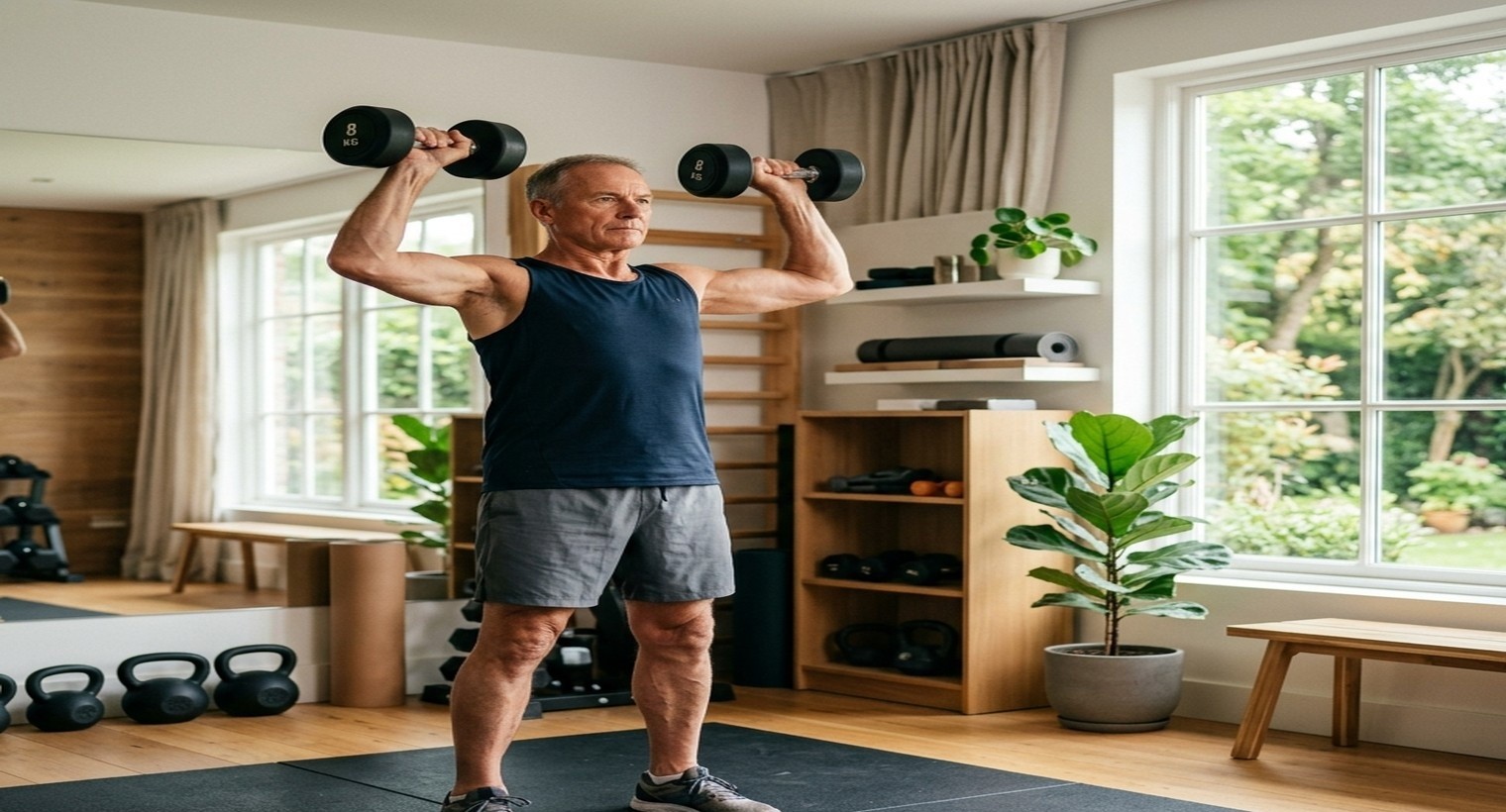
Cardio alone isn’t sufficient for older adults. Broader literature on combined training points to additional benefits beyond cardio alone for:
- Sarcopenia prevention.
- Bone density.
- Fall risk reduction.
- Balance.
- Insulin sensitivity.
Recommendation: 2 strength training sessions per week alongside the cardio. Even very light loads produce meaningful gains in previously untrained older adults. A secondary analysis of the 2014 Liu et al. LIFE-P trial found that older adults with sarcopenia — not just those without it — showed real improvements in physical performance from a combined aerobic, strength, balance, and flexibility program, supporting exercise prescription regardless of muscle-mass status.
Common myths
- “After 60, you should only do gentle exercise.” Wrong. Vigorous exercise is generally safe and produces larger benefits when medically cleared. Don’t under-dose by default.
- “You need a stress test before any exercise.” Not for moderate-intensity activity in asymptomatic adults. The 2015 ACSM update explicitly removed this requirement.
- “HIIT is dangerous for seniors.” Not when prescribed appropriately. The 2007 Wisløff trial in heart failure patients used 4-by-4 protocol with strong safety profile.
- “You can’t rebuild fitness after a long period of being sedentary.” Wrong. Previously sedentary 65-year-olds can rebuild VO2max ~15–20% in 6 months.
- “The benefits don’t apply if you start late.” Wrong. The 2018 Powell guidelines summary confirmed mortality and event-rate reductions in adults starting exercise as late as their 70s and 80s.
Practical takeaways
- Aerobic training in older adults reduces all-cause mortality 25–35% and cardiovascular events 30–40%.
- Most of the benefit comes from the first 90–150 weekly minutes.
- Walking is the safest, most-accessible default; cycling and swimming protect joints; HIIT works when medically cleared.
- Use RPE-based intensity targeting, especially on beta-blockers.
- Add 2 strength training sessions weekly alongside cardio — cardio alone underdoses for older adults.
- Warmup matters more with age; 8–12 minute warmups reduce injury risk and improve performance.
- Most asymptomatic adults don’t need extensive screening for moderate-intensity walking; clinical evaluation is warranted for diagnosed disease, symptoms, or vigorous-intensity programs.
Frequently asked questions
Is it too late to start cardio at 70?
No. The 2018 Powell physical activity guidelines summary explicitly confirmed mortality and cardiovascular event-rate reductions in adults starting exercise as late as their 70s and 80s. Previously sedentary older adults can rebuild VO2max about 15 to 20 percent in 6 months of structured training. Starting late produces real benefits.
Do I need a stress test before walking?
Almost certainly not. The 2015 ACSM screening recommendations explicitly removed the historical 'everyone gets cleared' requirement. Asymptomatic older adults beginning moderate-intensity walking generally don't need extensive screening. Diagnosed cardiovascular disease, symptoms, or vigorous-intensity programs do warrant clinical input.
Should I do HIIT or just walk?
Both work. Walking captures most of the mortality benefit. Adding interval training produces larger VO2max gains and fitness improvements but isn't necessary for general health. The Norwegian 4-by-4 protocol (4 intervals of 4 minutes vigorous, 3 minutes recovery) has good evidence and good safety profile in cleared older adults. Start with walking; add intervals later if interested.
How does being on a beta-blocker affect my training?
Beta-blockers blunt heart-rate response, so HR-based intensity targeting (e.g., 'work at 70 percent of max heart rate') doesn't work well. Use RPE (rating of perceived exertion) instead. RPE 5 to 6 out of 10 corresponds roughly to moderate intensity; 7 to 8 to vigorous. The 'talk test' also works: moderate intensity allows full conversation; vigorous breaks it up.
Should I just do cardio or also lift weights?
Both. A secondary analysis of the 2014 Liu et al. LIFE-P trial found that even older adults with sarcopenia showed real gains in physical performance from a combined aerobic, strength, balance, and flexibility program, supporting exercise prescription regardless of muscle-mass status. Add 2 strength sessions per week alongside the cardio. Even very light loads produce meaningful gains in previously untrained older adults.
References
Powell 2018Powell KE, King AC, Buchner DM, et al. The scientific foundation for the Physical Activity Guidelines for Americans, 2nd Edition. J Phys Act Health. 2019;16(1):1-11. View source →Garber 2011Garber CE, Blissmer B, Deschenes MR, et al. American College of Sports Medicine position stand. Quantity and quality of exercise for developing and maintaining cardiorespiratory, musculoskeletal, and neuromotor fitness in apparently healthy adults. Med Sci Sports Exerc. 2011;43(7):1334-1359. View source →Brawner 2006Brawner CA, Vanzant MA, Ehrman JK, et al. Guiding exercise using the talk test among patients with coronary artery disease. J Cardiopulm Rehabil. 2006;26(2):72-75. View source →Wisloff 2007Wisløff U, Støylen A, Loennechen JP, et al. Superior cardiovascular effect of aerobic interval training versus moderate continuous training in heart failure patients. Circulation. 2007;115(24):3086-3094. View source →Robinson 2017Robinson MM, Dasari S, Konopka AR, et al. Enhanced protein translation underlies improved metabolic and physical adaptations to different exercise training modes in young and old humans. Cell Metab. 2017;25(3):581-592. View source →Liu 2014Liu CK, Leng X, Hsu FC, et al. The impact of sarcopenia on a physical activity intervention: the Lifestyle Interventions and Independence for Elders Pilot Study (LIFE-P). J Nutr Health Aging. 2014;18(1):59-64. View source →Lazarus 2018Lazarus NR, Harridge SDR. Declining performance of master athletes: silhouettes of the trajectory of healthy human ageing? J Physiol. 2017;595(9):2941-2948. View source →Riebe 2015Riebe D, Franklin BA, Thompson PD, et al. Updating ACSM's recommendations for exercise preparticipation health screening. Med Sci Sports Exerc. 2015;47(11):2473-2479. View source →Bishop 2006Bishop D. Warm up I: potential mechanisms and the effects of passive warm up on exercise performance. Sports Med. 2003;33(6):439-454. View source →Buchman 2018Buchman AS, Yu L, Wilson RS, et al. Physical activity, common brain pathologies, and cognition in community-dwelling older adults. Neurology. 2019;92(8):e811-e822. View source →Billinger 2014Billinger SA, Arena R, Bernhardt J, et al. Physical activity and exercise recommendations for stroke survivors. Stroke. 2014;45(8):2532-2553. View source →Warburton 2017Warburton DER, Bredin SSD. Health benefits of physical activity: a systematic review of current systematic reviews. Curr Opin Cardiol. 2017;32(5):541-556. View source →