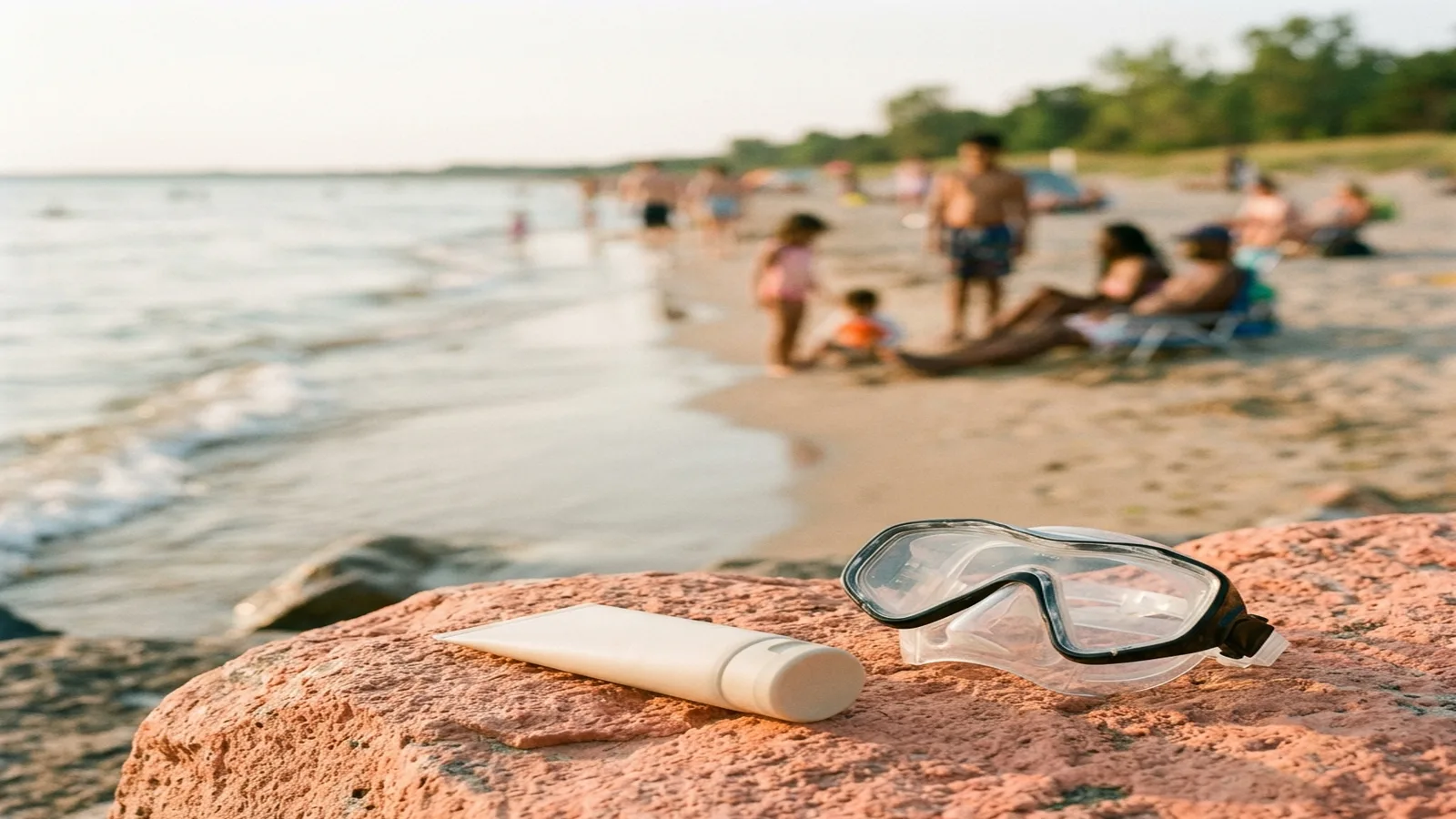
The 60-second version
“Reef-friendly” is a marketing term, not a regulated label — some products bearing it still contain ingredients shown to damage coral. The published environmental-toxicology evidence converges on two ingredients athletes should avoid in water: oxybenzone and octinoxate. Both are banned in Hawaii and several other reef jurisdictions because at the concentrations found in popular swimming areas they bleach coral and disrupt the reproductive cycles of marine organisms. The replacements — non-nano zinc oxide and non-nano titanium dioxide — are mineral (physical) filters that haven’t been shown to cause the same reef damage. The catch for athletes is sweat resistance and white residue: physical sunscreens were historically inferior to chemical ones for swimming and intense exercise, but the formulation gap has closed substantially in the last 5 years. The piece below covers what to look for, what the evidence actually says, and how to apply for athletic use.
Educational journalism, not medical advice. Every claim here is checked against its cited sources by editor Timothy Bunce — a health writer, not a physician. It isn’t specific to your situation: for health decisions, talk to your own clinician. How we work →
Some links in this article are affiliate links. If you buy through one, The Beachside Reader earns a commission at no extra cost to you. It never changes which products we pick, or what we say about them. Full affiliate disclosure →
Why this matters for the athletic population
Endurance athletes, open-water swimmers, beach volleyball players, and trail runners spend disproportionate hours in UV exposure compared to general populations, and many of those hours are in or near aquatic environments. The per-capita sunscreen contribution to recreational waters from this group is large. The dermatology and environmental-toxicology evidence on the two main chemical UV filters identified in Hawaii’s 2018 reef-sunscreen legislation is now extensive enough to support strong recommendations Downs 2016.
The specific findings on oxybenzone (benzophenone-3):
- Coral bleaching at low concentrations. Downs and colleagues documented coral bleaching at oxybenzone concentrations of 62 parts per trillion — well below levels measured in popular Hawaiian and Caribbean swimming areas.
- Endocrine disruption in marine fish at concentrations measured in coastal water samples.
- Larval mortality in coral and several reef-fish species at environmentally relevant doses.
Octinoxate itself hasn’t been tested in the same coral-toxicology trials as oxybenzone. Separate testing on the mineral filters used as reef-safe alternatives found a sharp split: uncoated zinc oxide nanoparticles caused severe, fast coral bleaching, while modified (coated) titanium dioxide forms did not — evidence for non-nano titanium dioxide as a reef-safer mineral option, not evidence of octinoxate’s toxicity Corinaldesi 2018.
“Oxybenzone produces coral bleaching at concentrations of 62 parts per trillion. Average concentrations measured in popular Hawaiian swimming bays during peak tourist hours exceed this threshold by roughly 10-fold to more than 300-fold.”
— Downs et al., Arch Environ Contam Toxicol, 2016 view source
What to use instead
The two evidence-supported alternatives are mineral (physical) filters:
- Zinc oxide (non-nano). The best-supported reef-safe option. Broad-spectrum coverage from UVA through UVB. Sits on the skin surface and reflects/scatters UV rather than absorbing it. The non-nano specification (particle size >100 nm) matters for reef safety as well as skin absorption: uncoated nano-particle zinc oxide has been shown to cause severe, fast coral bleaching in lab testing Corinaldesi 2018, in addition to different skin-absorption behaviour EOS 2018.
- Titanium dioxide (non-nano). Slightly less broad than zinc oxide on the UVA side, but well-tolerated and reef-safe. Often blended with zinc oxide in mineral sunscreens for cosmetic elegance.
What “non-nano” means in practice: particle size larger than 100 nanometers. Most reputable mineral sunscreen brands now state this on the label. The standard the European Union and Australia use is particle size >100 nm to qualify as “non-nano.”
Athletic considerations
The historic complaint about mineral sunscreens for athletic use was the trade-off between coverage and cosmetic acceptability. The formulation gap has narrowed substantially:
- Water resistance. Current mineral sport formulations carry 80-minute water-resistance ratings, comparable to leading chemical sunscreens.
- Sweat resistance. Mineral filters sit on the skin and are less affected by sweat-induced wash-off than some chemical filters that depend on continuous skin binding.
- White cast. The trade-off for athletes with darker skin tones. The newer micronised (but non-nano) formulations have substantially reduced the visible white cast, but it’s still more pronounced than chemical sunscreens. Tinted versions exist.
- Application thickness. Mineral sunscreens require somewhat thicker application for full UV protection than chemical formulations. The dermatology recommendation is 2 mg per cm² of skin — about a shot glass full for full-body coverage Petersen 2014.
Application for athletic use
- Apply 15-20 minutes before exposure. Mineral sunscreens work immediately but the application needs time to settle and form an even film.
- Reapply every 2 hours during sustained exposure. The 80-minute water-resistance rating is the wet-skin extreme — in practice 2-hour intervals match the dermatology recommendation for outdoor athletes.
- Reapply after major sweat sessions or water exits. Even sweat-resistant formulations partially wash off; the “towel off and re-apply” pattern is the safest.
- Don’t miss the ears, the back of the neck, and the tops of the feet. These are the leading skin-cancer sites in endurance athletes, and they’re the most frequently missed in application.
- Layer with sun-protective clothing where practical. A UPF 50+ rash guard reduces sunscreen requirement for the covered area to near zero — both cheaper and more reliable than sunscreen alone for long-exposure swims and beach sports.
What to look for on the label
- Active ingredients: zinc oxide and/or titanium dioxide. Both ideally non-nano. Avoid products that combine these with oxybenzone or octinoxate.
- SPF 30 minimum, 50+ for sustained outdoor exposure. The marginal protection above SPF 50 is small.
- Broad-spectrum labelling (FDA standard in the US; equivalents in other markets). UVB-only protection isn’t enough; UVA contributes substantially to long-term skin damage and skin cancer risk.
- Water-resistance rating. 40 or 80 minutes are the standard FDA ratings. 80-minute is appropriate for swimming and intense exercise.
- “Reef-friendly” alone is not enough. Verify the active ingredients are mineral. The phrase is unregulated and has been used on products containing oxybenzone.
A bigger picture for athletes
Published research on UV radiation’s role in skin-cancer biology shows that cumulative UV exposure drives the DNA damage and immune suppression that underlie melanoma and squamous-cell carcinoma, with risk rising as a function of lifetime UV dose Narayanan 2010. Endurance and water-sport athletes rack up outsized outdoor training hours over a lifetime — exactly the cumulative-exposure pattern that dose-dependent biology flags as elevated-risk. The combination of mineral sunscreen + sun-protective clothing + behavioural sun avoidance (shade between intervals, early-morning or late-afternoon training in summer) reduces this risk substantially without compromising training. Reef protection and skin protection align here — the same products and habits help both.
Practical takeaways
- Avoid oxybenzone and octinoxate in water; the published reef-toxicology evidence shows coral bleaching at environmentally relevant concentrations.
- Use non-nano zinc oxide and/or titanium dioxide mineral sunscreens. Current sport formulations are competitive with chemical alternatives on water resistance.
- Apply 2 mg/cm² — about a shot glass full for full-body — 15-20 minutes before exposure. Reapply every 2 hours and after water exits.
- “Reef-friendly” on the label is not enough. Read the active ingredients.
- For long-exposure swims and beach sports, layer with UPF 50+ clothing — cheaper and more reliable than sunscreen alone.
- Don’t miss the ears, back of neck, tops of feet — the leading missed skin-cancer sites in endurance athletes.
Frequently asked questions
Is “reef-friendly” sunscreen actually reef-friendly?
Not always — the phrase is unregulated marketing. Read the active ingredients. To be evidence-supported reef-friendly, the product should use non-nano zinc oxide and/or non-nano titanium dioxide, and should NOT contain oxybenzone or octinoxate.
Are mineral sunscreens worse than chemical ones for athletes?
Less than they used to be. Current sport formulations of mineral sunscreens carry 80-minute water-resistance ratings comparable to chemical alternatives. The remaining trade-offs are slight white cast (better than 5 years ago) and slightly thicker required application.
How much sunscreen should I actually apply?
The dermatology standard is 2 mg per cm² of skin — about a shot glass full for full-body coverage. Most people apply 25-50% of that, which produces substantially less UV protection than the SPF rating implies. Apply more than feels necessary.
How often should I reapply during exercise?
Every 2 hours during sustained exposure, and after any major water exit or sweat session. The 80-minute water-resistance rating is the wet-skin extreme, not the practical reapplication interval. Carry the bottle with you on long sessions.
Where do athletes most often get skin cancer?
Ears, back of the neck, tops of the feet, lips. All sites that are easy to miss in application. The published skin-cancer surveillance work in endurance athletes consistently identifies these as the leading missed sites.
Is UPF clothing better than sunscreen?
For the covered area, yes — it’s more reliable than sunscreen and doesn’t need reapplication. A UPF 50+ rash guard reduces sunscreen requirement on the covered area to near zero. For long-exposure swims and beach sports, layering UPF clothing with sunscreen on exposed skin is the gold-standard approach.
References
Downs 2016Downs CA, Kramarsky-Winter E, Segal R, et al. Toxicopathological effects of the sunscreen UV filter, oxybenzone (benzophenone-3), on coral planulae and cultured primary cells and its environmental contamination in Hawaii and the U.S. Virgin Islands. Arch Environ Contam Toxicol. 2016;70(2):265-288. View source →Corinaldesi 2018Corinaldesi C, Marcellini F, Nepote E, Damiani E, Danovaro R. Impact of inorganic UV filters contained in sunscreen products on tropical stony corals. Sci Total Environ. 2018;637-638:1279-1285. View source →EOS 2018Environmental Working Group. Guide to Sunscreens: Methodology. EWG; 2018. View source →Petersen 2014Petersen B, Wulf HC. Application of sunscreen — theory and reality. Photodermatol Photoimmunol Photomed. 2014;30(2-3):96-101. View source →Narayanan 2010Narayanan DL, Saladi RN, Fox JL. Ultraviolet radiation and skin cancer. Int J Dermatol. 2010;49(9):978-986. View source →