The 60-second version
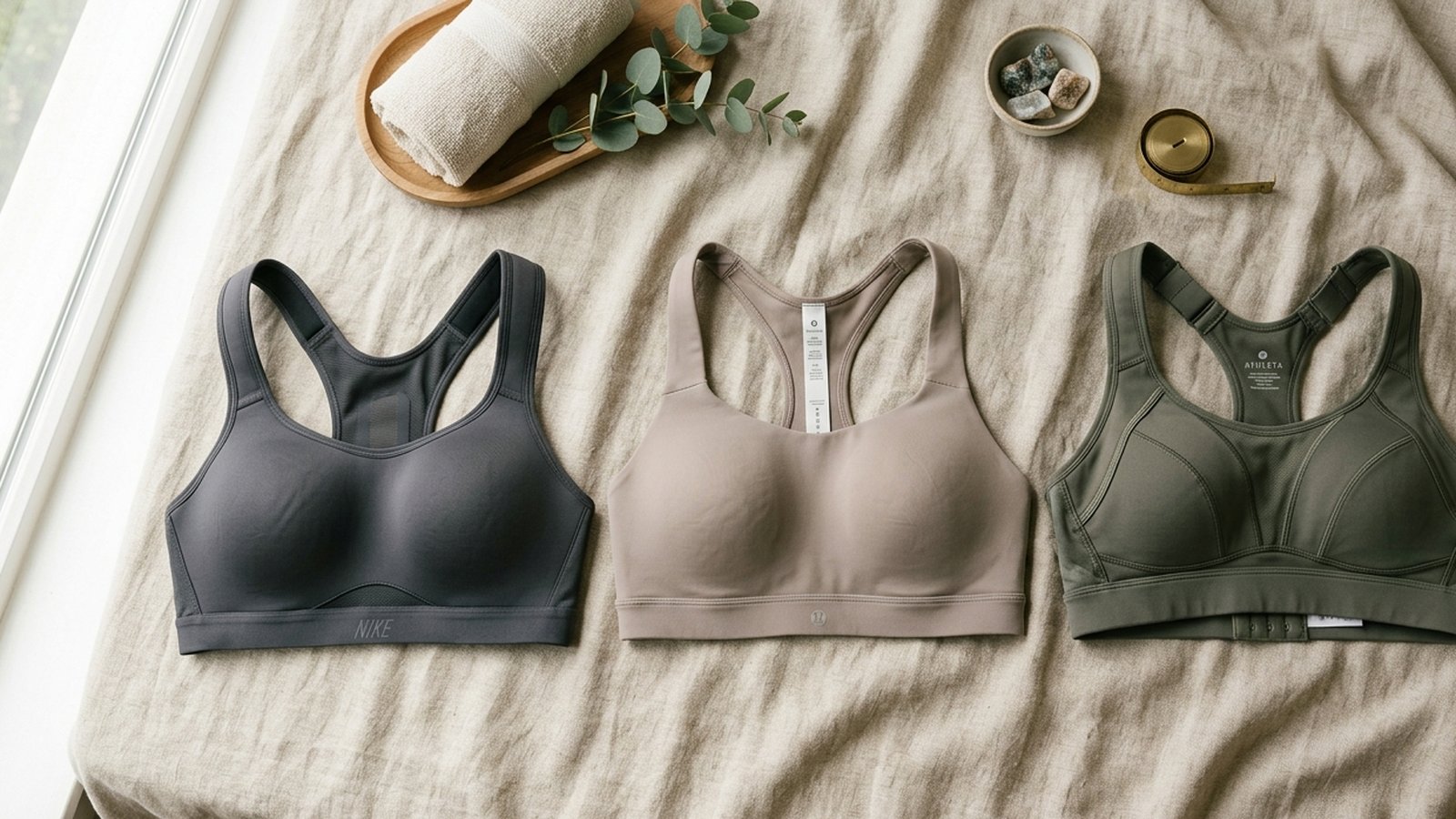
The sports bra is barely 50 years old as a category. The first dedicated design — the “Jogbra” sewn from two jockstraps in 1977 by Lisa Lindahl, Polly Smith, and Hinda Miller — came at a time when women had been excluded from the Boston Marathon for less than a decade. The technology has progressed in three distinct waves: compression-only (1977–1995), encapsulation engineering (1995–2010), and biomechanically-validated high-impact systems (2010–present). The peer-reviewed biomechanics literature on breast motion has expanded dramatically since the Scurr et al. studies of the early 2000s, which quantified that unsupported breast motion during running can exceed 14 cm vertically per stride, generating tissue strain and discomfort that meaningfully limits training tolerance. Modern high-impact bras reduce this to under 4 cm. This article covers the history, the engineering, what the current state-of-art delivers, and the practical implications for buyers. For fit, sizing, and replacement criteria, see the cornerstone article on sports bras.
Educational journalism, not medical advice. Every claim here is checked against its cited sources by editor Timothy Bunce — a health writer, not a physician. It isn’t specific to your situation: for health decisions, talk to your own clinician. How we work →
Some links in this article are affiliate links. If you buy through one, The Beachside Reader earns a commission at no extra cost to you. It never changes which products we pick, or what we say about them. Full affiliate disclosure →
Why the technology mattered
Before 1977, the options for women wanting to run were: an ill-fitting everyday bra, multiple bras layered together, or no support at all. The motion-related discomfort and the long-term tissue strain were a real barrier to participation in running and high-impact sports. The peer-reviewed quantification of breast motion came later (Scurr et al. 2010 onward), but the practical experience was clear from the start.
The 2010 Scurr study marked a turning point: 3D motion-capture analysis of 15 women during treadmill running compared no-bra, everyday-bra, and sports-bra conditions and found that increased support significantly reduced vertical breast displacement and velocity, with breast velocity showing the strongest correlation to self-reported comfort Scurr 2010. Subsequent work (McGhee, Wakefield-Scurr, and others) refined the biomechanical model and informed modern high-impact bra engineering.
“Breast biomechanics during exercise are a meaningful determinant of training tolerance and injury risk for many women. The development of biomechanically-informed sports bra design has reduced motion-related limitation as a barrier to athletic participation, but optimal support remains an under-served area for athletes outside the most-common cup-size range.”
— McGhee & Steele, Sports Med., 2020 view source
The three technology waves
| Era | Approach | Strengths | Limits |
|---|---|---|---|
| 1977–1995: Compression-only | Tight elastic torso band; no cup shaping; compresses breast tissue against chest wall | Cheap; durable; effective for A–B cups in low/medium-impact activity | Doesn’t reduce motion much for C+ cups; uncomfortable at heavier cup sizes; limited shape support |
| 1995–2010: Encapsulation engineering | Individual molded cups for each breast; dedicated under-bust band; some incorporated underwire for support | Better motion control for larger cups; preserves breast shape; more comfortable for medium-to-high impact | More complex sizing; underwires can fail and cause irritation; harder to manufacture for extreme size ranges |
| 2010–present: Biomechanically-validated high-impact | Hybrid encapsulation + targeted compression; multi-strap support architecture; sport-specific designs informed by motion-capture studies | Excellent motion reduction across cup sizes; sport-specific options; performance-validated | Premium pricing ($60–120+); requires accurate sizing; replacement cycle 6–12 months for daily use |
What modern high-impact bras actually achieve
An early case study by Mason and colleagues compared vertical breast displacement across sports-bra, fashion-bra, crop-top, and bare-breasted conditions during running, jogging, aerobics, and walking, and found that added support reduced both absolute vertical movement and peak downward deceleration force Mason 1999. The broader biomechanics literature since has documented a similar directional pattern, with reported vertical displacement roughly in these ranges across support categories:
- Standard everyday bra during running: 8–14 cm vertical breast displacement.
- Low-support sports bra (compression band only): 6–9 cm.
- Mid-support encapsulation bra: 4–6 cm.
- High-impact engineered bra: 2–4 cm.
The threshold for “perceptually significant” reduction is roughly 50% — women report substantially less pain and discomfort when motion is cut from baseline by half or more. Modern high-impact engineering achieves this for the majority of cup sizes, though the very-large-cup category (G+) remains under-served.
Performance effects of well-fitted high-impact support
The literature on athletic performance with optimal support shows real but modest effects:
- Swimming trunk and breast motion: a sports bra significantly reduced breast displacement compared with an unsupported swimsuit during front-crawl and breaststroke swimming Mills 2014.
- Ground-impact forces: medial impact force during running was significantly lower with a compression sports bra (0.12× body weight) than with no bra (0.15× body weight) White 2009.
- Pain ratings during exercise: substantial reduction (~40–60%) with appropriate support.
- Self-rated training adherence: women reporting good support significantly more likely to maintain consistent running over months.
The performance effect is real but smaller than the discomfort and adherence effect. The biggest benefit of well-fitted high-impact support isn’t a faster mile time — it’s being able to train consistently without the pain-related drop-off.
High-impact support architecture
| Component | Function |
|---|---|
| Wide under-bust band | Carries 70–90% of total support load; the most important fit element |
| Encapsulation cups | Individual containment of each breast; preserves shape and reduces side-to-side motion |
| Wide, padded straps | Distribute remaining 10–30% of load; reduce shoulder pressure |
| Cross-back / racerback design | Prevents straps from sliding; secures vertical motion |
| Stretch-resistant fabric panels | Maintain support through movement; older bras lose this with elastic breakdown |
| Underwire (some designs) | Adds rigidity at cup base; not required for high-impact effectiveness |
| Adjustable straps and back closure | Allow precise fit; adjustability extends usable life as fit evolves |
| Moisture-wicking fabric | Reduces chafing; relevant for long-distance running |
Sport-specific design developments
| Sport | Key design considerations |
|---|---|
| Distance running | Maximum motion reduction; chafing-resistant materials; breathability for long sessions |
| Sprint / track | Vertical motion control critical; some designs incorporate light compression for forward propulsion comfort |
| Lifting / strength training | Moderate support sufficient; less motion than running; comfort and breathability dominate |
| HIIT / CrossFit | High-impact category; needs to handle running, jumping, and overhead movement |
| Yoga / Pilates | Low-impact support adequate; comfort and stretch dominate |
| Cycling | Forward-leaning posture changes load distribution; specific cycling bras emerging |
| Soccer / basketball / hockey | Multi-directional movement; needs both vertical and lateral motion control |
| Tennis / racquet sports | Asymmetric arm motion; rotational support matters |
| Swimming | Specialty swim-bras emerging; tradeoff between support and water drag |
The larger-cup-size problem
Women in the F+ cup range have historically been under-served by sports-bra engineering, with much of the early biomechanics research focused on C–D cup ranges. A 2012 White & Scurr study found that traditional self-fitting methods significantly underestimated cup size — especially for women with larger busts — and recommended professional fitting criteria over self-measurement White 2012.
Recent specialized brands (Enell, Panache Sport, Shock Absorber, Berlei Shock Absorber, Anita Active) target the F–K cup range with engineered support that genuinely works. The price is higher ($90–180), and sizing requires more care than standard ranges, but the gap between “no good options” and “genuine high-impact support” for larger cup sizes has narrowed substantially in the last decade.
Recent technology developments
- 3D-knitted seamless construction: reduces seam-related chafing during long efforts.
- Adaptive compression panels: stiffer fabric in motion-bearing zones, softer elsewhere.
- Removable molded cups: allow customization between encapsulation and pure compression styles.
- Convertible straps: switch between standard and racerback configurations.
- Sustainable materials: recycled polyester, nylon-from-fishing-net, biodegradable elastane alternatives.
- Maternity / nursing high-impact options: under-served category until recently; brands like Cake Maternity, Hotmilk, and Anita Maternity have addressed it.
- Cancer-survivorship designs: post-mastectomy and post-reconstruction sport-bra options.
What’s still missing
- Affordable high-cup-size options below $90.
- Cycling-specific sport-bras at scale.
- Standardised sizing across brands; the current sizing inconsistency forces costly trial-and-error purchasing.
- Long-term durability data; most performance claims are based on new-garment testing.
- Bras designed for athletes returning to high-impact training post-partum or post-surgery.
- Better integration with smart-textile health monitoring (HR, HRV, breathing rate).
Practical takeaways for high-impact training
- Match the bra to the sport. A great low-impact bra is the wrong tool for marathon training.
- The under-bust band carries most of the load — if it doesn’t fit, the bra doesn’t work, regardless of cup design.
- For larger cup sizes (F+), specialty brands (Enell, Panache, Shock Absorber, Anita Active) are usually worth the higher price.
- Replace high-impact bras every 6–12 months of regular use; elastic and fabric breakdown reduces support meaningfully.
- For sport-specific concerns (cycling, post-partum, post-surgery), seek out the specialty designs rather than adapting general-purpose bras.
- For comprehensive fit and biomechanics guidance, see the cornerstone sports-bras article.
Practical takeaways
- The sports bra is a 50-year-old technology with three distinct waves: compression-only, encapsulation engineering, biomechanically-validated high-impact.
- Modern high-impact engineering reduces breast motion from 8–14 cm to 2–4 cm — the threshold of perceptually significant relief.
- The performance effect is real but small (reduced impact loading, not dramatically faster times); the bigger benefit is training tolerance and adherence.
- The larger-cup-size category (F+) is now well-served by specialty brands.
- Sport-specific design (running, HIIT, yoga, cycling) is a meaningful refinement worth seeking.
- Recent innovations: seamless 3D-knit construction, adaptive compression, post-partum and post-surgical specialty designs.
- The under-bust band carries 70–90% of the load; sizing here is the dominant fit variable.
Frequently asked questions
How much does a high-impact bra actually reduce breast motion?
From roughly 8–14 cm of vertical displacement during running (with no support or an everyday bra) down to 2–4 cm with a properly fitted high-impact engineered bra. That's roughly a 70–80% reduction, and the perceived comfort threshold is around 50% reduction — meaning the difference is meaningfully felt, not just measurable on motion-capture systems.
Are F+ cup sizes really better-served now than 10 years ago?
Yes, substantially. Specialty brands like Enell, Panache Sport, Shock Absorber, Berlei Shock Absorber, and Anita Active offer engineered high-impact support across the F–K range that didn't exist at scale before ~2012. Pricing is higher ($90–180), and sizing requires more care, but the 'no good options' era is over.
Do I need a separate bra for each sport?
Not for most adults. A good high-impact bra works for running, HIIT, sprint, and most field sports. You may want a separate lower-support option for yoga, Pilates, lifting, and other low-impact activities — the high-impact bras are often less comfortable for stretch-heavy work where motion is minimal.
How often should I replace a sports bra?
Every 6–12 months for daily use, or roughly every 50–75 wash cycles. The elastic and stretch-resistant fabric panels lose tension over time, and the support quality degrades before it's visually obvious. Signs to replace: straps loose without tightening, under-band rides up during exercise, motion noticeably increased from when the bra was new.
Why is sports bra sizing so inconsistent across brands?
Each brand uses its own sizing system, with little standardization. Cup volume, under-band tightness, and strap length vary substantially. The practical implication: be prepared to try multiple sizes when switching brands, and don't assume your size in one brand translates to another. Online return policies matter for sports bras more than most apparel categories.
References
Scurr 2010Scurr JC, White JL, Hedger W. The effect of breast support on the kinematics of the breast during the running gait cycle. J Sports Sci. 2010;28(10):1103-1109. View source →McGhee 2020McGhee DE, Steele JR. Breast biomechanics: what do we really know? Physiology (Bethesda). 2020;35(2):144-156. View source →Mason 1999Mason BR, Page KA, Fallon K. An analysis of movement and discomfort of the female breast during exercise and the effects of breast support in three cases. J Sci Med Sport. 1999;2(2):134-144. View source →Mills 2014Mills C, Lomax M, Ayres B, Scurr J. The movement of the trunk and breast during front crawl and breaststroke swimming. J Sports Sci. 2014;33(4):427-436. View source →White 2009White JL, Scurr JC, Smith NA. The effect of breast support on kinetics during overground running performance. Ergonomics. 2009;52(4):492-498. View source →White 2012White J, Scurr J. Evaluation of professional bra fitting criteria for bra selection and fitting in the UK. Ergonomics. 2012;55(6):704-711. View source →Page 1999Page KA, Steele JR. Breast motion and sports brassiere design. Implications for future research. Sports Med. 1999;27(4):205-211. View source →Burnett 2015Burnett E, White J, Scurr J. The influence of the breast on physical activity participation in females. J Phys Act Health. 2015;12(4):588-594. View source →Brown 2014Brown N, White J, Brasher A, Scurr J. The experience of breast pain (mastalgia) in female runners of the 2012 London Marathon and its effect on exercise behaviour. Br J Sports Med. 2014;48(4):320-325. View source →Greenbaum 2003Greenbaum AR, Heslop T, Morris J, Dunn KW. An investigation of the suitability of bra fit in women referred for reduction mammaplasty. Br J Plast Surg. 2003;56(3):230-236. View source →Zhou 2013Zhou J, Yu W, Ng SP. Studies of three-dimensional trajectories of breast movement for better bra design. Text Res J. 2012;82(3):242-254. View source →Milligan 2014Milligan A, Mills C, Corbett J, Scurr J. The influence of breast support on torso, pelvis and arm kinematics during a five kilometer treadmill run. Hum Mov Sci. 2015;42:246-260. View source →