The 60-second version
Exosome and stem-cell treatments for hair loss are producing real early results, but almost all of that evidence comes from needles rather than bottles — injections or microneedling that deliberately breach the skin barrier. Only two of the eleven published clinical studies were randomised Al Ameer 2025. Meanwhile minoxidil, and minoxidil combined with low-level laser therapy, are backed by seven randomised controlled trials pooled in a meta-analysis Mawu 2025. If you are choosing where to put your money and your months, that asymmetry is the whole story.
Educational journalism, not medical advice. Every claim here is checked against its cited sources by editor Timothy Bunce — a health writer, not a physician. It isn’t specific to your situation: for health decisions, talk to your own clinician. How we work →
Start with the benchmark, not the newcomer
The most common mistake in reading hair-loss research is judging a new treatment against nothing instead of against the current standard. So begin with the standard.
A 2025 systematic review and meta-analysis in Lasers in Medical Science pooled seven randomised controlled trials comparing topical minoxidil alone against minoxidil combined with low-level laser therapy in androgenetic alopecia Mawu 2025. The combination won on every measure the authors examined. Hair density improved by a mean difference of 6.62 in favour of combination therapy (95% CI 2.04 to 11.20, p = 0.005). Hair diameter improved by a mean difference of 0.01 mm (95% CI 0.00 to 0.01, p = 0.002). Patient satisfaction was higher, with a risk ratio of 1.71 (95% CI 1.23 to 2.38, p = 0.002). Adverse events did not differ between groups Mawu 2025.
That is what a mature evidence base looks like: multiple randomised trials, pooled, with confidence intervals and a safety comparison Mawu 2025. It is unglamorous, and it is the bar.
What the stem cell studies actually report
A 2025 systematic review in Clinical, Cosmetic and Investigational Dermatology assembled the clinical evidence for exosomes in hair regeneration across alopecia types Al Ameer 2025. It found 11 clinical studies published between 2022 and 2025, covering 298 patients in total.
The reported outcomes look striking. Exosomes derived from mesenchymal stem cells were associated with hair density increases of 9.5 to 35 hairs per square centimetre, and hair thickness increases of up to 13.01 micrometres. Patient satisfaction was consistently high, no serious adverse events were reported, and side effects were mild and transient Al Ameer 2025.
Now the composition of those 11 studies. Two were randomised controlled trials. The rest were three retrospective studies, three prospective single-arm studies, one case series and two case reports. Sample sizes ran from a single patient to 85. The authors report that heterogeneity in design and outcome measures prevented direct comparison between studies. They rated the two randomised trials at low risk of bias across most domains, but judged the risk of bias across the non-randomised studies "predominantly serious", and found that the case reports and small case series "exhibited high risk of bias due to serious confounding, unclear selection processes, and selective outcome reporting" Al Ameer 2025.
Why you must not put those two numbers side by side
Here is the trap, and it is worth understanding because the entire category is sold through it.
A casual reader sees 9.5 to 35 hairs per square centimetre from exosomes, and a mean difference of 6.62 from minoxidil plus laser, and concludes the newcomer is several times better. That comparison is invalid, and it is invalid in a way that systematically flatters the weaker evidence.
The 6.62 figure is a between-group mean difference: how much better the combination group did than the comparison group, in randomised trials Mawu 2025. It has already subtracted out everything that would have happened anyway — seasonal shedding cycles, regression to the mean, the measurement enthusiasm of an investigator who knows what they hope to find.
The 9.5 to 35 figures come largely from single-arm and retrospective studies Al Ameer 2025. In a study with no control group, the number reported is the within-group change: where the patient started versus where they finished. Nothing has been subtracted. Every non-treatment influence is still inside the number.
Those are different quantities. They cannot be ranked against each other, and the absence of a control arm is precisely why the uncontrolled figure looks larger. When you see a hair-loss result quoted without a comparison group, the correct response is not to be impressed. It is to ask what the control group did, and to notice when there wasn't one.
The delivery tell
There is a detail in the exosome review that matters more than any of the effect sizes. The studies used intradermal injection and topical application, the topical protocols it describes were delivered with microneedling or a microneedle roller, and the authors observe that "studies involving microneedling or other mechanical delivery methods appeared to enhance treatment outcomes" Al Ameer 2025.
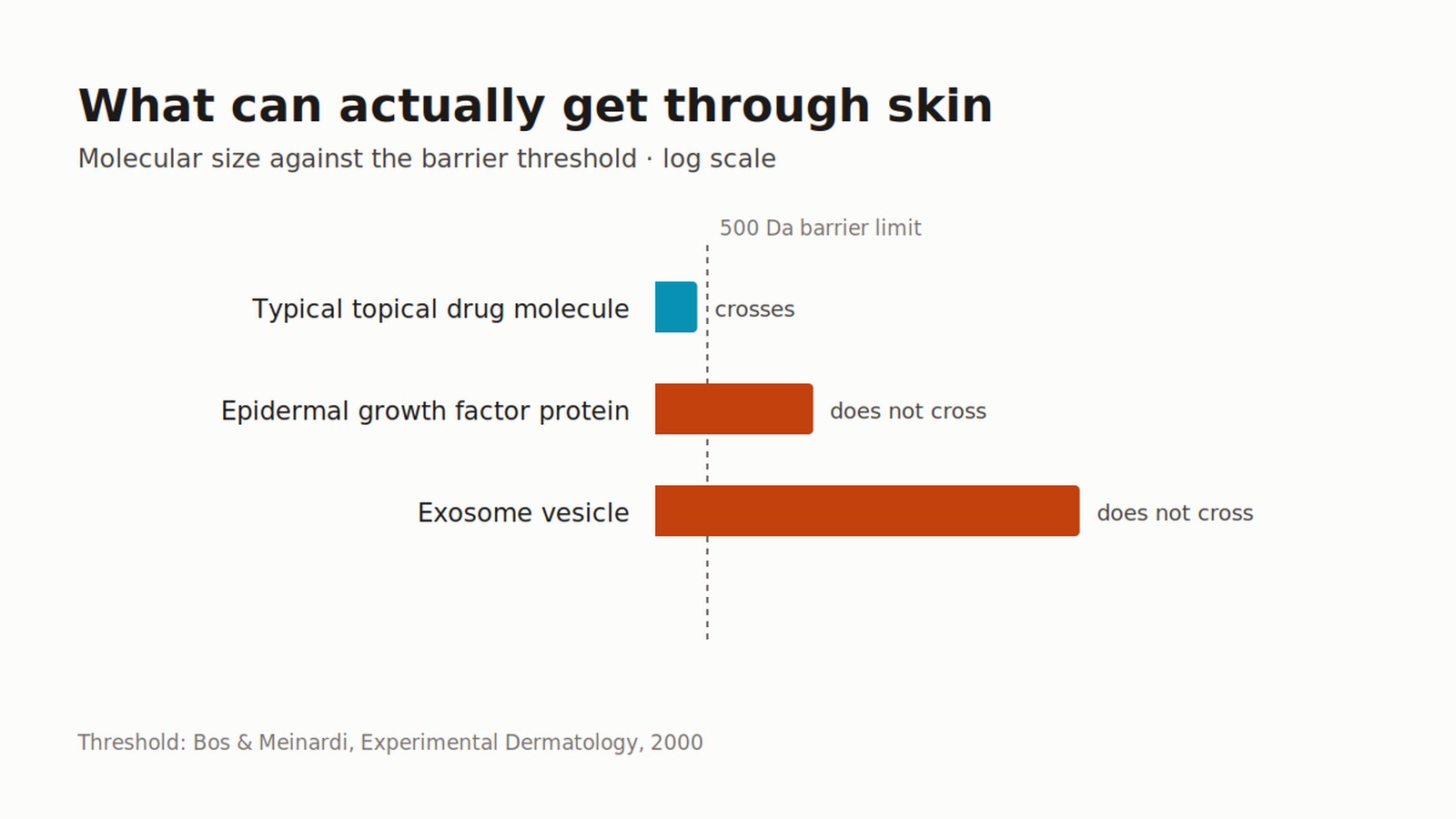
Read that again with the previous article's physics in mind. Bos and Meinardi's 500 Dalton rule holds that molecules much heavier than about 500 Daltons do not meaningfully cross intact skin Bos 2000. Exosomes are vesicles, around 100 to 150 nanometres across in the studies reviewed Al Ameer 2025, vastly larger. If a protocol needs a needle or a roller studded with needles to produce its effect, that is not incidental to the treatment. It is a working admission that the barrier has to be physically defeated for the active material to get anywhere.
Which has a direct consequence for anything sold in a bottle. A serum you apply at home with your fingertips is not delivering what an in-clinic microneedling protocol delivers, even if the active ingredient on the label is identical. The published results were produced by the delivery method, not only by the molecule, and the results do not transfer to a gentler route of administration just because the ingredient list matches.
What Canadian regulation does with that
Health Canada made the same connection explicitly. Its final notice of 10 April 2026 on topical products containing human-derived exosomes, extracellular vesicles and cell conditioned media, which followed a consultation opened on 14 August 2025, sets out that a given product may be regulated as a drug or as a cosmetic, decided case by case Health Canada 2026. Products that exhibit therapeutic or pharmacological activity, or that are labelled for administration by injection or microneedling, are not considered cosmetics. Cosmetics, by contrast, are "normally applied to an external part of the body and not absorbed below the skin" Health Canada 2026.
The broader framework points the same way. Health Canada's guidance on the cosmetic-drug interface classifies products by their representation for sale: a product claiming to treat, prevent or cure disease, or to restore, correct or modify organic functions, is a drug, while cosmetics are limited to cleaning, improving or altering the complexion, skin, hair or teeth Health Canada guidance. Reversing androgenetic alopecia sits on the drug side of that line by definition, whatever the product is called on the shelf. (The guidance sets out the framework rather than listing hair growth as a worked example.)
Health Canada also raises safety concerns specific to human-derived starting material: unsubstantiated therapeutic claims, potential toxic effects, and the possibility of transmitting infectious diseases and adventitious agents Health Canada 2026.
The practical position
Nothing here says exosome hair treatments do not work. Two randomised trials exist, the reported effects are in a plausible direction, and the safety signal so far is reassuring Al Ameer 2025. In a few years there may be a solid answer.
What the evidence does not support is substitution. If you have androgenetic alopecia and you are choosing between a treatment with seven pooled randomised trials behind it Mawu 2025 and one with two randomised trials among eleven heterogeneous studies, most of them carrying serious risk of bias Al Ameer 2025, the asymmetry is not close. Minoxidil is inexpensive, and adding low-level laser therapy to it has measurable additional benefit without additional adverse events Mawu 2025.
If you are considering an in-clinic exosome protocol as an addition rather than a replacement, the questions worth asking are: what is being injected, where was it produced and how was it characterised, is the product authorised for sale in Canada for this use, and what happens when you stop. The last one matters, because none of the published studies followed patients long enough to answer it Al Ameer 2025.
Frequently asked questions
Do exosome treatments regrow hair?
Eleven clinical studies in 298 patients report density and thickness improvements, but only two were randomised controlled trials and the remainder carry serious risk of bias Al Ameer 2025. The evidence is early rather than settled.
Are they better than minoxidil?
That comparison cannot currently be made. The minoxidil evidence comes from randomised trials reporting between-group differences Mawu 2025; most exosome figures are within-group changes from uncontrolled studies Al Ameer 2025. The numbers are not the same kind of measurement.
Why do the exosome numbers look bigger?
Largely because most of the exosome figures come from designs with no control group Al Ameer 2025, so nothing has subtracted out everything that would have happened anyway.
Can a take-home serum do what an in-clinic treatment does?
Unlikely on current evidence. Most published protocols used injection or microneedling to bypass the skin barrier Al Ameer 2025, and molecules of this size do not cross intact skin readily Bos 2000.
How does Canada regulate these products?
Case by case, under a final notice Health Canada published in April 2026. Products labelled for injection or microneedling, or showing therapeutic activity, are not considered cosmetics and fall under drug regulation Health Canada 2026.
What has the strongest evidence right now?
Topical minoxidil, with low-level laser therapy added, supported by a meta-analysis of seven randomised controlled trials Mawu 2025.
References
Al Ameer 2025Al Ameer MA, Alnajim AT, Al Ameer A, et al. Exosomes and Hair Regeneration: A Systematic Review of Clinical Evidence Across Alopecia Types and Exosome Sources. Clinical, Cosmetic and Investigational Dermatology. 2025;18:2215–2227. View source →Mawu 2025Mawu FO, Sondakh ORL, Kairupan TS, Christopher PM. Comparative efficacy and safety of low-level laser therapy and topical Minoxidil combination vs. topical Minoxidil monotherapy in androgenetic alopecia management: a systematic review and meta-analysis of randomized controlled trials. Lasers in Medical Science. 2025;40:338. View source →Bos 2000Bos JD, Meinardi MMHM. The 500 Dalton rule for the skin penetration of chemical compounds and drugs. Experimental Dermatology. 2000;9(3):165–169. View source →Health Canada 2026Health Canada. Final notice: Classification of topical products containing human-derived exosomes, human extracellular vesicles, or human cell-conditioned media. 10 April 2026. View source →Health Canada guidanceHealth Canada. Guidance Document: Classification of Products at the Cosmetic-Drug Interface. View source →