The 60-second version
Stroller running is a category-defining postnatal cardiovascular activity that lets parents return to or maintain running volume without daycare or partner-handoff logistics. Done with proper technique it’s a strong cardio session; done with poor technique it produces the lower-back, shoulder, and forearm complaints that drive new parents to give up on running. The published research is small but growing (Gregory et al. 2012 on exertion; Alcantara & Wall-Scheffler 2017 on pushing-method biomechanics; Sandbakk et al. 2020 on terrain): running with a loaded jogging stroller produces only a modest rise in exertion at an easy pace, pushing method affects stride length and arm mechanics more than the stroller itself, and the added energy cost climbs substantially on uphill terrain. The protocol that works for most healthy postnatal parents: alternating-hand pushing technique, 3–5 km easy-to-moderate runs in the early weeks back, the Wasaga paved-trail surfaces (avoiding sand and rough singletrack), and the 6–8 week progression that respects whatever postnatal recovery profile applies. Critical: get medical clearance before resuming high-impact exercise after birth (most providers clear at 6 weeks for vaginal delivery, 8–12 weeks for caesarean), and respect any pelvic floor or diastasis-recti symptoms.
Educational journalism, not medical advice. Every claim here is checked against its cited sources by editor Timothy Bunce — a health writer, not a physician. It isn’t specific to your situation: for health decisions, talk to your own clinician. How we work →
Some links in this article are affiliate links. If you buy through one, The Beachside Reader earns a commission at no extra cost to you. It never changes which products we pick, or what we say about them. Full affiliate disclosure →
Why stroller running matters as a category
The transition from active pre-pregnancy life to active early-parenthood life is where many runners lose their running practice. The dominant friction points are not motivation but logistics: childcare scheduling, partner availability, fitting a 30–60 minute solo session into a day governed by a baby’s nap schedule and feed times.
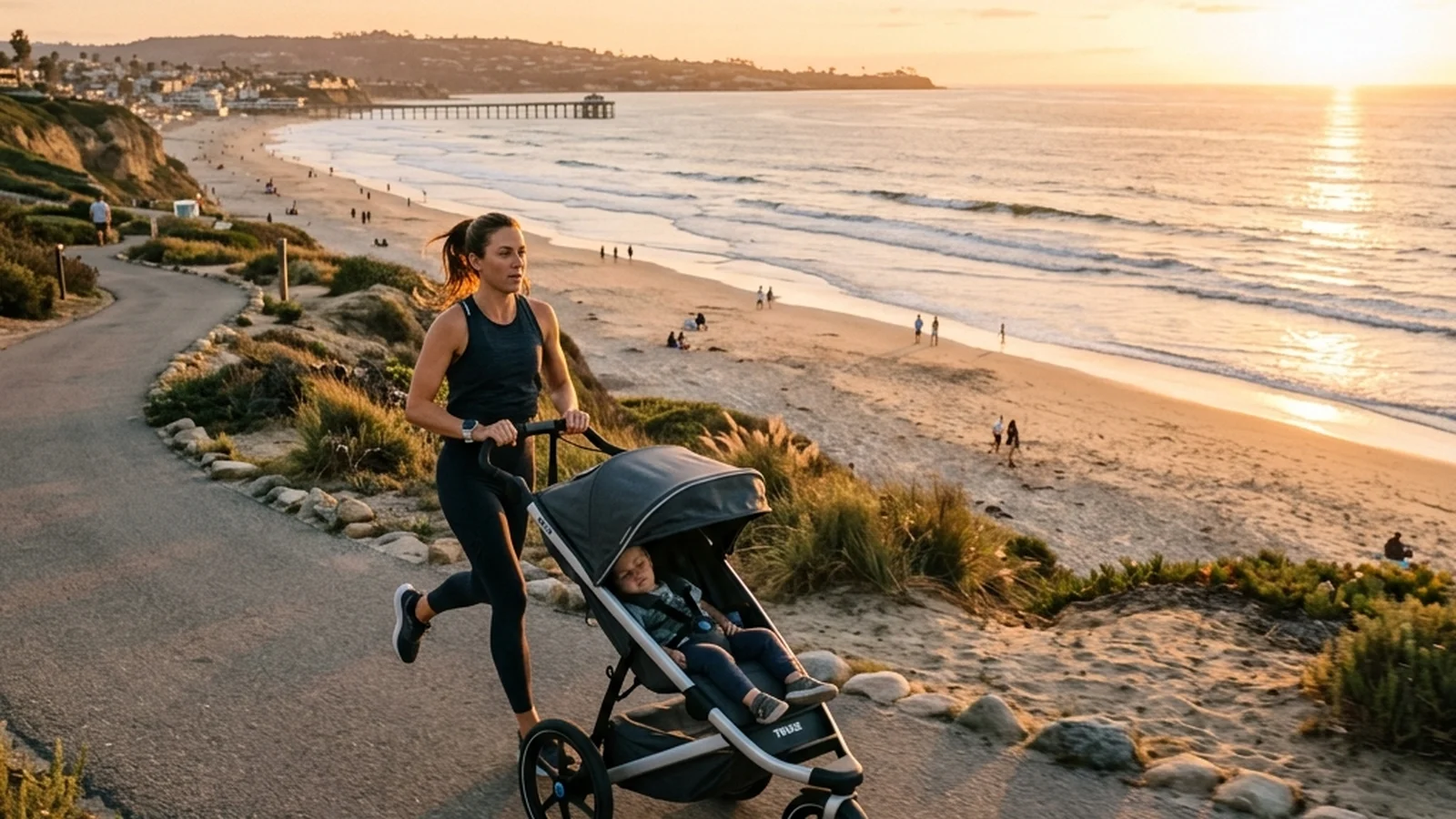
Stroller running solves this by combining the run with the activity the parent has to do anyway (taking the baby out for a walk or fresh-air session). For many parents, this is the only realistic way to maintain 3× weekly cardiovascular volume in the first 12–18 months postpartum.
The published evidence on stroller running is small but informative. Gregory et al. (2012) found that running with a loaded jogging stroller produced only minimal increases in exertion compared to running unencumbered Gregory 2012. Alcantara & Wall-Scheffler (2017) found that pushing method, more than the stroller itself, drives most of the change in stride length and running kinematics Alcantara 2017. Sandbakk et al. (2020) found that pushing a loaded stroller increased energetic cost under most conditions, with the effect roughly three times greater on uphill terrain than on the flat Sandbakk 2020.
Postnatal recovery context
Before any postnatal running discussion, the medical-clearance qualification matters. The published guidelines from organisations like the American College of Obstetricians and Gynecologists (ACOG) ACOG Postpartum Guidelines and the Society of Obstetricians and Gynaecologists of Canada (SOGC) SOGC Canada are consistent:
- Vaginal delivery without complications: most providers clear gentle exercise (walking) within days, and graded return to higher-impact activity (running) by 6–8 weeks. The variation is for individual recovery profile.
- Caesarean delivery: 8–12 weeks before high-impact activity. The abdominal incision needs the longer healing window.
- Pelvic floor concerns: any symptoms of incontinence, pelvic heaviness, or prolapse during exercise are signals to pause and consult a pelvic floor physiotherapist before continuing.
- Diastasis recti: a separation of the abdominal muscles common after pregnancy. Most resolve over weeks to months but persistent separation needs targeted rehab before high-impact activity.
- Lactation: vigorous exercise doesn’t reduce milk supply, but timing the session after a feed is more comfortable for most. Sports bras need re-fitting at the size lactation produces.
The literature on postnatal exercise is consistently supportive of return to activity, with the caveat that pacing matters. The frequent failure mode is doing too much too soon, producing pelvic floor or back symptoms that then require longer rehab than a slower return would have needed.
Technique fundamentals: the alternating-hand pattern
The dominant technique error in stroller running is the “both hands extended, push and run” pattern. This pattern produces shoulder, forearm, and lower-back complaints because:
- Both arms locked in an extended forward position cannot swing, eliminating the natural counter-rotation that running uses to stabilise the trunk.
- The forward-extended grip loads the shoulders and forearms isometrically for the entire run.
- The trunk lean produced is a sustained 5–10 degrees of forward flex, which over 30–60 minutes loads the lower back disproportionately.
The alternating-hand pattern fixes most of this:
- Push the stroller with one hand (typically the dominant) for 60–120 seconds.
- Let the other arm swing naturally in the running rhythm.
- Switch hands for the next interval, restoring symmetry of arm swing across the run.
- Reach with both hands only briefly for hill climbs, sharp turns, or quick course corrections.
This pattern keeps one arm in the natural running rhythm at any given time, eliminates the locked-in shoulder isometric, and reduces forward trunk lean. The trade-off is that turning the stroller is slightly slower; for most paved-path runs in Wasaga this is fine.
Surface selection: where to run with a stroller in Wasaga
Stroller surfaces are not interchangeable. The realistic options for the Wasaga-based parent:
- The Georgian Trail: paved or smooth crushed-stone, flat, well-shaded in summer. The 32 km Meaford-to-Wasaga corridor offers easy 3–10 km out-and-back runs from any access point. Best surface in the area for stroller running.
- Paved residential streets: Park Street, River Road East, and the inland subdivision streets have light traffic, sidewalks in some sections, and minimal grade. Useful for shorter runs near home.
- Beach Drive boardwalk: the wooden boardwalk along Beach Area 1 is reasonable for stroller use, though wheelchair-accessible stretches alternate with rougher sections. Watch for crowded tourist hours.
- Wasaga Provincial Park paved roadways: the day-use access roads inside the park (when traffic is light) are stroller-friendly and add light variety.
Surfaces to avoid for serious stroller running:
- Beach sand: the bumpy, uneven surface is fatiguing for both pusher and rider. Walk it; don’t run it.
- Wooded singletrack trails: roots, drops, narrow clearance. Standard jogging strollers don’t handle this terrain.
- Steep gravel paths: the rolling resistance is high and the loose-stone surface puts the stroller wheel control at risk.
- Crowded boardwalks during peak season: tourist density makes consistent running impossible. Either run early/late or pick a quieter route.
Stroller selection for running
Not every stroller is designed for running. The category “jogging stroller” or “running stroller” is specifically engineered for the speed and bumps of running. Key features:
- Three large pneumatic tires (typically 12” in front, 16”+ in rear) absorb bumps and roll smoothly.
- Fixed front wheel for running, with optional swivel-lock for walking flexibility. Free-swivel front wheels can become unstable at running speeds.
- Hand-brake for descent control. Standard parking-brake-only strollers don’t handle running speeds on grade.
- Wrist strap to prevent the stroller from rolling away if the parent stumbles.
- Adjustable handle height matched to the parent’s pushing comfort. Too-low handles produce excessive forward lean; too-high handles produce shoulder fatigue.
- Suspension on the rear wheels reduces baby vibration on rough surfaces.
- Sun canopy and weather coverage appropriate to Wasaga’s summer sun and shoulder-season cool.
The investment is meaningful (most jogging strollers run $300–800 new) but the durability and resale value are good if the stroller will be used for 2–4 years across multiple kids.
A 6–8 week return-to-running progression
For a postnatal parent cleared by their physician for return to running:
- Weeks 1–2: brisk walking with the stroller, 30–45 minutes 3× per week. No running yet. Focus on walking pace, technique, hydration, and any pelvic floor or back symptoms.
- Weeks 3–4: walk-run intervals. 30 seconds of running interleaved with 90 seconds of walking, total 30–40 minutes 3× per week. The running portions stay easy.
- Weeks 5–6: run-walk shift. 60 seconds running with 60 seconds walking, total 30–40 minutes 3× per week. Symptoms remain the gating variable; if pelvic floor or back symptoms appear, drop back a week.
- Weeks 7–8: continuous easy running, 20–30 minutes 3× per week. The pace is conversational; this is base building, not training.
- Beyond week 8: building toward 30–45 minute easy runs 3× per week, with one slightly longer (45–60 minute) run per week. Speed work and longer runs come later, after the base is established.
The progression is intentionally conservative. The goal is establishing a sustainable habit, not chasing a fitness target. Many postnatal runners report that pushing too hard in weeks 4–8 produced setbacks that took months to recover from.
Weather and environmental considerations
Stroller running outdoors involves managing the baby’s comfort as well as the parent’s training:
- Summer heat: babies overheat faster than adults. Avoid stroller runs in direct sun above 25°C; if the parent feels warm, the baby is hotter. Use sun canopy, dress baby in light layers, and stop frequently to check for overheating signs (red face, sweating, unusual fussiness).
- Cold weather: babies cool faster than adults too. Layer the baby and use a stroller bunting or footmuff. Stop and check temperature every 15–20 minutes in cold conditions.
- Wind: wind chill affects babies more than adults. Use the stroller’s weather shield in cold or windy conditions. The parent can be comfortable in light layers while the baby needs full insulation.
- Sun protection: babies under 6 months should have minimal direct sun exposure; full canopy use is mandatory. Babies over 6 months can use sunscreen but full canopy is still preferred.
- Rain: most jogging strollers have rain covers. The baby stays dry; the parent makes a personal call. The pavement gets slippery.
- Bug season: the spring bug pressure (May-June) can make the baby uncomfortable. Stroller netting and the parent’s movement keep most insects off, but pause if the baby is bothered.
Maximising the parent’s fitness benefit
For parents using stroller running as their primary cardio:
- The 8–15% energy cost increase means a 5 km stroller run produces the cardiovascular work of a 5.5–6 km solo run. Use this when comparing pace and perceived effort.
- Heart rate is the better gauge than pace. Run at conversational effort (zone 2–3) for base building, regardless of pace.
- Posture cues: chest up, shoulders relaxed, alternating-hand pushing. The technique cue is “run with the stroller, not against it.”
- Strength supplementation: 2 sessions per week of basic strength work (squats, hinges, rows, presses, plank work) supports the running and the postnatal recovery. 20–30 minutes is enough.
- Pelvic floor maintenance: Kegels and breathing-coordination work daily. Most postnatal parents benefit from at least one pelvic floor physiotherapy assessment regardless of symptom presence.
- Sleep recovery: stroller running produces less recovery debt than gym strength training, which helps when sleep is fragmented. Keep intensity easy on poor-sleep days.
Keeping the kid engaged during the run
Babies and young toddlers tolerate the stroller well for 30–60 minutes but may fuss at longer durations. Patterns that work:
- Run during nap-friendly windows: many babies sleep in the stroller, particularly if the route is smooth. The motion plus white noise of running shoes on pavement is sleep-conducive.
- Bring a small toy attached to the stroller for older babies who want stimulation.
- Sing or talk during the run. The baby hears your voice; this is a connection moment for the toddler-aged kid.
- Short pause-and-resume: if the baby fusses, pause for a 2-minute walk break; this often resets engagement.
- Snacks for older toddlers: a snack pouch or applesauce keeps a 18-month-old happy in the stroller for an extra 15 minutes.
- Schedule near a feed: a freshly-fed baby is happier than a hungry one. Plan the run accordingly.
Practical takeaways
- Get medical clearance before resuming running: 6 weeks for uncomplicated vaginal birth, 8–12 weeks for caesarean. Pelvic floor physiotherapy is recommended for most.
- Alternating-hand pushing technique prevents the shoulder and back complaints that drive parents to quit stroller running.
- The Georgian Trail is the best Wasaga-area surface; paved subdivision streets are next best. Avoid beach sand and rough singletrack.
- A real jogging stroller (3 large pneumatic tires, hand brake, fixed-front-wheel option) is meaningful gear; standard strollers don’t handle running.
- 6–8 week graded progression from walking to walk-run to continuous running. Conservative pacing prevents the symptoms that produce months-long setbacks.
- Stroller running is ~10% harder energetically than solo running at the same pace; use heart rate, not pace, for effort calibration.
Frequently asked questions
How young can the baby start in a jogging stroller?
Most jogging-stroller manufacturers specify 6 months minimum (and a baby able to hold their head up consistently). Younger babies don’t have the neck stability for the running motion. Walking with a stroller is fine from infancy with proper insert support.
Can I do speed work with a stroller?
Yes, but selectively. Tempo runs and modest fartlek work fit fine with the stroller. True interval work (400 m repeats, hill sprints) is harder — the steering and braking demands break the rhythm. Most parents do steady-state runs with the stroller and save speed work for solo sessions.
What about double-strollers for running with two kids?
They work but the energy cost increase is 15–25%, the maneuvering is harder, and they’re wider than single strollers. Pace and route selection matter more. Many parents alternate: solo runs when partner has both kids, double-stroller runs when bringing both.
Is it safe to run with the baby in cold weather?
Yes, with appropriate insulation and weather protection. Most jogging strollers have weather covers; layer the baby in winter clothing plus a bunting. Watch the baby’s extremities (face, hands, feet) for cold signs every 10–15 minutes. Below -10°C ambient, indoor exercise is the safer call for most.
Should I run with a chest-pack baby carrier instead?
Different activity, different physiology. Carriers add direct trunk load (5–15 kg in the front) that the stroller doesn’t. Most postnatal physios recommend stroller running over carrier running for the first year, particularly for parents with diastasis recti or pelvic floor concerns. Carrier-walking is fine; carrier-running has more biomechanical considerations.
References
Gregory 2012Gregory D, Pfeiffer K, Vickers K, Aubrey A, Flynn J, Connolly C, Coe D. Physiologic responses to running with a jogging stroller. Int J Sports Med. 2012;33(9):711-715. View source →Alcantara 2017Alcantara RS, Wall-Scheffler CM. Stroller running: energetic and kinematic changes across pushing methods. PLOS ONE. 2017;12(7):e0180575. View source →Sandbakk 2020Sandbakk Ø, Perl R, Holmberg HC, Steiner T. Energetic cost and kinematics of pushing a stroller on flat and uphill terrain. Front Physiol. 2020;11:574. View source →ACOG Postpartum GuidelinesAmerican College of Obstetricians and Gynecologists. Physical activity and exercise during pregnancy and the postpartum period. View source →SOGC CanadaSociety of Obstetricians and Gynaecologists of Canada. Postnatal exercise guidelines. View source →