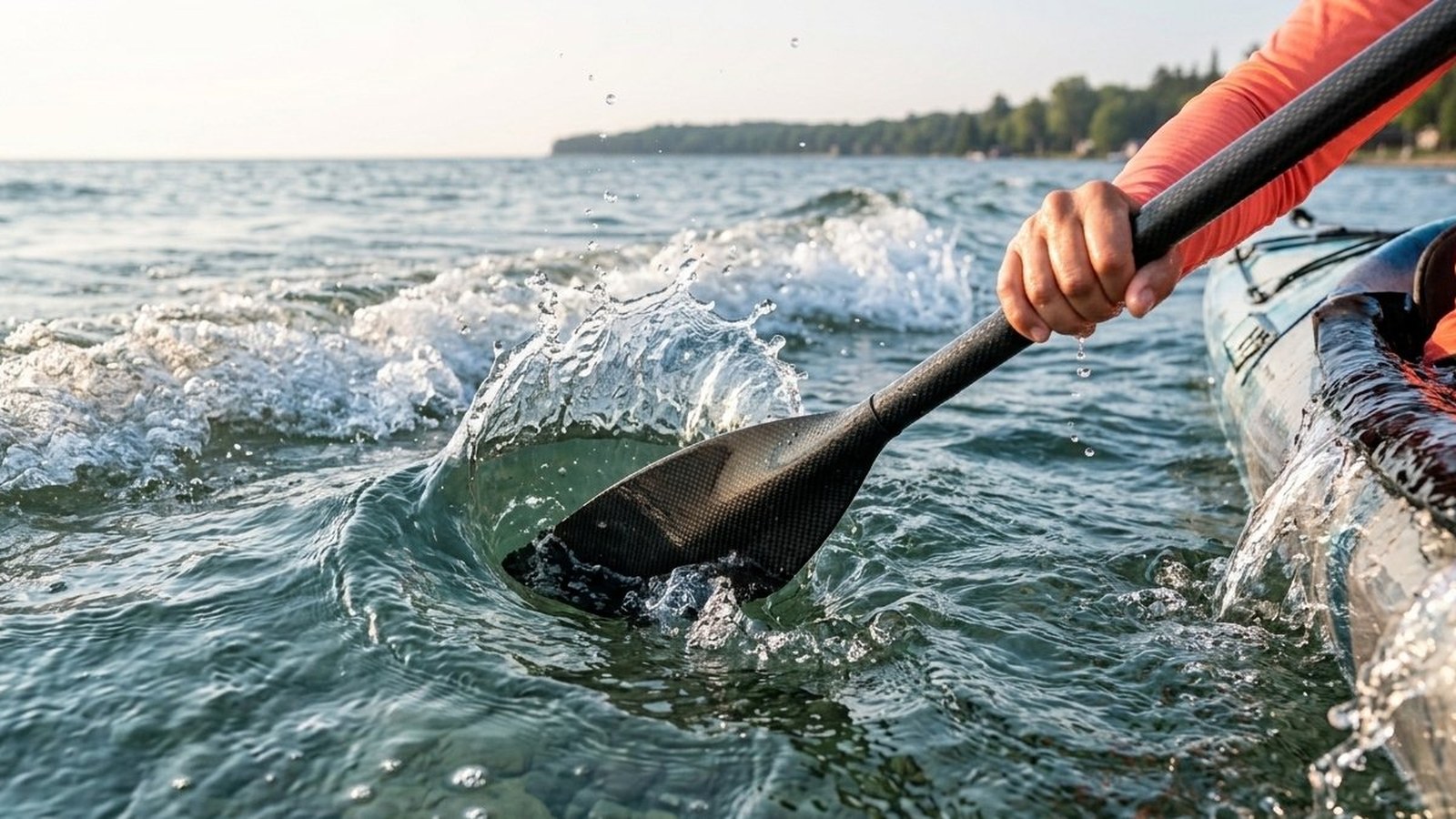
The 60-second version
For multi-hour paddling, grip endurance often gives out before the shoulders, core, or legs do. Building grip in summer means the autumn paddle still feels controlled instead of forearm-cramped in the third kilometre. As a bonus, grip strength is one of the best-studied markers of whole-body strength and long-term health.
Educational journalism, not medical advice. Every claim here is checked against its cited sources by editor Timothy Bunce — a health writer, not a physician. It isn’t specific to your situation: for health decisions, talk to your own clinician. How we work →
Some links in this article are affiliate links. If you buy through one, The Beachside Reader earns a commission at no extra cost to you. It never changes which products we pick, or what we say about them. Full affiliate disclosure →
Grip strength as the limiting factor in paddle sports
Watch any recreational paddler at hour two of a Georgian Bay tour and the pattern becomes obvious. The shoulders are still functional, the core still engaging, the legs still bracing — but the hands are visibly opening between strokes. The grip has failed before the cardiovascular or muscular systems have come close to their limits. The result is sloppy stroke entry, reduced power transfer, and the white-knuckle cramping familiar to anyone who has tried to extend a planned 90-minute paddle into a three-hour day.
In kayak, canoe, stand-up paddleboard, and dragon boat alike, the hand is the single point of force transfer between the body and the water. If the grip cannot hold a relaxed, controlled position for the duration of the session, every other input — leg drive, hip rotation, lat engagement — bleeds output through the failing hand. In practical terms this makes grip endurance, more than peak strength, the bottleneck most recreational paddlers run into first. (That observation is field experience, not a research finding.)
What grip strength actually tells us
Handgrip strength is one of the most-studied functional measurements in physical medicine, in large part because it is cheap to measure and tracks meaningfully with the rest of the body. Handgrip strength correlates with whole-body and upper-limb strength and with bone mineral density, and it predicts all-cause mortality.1 It is also a reasonable proxy for whole-body muscle mass, which is part of why a single hand measurement carries so much information.4
The relevance for paddlers is indirect but real: grip is a window onto the strength of the whole kinetic chain that drives a stroke, not an isolated party trick of the hand. Improving it is unlikely to do harm and tends to travel with broader strength.
Forearm endurance vs maximum grip
Two different qualities matter for paddlers, and they train differently. Maximum grip strength — what a hand dynamometer measures in a single squeeze — reflects how hard you can pull on a single stroke. Forearm endurance — how long you can sustain a submaximal hold without failure — is what determines whether the third hour of paddling still feels controlled.
Recreational paddlers tend to need endurance more than peak force. A two-hour tour requires sustained moderate grip force, not occasional maximal pulls. Training that emphasises higher-rep, lower-load grip work — sustained submaximal holds, or hangs from a bar with relaxed shoulders — builds the relevant capacity. Crushing harder on a high-tension gripper builds peak strength but does little for endurance until the loads are deliberately reduced. This is a training-design distinction rather than a claim from any single study.
Building grip during paddle sessions vs gym
Paddle sessions themselves are good grip training when structured deliberately. Paddling for 90 minutes with neutral grip pressure trains exactly the endurance capacity that gym work struggles to replicate. The trade-off is volume: most adults cannot paddle five times a week, but most can fit two short gym-based grip sessions into the schedule.
The gym work fills the gap. A weekly pattern of two short grip sessions — one focused on sustained holds (dead hangs, farmer carries, plate pinches), one focused on dynamic squeeze-and-release work with a hand strengthener — combined with one or two paddle sessions, is a sensible structure for most adults. Treat the on-water benchmark, not a dynamometer number, as the goal: the third hour of an October paddle feeling manageable instead of ending in forearm cramps.
Hand fatigue and the SUP/kayak transition
Stand-up paddleboarding and kayaking load the grip differently. The SUP single-blade paddle is held with one hand high on the T-grip and one wrapped around the shaft — the shaft hand bears most of the sustained load. The kayak double-blade paddle distributes load across both hands but generally rewards a looser grip that lets the shaft rotate during stroke recovery.
This matters because adults transitioning between disciplines often carry forward grip habits that fail in the new context. A kayaker who clenches the shaft like a SUP shaft loses stroke efficiency and accelerates hand fatigue. A SUP paddler who keeps a kayak-loose grip on the shaft hand loses control of the blade angle. Both disciplines benefit from grip training, but the transition between them is its own skill.
Why grip is worth training — especially for women
Grip strength is sometimes dismissed as “a guy thing,” but the functional consequences of low grip — early fatigue, reduced paddle control, increased risk of dropping equipment in awkward conditions — apply to everyone. And the longer-term case is, if anything, stronger for women: grip strength predicts bone mineral density and bone loss in postmenopausal women.3 Grip strength also correlates with bone mineral density more broadly and with general functional capacity.1
A weekly grip session is one of the smaller training investments with one of the larger plausible long-term returns, particularly for women in their 40s and beyond who may be neglecting it. (Starting loads will differ between individuals; the principles of progression do not.)
Grip and aging
The case for grip training is not just sport-specific. In older adults, low handgrip strength predicts functional (activities-of-daily-living) decline and elevated mortality, in a dose-dependent, per-5-kilogram fashion.5 In the large international PURE study, each roughly 5-kilogram decrement in grip strength corresponded to about a 16% increase in all-cause mortality and about a 17% increase in cardiovascular mortality — and grip strength predicted mortality more strongly than systolic blood pressure.2
Part of this is likely direct (grip strength is a proxy for whole-body muscle mass, which is itself protective)4 and part is probably an index of overall activity level. Either way, the implication for adult paddlers is clear: grip training is a general health-aligned habit that happens to produce better paddle endurance as a side effect.
Practical 4-week grip block
A workable 4-week introduction for adults new to deliberate grip training. Week 1 — two short sessions, focused on familiarisation with a hand strengthener at moderate resistance, around 3 sets of 15–20 squeezes per hand. Week 2 — add 30-second dead hangs from a pull-up bar (one set per session, building toward two). Week 3 — introduce farmer carries with moderate weight (a kettlebell or dumbbell per hand) for 30-to-60-second walks, two sets per session, alongside the strengthener and hangs. Week 4 — extend total hang time toward 45–60 seconds per session, increase farmer-carry duration, and add plate pinches (holding two light plates together with fingertips) for 20 to 30 seconds per set.
Progress the load gradually and let the on-water feel — a more controlled third hour — be your measure of success. Continued maintenance at one or two sessions per week helps preserve the gains. (This is a sensible starter template, not a protocol validated in a trial; build progression over weeks, not days.)
Practical takeaways
- Grip endurance — not peak force — is usually the first thing to give out in multi-hour paddling.
- Grip strength correlates with whole-body strength, muscle mass, and bone density.14
- Train sustained holds (hangs, farmer carries) more than crushing strength.
- A short weekly session is a low-cost way to build and maintain grip.
- Grip strength predicts long-term health outcomes independent of paddle goals.25
Extended takeaways
The most useful frame is to think of grip as the leverage point for the entire upper-body kinetic chain. The arms, shoulders, and torso can be powerful, but if the hand holding them to the paddle fails, that power dissipates through a loose grip. Strengthening the grip lets the rest of the chain actually deliver what it is capable of producing.
The second principle is that grip endurance, like cardiovascular endurance, is built by accumulated time under load rather than occasional maximal efforts. Crushing a high-resistance gripper for five seconds emphasises peak force; holding a moderate-resistance gripper for longer emphasises endurance. The paddler usually needs the second more than the first, and many introductory grip programs over-weight the first by default.
The third pattern is the long-term value. Grip strength is a well-validated marker of whole-body strength, muscle mass, and mortality risk,12 so a modest weekly grip routine maintained across years is a small intervention with a plausibly large cumulative benefit — and, incidentally, it keeps the autumn paddle enjoyable.
Frequently asked questions
How long until I notice the difference on the water?
This varies between individuals and is not something we can put a precise figure on. Use the on-water benchmark — whether the third hour of a paddle still feels controlled — rather than chasing a specific number, and give any new routine several weeks before judging it.
Will deadlifts and pull-ups train enough grip?
For general fitness, often yes. For multi-hour paddle endurance, frequently not: compound lifts build peak grip force but rarely accumulate the sustained-load time that paddling demands. Adding a short block of isolated, endurance-focused grip work each week closes that gap. (This reflects training-design logic, not a head-to-head study.)
Is grip training risky for tendons?
The forearm flexor tendons can be overloaded if grip volume is increased too quickly. Build progression across weeks, not days, and pull back if you feel persistent ache at the medial elbow. General injury-prevention practice, not a specific finding from the studies cited here.
Do I need expensive equipment?
No. A simple spring-loaded hand strengthener, a doorway pull-up bar for hangs, and a pair of dumbbells or kettlebells for farmer carries cover the entire program. The total equipment cost is modest.
Should women train grip differently from men?
The principles are the same. Starting loads will differ, but the progression, exercise selection, and weekly volume can match. The functional and long-term health case for training grip is at least as strong for women, including its link to bone density in later life.3
References
Bohannon 2019Bohannon RW. Grip Strength: An Indispensable Biomarker For Older Adults. Clinical Interventions in Aging. 2019;14:1681-1691. PMID 31631989; doi:10.2147/CIA.S194543. View source →Leong 2015 (PURE)Leong DP, Teo KK, Rangarajan S, et al. Prognostic value of grip strength: findings from the Prospective Urban Rural Epidemiology (PURE) study. The Lancet. 2015;386(9990):266-273. PMID 25982160. View source →Sirola 2005Sirola J, Tuppurainen M, Honkanen R, Jurvelin JS, Kroger H. Associations between grip strength change and axial postmenopausal bone loss - a 10-year population-based follow-up study. Osteoporosis International. 2005;16(12):1841-8. PMID 16049626. View source →Chan 2022Chan W-C, Lu T-W, Yao H-H, Kosik RO. Correlation between hand grip strength and regional muscle mass in older Asian adults: an observational study. BMC Geriatrics. 2022;22:206. PMC8922763. View source →McGrath 2018McGrath RP, Vincent BM, Lee I-M, Kraemer WJ, Peterson MD. Handgrip Strength, Function, and Mortality in Older Adults: A Time-varying Approach. Medicine & Science in Sports & Exercise. 2018;50(11):2259-2266. PMID 29933349. View source →