The 60-second version
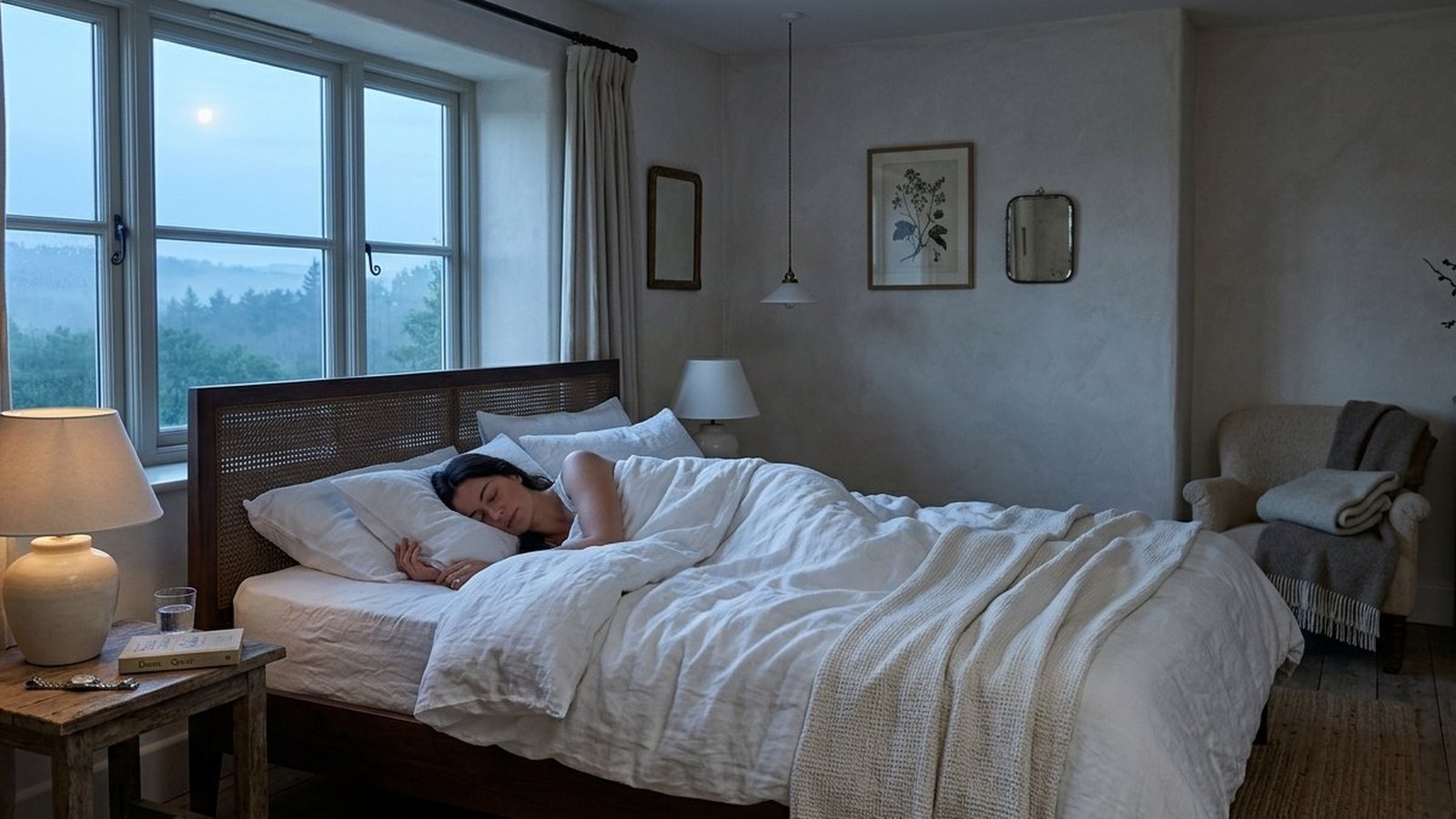
Long Ontario evenings push bedtime later and morning light wakes you earlier. The net sleep loss is real, and the fix is more about managing light than about discipline.
Educational journalism, not medical advice. Every claim here is checked against its cited sources by editor Timothy Bunce — a health writer, not a physician. It isn’t specific to your situation: for health decisions, talk to your own clinician. How we work →
Some links in this article are affiliate links. If you buy through one, The Beachside Reader earns a commission at no extra cost to you. It never changes which products we pick, or what we say about them. Full affiliate disclosure →
Why solar latitude messes with sleep
Wasaga Beach sits at roughly 44.5 degrees north latitude. That places it far enough from the equator that day length swings by close to six hours between the December and June solstices. In late June, civil twilight lingers past 10 PM and the first hint of dawn appears before 5 AM. That long evening light is the heart of the problem: bright light in the hours before bed holds the body clock back.
That evening light is not a cosmetic detail. A field study by Wright and colleagues showed that when people spent a week camping under natural light only, with no electric light in the evening, their internal clock and melatonin timing shifted earlier compared with their normal electrically-lit, city-living baseline.1 The lesson runs both ways: evening artificial light delays the clock, and so does the long natural light of a northern summer evening that keeps stimulating the eyes during dinner, dog walks, and patio time.
Melatonin onset timing in long days
Dim-light melatonin onset, often abbreviated DLMO, is a standard marker of circadian phase. The hormone melatonin signals biological night, and its release is governed largely by light reaching the eye. Light before and during the night suppresses melatonin, and even modest indoor room light is enough to meaningfully suppress it and delay its onset.3 For a deeper look at the hormone itself — effective dose, timing, and why most store-bought pills contain far more than that — see our evidence review of melatonin.
The mechanism is specific. Short-wavelength light, around 460 nanometres, activates a dedicated light-sensing pathway in the retina (the melanopsin-containing ganglion cells) that projects to the suprachiasmatic nucleus, the body's master clock. This short-wavelength light suppresses melatonin far more strongly than longer-wavelength light of the same intensity.6 In practical terms, the blue-rich light of a bright summer evening keeps telling the clock that it is still daytime, holding melatonin down and pushing sleepiness later.
The weekday cumulative loss
Here is where it gets uncomfortable. If summer pushes your sleep onset later but your wake time stays fixed at 6:30 AM for work or school, you lose sleep on every weekday, and that loss adds up across the week.
The deficit is sneaky because it does not feel like much. A two-week study by Van Dongen and colleagues, in which people slept less than they needed each night, found that cognitive impairment built up steadily over the days, yet the participants did not perceive it: they rated their own alertness as close to normal while objective tests showed real deficits.2 The summer version is sneakier still, because it does not feel like restriction at all. You go to bed when you feel sleepy, get up when the alarm sounds, and assume the alarm is the only problem. In reality, the light environment is doing much of the damage on both ends of the night.
Light management strategies
The fix is to manage light rather than rely on willpower. Three approaches have evidence behind them — they line up closely with the free, no-supplement habits in our fact-check of the viral "sleep stack".
First, reduce short-wavelength light in the evening. Because blue light is the most potent suppressor of melatonin,6 cutting it before bed lets melatonin secretion start closer to its natural time. In a randomized trial, wearing amber (blue-blocking) lenses in the hours before bed improved sleep, though this is best understood as a modest, mixed-evidence strategy rather than a guaranteed fix.4
Second, reinforce the daytime phase with morning light. Morning bright light anchors circadian phase and shifts sleep earlier, which means more morning light can actually help you fall asleep earlier at night.5 Getting outside soon after waking is the simplest way to use this.
Third, darken the bedroom as much as possible. Because even modest indoor light suppresses melatonin,3 light leaking in through windows at night can blunt the hormone you are trying to protect. Low light levels well under typical indoor lighting are enough to matter, so genuine darkness is worth the effort.
Blackout curtains versus eye masks
The two practical tools for bedroom darkening serve overlapping but different functions. Blackout curtains block external light at the window; eye masks block any remaining light at the eye. Each has trade-offs.
Blackout curtains are passive. Once installed and closed, they work without effort, and they also keep the bedroom cooler during the day by blocking solar gain. The downsides are cost, the need to physically draw them, and the fact that pets, partners, and household traffic can defeat them. Quality matters too: many curtains marketed as blackout still let a noticeable amount of light through at the edges, so look for side channels or other features that close those gaps.
Eye masks are portable and personal. They follow you to a hotel, a relative's house, or a tent, and they cost a fraction of curtains. The downside is fit and comfort: a mask that presses on the eyes can be disruptive, and one that slides off in the night provides no benefit. A contoured-cup style that leaves space around the eye sockets avoids both problems.
For most households, the answer is both: curtains for the home bedroom and a quality mask for travel, partner-different-schedule situations, and as a backup if curtains fail.
Cool-bedroom strategy carryover
Sleep is also temperature-sensitive: higher indoor temperatures are generally associated with degraded sleep quality and quantity, so a warm summer bedroom can make falling asleep harder.7 Keeping the room cool is a sensible, low-risk piece of the puzzle, even though the exact optimal temperature is a general guideline rather than a single settled number.
Three practical interventions help. Air conditioning is the most powerful but the most expensive to run nightly. A fan moving air across the body lowers perceived temperature through evaporative cooling. A cooling mattress topper or breathable bedding addresses the microclimate immediately around the sleeper without cooling the whole room.
For Wasaga residents close enough to Georgian Bay to benefit from the lake breeze, opening windows for cross-ventilation in the late evening can drop bedroom temperatures faster than the air-conditioning cycle. The trade-off is light and noise from outside, which brings us back to curtains and masks as the necessary complement.
Evening blue-light reality vs hype
Blue-blocking glasses have been marketed aggressively for the better part of a decade. The evidence is more mixed than the marketing suggests, but it is not zero. A randomized trial of amber blue-blocking lenses worn before bed found improved sleep,4 which fits the underlying biology: short-wavelength light is the strongest suppressor of melatonin, so filtering it out in the evening removes part of the signal keeping the clock awake.6
One practical caveat worth keeping in mind: on a bright summer evening, a phone screen is not the only blue-light source in play. Outdoor light during a sunset walk delivers far more light to the eye than a screen indoors, so reducing evening light exposure broadly matters more than fixating on devices alone.
Preventing the loss beats catching up
The natural impulse with weekday sleep debt is to sleep late on weekends. Sleeping in can feel restorative, but a later weekend wake-up also means skipping the early-morning light that anchors your clock,5 which can leave the Sunday-to-Monday transition feeling harder.
The cleaner solution is to prevent the weekday loss in the first place by managing light. Morning bright light pulls the clock earlier and strengthens the evening sleep signal,5 while cutting bright and blue-rich light in the evening lets melatonin rise closer to its natural time.36 Catch-up sleep is an emergency measure, not a sustainable strategy.
Extended takeaways
The summer sleep problem in southern Ontario is not a willpower failure. The long northern photoperiod keeps light reaching the eye late into the evening, and that light is what delays the clock. The most reliable countermeasure is to control what the eye sees: deliberate management of evening light, morning light, and the bedroom environment.
Tools tend to beat rules. A blackout curtain that closes once and stays closed beats a daily reminder to be careful with screens. A morning walk that becomes a habit beats an alarm that gets snoozed. An eye mask that lives on the bedside table beats one that lives in a drawer. The interventions that last are the ones that require no decision-making once they are in place. Wasaga's long summer evenings are one of the best parts of living here; the cost of enjoying them is a small amount of nightly engineering to keep the body clock honest.
Frequently asked questions
Are blue-blocking glasses worth wearing in the evening?
There is reasonable, if mixed, evidence for them. A randomized trial found that amber blue-blocking lenses worn before bed improved sleep.4 Deeper amber lenses block more short-wavelength light than lightly tinted "computer" lenses, so they are more likely to make a difference. Treat them as a modest aid, not a cure.
Will an early-morning walk help me fall asleep earlier at night?
The evidence points that way. Morning bright light anchors circadian phase and shifts sleep earlier, so getting bright light soon after waking can make the evening sleep signal arrive sooner.5 The effect builds over days rather than working instantly.
Does completely darkening the bedroom really matter?
Yes. Even modest indoor light suppresses melatonin and delays its onset,3 so light leaking in at night can work against the hormone you want to rise. Genuine darkness, from curtains, a mask, or both, is worth the effort.
Is melatonin supplementation a reasonable summer fix?
This article does not evaluate supplement dosing, and melatonin is a medication-like product in some jurisdictions. If you are considering nightly use, talk to a pharmacist or your family doctor first.
References
Wright 2013Wright KP Jr, McHill AW, Birks BR, Griffin BR, Rusterholz T, Chinoy ED. Entrainment of the Human Circadian Clock to the Natural Light-Dark Cycle. Current Biology. 2013;23(16):1554-1558. View source →Van Dongen 2003Van Dongen HPA, Maislin G, Mullington JM, Dinges DF. The Cumulative Cost of Additional Wakefulness: Dose-Response Effects on Neurobehavioral Functions and Sleep Physiology From Chronic Sleep Restriction and Total Sleep Deprivation. Sleep. 2003;26(2):117-126. View source →Gooley 2011Gooley JJ, Chamberlain K, Smith KA, Khalsa SBS, Rajaratnam SMW, Van Reen E, Zeitzer JM, Czeisler CA, Lockley SW. Exposure to Room Light before Bedtime Suppresses Melatonin Onset and Shortens Melatonin Duration in Humans. J Clin Endocrinol Metab. 2011;96(3):E463-E472. View source →Burkhart 2009Burkhart K, Phelps JR. Amber Lenses to Block Blue Light and Improve Sleep: A Randomized Trial. Chronobiology International. 2009;26(8):1602-1612. View source →Crowley 2015Crowley SJ, Eastman CI. Phase advancing human circadian rhythms with morning bright light, afternoon melatonin, and gradually shifted sleep: can we reduce morning bright-light duration? Sleep Medicine. 2015;16(2):288-297. View source →Lockley 2003Lockley SW, Brainard GC, Czeisler CA. High Sensitivity of the Human Circadian Melatonin Rhythm to Resetting by Short Wavelength Light. J Clin Endocrinol Metab. 2003;88(9):4502-4505. View source →Chevance 2024Chevance G, Minor K, Vielma C, Campi E, O'Callaghan-Gordo C, Basagana X, Ballester J, Bernard P. A systematic review of ambient heat and sleep in a warming climate. Sleep Medicine Reviews. 2024;75:101915. View source →