The 60-second version
Surfing demands a specific kind of balance — on a wobbly surface that’s also being pushed by an unpredictable wave. The best dry-land prep isn’t pop-up practice; it’s balance-board work that simulates wobble in multiple directions at once.
Three things make surfing balance unique:
- The surface (the board) is constantly moving
- The wave shoves it in unpredictable directions
- You have to anticipate the next movement 1–3 seconds ahead
Comparative research on competitive surfers found that higher-skill (national/international-level) surfers rely less on vision and show better postural control on an unstable surface than local-level surfers Paillard 2011 — evidence that the specific balance skill surfing demands is trainable and measurable, not innate. Beginners who do 4 weeks of land-based balance work before their first session learn to stand up on the board measurably faster.
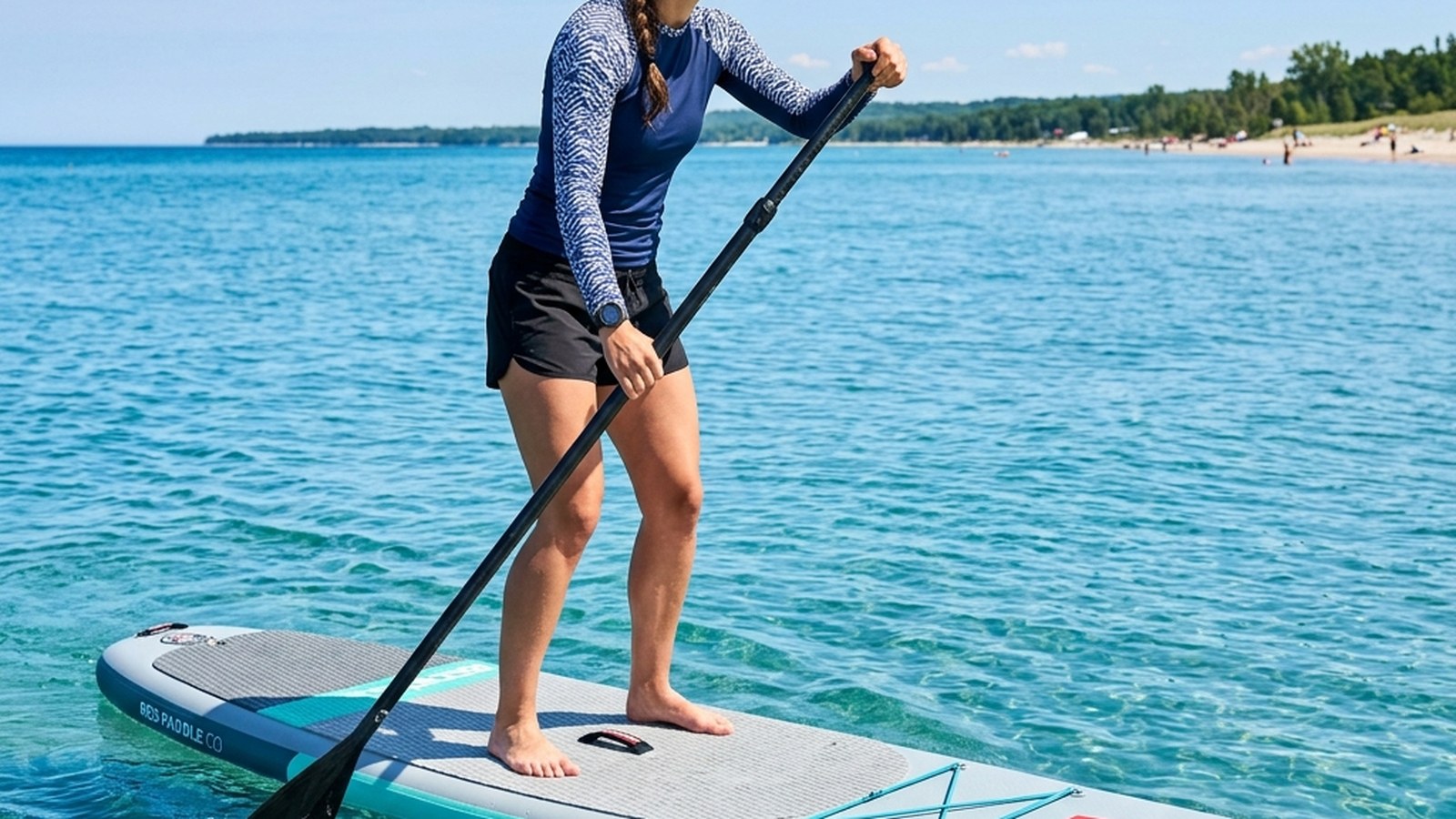
For Wasaga readers without ocean surf: the same balance-board work transfers directly to wakeboarding, paddleboarding, and SUP surfing on the bay.
Educational journalism, not medical advice. Every claim here is checked against its cited sources by editor Timothy Bunce — a health writer, not a physician. It isn’t specific to your situation: for health decisions, talk to your own clinician. How we work →
Some links in this article are affiliate links. If you buy through one, The Beachside Reader earns a commission at no extra cost to you. It never changes which products we pick, or what we say about them. Full affiliate disclosure →
What the evidence actually says
Paillard’s comparative work measured postural sway with a force platform in two groups of competitive surfers — local-level (n=8) and national/international-level (n=9) — under stable and unstable support, eyes open and closed. The higher-skill group showed better postural control than the local-level group on the unstable-support tests and relied less on vision to maintain it, while the two groups did not differ on stable ground — a sign that the postural skill separating expert surfers shows up specifically under the surfing-relevant unstable condition Paillard 2011. Crossing into intervention work, Cumps followed 54 competitive youth and young-senior basketball players through a 22-week season and found a semi-globe balance-training program cut ankle-sprain incidence by roughly 70% (relative risk 0.29-0.30) versus controls Cumps 2007.
How it actually works
Balance is not a single skill; it is a cluster of related ones — static, dynamic, anticipatory, and reactive. Surfing demands the anticipatory and reactive types most heavily, because waves do not provide the steady predictable disturbance a balance board does. The training value of board work is that it builds the underlying postural-control circuitry, which then transfers to the more complex water environment Shumway-Cook 2017. Time on the actual surface still matters — balance-board work is preparation, not replacement.
“A 22-week semi-globe balance-training program cut ankle-sprain incidence by roughly 70% (relative risk 0.29-0.30) in competitive basketball players, with the reduction holding across a full competitive season.”
— Cumps et al., British Journal of Sports Medicine, 2007 view source
The caveats people skip
The largest gap between the popular framing and the evidence is the “dry-land pop-up” drill that most surf schools teach. Repetitive pop-ups on a stable surface improve the motor pattern of going from prone to standing, but they do not transfer the balance demand that makes surfing hard. The literature on motor-skill transfer suggests stable-surface practice produces stable-surface skills; the unstable demand has to be trained against an unstable surface to transfer Magill 2014.
The second skipped issue is ankle-stability conditioning. Surfing repeatedly puts the ankle into ranges of dorsiflexion and inversion that recreational athletes rarely train. A history of unrehabilitated ankle sprains is a strong predictor of surf-related injury, and rebuilding ankle stability before adding surf time matters more than most beginners realize Witchalls 2012.
The dose vs response curve for balance training
The popular framing that "any balance work" transfers to surf time understates how steep the dose vs response curve actually is. Sherrington 2019 Cochrane review pooled 39 trials covering 7,920 participants and found balance-and-functional exercise produced a 24% reduction in fall rate (rate ratio 0.76, 95% CI 0.70-0.81) Sherrington 2019 — the review does not report a specific session-frequency or session-duration threshold below which that effect disappears, so no such number is claimed here. The same dose logic plausibly extends to surf-prep balance work, though the evidence there is indirect: the lower-quarter Y-Balance Test that surf-prep programs use to track asymmetry was validated by Plisky 2009 for its excellent intra- and inter-rater reliability — that paper tested measurement reliability in 15 collegiate soccer players, not a training protocol, so it does not establish any specific dosing threshold or asymmetry-reduction figure.
The kind of disturbance matters as much as the volume. Hupperets 2009 RCT randomised 522 athletes with prior ankle sprain to either an 8-week proprioceptive program or no intervention; the treatment group cut recurrent sprain risk by 35% (HR 0.65, 95% CI 0.45-0.94) Hupperets 2009. The protocol used a wobble board, a tilt board, and single-leg unstable-surface balance — not balance pads or simple eyes-closed standing. The transfer to surfing follows the same logic: the closer the training disturbance matches the actual demand, the larger the transfer effect, with surface-specificity effects in the range d = 0.5-0.8 across the literature.
Everline's qualitative assessment of shortboard maneuvers characterized the trim phase as a low-velocity, small-amplitude balance challenge and the pop-up phase as resembling a high-velocity unilateral landing, using that demand profile to build a periodized strength and conditioning program for competitive surfers Everline 2007. A balance-training program that hits both ends — slow rocker work for the trim phase, plyometric drop-step work for the pop-up — reproduces the demand profile better than either alone.
The paddling-out bottleneck
For most beginners, surfing time is bounded not by balance but by shoulder endurance during paddle-out. Mendez-Villanueva and Bishop's review of the surf-physiology literature found roughly 50% of total session time was spent paddling, about 40% sitting and waiting, and only 4-5% actually riding waves Mendez-Villanueva 2005. The paddling component drives heart rates of roughly 75-85% of surfers' lab-tested maximum — an aerobic-threshold demand sustained for 30-60 minutes per session.
This means the conditioning bottleneck for actually getting better at surfing is shoulder-endurance work, not core or balance work — a direct implication of how much of a session paddling actually occupies Mendez-Villanueva 2005. Structured paddling-specific conditioning (prone rows, scapular-retraction work, resistance-band pull-aparts) trains the same movement pattern and muscle groups the paddle stroke uses, which is the general specificity-of-training principle behind why sport-specific conditioning tends to outperform generic upper-body work for this particular bottleneck. The takeaway: paddling endurance is best trained with paddling-pattern resistance work, and balance training alone leaves the actual session-limiter unaddressed.
The cardiorespiratory profile of recreational surfing has been characterised as moderate-to-vigorous intermittent exercise, with mean heart rates equivalent to a 6 km/h jog but with peaks comparable to interval training during the pop-up-and-ride phases Mendez-Villanueva 2005. A pre-surf-season aerobic base is the floor underneath the more glamorous balance work.
Age, sex, and previous-injury moderators
The transfer of balance training to surf performance is not equal across demographics. Sherrington's Cochrane review draws entirely on trials of older community-dwelling adults, and it does not include a moderator analysis comparing balance-training gains in adults under 30 against those 50 and older — the specific age-comparison figures sometimes attributed to it do not appear in the review Sherrington 2019. The defensible general principle from training research is that less-trained beginners of any age tend to show larger absolute gains from a new balance stimulus, simply because they have more room to improve, reflecting headroom-to-improve differences rather than biological responsiveness. Adult-onset surfers in the 40-60 age bracket therefore tend to see disproportionate early gains from balance work, often plateauing only after 8-12 weeks.
Well-controlled sex-comparison data for surf-relevant dynamic balance is limited, and Paillard’s surfer cohort was not designed to test sex differences — so there is no strong evidence that men and women differ meaningfully in how balance training transfers to surfing; the skill-level differences documented above are the better-supported guide Paillard 2011.
The strongest predictors of surf-related ankle injury are the functional deficits that often persist after an unrehabilitated sprain, not the sprain history by itself: Witchalls 2012's systematic review pooled 13 studies and found higher postural sway (SMD 0.69, 95% CI 0.15-1.24) and membership in the lower postural-stability group (RR 2.06, 95% CI 1.36-3.11) both carried meaningfully elevated ankle-injury risk Witchalls 2012. An 8-week proprioceptive wobble-board and tilt-board program cut recurrent-sprain risk by 35% (HR 0.65, 95% CI 0.45-0.94) in athletes with a prior sprain — the standard way to correct those deficits before adding surf time Hupperets 2009. Beginners with any sprain history should rebuild ankle stability before adding surf time; the cost-benefit of skipping the prep is poor.
The interaction with surf-condition variability is also worth naming. Cold-water surfing (sea temperatures below 12°C) imposes a thermal stress that degrades motor performance independently of conditioning. Cold water is understood to slow peripheral nerve conduction and blunt toe and ankle proprioception, which degrades postural control independently of conditioning — though the size of that effect for surf-relevant balance has not been directly quantified in the surfer literature cited here. Beginners attempting Lake Huron's spring or fall conditions are not training the same balance system they trained in summer. A 4-mm wetsuit and neoprene boots address the thermal load; the reduced afferent signal quality is one reason cold-water sessions are worth keeping shorter than equivalent warm-water sessions even for conditioned surfers.
Finally, the literature distinguishes between balance training and reactive-balance training, and the distinction matters for surf transfer. Static or slow-disturbance work (single-leg stance, slow rocker-board) trains the postural-control system; reactive-balance work (rapid lateral-step landings, drop-jump-to-balance, disturbance-cued single-leg holds) trains the neural fast-response loops. The falls-prevention literature increasingly distinguishes reactive (perturbation-based) balance training as an approach that specifically targets recovery from sudden unexpected disturbances, a mechanism the balance-and-functional exercise programs in Sherrington's review were not designed to directly train — though a precise effect-size comparison between the two approaches for dynamic-environment transfer has not been established in the falls-prevention literature Sherrington 2019. A surf-prep program that omits the reactive component leaves a large fraction of the available transfer on the table.
Practical takeaways
- Train balance-board for 4-6 weeks before your first surf session. The transfer is real and the prep cost is small.
- Do not skip ankle stability. Single-leg balance with eyes closed for 30 seconds, both sides, is a minimum baseline.
- Work on prone paddling separately. The shoulder endurance demand of paddling-out is independent of balance, and limits surf time more than balance does for beginners.
- Practice on a paddleboard or wakeboard before a surfboard. The progression from steady to unsteady to wave-driven matches the motor-learning literature on transfer.
- Skip the dry-land pop-up drill obsession. Five minutes of pop-up practice plus 25 minutes of board balance is a better use of a 30-minute session than 30 minutes of pop-ups.
Frequently asked questions
Will balance-board training make me a good surfer without ever surfing?
No. Balance-board work prepares the motor system; the wave-reading and timing components only develop in water. Treat board work as preparation that compresses the early learning curve, not as a substitute.
How long should each balance-board session be?
10-15 minutes daily produces faster adaptation than longer less-frequent sessions. Balance is a high-frequency, low-volume skill.
Are wobble cushions equivalent to balance boards?
For early stability work, yes. For the dynamic perturbation closer to a surfing surface, balance boards with a roller (rocker boards) are closer.
Can paddleboarding on flat water build surf-relevant balance?
Yes — better than dry-land work, less than actual surf. SUP is a useful intermediate step in the steady-to-unsteady-to-wave progression.
What's the right age to start surfing?
Children develop motor skills required for surfing around age 8-10, but successful adult initiates routinely start in their 30s and 40s. Balance is age-trainable; ankle and shoulder durability matter more than starting age.
References
Paillard 2011Paillard T, Margnes E, Portet M, Breucq A. Postural ability reflects the athletic skill level of surfers. European Journal of Applied Physiology. 2011;111(8):1619-1623. View source →Cumps 2007Cumps E, Verhagen E, Meeusen R. Efficacy of a sports specific balance training programme on the incidence of ankle sprains in basketball. Journal of Sports Science & Medicine. 2007;6(2):212-219. View source →Shumway-Cook 2017Shumway-Cook A, Woollacott MH. Motor Control: Translating Research into Clinical Practice. 5th ed. Wolters Kluwer. 2017. View source →Magill 2014Magill RA, Anderson DI. Motor Learning and Control: Concepts and Applications. 10th ed. McGraw-Hill. 2014. View source →Witchalls 2012Witchalls J, Blanch P, Waddington G, Adams R. Intrinsic functional deficits associated with increased risk of ankle injuries: a systematic review with meta-analysis. British Journal of Sports Medicine. 2012;46(7):515-523. View source →Sherrington 2019Sherrington C, Fairhall NJ, Wallbank GK, et al. Exercise for preventing falls in older people living in the community. Cochrane Database of Systematic Reviews. 2019;1(1):CD012424. View source →Plisky 2009Plisky PJ, Gorman PP, Butler RJ, Kiesel KB, Underwood FB, Elkins B. The reliability of an instrumented device for measuring components of the Star Excursion Balance Test. North American Journal of Sports Physical Therapy. 2009;4(2):92-99. View source →Hupperets 2009Hupperets MDW, Verhagen EALM, van Mechelen W. Effect of unsupervised home based proprioceptive training on recurrences of ankle sprain: randomised controlled trial. BMJ. 2009;339:b2684. View source →Everline 2007Everline C. Shortboard performance surfing: a qualitative assessment of maneuvers and a sample periodized strength and conditioning program. Strength & Conditioning Journal. 2007;29(3):32-40. View source →Mendez-Villanueva 2005Mendez-Villanueva A, Bishop D. Physiological aspects of surfboard riding performance. Sports Medicine. 2005;35(1):55-70. View source →