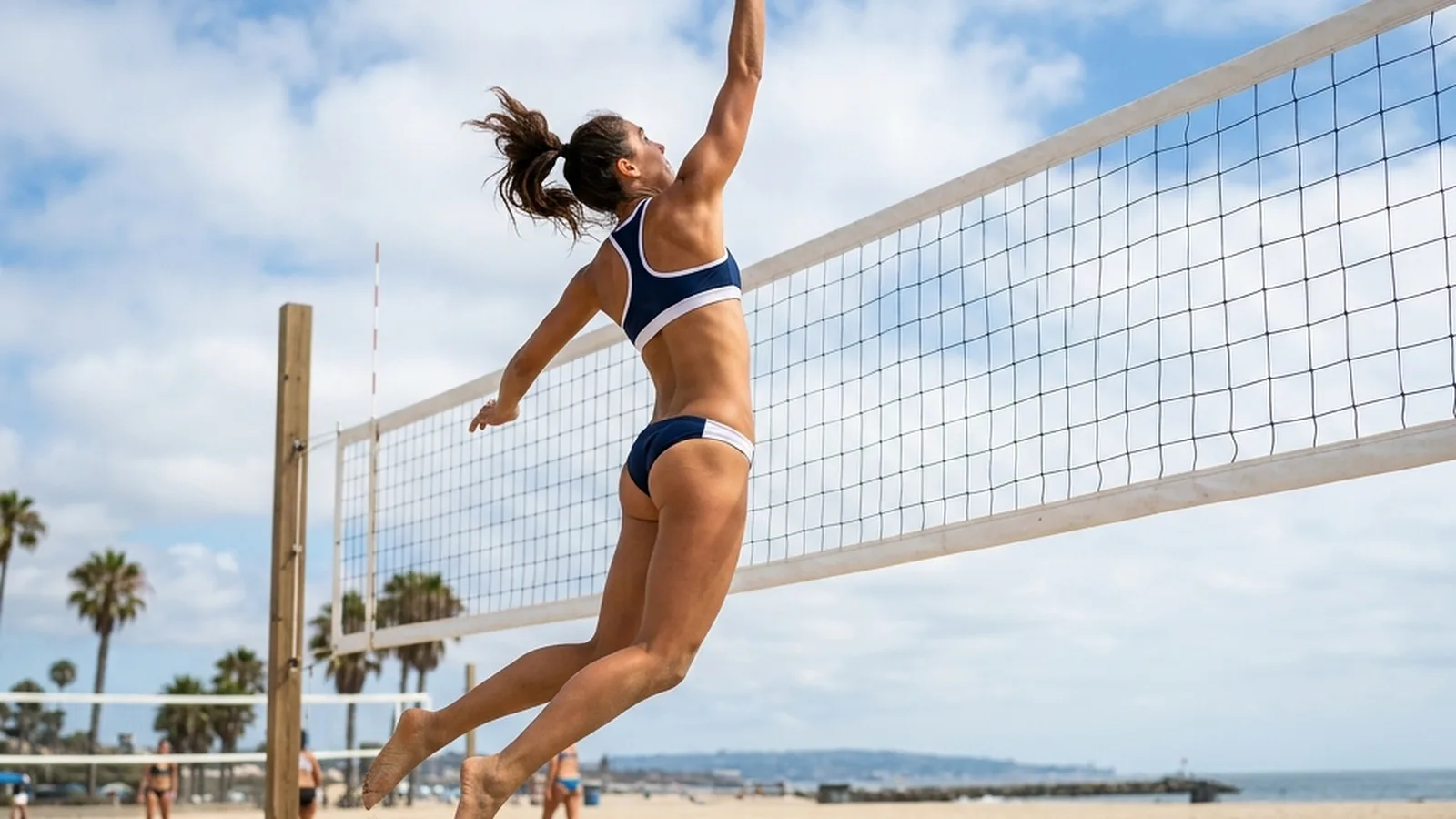
The 60-second version
Beach volleyball looks recreational and produces serious conditioning. Time-motion analysis of competitive matches shows roughly 140-180 jumps per 2-hour session for an active player, with most of the work in a high-intensity intermittent pattern that closely resembles a structured HIIT protocol. The sand surface adds a metabolic and stabiliser load on top: 1.6× the energy cost of equivalent hard-surface movement, plus 20-40% more recruitment of ankle and trunk stabilisers. The injury profile is friendly to joints — ground-reaction forces on sand are well below indoor volleyball — but ankle sprains are a real and different risk because of the unstable surface. Programmed as 2-3 sessions weekly, beach volleyball delivers cardiovascular conditioning, vertical-jump development, and proprioceptive ankle training in one package.
Educational journalism, not medical advice. Every claim here is checked against its cited sources by editor Timothy Bunce — a health writer, not a physician. It isn’t specific to your situation: for health decisions, talk to your own clinician. How we work →
Some links in this article are affiliate links. If you buy through one, The Beachside Reader earns a commission at no extra cost to you. It never changes which products we pick, or what we say about them. Full affiliate disclosure →
What the jump biomechanics show
The most cited beach-volleyball physiology work is Giatsis’s laboratory study comparing elite players’ vertical squat-jump mechanics on sand versus a rigid surface — not match data, but it explains a lot about why the sport feels different in the legs. The key findings, from 15 elite male players tested on both surfaces:
- Jump height was significantly lower on sand than on a rigid surface.
- Maximal force and maximal power were both significantly lower on sand, showing how much energy the compressible surface absorbs before it reaches the legs.
- Ankle range of motion and angular velocity were larger on sand, as the joint compensates for slippage in the compliant surface.
- Hip and ankle joint angles at takeoff differed measurably between surfaces — players restructure the jump on sand rather than simply doing a slower version of the same movement Giatsis 2004.
Those biomechanical shifts are consistent with why beach volleyball feels far more taxing on the legs than a casual glance would suggest — the surface itself is doing systematic work on jump mechanics, not just slowing players down.
What the sand adds
The sand surface changes everything. The published sand-running and sand-jumping literature converges on two effects:
- Energy cost is 1.6× hard-surface running at the same speed. Sand absorbs the elastic-recoil energy that tendons normally return on each stride, so the muscles have to generate that work from scratch every step Pinnington 2001.
- Jump height drops roughly 14% on dry sand vs. firm ground. The compressible surface gives during push-off, so less of the leg’s force translates to vertical velocity Giatsis 2004. The trade-off: sand’s give reduces the impact load the musculoskeletal system absorbs on each rep — in a 4-week plyometric programme with soccer players, the group training on sand reported lower average muscle soreness across the block than the group training the identical volume on grass Impellizzeri 2008.
The combined effect: beach volleyball produces the metabolic load of high-intensity training with much less impact load per jump. Most players can do 5-10× the jump volume per week on sand compared to indoor before symptoms appear.
What it actually trains
- Vertical jump development. 140-180 jumps per session is high volume even by structured plyometric training standards. The one controlled trial behind sand-based plyometric claims — a 4-week programme in soccer players, not volleyball — actually found the players training on grass improved their countermovement jump more than the sand group did; squat-jump gains trended similarly between surfaces. Sand’s real advantage in that trial was lower DOMS across the block, not bigger jump gains Impellizzeri 2008.
- Cardiovascular base. The 50-70% V̇O2max average lands in zone 2-3 of standard endurance training, with intermittent zone-4/5 peaks. A 2-hour session produces the metabolic stimulus of a structured 60-90 minute conditioning workout.
- Ankle stability and proprioception. Constant micro-adjustments to the unstable sand surface recruit ankle stabilisers continuously. Players who add beach volleyball typically report improved single-leg balance within 4-6 weeks.
- Trunk rotation strength. The spike and serve motions are repetitive trunk-rotation efforts under load, and the unstable sand surface adds an extra core-stabilisation demand to every approach and swing. That’s a plausible training stimulus for rotational strength, though it hasn’t been directly measured against indoor players in controlled research.
The injury profile shifts but doesn’t disappear
Beach volleyball is dramatically friendlier to knees than indoor volleyball — patellar tendinopathy rates are 30-50% lower in published surveillance. But the unstable surface produces a different injury pattern:
- Ankle inversion sprains are a genuine risk on the unstable surface. The combined factors of uneven dry sand, repeated landings, and the lateral footwork of defensive play raise the odds of a foot finding an asymmetric pocket of sand on landing. Published injury surveillance shows ankle injuries are common in both indoor and beach volleyball, with different mechanisms rather than a simple multiple of one over the other.
- Sun and heat injuries. Sand temperatures of 50-60°C are common on hot afternoons, and reflective UV doses are well above ground-level exposure. Plantar burns and sunburn are the most-cited acute injuries in recreational beach-volleyball surveys.
- Shoulder impingement from over-volume serving. Less common than in indoor volleyball but present in players who increase volume rapidly.
- Calf and Achilles overload in players new to sand training. The longer ground contact times stretch tendons in patterns most adults aren’t adapted to.
How to programme it for training benefit
- 2-3 sessions weekly is the sweet spot for most adults. More than 3 produces accumulating fatigue without proportional adaptation benefit.
- Cap session length at 90 minutes for adults new to sand. The metabolic load is high enough that 2-hour sessions on day one produce DOMS that interferes with the rest of the week.
- Stable ankle support helps in the first month. A lightweight ankle brace or taping reduces the early-transition sprain rate while ankle stabilisers adapt to the unstable surface.
- SPF 50+ and shade between points. The UV dose on reflective sand on a sunny day is comparable to high-altitude skiing.
- Hydration: drink 750 mL per hour minimum in 25-30°C ambient temperature. Sweat losses on sand are higher than indoor volleyball because of the radiant heat.
- If transitioning from indoor volleyball, start with one beach session per week and progress over 4-6 weeks. The metabolic-load difference catches most indoor players by surprise.
Who beach volleyball suits as cross-training
| Profile | Fit | Why |
|---|---|---|
| Runner managing chronic knee complaints | Excellent | Jump volume with reduced impact |
| Lifter wanting low-impact conditioning | Excellent | HIIT-equivalent stimulus without joint cost |
| Aging adult wanting power maintenance | Good | Sand reduces injury risk of plyometric work |
| Player with chronic ankle instability | Caution | Unstable-surface ankle-sprain risk is real |
| Person with sun-sensitive skin | Caution | UV exposure is the highest of any common sport |
| Endurance athlete during base-building | Excellent | Zone-2-to-3 with built-in HIIT bouts |
Practical takeaways
- Beach volleyball produces HIIT-equivalent cardiovascular load with naturally occurring 30-60s work, 60-90s recovery intervals.
- 140-180 jumps per 2-hour session lands in the high range of structured plyometric volume, with 40-50% lower peak landing forces than indoor volleyball.
- Trained capacities: vertical jump, cardiovascular base, ankle stability, trunk rotation strength.
- Ankle injuries are the dominant concern on sand, driven by the unstable surface rather than a confirmed multiple over indoor play. Brace or tape in the first month if transitioning.
- UV exposure on reflective sand approaches high-altitude levels. SPF 50+, shade, hydration are non-negotiable.
- Programme as 2-3 sessions weekly, 60-90 minutes, expect 6-8 weeks before adaptations show.
Frequently asked questions
Is beach volleyball really good cardio?
Better than most recreational sports. Time-motion analysis shows competitive matches produce 75-85% max heart rate average with 90%+ peaks, V̇O2 demand of 50-70% V̇O2max, and natural HIIT-pattern work/rest intervals. A 2-hour beach session produces the metabolic stimulus of a structured 60-90 minute conditioning workout.
Will beach volleyball help me jump higher?
Yes. 140-180 jumps per 2-hour session is high plyometric volume. The controlled evidence behind that claim comes from soccer players, not volleyball, and over a 4-week block found that training on grass produced bigger jump gains than sand did. Sand's real advantage was less muscle soreness along the way, not extra height.
Why is beach volleyball easier on the knees than indoor?
The sand surface absorbs roughly 40-50% of the peak ground-reaction force at landing. Repeated jumping that produces patellar tendinopathy on a hard floor produces much less tendon load on sand.
How often should I play for fitness benefit?
2-3 sessions weekly is the sweet spot for most adults. More than 3 produces accumulating fatigue without proportional adaptation. Less than 2 doesn’t build the aerobic and plyometric base.
Are ankle sprains really that much worse on sand?
Ankle injuries are common on sand, but published surveillance doesn’t support a clean multiple over indoor volleyball — the two codes show different injury patterns rather than one being simply worse. The unstable surface does produce more asymmetric landings, so a lightweight ankle brace or taping in the first month while stabilisers adapt is a sensible precaution.
How do I avoid getting roasted by the sun?
SPF 50+, broad-spectrum, applied 15 minutes before play and reapplied every 2 hours. Sun-protective rash guard helps. Schedule sessions before 10 AM or after 4 PM in summer. UV exposure on reflective sand approaches high-altitude levels.
References
Giatsis 2004Giatsis G, Kollias I, Panoutsakopoulos V, Papaiakovou G. Volleyball: biomechanical differences in elite beach-volleyball players in vertical squat jump on rigid and sand surface. Sports Biomech. 2004;3(1):145-158. View source →Pinnington 2001Pinnington HC, Dawson B. The energy cost of running on grass compared to soft dry beach sand. J Sci Med Sport. 2001;4(4):416-430. View source →Impellizzeri 2008Impellizzeri FM, Rampinini E, Castagna C, Martino F, Fiorini S, Wisløff U. Effect of plyometric training on sand versus grass on muscle soreness and jumping and sprinting ability in soccer players. Br J Sports Med. 2008;42(1):42-46. View source →