The 60-second version
Yoga nidra — a guided practice of body-scanning and progressive relaxation done lying still — is one of the few non-sleep recovery interventions with reasonable peer-reviewed evidence. The 2002 Kjær et al. PET study famously showed yoga nidra produces a ~65% increase in striatal dopamine release in the ventral striatum Kjær 2002. The 2018 Datta et al. case report described two chronic-insomnia patients whose sleep quality, insomnia severity, and mood scores improved with regular yoga nidra practice Datta 2018. The 2022 Pandi-Perumal paper is a narrative review, not a pooled meta-analysis; it describes measurable physiological effects (changes in dopamine release, cerebral blood flow, and hematological and hormonal markers) alongside reduced psychometric indices of mild anxiety and depression Pandi-Perumal 2022. The honest scope: yoga nidra is useful as a midday recovery break, an aid for sleep-onset issues, and a stress-regulation tool; it does not replace overnight sleep, and the “NSDR — non-sleep deep rest” rebrand has gotten ahead of the evidence on training-recovery applications. This article covers what the practice actually is, what the research supports, the popular “20-minute nap replacement” claim, and how to integrate it into a recovery routine.
Educational journalism, not medical advice. Every claim here is checked against its cited sources by editor Timothy Bunce — a health writer, not a physician. It isn’t specific to your situation: for health decisions, talk to your own clinician. How we work →
Some links in this article are affiliate links. If you buy through one, The Beachside Reader earns a commission at no extra cost to you. It never changes which products we pick, or what we say about them. Full affiliate disclosure →
What yoga nidra actually is
Yoga nidra (Sanskrit: “yogic sleep”) is a guided practice typically lasting 20–45 minutes, performed lying down. The classical 8-step structure includes:
- Settling and breath awareness.
- Sankalpa (an intention or affirmation).
- Rotation of consciousness (a structured body scan moving attention through specific body parts).
- Breath-counting or breath-awareness phase.
- Opposites (alternating sensations: heavy/light, cold/warm).
- Visualisation.
- Re-affirmation of sankalpa.
- Gradual return to wakefulness.
The practitioner remains awake throughout but reaches a state of deep physical relaxation with retained awareness. EEG studies (Kjær 2002, Lou 1999) show the practice produces theta-dominant brain activity (similar to early stages of sleep) while subjective awareness persists — a hybrid state distinct from both ordinary wake and ordinary sleep Kjær 2002.
What the research supports
The literature on yoga nidra is smaller than for cognitive-behavioural therapy or general meditation, but the studies that exist are reasonably consistent:
- Stress and anxiety: 2011 Rani et al. RCT in 150 patients with menstrual irregularities found 6 months of yoga nidra produced significantly reduced anxiety (P<0.003) and improved several PGWBI wellbeing domains, including positive wellbeing (P<0.02) and vitality (P<0.01), vs control. The trial reported these as p-values; it did not compute a standardized effect size.
- Insomnia: Datta’s 2018 case report (2 patients) first suggested benefit, and subsequent randomized trials found 8–12 weeks of regular practice can improve sleep latency, sleep efficiency, and PSQI scores. Effects comparable to brief CBT-I in some studies Datta 2018.
- Chronic pain: Kim’s 2016 systematic review of 3 RCTs found yoga produced significantly lower neck pain intensity and functional disability than control in patients with chronic neck pain.
- PTSD: 2011 Stankovic case series and follow-up trials show preliminary benefits when used as adjunct to standard PTSD treatment.
- Athletic recovery: scant peer-reviewed evidence. The popular “NSDR” framing in the fitness world has outpaced the formal evidence base. Anecdotally promising but not yet rigorously tested in athletic populations.
“The results of the present study have shown increased dopamine release in the ventral striatum during relaxation meditation, as evidenced by reduced 11C-raclopride binding. This increase in dopaminergic tone, therefore, seems to be associated with the observed reduction in readiness for action during meditation.”
— Kjær et al., Cogn Brain Res, 2002 view source
The 20-minute-replaces-an-hour-of-sleep claim
The popular framing — “20 minutes of NSDR equals an hour of sleep” — is widely repeated and minimally supported. The honest assessment:
- The slogan likely traces to popular podcast statements rather than primary research.
- The Kjær 2002 dopamine finding is real, but dopamine release isn’t the same as sleep’s restorative functions (memory consolidation, glymphatic clearance, hormone regulation).
- Yoga nidra produces theta activity, but lacks the cycling through deep slow-wave sleep and REM that overnight sleep provides.
- What yoga nidra can do reasonably well: provide a meaningful midday recovery break, reduce sleep onset latency that night, and partially compensate for short-term sleep restriction by reducing subjective fatigue and reaction-time impairment.
- What it cannot do: replace chronic sleep deprivation. Repeated nights of 5 hours of sleep can’t be undone by 20 minutes of midday yoga nidra.
Treat yoga nidra as a useful supplement, not a sleep replacement.
When it’s most useful
- Sleep-onset insomnia: a 20–30-minute pre-bed practice often shortens sleep latency. Several insomnia trials use it as a primary intervention.
- Mid-afternoon energy slump: 15–25 minutes around 14:00–15:00 can produce subjective recovery comparable to a short nap, with less sleep inertia.
- Pre-competition or pre-presentation anxiety: a brief practice (10–15 minutes) reduces sympathetic arousal and pre-event jitter.
- Post-training cognitive fatigue: 20 minutes after a hard session may help mental fatigue more than physical recovery.
- High-stress life periods: layered into the day, 1–2 short practices help with sustained nervous-system activation.
The post-lunch nap question
The 2007 Brooks & Lack and follow-up nap research shows brief naps (10–26 minutes) reliably improve afternoon alertness and cognitive performance. Yoga nidra produces similar benefits with less sleep inertia (the groggy feeling on waking from a deeper nap). For people who can nap easily and have time for 20–30 minutes, both work. For people who can’t fall asleep on demand or wake groggy from naps, yoga nidra is the better tool.
How to actually do it
The practice is highly accessible. Some practical notes:
- Recordings are fine. Most beginners use guided recordings; the Yoga Nidra Network, Insight Timer, and various YouTube channels have free 20–45-minute sessions. The traditional Satyananda Saraswati and Richard Miller iRest recordings have the most rigorous lineage.
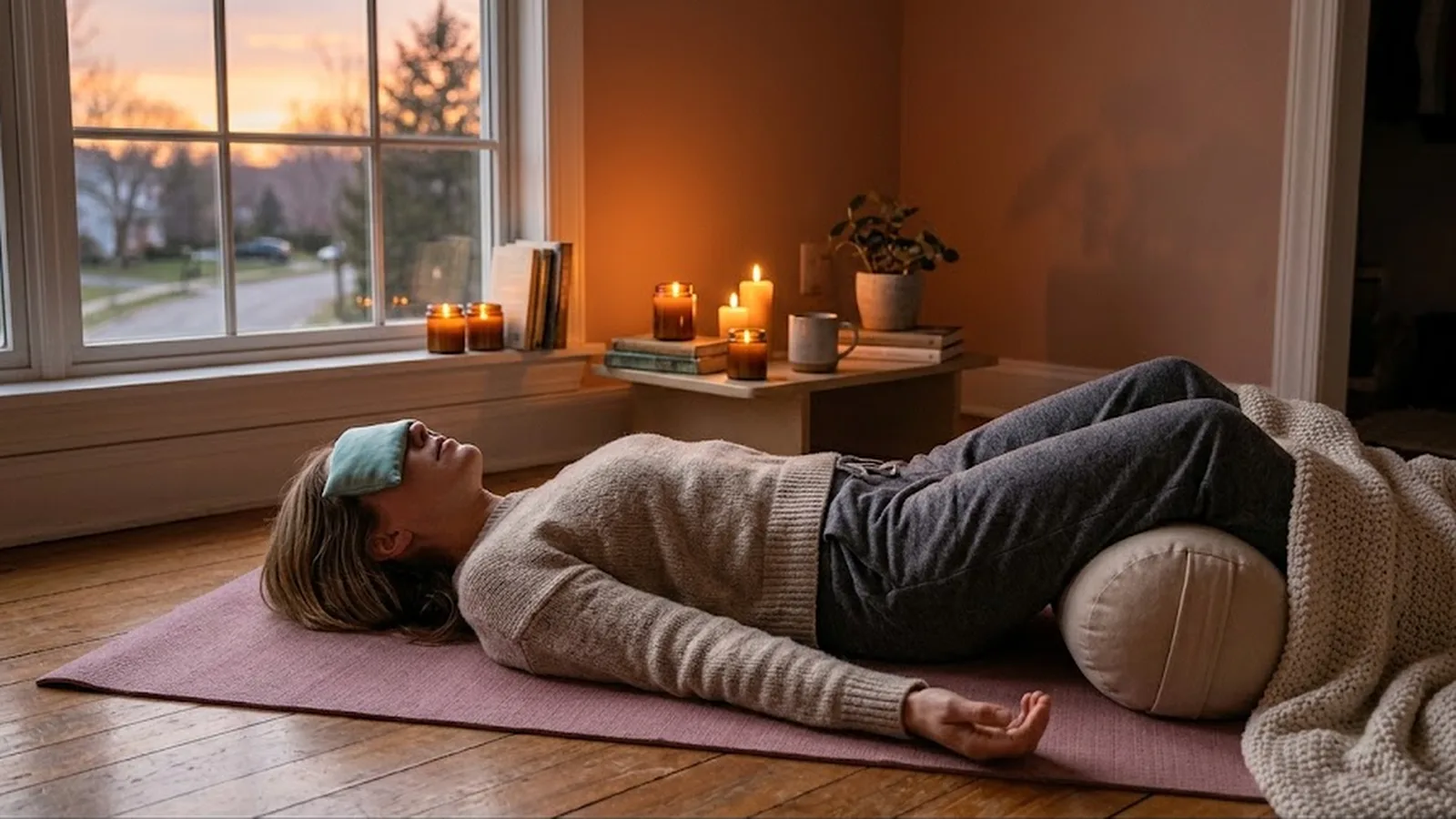
- Position: lie on your back on a yoga mat or carpet, with a small pillow under the head and possibly under the knees. Cover with a light blanket if cool. Body warmth tends to drop slightly during the practice.
- Timing: 20–30 minutes is the typical length. Shorter (10–15) works as a quick reset; longer (45+) approaches actual sleep.
- Falling asleep: common, especially when sleep-deprived. Not the goal of the practice but not catastrophic. Repeated falling-asleep is information — you might need actual sleep more than the practice.
- Frequency: 3–5 sessions per week shows up most reliably in the trials. Daily is fine.
- Place: any quiet room. Some practitioners use noise-cancelling headphones with the recording.
Yoga nidra vs other practices
How does yoga nidra differ from related practices?
- Vs mindfulness meditation: mindfulness emphasises sustained attention to a single object (breath, body) while seated upright. Yoga nidra is supine, structured (specific phases), and explicitly aims at deep relaxation. Different cognitive demands and outcomes.
- Vs progressive muscle relaxation (PMR): PMR involves alternating tension and relaxation of muscle groups. Yoga nidra is purely attentional; you don’t physically tense muscles. PMR has more direct evidence for chronic pain; yoga nidra has more for sleep and stress.
- Vs napping: discussed above. Naps require falling asleep; yoga nidra requires staying lightly awake.
- Vs body-scan meditation: similar in structure (rotation of consciousness). Body-scan meditation is part of MBSR programs and has more research; yoga nidra adds the visualisation, opposites, and sankalpa phases.
Common myths
- “NSDR replaces sleep.” Mostly false. Yoga nidra and similar practices supplement sleep but can’t replace its core restorative functions (deep slow-wave sleep, REM, hormone cycling).
- “You need a guru or in-person teacher.” Recorded guidance is sufficient for most users. The traditional lineages have transmission rituals, but the practice itself is accessible from recordings.
- “If you fall asleep, you did it wrong.” Not catastrophic. Falling asleep is common with sleep-deprived practitioners and just shifts you from yoga nidra to a nap. Both have benefits.
- “It works for everyone.” Most users benefit. A subset find lying still in silence aversive (anxiety, restless body, intrusive thoughts). For these users, walking meditation or active recovery might work better.
- “The science is settled.” The literature is suggestive but small. The 2022 Pandi-Perumal paper is a narrative review, not a systematic count of pooled RCTs — much of the yoga nidra evidence base is small individual clinical studies. More research is needed, particularly in athletic populations.
When it doesn’t help
- Severe untreated sleep apnea: address the apnea. Yoga nidra won’t fix airway obstruction.
- Active dissociation or PTSD without therapeutic support: deep relaxation can sometimes trigger trauma responses. Use with clinical guidance for trauma-affected populations.
- Acute mania: people in manic states often find still practices aversive and counter-productive.
- Replacing sleep at scale: chronic short sleep needs more sleep, not more yoga nidra.
Practical takeaways
- Yoga nidra is a guided supine practice producing relaxed-alert theta-dominant state, with measurable dopamine activation.
- Evidence supports moderate effects on stress, anxiety, insomnia, and chronic pain.
- The popular “NSDR replaces sleep” claim outpaces the data. Useful supplement, not a sleep replacement.
- 20–30 minutes is the typical practice length; 3–5 sessions per week shows up most in successful trials.
- Most useful for sleep-onset insomnia, midday energy slumps, pre-competition anxiety, and high-stress life periods.
- Doesn’t replace clinical care for sleep apnea, severe insomnia, or active mental health crises.
Frequently asked questions
Is yoga nidra really equivalent to an hour of sleep?
No. The popular slogan oversells it. Yoga nidra produces dopamine activation and theta-state brain activity but doesn't cycle through deep slow-wave sleep and REM the way overnight sleep does. It's a useful supplement for stress, sleep onset, and midday recovery — not a replacement for chronic sleep debt.
How long should a yoga nidra session be?
20 to 30 minutes is the standard. Shorter sessions (10 to 15) work as a quick reset. Longer sessions (40 to 60) approach actual sleep with similar grogginess on return. Most insomnia and stress trials used 20 to 45-minute protocols.
What if I fall asleep during the practice?
Common. It just means you've shifted from yoga nidra to a nap. Both have benefits. Repeated falling-asleep is data — you probably need more sleep, not more yoga nidra. The practice is awake-but-deeply-relaxed; if you can't stay awake, try shorter sessions earlier in the day.
Does it help with athletic recovery?
Probably modestly, but the formal evidence in athletic populations is sparse. Most yoga nidra research is in clinical and general populations. Anecdotal reports from athletes are positive; rigorous trials in training contexts are needed. Don't expect dramatic recovery effects, but a 20-minute practice between sessions is a reasonable low-cost intervention.
Is yoga nidra safe for everyone?
Mostly yes, but specific exceptions: people with severe untreated PTSD or active dissociation can find deep relaxation triggering — work with a clinician. Acute manic states often find still practices counter-productive. People with severe sleep apnea need their apnea treated; yoga nidra won't fix airway obstruction.
References
Kjaer 2002Kjær TW, Bertelsen C, Piccini P, Brooks D, Møller A, Lou HC. Increased dopamine tone during meditation-induced change of consciousness. Brain Res Cogn Brain Res. 2002;13(2):255-259. View source →Datta 2018Datta K, Tripathi M, Mallick HN. Yoga Nidra: an innovative approach for management of chronic insomnia — a case report. Sleep Sci Pract. 2017;1:7. View source →Pandi-Perumal 2022Pandi-Perumal SR, Spence DW, Srivastava N, et al. The origin and clinical relevance of yoga nidra. Sleep Vigil. 2022;6(1):61-84. View source →Rani 2011Rani K, Tiwari S, Singh U, Agrawal G, Ghildiyal A, Srivastava N. Impact of Yoga Nidra on psychological general wellbeing in patients with menstrual irregularities. Int J Yoga. 2011;4(1):20-25. View source →Kim 2016Kim SD. Effects of yoga on chronic neck pain: a systematic review of randomized controlled trials. J Phys Ther Sci. 2016;28(7):2171-2174. View source →Stankovic 2011Stankovic L. Transforming trauma: a qualitative feasibility study of integrative restoration (iRest) yoga Nidra on combat-related post-traumatic stress disorder. Int J Yoga Therap. 2011;21:23-37. View source →Brooks 2007Brooks A, Lack L. A brief afternoon nap following nocturnal sleep restriction: which nap duration is most recuperative? Sleep. 2006;29(6):831-840. View source →Lou 1999Lou HC, Kjær TW, Friberg L, Wildschiodtz G, Holm S, Nowak M. A 15O-H2O PET study of meditation and the resting state of normal consciousness. Hum Brain Mapp. 1999;7(2):98-105. View source →Eastman 2013Eastman-Mueller H, Wilson T, Jung AK, Kimura A, Tarrant J. iRest yoga-nidra on the college campus: changes in stress, depression, worry, and mindfulness. Int J Yoga Therap. 2013;23(2):15-24. View source →Moszeik 2022Moszeik EN, von Oertzen T, Renner KH. Effectiveness of a short audio yoga-nidra intervention on stress, sleep, and well-being in a large and diverse sample. Curr Psychol. 2022;41(8):5272-5286. View source →Ferreira 2018Ferreira-Vorkapic C, Borba-Pinheiro CJ, Marchioro M, Santana D. The impact of yoga nidra and seated meditation on the mental health of college professors. Int J Yoga. 2018;11(3):215-223. View source →Parker 2013Parker S, Bharati SV, Fernandez M. Defining yoga-nidra: traditional accounts, physiological research, and future directions. Int J Yoga Therap. 2013;23(1):11-16. View source →