The 60-second version
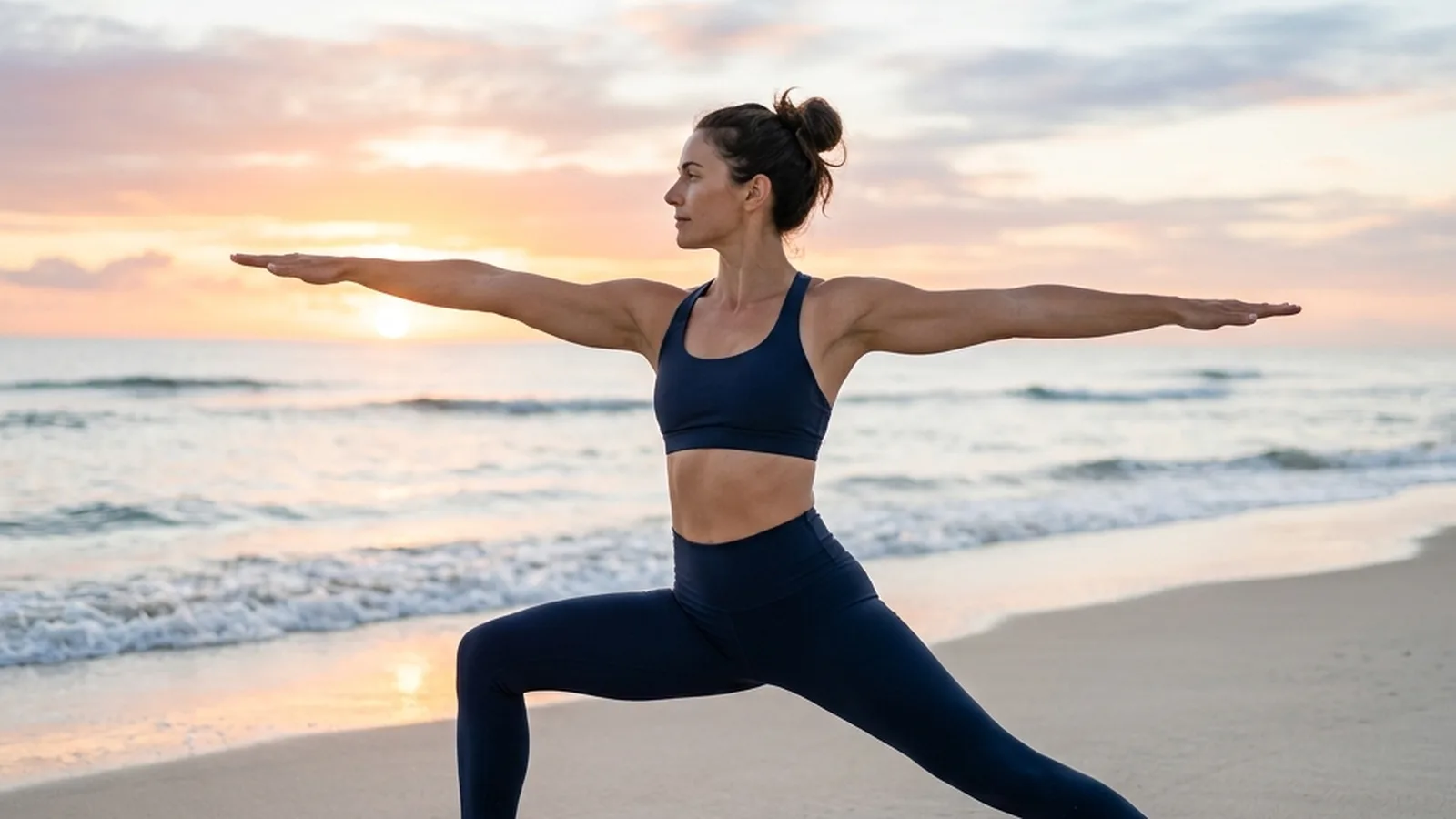
Warrior I, II, and III are the workhorse poses of every yoga class because they train a combination most adults are short of: hip extension on the trail leg, hip flexion with external rotation on the lead leg, single-leg balance, and isometric quad endurance — all at once. The published stretching-research literature finds that regular hip-mobility drills, held 15-30 seconds and performed 2-3 times a week, meaningfully improve hip range of motion. The warrior family delivers a high dose of all three hip directions per session. Doing it on a beach adds an unstable-surface stimulus that recruits ankle stabilisers and trunk muscles in a way a yoga mat indoors does not. The trade-off is form: dry deep sand makes the foundation unstable enough that beginners often compensate by bracing the lumbar spine instead of the glutes. Firm damp sand near the waterline is the better learning surface.
Educational journalism, not medical advice. Every claim here is checked against its cited sources by editor Timothy Bunce — a health writer, not a physician. It isn’t specific to your situation: for health decisions, talk to your own clinician. How we work →
Some links in this article are affiliate links. If you buy through one, The Beachside Reader earns a commission at no extra cost to you. It never changes which products we pick, or what we say about them. Full affiliate disclosure →
Why the warrior poses do more than they look like
A warrior pose looks static. The published EMG and joint-angle work shows it is not. Warrior II in particular is a sustained isometric load on the lead-leg quadriceps and gluteus medius, with a continuous low-grade demand on the trunk rotators and shoulder girdle. Hold it for 60-90 seconds — standard in a vinyasa class — and you have produced more single-leg time-under-tension than most lifters get from a typical lunge set.
What makes the warrior family particularly useful as a mobility drill is the combination of directions it puts the hips through. The lead hip is in deep flexion with external rotation; the trail hip is in extension with internal rotation. Most adults are short of range in at least two of these directions, and regular mobility work through both directions is what the stretching-research literature shows most reliably improves hip range of motion Page 2012.
What it actually trains
- Lead-leg quad isometric endurance. The lunge position with a 90° front-knee angle is a sustained quad contraction, and holding it for 60 seconds accumulates meaningful isometric time-under-tension for the vastus lateralis.
- Trail-leg hip flexor lengthening under load. The classic adult hip-flexor pattern — tight psoas from prolonged sitting — responds well to active stretching with the contralateral glute engaged. Warrior is exactly that drill.
- Glute medius and ankle stabilisers. Maintaining balance with weight evenly distributed between front and back foot recruits hip abductors and ankle invertors continuously.
- Thoracic extension and shoulder external rotation. Warrior II’s arms-out posture combats the protracted-shoulder pattern most desk-workers carry.
- Trunk anti-rotation strength. Holding the torso vertical while the legs are in a wide stance demands continuous low-grade trunk activation McGill 2010.
What the mobility-training evidence shows
The stretching-research evidence for hip mobility is worth taking seriously, though it comes from the broader stretching literature rather than yoga-specific trials. A 2012 review of static, dynamic, and pre-contraction (PNF) stretching research found that regular stretching reliably increases range of motion, with holds of 15-30 seconds performed 2-3 sessions per week sufficient to produce a measurable gain — benefits vary by the population and stretch type used Page 2012.
The yoga-specific work tells a similar story. A 2013 meta-analysis of yoga interventions for chronic lower-back pain pooled 10 randomised trials (967 patients) and found strong evidence for short-term improvement and moderate-quality evidence for longer-term improvement in pain and function at 3-6 month follow-up Cramer 2013. The active ingredient in most of those programmes was the standing-pose family — warriors, triangle, side-angle — which load the hips in the directions most adults are stuck in.
What changes on sand
Doing warriors on a beach adds an unstable-surface stimulus that the published yoga literature has not directly studied, but the unstable-surface resistance-training research lets us predict the effects. Behm and Anderson’s landmark review of unstable-surface training found:
- The antagonist-to-agonist activation ratio rises roughly 30-40%. Behm and colleagues found the nervous system leans on more stabilising co-contraction rather than extra prime-mover force when the base is unstable; ankle peroneals, gluteus medius, and trunk rotators weren’t tested directly, but are plausible candidates for that stabilising role Behm 2002.
- Peak load on the primary muscles drops modestly. The quad doesn’t generate the same force when the foot is unstable, so the pose feels easier on the front leg even though you are working harder overall.
- Form variability increases. The foot position drifts as the sand collapses. For experienced practitioners this is useful proprioceptive work. For beginners it muddies the cueing.
The practical implication: firm damp sand near the waterline is an ideal mobility-and-stability surface for someone who already has warrior pose dialled in. Dry, deep sand higher up the beach is a stabiliser-only drill where holding the shape becomes more important than the technical cues.
Where it goes wrong
- Lumbar overload from arching to feel the stretch. The most common error is extending the lumbar spine to deepen the hip-flexor stretch. The hip flexor lengthens, but the stretch sensation is from lumbar facet compression, not psoas. The fix: posteriorly tilt the pelvis and engage the trail-leg glute. The pose suddenly feels much harder, because that is the correct movement.
- Front-knee valgus collapse. The knee tracking inward over the ankle is the most-common error in warrior II and the leading mechanism for medial-knee complaints. The cue is to drive the knee toward the pinky toe, not the big toe.
- Ankle inversion on dry sand. The trail foot, often parallel to the back of the mat in warrior II, is at risk of rolling on uneven sand. Firm damp sand or grass solves this; dry deep sand does not.
- Shoulder impingement from arms-overhead variations. Warrior I with arms straight up loads the subacromial space; people with rotator-cuff issues should keep arms in front or at sides.
How to program it
- 2-3 sessions weekly, 15-30 minutes per session. The published stretching-research literature shows this frequency and duration is enough to produce a measurable improvement in hip range of motion.
- Hold each warrior 60-90 seconds per side. Below 30 seconds you don’t accumulate enough time-under-tension for either mobility or isometric strength benefit.
- Cycle through the family. Warrior I, warrior II, reverse warrior, warrior III — together these load every hip direction and every leg position.
- Beach surface: default to firm damp sand near the waterline. Dry deep sand is a deliberate stabiliser block for experienced practitioners.
- Skip overhead arm variations if you have rotator-cuff symptoms. Warriors work just as well with hands at heart centre or out to the sides.
- Use a folded towel under the back heel if the calf is tight. A 1-2 cm heel lift takes the ankle out of the deep-dorsiflexion that defeats most beginners’ warrior I.
Practical takeaways
- The warrior family delivers combined hip-direction mobility, single-leg balance, and isometric quad endurance in 60-90-second holds — a dose comparable to weighted single-leg work.
- The stretching-research literature supports yoga-based standing-pose programmes for hip mobility, and yoga-specific trials support benefit for chronic lower-back pain at 3-6 month follow-up.
- Beach surface adds a stabiliser stimulus. Firm damp sand is the learning surface; dry deep sand is for experienced practitioners.
- Posteriorly tilt the pelvis and engage the trail-leg glute. If the stretch sensation is in the lumbar spine, you are doing the pose wrong.
- Drive the front knee toward the pinky toe, not the big toe. Valgus collapse is the leading mechanism for medial-knee complaints in warrior II.
- 2-3 sessions weekly, 60-90-second holds, cycle through the warrior family. That is the prescription that produces measurable mobility improvements in the published literature.
Frequently asked questions
Is yoga actually good for hip mobility, or is it just marketing?
The evidence for hip mobility is reasonably strong, though it comes from the broader stretching-research literature rather than yoga-specific trials. A 2012 review of static, dynamic, and pre-contraction stretching research found that regular stretching, held 15-30 seconds and performed 2-3 sessions per week, reliably improves range of motion.
How long should I hold a warrior pose?
60-90 seconds per side is the standard yoga prescription and matches the time-under-tension that produces measurable strength-endurance and mobility benefit in the published intervention literature. Below 30 seconds you don’t accumulate enough stimulus.
Is beach yoga better than indoor yoga?
Different, not better. Beach yoga adds an unstable-surface stimulus that shifts muscle activation toward stabilising co-contraction rather than raw force — lab research on unstable surfaces shows this shift on the order of 30-40% — which is useful proprioceptive work for experienced practitioners. For beginners learning the shapes, a stable indoor floor is much easier to coach and easier to hold correct form on.
Why does my lower back hurt after warrior poses?
Almost always because you are extending the lumbar spine to feel the hip-flexor stretch. The fix is to posteriorly tilt the pelvis and engage the trail-leg glute. The pose suddenly feels much harder — that is the correct movement.
Should my front knee go over my front toes?
Past the toes is fine; collapsing inward is not. The critical cue is to drive the knee toward the pinky toe, not the big toe. Valgus collapse (knee falling inward) is the leading mechanism for medial-knee complaints in warrior II.
How many times a week should I do beach yoga?
2-3 sessions of 15-30 minutes is the dosage that produces measurable hip-mobility improvements in the published intervention work. More than 4-5 sessions per week shows diminishing returns and slightly elevated soft-tissue strain.
References
Page 2012Page P. Current concepts in muscle stretching for exercise and rehabilitation. Int J Sports Phys Ther. 2012;7(1):109-119. View source →Cramer 2013Cramer H, Lauche R, Haller H, Dobos G. A systematic review and meta-analysis of yoga for low back pain. Clin J Pain. 2013;29(5):450-460. View source →McGill 2010McGill SM. Core training: evidence translating to better performance and injury prevention. Strength Cond J. 2010;32(3):33-46. View source →Behm 2002Behm DG, Anderson K, Curnew RS. Muscle force and activation under stable and unstable conditions. J Strength Cond Res. 2002;16(3):416-422. View source →