The 60-second version
Deep-water running — suspended in chest-deep water with a flotation belt, mimicking running stride without the foot ever touching the bottom — is one of the most studied cross-training modalities in sports medicine. The peer-reviewed evidence is unusually clean. Aquatic running produces cardiovascular adaptations comparable to treadmill running in matched-effort trials, with essentially zero impact loading on knees, ankles, and hips. Trained runners who replace land training entirely with pool running for 4-6 weeks maintain VO2max within 1-2% of baseline in controlled trials — the physiological basis clinicians rely on for using pool running during injury rehab. The catch is sport-specificity. Cardiovascular fitness transfers cleanly from pool to land, but neuromuscular running adaptations don’t — you cannot stay race-sharp in the pool without occasional land running. As cardio for adults with chronic knee, hip, or shin issues, this is one of the most underrated tools in the published rehabilitation literature.
Educational journalism, not medical advice. Every claim here is checked against its cited sources by editor Timothy Bunce — a health writer, not a physician. It isn’t specific to your situation: for health decisions, talk to your own clinician. How we work →
Some links in this article are affiliate links. If you buy through one, The Beachside Reader earns a commission at no extra cost to you. It never changes which products we pick, or what we say about them. Full affiliate disclosure →
What deep-water running actually is
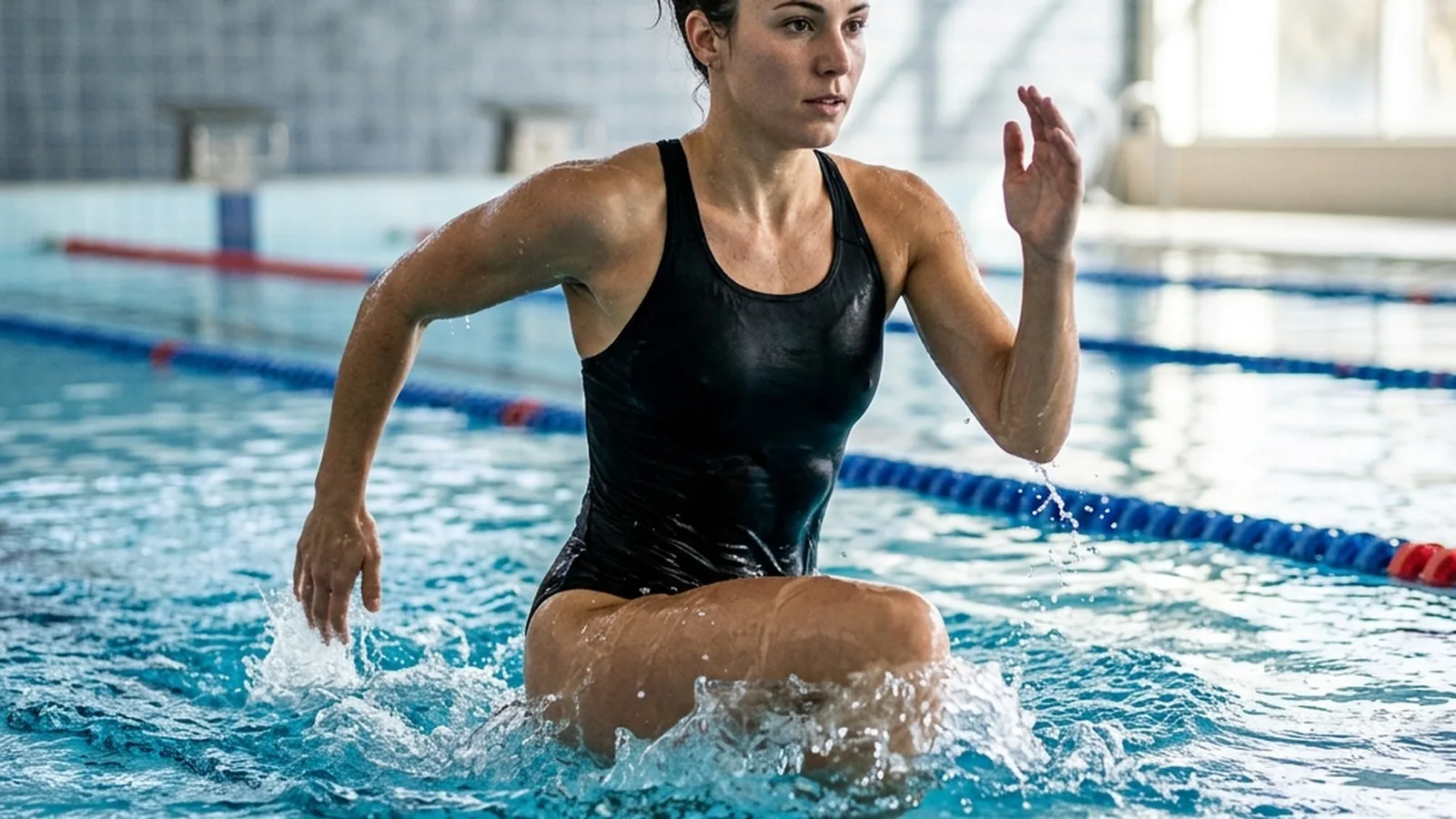
Deep-water running (DWR), also called aquatic jogging or pool running, is performed in water deep enough that the feet do not touch the bottom — typically 1.8-2.5 m. A buoyancy belt around the waist keeps the runner upright; the running motion is replicated as closely as possible, with high knee drive, opposing arm swing, and a slight forward lean. The hands are held in fists or with cupped fingers. The session continues for 20-60 minutes at heart rates calibrated to the runner’s land-running zones — with the important adjustment that water-based heart rates run 10-15 bpm lower than land-based heart rates at matched perceived effort due to immersion-induced cardiovascular changes Reilly 2003.
The format is distinct from shallow-water running (jogging in chest-deep water with feet touching bottom), which still produces meaningful ground-reaction force, and from regular swimming, which uses entirely different musculature. The peer-reviewed evidence overwhelmingly references deep-water running specifically.
The cardiovascular evidence
Wilber’s 1996 randomised trial put 16 trained runners through 6 weeks of either land or deep-water running training, matched for heart-rate zones and session duration. Both groups maintained VO2max within 1-2% of baseline. Submaximal running economy actually converged rather than diverged: the land group was essentially unchanged (48.4 to 48.9 mL/kg/min) while the water group improved from a poorer baseline (51.8 to 48.9 mL/kg/min), ending statistically equivalent to the land group by week 6 — the opposite of a neuromuscular-specificity penalty on this particular measure Wilber 1996.
Bushman’s 1997 study tested healthy, well-trained competitive runners rather than injured ones. Eleven competitive runners replaced all land training with pool-only running for 4 weeks; VO2max, submaximal oxygen consumption, and lactate-threshold running velocity showed no significant change, and 5-km treadmill race times were statistically unchanged (1142.7 seconds before training vs. 1149.8 seconds after) — evidence that a month of pool-only training does not erode land-running fitness in already-fit runners Bushman 1997.
Frangolias and Rhodes’ 1995 work measured oxygen consumption, ventilation, and heart rate at matched RPE levels and confirmed the cardiovascular load equivalence: at hard-effort work, deep-water runners produced 91-96% of the VO2 they produced on land at the same effort — a small but consistent gap that explains the modest specificity loss Frangolias 1995.
“Deep-water running is the closest land-running substitute available. For injured runners, it preserves cardiovascular fitness within 1-2% of baseline through training periods of 4-6 weeks. The transfer back to land running is rapid and largely complete within 1-2 weeks of resumed land work.”
— Reilly et al., Sports Medicine, 2003 view source
The impact-loading argument
The single biggest argument for aquatic running is what it doesn’t do. Land running produces ground-reaction forces of 2-3 times body weight at every foot-strike — the loading pattern that drives the majority of running-overuse injuries (shin splints, patellofemoral pain, IT-band syndrome, plantar fasciitis, stress fractures). Deep-water running produces zero ground-reaction force. The legs cycle through the running motion with no foot-strike at all Becker 2009.
This is why the aquatic-jogging literature is dominated by sports-medicine and rehabilitation studies. For most chronic running injuries, deep-water running is the only cardiovascular modality that:
- Maintains specific running musculature (hip flexors, hamstrings, quadriceps) in the precise patterns of running gait
- Preserves cardiovascular fitness within 1-2% of land-running adaptations
- Does not aggravate the underlying injury
- Provides the psychological continuity of "still training" during rehabilitation
For non-injured adults
Two profiles use aquatic running productively even outside of injury rehabilitation. First, masters runners (40+) for whom accumulated knee and hip wear makes high-volume land running unsustainable. The 2010 randomized controlled trial by Lim found that aquatic exercise produced significantly greater improvement in pain-related activity interference and a significant reduction in body-fat percentage compared with land-based exercise in obese adults with knee osteoarthritis, while both approaches produced comparable improvements in osteoarthritis disability scores Lim 2010.
Second, runners adding training volume without raising injury risk. The published guideline that running mileage should not increase by more than 10% per week is largely about cumulative impact loading. Adding pool-running sessions on top of a stable land-running volume is one of the cleaner ways to add total cardiovascular training time without crossing the impact-load threshold that triggers overuse injury Hreljac 2004.
Protocols the trials actually use
| Goal | Session structure | Frequency |
|---|---|---|
| Maintenance during injury rehab | 30-60 min continuous, mixed pace | 3-5 sessions/week |
| Cross-training (non-injured) | 30-45 min, alternating intensity | 1-2 sessions/week |
| VO2max maintenance during heavy land-training block | 4-6 sets × 4 min hard, 2 min easy | 1 session/week |
| Older adult cardio (joint-friendly) | 20-40 min, conversational pace | 2-3 sessions/week |
Heart-rate adjustment matters: water-based heart rates run 10-15 bpm lower at matched effort. Use perceived exertion or a percentage-of-max-water-HR rather than carrying over land-based zones directly Frangolias 1995.
Technique points the studies emphasize
- High knee drive. The natural tendency in water is to "cycle" with low knees. Forcing the knees up to 70-90° flexion approximates land-running mechanics and recruits the hip flexors more authentically.
- Slight forward lean. Vertical posture in deep water reduces the running-specific muscle activation pattern. A slight forward lean (about 5-10°) closer to land-running posture is associated with better neuromuscular transfer in published comparisons.
- Hands held in cupped fists, opposing arm swing. Open hands create excessive drag and shift the activity toward swimming-style upper-body work; cupped fists with arm swing matched to the legs preserves the running pattern.
- Use a flotation belt, not a noodle. Pool-noodle improvisation leads to back-arching and altered posture. A proper deep-water-running belt costs CAD$30-50 and matters for technique fidelity.
- Don’t expect race-sharpness without land running. The neuromuscular component of race-pace running degrades within 4-6 weeks of pool-only training. Even injured runners who can’t run on land should walk, hike, or use elliptical to preserve some weight-bearing pattern when possible.
Who aquatic jogging actually suits
| Profile | Aquatic jogging fit | Why |
|---|---|---|
| Injured runner (acute or chronic) | Excellent | Preserves cardiovascular fitness well; doesn’t aggravate injury |
| Masters runner with degenerative joint changes | Excellent supplement | Adds training volume without impact load |
| Adult with chronic patellofemoral or IT-band pain | Excellent | Zero ground-reaction force |
| Pregnant runner (cleared by physician) | Excellent | Buoyancy reduces lumbar spine load; no impact |
| Adult with osteoarthritis | Excellent | Lim 2010 trial shows greater pain-interference and body-fat improvement than land-based exercise |
| Beginner runner building base mileage | Excellent supplement | Can add cardio volume during the 8-12 week injury-prone adaptation window |
| Anyone with severe ear infections / middle-ear issues | Caution | Buoyancy belt typically keeps head above water but pool environments concern |
| Adults uncomfortable in deep water | Skip or use buoyancy aids | Sport-specific training requires deep water and a belt; shallow-water running has different mechanics |
How to actually start
- Buy a real flotation belt. AquaJogger or similar brand belts cost CAD$30-50 and make the difference between maintaining proper form and floundering. Don’t improvise with pool noodles — the technique fidelity matters.
- Find a 1.8m+ deep pool. Most lap pools have a deep end suitable for this; community recreation centres are typically the easiest option. Stay clear of swimmer lanes.
- Start at 20 minutes. Even fit land runners find pool running surprisingly hard the first few sessions — the unfamiliar muscle pattern produces hip-flexor and shoulder fatigue beyond what cardio fitness predicts.
- Use perceived exertion, not heart rate zones. Water-based HR runs 10-15 BPM lower at matched effort. If you typically train at 150 BPM on land, expect 135-140 BPM at the same perceived effort in the pool. Train by feel until you calibrate.
- Resist the cycling motion. The default pool-running motion is a slow knee-cycle. Force a higher knee drive (70-90° flexion) to approximate land-running mechanics. The forward lean and arm swing matter too.
- For injured runners: 3-5 sessions weekly is the typical rehab frequency. It mirrors the schedule Bushman’s 1997 trial used to show pool-only training preserves fitness in healthy competitive runners over 4 weeks — not a trial of injured athletes.
Practical takeaways
- VO2max preservation is excellent — no significant decline across 4 weeks of pool-only training in healthy, well-trained runners (Bushman 1997).
- Deep-water running produces zero ground-reaction force — the only meaningful cardio that fully unloads the lower-body joints.
- Heart rate runs 10-15 BPM lower at matched effort due to immersion physiology — use perceived exertion, not carry-over land HR zones.
- Cardiovascular fitness transfers cleanly back to land; neuromuscular running specificity does not. Race-sharpness requires occasional land running.
- For chronic-injury runners and masters athletes, this is one of the most underrated tools in the rehab literature.
- Use a real flotation belt and force high knee drive — technique fidelity matters more than effort level.
Frequently asked questions
Is pool running really as good as treadmill running?
For maintaining cardiovascular fitness, the trial evidence says yes — within 1-2% of treadmill outcomes over 4-6 weeks of training (Wilber 1996, Bushman 1997). For neuromuscular running specificity (race pace, gait economy), it’s not equivalent — the running-specific patterns degrade somewhat with pool-only training. Cross-training: yes. Race specificity: no.
How deep does the pool have to be?
Deep enough that your feet do not touch the bottom — typically 1.8-2.5 m. The defining feature of deep-water running is suspension in water with a flotation belt; if your feet contact the floor, you’re doing shallow-water running, which has different mechanics and produces less of the joint-unloading benefit.
Why does my heart rate run lower in water?
Two factors: hydrostatic pressure increases venous return to the heart, allowing higher stroke volume per beat; cooler water temperatures reduce skin blood-flow demands. The result is 10-15 BPM lower heart rates at matched perceived effort. Use perceived exertion or pool-specific HR zones rather than carrying over land zones directly.
Will pool running help me lose weight?
Same caveats as any cardio — calorie burn is comparable to matched-effort treadmill running (about 8-10 METs at hard effort). The bigger value is consistency: adults who can’t train consistently on land due to joint pain often can train consistently in the pool. Adherence matters more than per-session efficiency.
Can I do this without a flotation belt?
Strongly discouraged. The point of the belt is to free the legs to mimic running gait without compensatory movement to stay afloat. Without a belt, you spend most of the session on water-treading mechanics, which is a different (and less running-specific) activity. AquaJogger or comparable belts cost CAD$30-50 and make the practice work as advertised.
References
Reilly 2003Reilly T, Dowzer CN, Cable NT. The physiology of deep-water running. J Sports Sci. 2003;21(12):959-972. View source →Wilber 1996Wilber RL, Moffatt RJ, Scott BE, Lee DT, Cucuzzo NA. Influence of water run training on the maintenance of aerobic performance. Med Sci Sports Exerc. 1996;28(8):1056-1062. View source →Frangolias 1995Frangolias DD, Rhodes EC. Maximal and ventilatory threshold responses to treadmill and water immersion running. Med Sci Sports Exerc. 1995;27(7):1007-1013. View source →Bushman 1997Bushman BA, Flynn MG, Andres FF, Lambert CP, Taylor MS, Braun WA. Effect of 4 wk of deep water run training on running performance. Med Sci Sports Exerc. 1997;29(5):694-699. View source →Becker 2009Becker BE. Aquatic therapy: scientific foundations and clinical rehabilitation applications. PM R. 2009;1(9):859-872. View source →Bartels 2016Bartels EM, Juhl CB, Christensen R, et al. Aquatic exercise for the treatment of knee and hip osteoarthritis. Cochrane Database Syst Rev. 2016;(3):CD005523. View source →Lim 2010Lim JY, Tchai E, Jang SN. Effectiveness of aquatic exercise for obese patients with knee osteoarthritis: a randomized controlled trial. PM R. 2010;2(8):723-731. View source →Killgore 2012Killgore GL. Deep-water running: a practical review of the literature with an emphasis on biomechanics. Phys Sportsmed. 2012;40(1):116-126. View source →Dowzer 1999Dowzer CN, Reilly T, Cable NT. Effects of deep and shallow water running on spinal shrinkage. Br J Sports Med. 1998;32(1):44-48. View source →Eyestone 1993Eyestone ED, Fellingham G, George J, Fisher AG. Effect of water running and cycling on maximum oxygen consumption and 2-mile run performance. Am J Sports Med. 1993;21(1):41-44. View source →Hreljac 2004Hreljac A. Impact and overuse injuries in runners. Med Sci Sports Exerc. 2004;36(5):845-849. View source →Warburton 2017Warburton DER, Bredin SSD. Health benefits of physical activity: a systematic review of current systematic reviews. Curr Opin Cardiol. 2017;32(5):541-556. View source →Paluch 2022Paluch AE, Bajpai S, Bassett DR, et al. Daily steps and all-cause mortality: a meta-analysis of 15 international cohorts. Lancet Public Health. 2022;7(3):e219-e228. View source →