The 60-second version
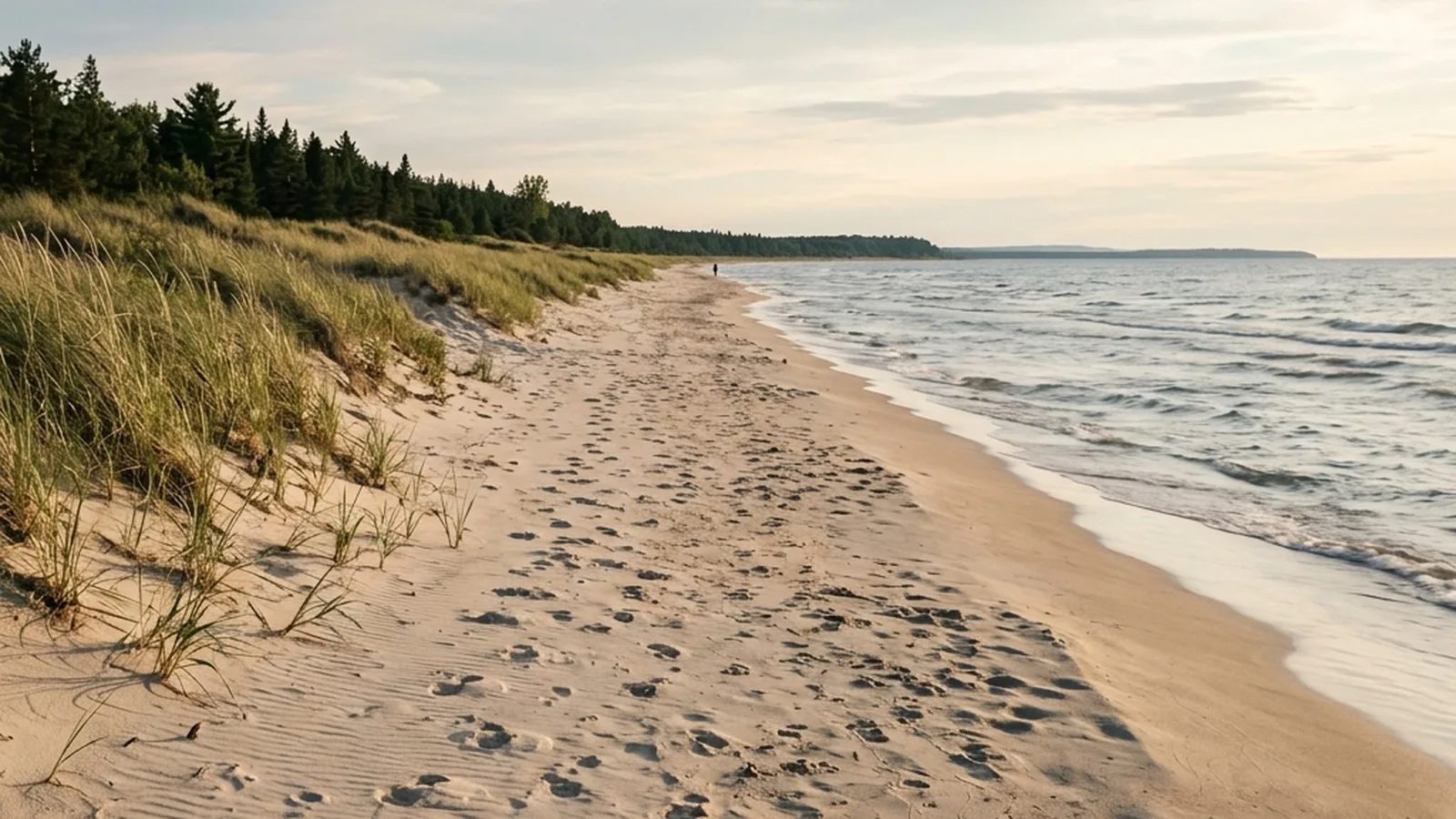
Wasaga Beach’s six numbered Beach Areas run east to west, not west to east. Area 1, the “Main End,” sits at the eastern end near Mosley Street, the boat launch, and the Nottawasaga River mouth; Area 6 is the western end, on Shore Lane between 48th and 50th Street North. Route-tracking data puts the Area 1–to–Area 6 corridor at roughly 10.7 km one way — part of the beach’s overall ~14 km freshwater shoreline, the longest in the world. There are no lifeguards anywhere on this beach, and haven’t been for about three decades, so swimming and exercising here is entirely at your own risk. The physiology is still real, though: soft sand burns roughly 2.1–2.7× the energy of the same walk on pavement, so building into the distance gradually matters regardless of which direction you're headed.
Search for a guide to walking or jogging Wasaga Beach’s numbered Areas and you’ll find plenty of confident-sounding detail — and some of it has the compass points backwards, invents lifeguards this beach hasn’t had in decades, and cites a footrace nobody can find a listing for. Below is what the Town of Wasaga Beach’s own beach-area map, and the people who’ve actually logged the whole corridor, say instead.
Educational journalism, not medical advice. Every claim here is checked against its cited sources by editor Timothy Bunce — a health writer, not a physician. It isn’t specific to your situation: for health decisions, talk to your own clinician. How we work →
Some links in this article are affiliate links. If you buy through one, The Beachside Reader earns a commission at no extra cost to you. It never changes which products we pick, or what we say about them. Full affiliate disclosure →
How the six Beach Areas actually run
Wasaga Beach’s numbered Areas run east to west. Area 1, the “Main End,” is the eastern terminus — the busy stretch off Mosley Street, with the beach access point at the foot of Jenetta Street, across from the boat launch, and closest to where the Nottawasaga River empties into Georgian Bay Town of Wasaga Beach. From there the numbering runs west: Area 2 begins near Nancy Island Historic Site, at Mosley Street and 3rd Street North, then Areas 3, 4, and 5 follow in sequence, with Area 6 as the western end, on Shore Lane between 48th and 50th Street North — a quieter stretch popular with kiteboarders Fastest Known Time.
One more correction worth making bluntly: Allenwood Beach and “New Wasaga” are not an extension of Area 6 on the west side. They sit on the opposite end — further east than Area 1, past the mouth of the Nottawasaga River. That river mouth carries a real hazard: a strong undertow plus active boat traffic, which is exactly why route-planning sources tell you not to attempt to cross it on foot to link the two stretches of beach Fastest Known Time. If you want to visit Allenwood, drive there; don’t treat it as a walkable continuation of the Area 1–6 corridor.
The eastern end of Area 1 also runs through active dune habitat, and stretches of it are seasonally roped off to protect nesting Piping Plovers, an endangered shorebird — expect signed closures there in nesting season and respect them.
How far you're actually walking
The Area 1-to-6 corridor measures out to roughly 10.7 km one way along the shoreline Fastest Known Time — call it about 21 km if you walk the whole thing out and back without a shuttle. That's the bulk of Wasaga Beach's famous ~14 km total length, a figure verified by Guinness as the longest freshwater beach in the world; the remaining few kilometres extend past the river mouth toward Allenwood, New Wasaga, and beaches in neighbouring Tiny Township, which most route guides deliberately exclude because of the crossing hazard above.
No official source publishes precise point-to-point distances between each numbered Area, and the Areas are not evenly spaced — so treat any guide (including this one) that hands you exact segment-by-segment kilometre figures with some skepticism. What's solid is the two endpoints and the total.
Why soft sand changes the workout
This part of the old guide held up under a real check: the energy cost of walking on soft sand is roughly 2.1–2.7× the cost of walking on a hard surface at the same speed, per the calorimetry work of Lejeune 1998. Running is different — about 1.6× the hard-surface cost in the same study, because running's elastic tendon-recoil mechanics are blunted less by loose sand than walking's push-off mechanics are. Either way, every footfall on sand displaces material instead of rebounding stored elastic energy, so the calf and ankle musculature does propulsion work that firm ground would otherwise return for free.
A broader review of sand-training research confirms the same pattern and adds a training note: sand's give reduces peak impact forces compared with pavement, which is part of why sand training shows up in return-to-running and lower-limb-rehab programs, alongside its higher metabolic demand Binnie 2014. Practically: a first exposure to sustained soft-sand walking routinely produces calf and Achilles soreness that a road walker of the same fitness has never felt, even at higher weekly mileage. Two sessions a week, capped at 20–25 minutes for the first few weeks, is a reasonable way to adapt without a week of hobbling. If you want the comparison spelled out in more depth — sand versus pavement versus treadmill, and what the evidence actually supports — this walk-surface comparison goes further into the numbers.
Three ways to use the corridor
You don't need to commit to all 10.7 km on day one, and honestly shouldn't. A short out-and-back from the Area 1 access point toward Area 2 and Nancy Island gives a first taste of sustained soft sand without overcommitting — walk out at an easy pace, turn around whenever the calves start complaining, and expect that "whenever" to arrive sooner than it would on pavement.
A mid-length outing continuing past Area 2 toward Area 3 adds real distance and passes Wasaga's designated on-leash dog beach (more on that below). For a longer day, most people who want the full Area 1-to-6 corridor either arrange a shuttle vehicle at the far end, split it across two outings on different days, or simply do a long out-and-back from one end and turn back well before the full distance rather than push through fatigue on unfamiliar terrain.
If you'd rather build general strength alongside the walking rather than just distance, Wasaga Beach Provincial Park has an outdoor fitness-station setup worth pairing with a shorter sand walk — see this guide to the park's calisthenics stations for what's actually there. And if soft sand isn't the right surface for you or someone you're walking with — a stroller, a wheelchair, a recovering joint — the beach corridor isn't your only option nearby; Wasaga's paved, accessible trail network covers firmer ground.
Picking your surface, and the safety realities
Any given strip of this beach has three walking surfaces. Wet sand right at the waterline is firmest, lowest energy cost, and fastest for distance work — but stay a couple of metres back from the edge, since wind and wave action (Georgian Bay is a freshwater lake system with no tidal cycle, so it's wash-up from wind and boat wake you're managing, not a tide) can put water over your shoes with little warning. Mid-beach packed sand is still firm with a bit more give, and is the most comfortable choice for a long walk. Upper-beach soft sand, near the dune line, is the deepest and hardest going — useful for training stimulus, punishing for distance.
The safety fact that matters most here: Wasaga Beach has had no lifeguards for roughly three decades. Lifeguard service was discontinued province-wide for cost reasons in the 1990s and was never brought back; municipal and park staff patrol for bylaw issues like alcohol and off-leash dogs, not water rescue Global News. That doesn't make the beach unsafe to walk or jog along — it's busy, well-signed, and cell coverage is solid — but it does mean nobody is watching the water for you if you decide to cool off with a swim afterward, and swim advisories do get posted at some Areas after heavy rain when bacteria counts rise. If you're planning to swim as part of the outing rather than just walk the sand, this guide to Georgian Bay's currents and exit protocols is the one to read first, especially anywhere near the river mouth.
Dogs, seasons, and the real local events
If you're walking with a dog, know the rule before you go: Wasaga Beach's only on-leash dog beach is a fenced section at the east end of the Area 3 parking lot; leashes are capped at 2 metres. Dogs are also allowed on the boardwalks at Areas 1 and 2 and on the park's trails, but not on the open sand at the other Areas Town of Wasaga Beach. For a fuller rundown of where dogs are actually welcome along this shoreline, this guide to Wasaga's off-leash beaches and trails covers it in more detail.
On timing: peak crowds hit Areas 1 through 3 in July and August, with Areas 4 through 6 noticeably quieter. May and September tend to be the most comfortable months for longer soft-sand efforts — cooler air, fewer people, and the water still usable for a cooldown dip. Facilities like washrooms at the Area access points generally follow the park's operating season, running through the warmer months and scaling back over winter; check the Town's site before a shoulder-season trip if that matters to your plans.
As for events: there's no annually recurring "Wasaga Beach Run" through Areas 1 to 3 that shows up in any race listing. What's actually held here are two real, findable events — The 5K Foam Fest, an obstacle-course fun run at Beach Area 2 in mid-July, and the MultiSport Canada Wasaga Beach Triathlon and Duathlon, held at the Municipal Picnic Area on Mosley Street (right by Area 1) in late August. If you're training toward either, using the firm wet-sand strip near Area 1 or 2 for race-pace intervals in the weeks beforehand is a reasonable way to adapt without inventing a race that isn't real.
Related reading
Georgian Bay swim safety: currents and exit protocol — read this before you treat any part of this walk as a swim, particularly near the river mouth. Off-leash dog beaches and trails in Wasaga — the full picture on where dogs are actually allowed, not just the Area 3 dog beach. Outdoor calisthenics stations at Wasaga Beach Provincial Park — a way to add strength work to a shorter sand walk instead of just racking up distance.
Frequently asked questions
Which end is Area 1, and which is Area 6?
Area 1, the Main End, is the eastern end of the numbered stretch, near Mosley Street, the boat launch, and the Nottawasaga River mouth. Area 6 is the western end, on Shore Lane between 48th and 50th Street North. A lot of casual guides get this backwards, so check the Town of Wasaga Beach's own beach map if you want to confirm it yourself before you go.
Are there lifeguards on this beach?
No. Wasaga Beach has had no lifeguard service for roughly three decades; it was discontinued province-wide in the 1990s for cost reasons and was never reinstated. Municipal staff patrol for bylaw enforcement, not water rescue, so swimming here is entirely at your own risk regardless of how busy the beach looks.
How far is the walk from Area 1 to Area 6?
Roughly 10.7 km one way, based on route-tracking data for the six-Area stretch, which forms most of the beach's overall roughly 14 km of freshwater shoreline. No official source breaks that down into exact distances between each numbered Area, so treat any guide that gives you precise segment-by-segment figures with some caution.
Can I bring my dog on this walk?
Only in specific spots. The one on-leash dog beach is a fenced section at the east end of the Area 3 parking lot, with leashes capped at 2 metres. Dogs are also allowed on the boardwalks at Areas 1 and 2 and on the park's trails, but not on the open sand anywhere else along the corridor.
Is it safe to keep walking past Area 1 toward Allenwood or New Wasaga?
Treat the Nottawasaga River mouth, just past Area 1, as a hard stop for walking or wading across. It carries a real undertow plus active boat traffic, and Allenwood/New Wasaga sit on the far side of it, further east, not connected to the Area 1-6 corridor by a safe on-foot route. Drive there instead if you want to visit.
References
Lejeune 1998Lejeune TM, Willems PA, Heglund NC. Mechanics and energetics of human locomotion on sand. Journal of Experimental Biology. 1998;201(13):2071-2080. View source →Binnie 2014Binnie MJ, Dawson B, Pinnington H, Landers G, Peeling P. Sand training: a review of current research and practical applications. Journal of Sports Sciences. 2014;32(1):8-15. View source →Town of Wasaga BeachTown of Wasaga Beach. Beaches — Area guide, dog policy, and visitor resources. View source →Global NewsGlobal News. Water-safety advocate on the decades-long absence of lifeguards at Wasaga Beach. View source →Fastest Known TimeFastest Known Time. Wasaga Beach route notes: Areas 1–6 distance, access points, and river-mouth crossing hazards. View source →