The 60-second version
Beach yoga is great for balance but not a complete replacement for studio practice. The shifting sand fires up small foot and ankle stabilisers continuously — and over 4–6 weeks, that improves balance noticeably. Studio practice still wins for the deep poses.
The trade-off is straightforward:
- Sand: more balance demand, better small-muscle training, harder to hold long static poses cleanly
- Studio floor: stable base, better for deep poses like Warrior III and Tree where you need the floor to give you feedback
Most of the research showing yoga helps with chronic low back pain was done on stable surfaces — so don’t expect sand-only practice to deliver that benefit the same way Cramer 2013.
The practical play: roughly 50/50 sand and studio practice, dawn or evening only in summer (the UV at midday is brutal), and treat sand sessions as added balance work, not deeper postural work.
Educational journalism, not medical advice. Every claim here is checked against its cited sources by editor Timothy Bunce — a health writer, not a physician. It isn’t specific to your situation: for health decisions, talk to your own clinician. How we work →
Some links in this article are affiliate links. If you buy through one, The Beachside Reader earns a commission at no extra cost to you. It never changes which products we pick, or what we say about them. Full affiliate disclosure →
What the evidence actually says
Direct beach-yoga clinical evidence is sparse, but the components have been well-studied. The broader yoga literature, summarized in Cramer and colleagues’ 2013 systematic review and meta-analysis, supports yoga’s effects on chronic low back pain — an effect that depends on the meditative and postural components rather than the surface Cramer 2013.
The mechanism by which sand adds to a yoga practice is the same one that makes it harder for unconditioned ankles: continuous low-grade contraction of the medial and lateral ankle stabilizers to maintain alignment. After 4-6 weeks of regular sand yoga, the same stabilizers fire faster and with less effort — a transfer that benefits all single-leg balance tasks.
The unstable-surface intervention literature provides the next layer of detail. Behm and colleagues’ 2015 systematic review of 22 controlled trials found that unstable-surface training produced medium-to-large strength, power, and balance gains compared with no training at all — but only small differences compared with stable-surface training, and for power output specifically, the stable surface came out ahead Behm 2015. The practical takeaway for yogis is modest, not concrete: sand isn’t a shortcut to bigger balance or strength gains than a stable mat already delivers, but the extra stabilizer demand it adds is a reasonable training stimulus in its own right.
How it actually works
Yoga’s primary documented benefits split between three pathways. The postural component improves spinal mobility and joint range of motion through sustained hold patterns. The breathing component (pranayama) shifts parasympathetic tone, which underlies the stress-reduction and sleep effects Pascoe 2017. The meditative component activates default-mode-network changes associated with reduced rumination. Sand modifies the postural component by adding a balance demand, but does not meaningfully alter the breathing or meditative components — those depend on attention, not surface.
The biomechanics of standing postures change visibly on sand. In Warrior III — a single-leg balance with the trailing leg parallel to the ground — postural sway increases noticeably on yielding surfaces compared with hardwood, with most of the increase concentrated in the medial-lateral axis. The increased sway is the recruitment stimulus that makes sand valuable; it is also why practitioners cannot hold the pose as long, which is why depth is sacrificed for breadth on sand.
The seated and supine postures behave differently. Sukhasana, paschimottanasana, savasana, and the bound-angle / pigeon family of hip-openers depend on a stable base for the deep stretch they target. Sand can deform unevenly under a single sit-bone, creating asymmetric pelvic tilt that the practitioner does not consciously notice but the spine integrates over a 60-second hold. For seated and supine work, layering a thick mat or microfiber towel restores the base; without that layer, the unstable surface introduces alignment faults rather than stabilizer recruitment.
Which postures suit sand and which don’t
Three categories of postures gain training value on sand. Single-leg balance postures (Warrior III, Tree, Half Moon) extract maximum benefit from the unstable surface because their stabilizer recruitment is exactly what sand amplifies. Mountain pose and standing flow sequences benefit too, though to a lesser degree. Sun salutations performed on a thick towel layered over sand combine the proprioceptive stimulus with reasonable wrist support during downward dog.
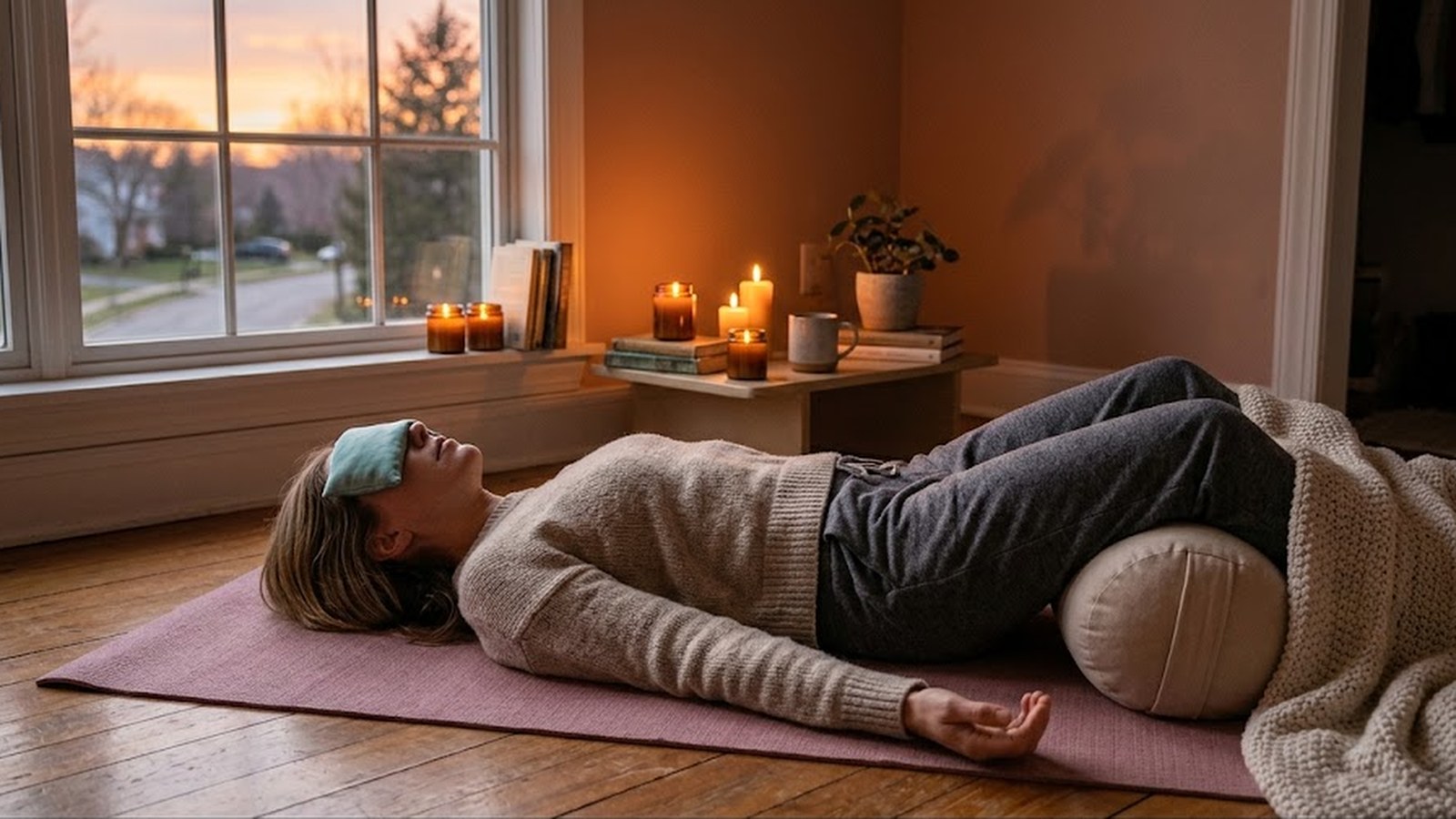
Three categories actively suffer on sand. Deep arm balances (Crow, Side Crow, Eight-Angle) place high force on a small base of contact; sand compresses unevenly under the wrists and amplifies wrist-injury risk on a population already prone to it. Inversions (Headstand, Shoulderstand, Forearm Stand) require a flat, predictable base for safe weight transfer; sand removes that predictability and cervical-spine injury risk rises a lot. Long restorative holds (extended supine twists, supported bridge, savasana over 5 minutes) require a perfectly level base for symmetric joint loading; uneven sand introduces compensatory tension that defeats the restorative purpose.
For a 60-minute practice, a sensible split is: 35-40 minutes of standing and balance work directly on sand; 15-20 minutes of seated and supine work on a thick mat or towel layer; 5-10 minutes of savasana with the mat layer. Inversions and deep arm balances are saved for studio days. Practitioners with thoracic mobility limitations should also save deeper backbends (Camel, Wheel) for the studio — the spinal extension demand requires reliable base contact.
Who should be careful
Five populations should approach beach yoga with extra caution. First, anyone with a history of vertigo, vestibular dysfunction, or unmanaged BPPV. The combined balance demand of unstable surface and standing-pose head positions can provoke vertigo episodes that resolve in indoor practice; the safer initial progression is studio practice with a simulated unstable surface (foam pad) before transitioning to sand.
Second, anyone with a history of chronic ankle instability or unrehabilitated lateral ankle sprain. Sand magnifies the demand on the very ligaments that previous sprains compromised; rebuild proprioception on firm sand or a foam pad in the studio over 4-6 weeks before progressing to soft-sand standing work.
Third, late-pregnancy practitioners. The shifted centre of mass during pregnancy already raises balance demand; adding an unstable surface compounds the fall risk, which becomes substantively more dangerous as pregnancy progresses. Studio practice on a stable mat is the appropriate adaptation.
Fourth, anyone over 65 with osteoporosis or osteopenia. Falls during single-leg standing postures on sand are mechanically harder to recover from than falls on a yoga mat; the fall-into-sand impact is softer than concrete but the rotational forces during a sand fall can still produce wrist or hip fractures in vulnerable bone.
Fifth, anyone whose practice is primarily for cervical-spine relief. The inversions, headstands, and deep neck-extension postures that benefit cervical mobility are the same ones that should not be performed on sand. Practice these in studio; use sand for the standing-balance and core-recruitment portions of the home routine.
How to measure progress
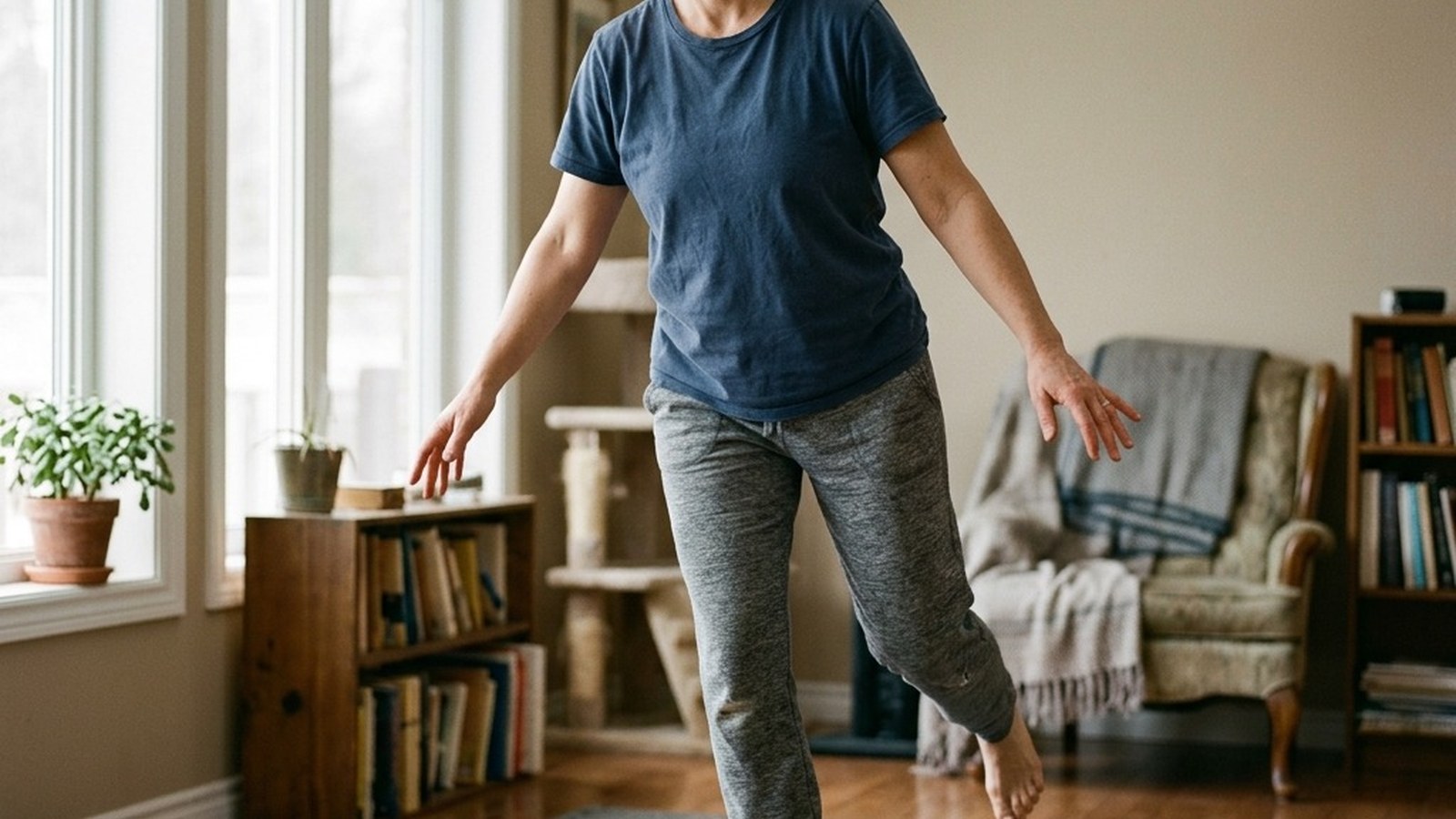
Three home tests track sand-yoga adaptation reliably. First, the eyes-closed single-leg stand: stand on the affected leg with eyes closed, time to first foot-touch-down or arm-touch-wall. Untrained adults typically last only a few seconds before the first touch-down; with regular sand-yoga practice, hold times improve measurably within 6-8 weeks. The test is sensitive to ankle and hip-stabilizer recruitment changes that hard-surface practice does not produce as quickly.
Second, the Tree-pose hold. On a stable mat indoors, hold Tree pose with the lifted foot on the standing-leg thigh, eyes open, focal point fixed on the wall. Time to first wobble that disrupts the lifted-foot position. With regular sand practice, most practitioners extend their indoor Tree-pose hold time noticeably over 4-6 weeks.
Third, post-session tendon and muscle response. Mild calf, peroneal, or arch soreness in the 24-48 hours after a sand session is expected adaptation. Sharp pain in the Achilles tendon, anterior tibialis, or plantar fascia within 24 hours is an over-reach signal: scale back session length by 25% for two weeks before progressing again.
The caveats people skip
Sun exposure is the most-overlooked beach-yoga risk. A 60-minute mid-morning summer practice on Wasaga Beach delivers a UV dose well above the threshold for sunburn in fair-skinned readers, even with SPF 30 sunscreen which most practitioners do not reapply during practice. Practice at dawn (before 9am) or after 5pm in summer; reapply SPF 50+ before starting; wear UPF clothing for any pose held longer than two minutes. Reflected UV from light-coloured sand adds 15-25% to the direct dose; sand-side practice receives more cumulative UV than equivalent grass practice.
The second underdiscussed point is asymmetric loading. Sand grade is rarely level — even a 2-3% slope produces measurable left/right asymmetry in standing pose alignment over a sustained hold. Periodically reposition the mat or switch direction during practice to avoid reinforcing the slope-driven asymmetry. The corrective rule is to flip practice direction every 5-10 minutes; a left-foot-forward sequence followed by a right-foot-forward sequence at the same orientation balances the slope-induced bias.
Practical takeaways
- Use beach yoga as a balance complement to studio practice, not as a complete substitute. The unstable-surface stimulus accrues; the postural depth on a yielding base does not.
- Dawn or evening practice in summer. The UV dose during a 60-minute mid-day session exceeds safe single-day exposure for fair-skinned readers; reflected sand UV adds 15-25% to direct exposure.
- Bring a thicker mat or yoga towel. Standard 4mm mats compress unevenly into sand; 6-8mm mats or microfiber towels layered on top stabilize the surface for hands-and-knees and seated poses.
- Skip deep arm-balances and inversions on sand. Crow, Side Crow, Eight-Angle, Headstand, and Forearm Stand all require predictable base contact that sand does not provide.
- Reposition the mat every 5-10 minutes. Even a 2-3% beach slope reinforces left/right asymmetry over a sustained hold.
- Track three field tests: eyes-closed single-leg stand time, Tree-pose hold time, and 24-48h tendon response. Adaptation shows in the first two over 4-8 weeks; sharp tendon pain in the third signals over-reach.
Frequently asked questions
Is beach yoga harder than studio yoga?
Per pose, yes — sand recruits stabilizers continuously, raising postural sway 35-50% on single-leg balance postures. But total practice volume usually drops on sand because deeper holds become harder to sustain.
Do I need a special yoga mat for sand?
A 6-8mm mat compresses more evenly into sand than a thin 4mm. Microfiber suede tops repel sand better than rubber. Specialty sand-yoga mats exist but a thick travel mat works.
Will the salt air damage my mat?
Modestly, over time. Rinse and air-dry after each beach session; a 1-2 year lifespan vs 3-5 years for studio-only use is typical.
Should I do hot yoga on the beach?
No — combining direct sun, beach reflection, and yoga heat can produce dangerous core temperature elevation in 30-45 minutes. Hot yoga should stay in climate-controlled studios.
Is grounding (bare feet on sand) actually beneficial?
The grounding/earthing literature is small and methodologically weak. Some readers report subjective benefit; rigorous evidence for physiological effects is limited.
Which postures should I save for studio?
Inversions (Headstand, Forearm Stand), deep arm balances (Crow, Eight-Angle), and long restorative holds. All require a predictable level base; sand doesn't provide it.
Can I do beach yoga during pregnancy?
Early pregnancy yes with caution; late pregnancy, no. The shifted centre of mass already raises fall risk, and sand compounds it. Switch to studio practice on a stable mat as pregnancy progresses.
References
Cramer 2013Cramer H, Lauche R, Haller H, Dobos G. Yoga for low back pain: a study that pools many studies and meta-analysis. The Clinical Journal of Pain. 2013;29(5):450-460. View source →Pascoe 2017Pascoe MC, Thompson DR, Ski CF. Yoga, mindfulness-based stress reduction and stress-related physiological measures: a meta-analysis. Psychoneuroendocrinology. 2017;86:152-168. View source →Behm 2015Behm DG, Muehlbauer T, Kibele A, Granacher U. Effects of strength training using unstable surfaces on strength, power and balance performance across the lifespan: a study that pools many studies and meta-analysis. Sports Medicine. 2015;45(12):1645-1669. View source →