The 60-second version
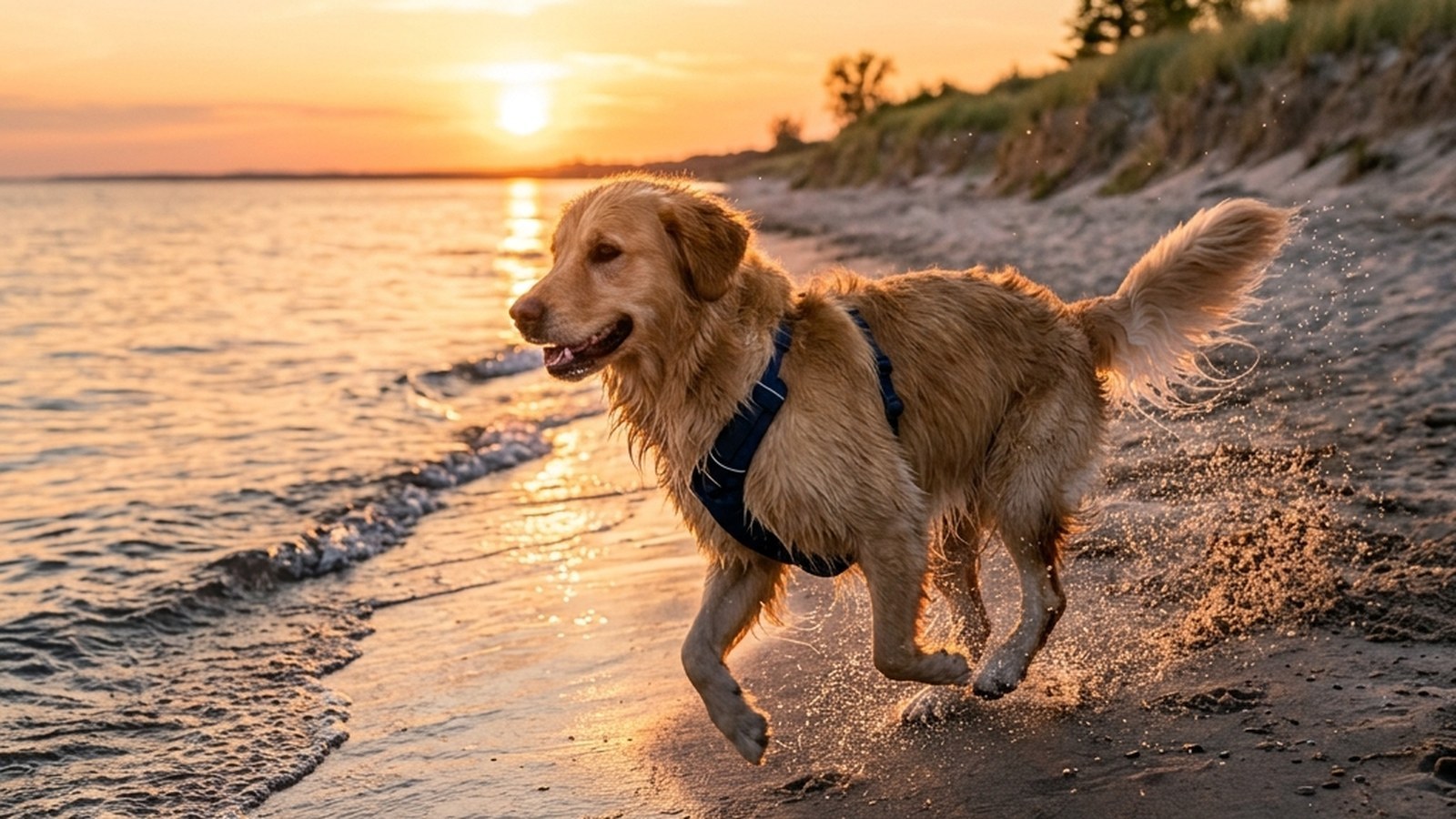
An active off-leash beach romp can give the owner more exercise than a controlled walk — but only if the human stays moving. The gain is in the chase-and-recall pattern, not in how tired the dog gets. And on soft sand, every step costs you more.
Educational journalism, not medical advice. Every claim here is checked against its cited sources by editor Timothy Bunce — a health writer, not a physician. It isn’t specific to your situation: for health decisions, talk to your own clinician. How we work →
Some links in this article are affiliate links. If you buy through one, The Beachside Reader earns a commission at no extra cost to you. It never changes which products we pick, or what we say about them. Full affiliate disclosure →
Off-leash vs on-leash energy expenditure for the owner
Walking the dog is one of the most commonly reported forms of incidental physical activity. The research on dog ownership and activity is consistent on one point: in studies tracking free-living movement, dog owners average more daily steps than comparable non-owners — on the order of roughly 1,500 to 2,500 or more additional steps, much of it at a moderate, health-beneficial intensity.1 What is less often discussed is that the owner's effort varies depending on whether the dog is on a leash or off.
The intuition is that off-leash walks are easier for the owner — the dog runs around, the human stands and watches. The reality, for owners who engage with their dog rather than supervise passively, is often the opposite. Off-leash recall practice, fetch games, and chase patterns produce intermittent bursts of higher-effort movement for the human that steady leashed walking does not. We don't have a clean published figure for exactly how much more energy that adds, so treat it as a meaningful but unquantified bump rather than a precise number.
The catch is in the word "actively." An owner who sits on a beach blanket while the dog runs gets minimal exercise. An owner who walks while the dog runs gets standard walking exercise. An owner who walks briskly, calls the dog back across the beach, and throws balls or sticks for the dog to chase gets meaningfully more.
The decision is not really between on-leash and off-leash. It is between passive supervision and active engagement, and off-leash conditions are simply what enables the active version. The dog determines the timing and pattern of the activity. The owner determines whether to engage.
The fetch-and-recall pattern: why it behaves like intervals
Active fetch and recall play is, by its nature, intermittent: short bouts of higher effort while you move, throw, and call the dog, separated by brief easier spells while the dog chases and returns. In structure this resembles interval-style activity — repeated short efforts with incomplete recovery — rather than steady, continuous walking.
That structural difference matters. Interval-style activity, with intermittent bursts and incomplete recovery, produces cardiorespiratory and peripheral conditioning benefits that steady low-intensity activity does not match.2 The beach session is not a substitute for structured aerobic training in athletes, but for a typical adult who does no other formal exercise, the intermittent pattern can be a useful contributor to fitness.
The pattern also has the advantage of being self-regulating. When you push hard during a recall or throw, the dog's chase-and-return gives you a natural breathing-recovery window. Push too little and you simply get the walking benefit instead. The activity tolerates a wide range of fitness levels without explicit modification. (We're describing the shape of the activity here, not claiming a specific heart-rate zone — your effort depends entirely on how much you put in.)
Wasaga's dog-friendly beach areas
Wasaga Beach has designated areas where dogs are permitted off-leash during specific periods of the year, and other areas where dogs are permitted only on a leash or not at all. The rules change between summer and shoulder seasons, and current rules should be confirmed with Wasaga Beach Provincial Park or the town's parks department before any visit.
The practical implication for active dog-and-human conditioning is that timing and location matter. Early-morning or late-evening visits to permitted areas during summer offer better conditions for both temperature and crowding than midday weekend visits. Off-shoulder months — May, late September, October — typically have more permissive rules and far fewer crowds. For the specific designated areas and their seasonal rules, see our guide to Wasaga's off-leash dog beaches and trails.
The dog beach areas tend to have more uneven terrain than the central tourist beaches: soft sand, driftwood, dune patches, and shallow water. That terrain is not incidental to the workout. Walking in soft sand expends substantially more energy than the same walk on a hard, packed surface3 — largely because muscles at the hip and knee must do extra work on a compliant surface that gives way underfoot.4 The harder surface makes the workout easier; the soft surface makes it harder, in a useful way.
For owners new to active beach play with their dog, starting with shorter sessions in cooler conditions is sensible. A 20-minute morning session three times a week is a workable starting point. Sessions extend naturally as both human and dog conditioning improve.
How dog play fits the activity guidelines
It helps to anchor any activity habit to a target. The Canadian (CSEP) movement guideline for adults is a minimum of at least 150 minutes per week of moderate-to-vigorous aerobic activity.5 Active dog play can contribute a real share of that: a 45-minute morning beach session done five days a week is 225 minutes per week — comfortably above the 150-minute floor.5
For weight management specifically, the picture is more demanding. Among people who have successfully kept weight off, high activity volumes are the norm: members of the National Weight Control Registry average roughly 60 or more minutes per day of moderate activity such as brisk walking, and about an hour a day is a reasonable benchmark for maintenance.6 We're not going to put a precise minute-figure on lighter maintenance — the evidence here points to the high-volume end, so think "most days, and generous helpings" rather than a tidy small dose.
The household calculus is still worth doing. A family that owns a dog and walks it twice daily, with one of those walks involving active beach play, can accumulate a substantial chunk of daily activity for the primary walker — and the more of it that lands at the intermittent, higher-effort end, the more it does for fitness.
When dog play is a workout — and when it isn't
The distinction between dog play that is exercise and dog play that is not is essentially about what the human does.
Workout dog play involves: walking briskly between throws or recalls, covering short distances at pace during fetch games, walking or jogging to retrieve dropped toys when the dog has not, calling the dog back across substantial distances repeatedly, throwing or carrying objects with arm engagement, and changing direction frequently during chase or recall sequences. The human moves continuously and varies pace.
Non-workout dog play involves: standing in one spot while the dog runs in circles, sitting on a blanket while the dog interacts with other dogs, throwing once and waiting for the dog to return without moving, or letting the dog run independently while the owner walks slowly or stops. The human moves minimally regardless of what the dog does.
The same beach session can be either, depending on the owner's engagement. Owners who want the workout benefit should be deliberate about which version they are doing. A simple test: at the end of the session, were you breathing harder than at the start? If not, the session was likely the non-workout version.
For households with multiple adults, alternating engagement is useful. The active owner gets the workout. The less active owner enjoys the beach. Both contribute to the dog's well-being. Switching roles between sessions keeps either party from carrying the entire load.
Older dogs and modified play
Dogs age faster than humans, and many older dogs cannot tolerate the intensity of play they enjoyed as younger animals. The signs are usually subtle — slower recall, less enthusiasm for repeated fetches, more recovery time between sprints, occasional limping after long sessions.
Modified play for older dogs can preserve the human's benefit while reducing the demands on the dog. Shorter throws keep the dog moving without requiring maximal sprints. Walking-pace games — where the human walks while the dog accompanies — provide companionship without hard joint loading on the older animal. Swimming, where conditions allow, gives older dogs exercise with minimal impact on aging joints.
Your own exercise can be maintained by adjusting the human side of the equation: carrying a weighted backpack during the walk, taking longer routes between dog interactions, or adding a personal walk before or after the shorter dog session. And because soft sand raises the energy cost of walking on its own,3 simply choosing the softer stretch of beach keeps your effort up even when the dog's pace drops — the same mechanism behind why barefoot sand walking builds foot strength.
None of this replaces veterinary judgement. Appropriate activity for a senior dog depends on breed, weight, and health history, and a conversation with the dog's veterinarian about activity levels is part of responsible senior-dog care.
Pulling-leash safety
On-leash walking has its own practical hazards, particularly for owners walking dogs that pull. A strong dog repeatedly jerking the leash places uneven, one-sided load on the holding arm and shoulder. This is offered as common-sense ergonomics, not a research finding — but it is the kind of repetitive, asymmetric strain that is worth designing out.
Prevention is partly about training the dog not to pull and partly about distributing the load. Hands-free leashes worn around the waist transfer load to the core rather than a single arm. Front-clip harnesses reduce the dog's mechanical advantage when it pulls. Two-handed leash management — particularly for owners of large or strong dogs — avoids loading one side of the body.
The other under-appreciated risk is falls. A strong dog that lunges unexpectedly can pull an owner off-balance, with extra risk on uneven surfaces like beach sand or icy sidewalks. Hands-free equipment and consistent training reduce this risk. These are sensible precautions rather than quantified claims, but they cost little and are easy to adopt.
Making it daily, not weekend-only
A reasonable working principle is that activity benefits accumulate with frequency and consistency, not just with the occasional long session. Several shorter sessions across the week are easier to sustain than one big weekend outing, and they keep the habit embedded in daily life. (This is general guidance on building an exercise habit, not a finding tied to a specific study.)
The practical implication is to structure dog activity into the daily routine rather than the weekend routine. A morning beach session before work, an after-dinner walk that includes some active play, or a lunchtime walk on work-from-home days are all easier to sustain than weekend-only outings.
For Wasaga families specifically, the proximity of the beach makes daily access more feasible than for inland residents. A 15-minute drive to the dog-permitted area, a 30-minute session, and a 15-minute return is an hour-long round trip — manageable on weekday mornings for many schedules. Owners who treat the beach session as part of the workday routine, rather than a special outing, tend to find daily access becomes the default — for both human and dog.
When dog play is a workout — and when it isn't (the short version)
If you take one thing away: the dog sets the timing, you set the intensity. Soft sand and an intermittent chase-and-recall pattern are what turn a stroll into something closer to a real workout — and both of those depend on you choosing to engage. Sit on the blanket and it's a nice morning; move with the dog and it starts to count.
References
Dall 2017Dall PM, Ellis SLH, Ellis BM, Grant PM, Colyer A, Gee NR, Granat MH, Mills DS. The influence of dog ownership on objective measures of free-living physical activity and sedentary behaviour in community-dwelling older adults: a longitudinal case-controlled study. BMC Public Health. 2017;17:496. View source →Gao 2025Gao C, Yue Y, Wu D, Zhang J, Zhu S. Effects of high-intensity interval training versus moderate-intensity continuous training on cardiorespiratory and exercise capacity in patients with coronary artery disease: a systematic review and meta-analysis. PLoS One. 2025;20(2):e0314134. View source →Lejeune 1998Lejeune TM, Willems PA, Heglund NC. Mechanics and energetics of human locomotion on sand. J Exp Biol. 1998;201(13):2071-2080. View source →Grant 2022Grant B, Charles J, Geraghty B, Gardiner J, D'Août K, Falkingham PL, Bates KT. Why does the metabolic cost of walking increase on compliant substrates? J R Soc Interface. 2022;19(196):20220483. View source →CSEP 2020Canadian Society for Exercise Physiology (CSEP). Canadian 24-Hour Movement Guidelines for Adults aged 18-64 years. View source →Catenacci 2008 (NWCR)Catenacci VA, Ogden LG, Stuht J, Phelan S, Wing RR, Hill JO, Wyatt HR. Physical Activity Patterns in the National Weight Control Registry. Obesity (Silver Spring). 2008;16(1):153-161. View source →