The 60-second version
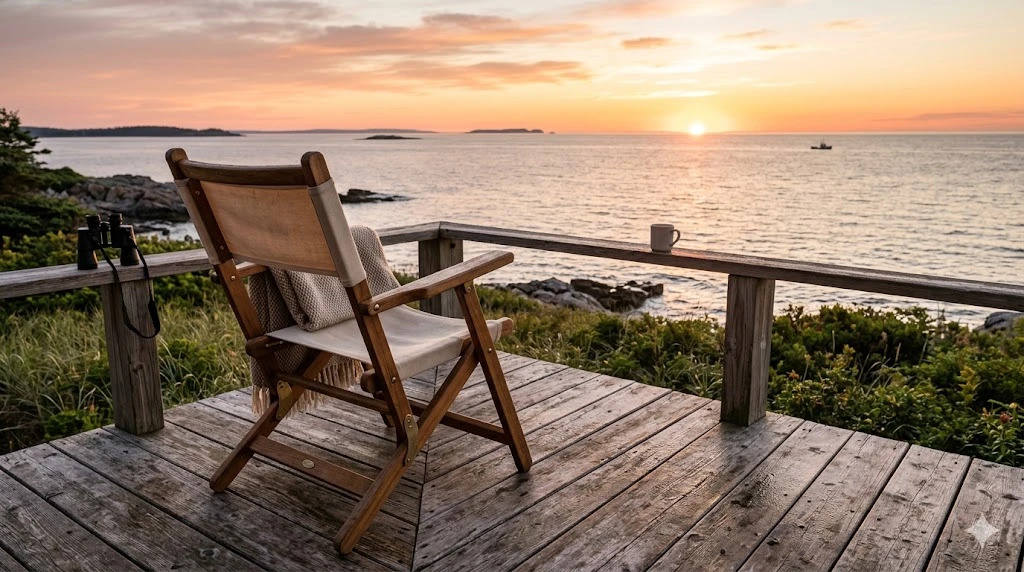
Low slung beach chairs are one of the most reliable causes of next-morning low-back stiffness. The fix is a chair with a higher seat, a more upright backrest — or just a $20 inflatable lumbar cushion.
Here’s what happens when you sink into a typical low beach chair: your seat ends up only 15–20 cm off the ground, your backrest tips well past upright, your pelvis rolls backward, and the natural curve in your lower back flattens out. In that position -- a fully slumped, forward-flexed posture rather than ordinary upright sitting -- the pressure on the discs in your lower spine can run roughly 65 to 75 percent higher than standing Wilke 1999. Sit there for two or three hours and the small back muscles fatigue, the discs “creep” under steady load, and you wake up stiff.
The fix is geometry, not gear:
- A seat pan 30–38 cm (12–15 in) off the sand
- A backrest tilted only slightly back — 100–110 degrees from the seat
- An upright, non-slumped sitting posture, which keeps the lower back’s stabilizing muscles more active than slumping does O’Sullivan 2006
If you’re over 50 or already have a touchy lower back, a small inflatable lumbar cushion (under $20) turns almost any beach chair into a tolerable one.
Educational journalism, not medical advice. Every claim here is checked against its cited sources by editor Timothy Bunce — a health writer, not a physician. It isn’t specific to your situation: for health decisions, talk to your own clinician. How we work →
Some links in this article are affiliate links. If you buy through one, The Beachside Reader earns a commission at no extra cost to you. It never changes which products we pick, or what we say about them. Full affiliate disclosure →
The disc-pressure evidence
The empirical foundation for the lumbar-support argument comes from Hans-Joachim Wilke’s landmark in vivo disc-pressure work, which used a strain-gauge-instrumented pressure transducer implanted in the L4-L5 disc of a healthy volunteer to measure intradiscal pressure across dozens of postures and activities Wilke 1999. Standing relaxed produced pressures around 0.5 megapascals (MPa); ordinary upright sitting without back support produced a broadly similar 0.46 MPa. Sitting in maximum (forced) lumbar flexion — a fully slumped, rounded-spine posture well beyond plain unsupported sitting — pushed pressures up to roughly 0.83 MPa, on the order of 65 to 75 percent higher than standing. Sitting slouched back into a supportive armchair backrest — letting the chair, not the spine, carry more of the trunk load — produced the lowest pressures Wilke recorded, as low as 0.27-0.30 MPa, roughly half of standing; the paper did not test a specific backrest angle in degrees or lumbar-pad thickness in centimetres. (The widely repeated ‘100-110 degree backrest plus a few centimetres of lumbar support’ design formula comes from a separate line of 1970s chair-ergonomics research that systematically varied backrest angle and lumbar-support depth, not from Wilke’s in vivo pressure measurements.)
The translation to beach chairs is direct. A typical low-slung beach chair collapses the pelvis and lumbar spine toward that maximum-flexion posture rather than the milder supported-recline condition. The seat pan tips backward, the pelvis follows into posterior tilt, the lumbar spine flexes out of its natural lordosis, and the discs absorb the increased load for as long as the user stays in the chair. Most beach sessions are two-to-three hours; some are all day. Either is enough exposure for the disc creep and small-muscle fatigue Wilke documented to produce the morning-after stiffness pattern most readers recognize.
Wilke’s pressure data also explains why a small lumbar cushion is so disproportionately effective. The same backrest-load-sharing mechanism behind Wilke’s lowest recorded sitting pressures (0.27-0.30 MPa) is not complicated engineering — a small lumbar cushion is just a roll of foam that prevents the lumbar segments from flexing into kyphosis while still letting the backrest carry load. Adding that to an otherwise-poorly-designed beach chair recovers most of the disc-pressure benefit without replacing the chair itself.
Seat-pan height vs back-rest angle: which matters more?
O’Sullivan’s 2006 work in Spine on superficial trunk-muscle activation during sitting added the muscle-side mechanism to Wilke’s disc-pressure mechanism O'Sullivan 2006. In a pain-free study population, slump and thoracic-dominant upright sitting reduced activation of the deep lumbar multifidus and internal obliques while increasing thoracic erector spinae activity relative to lumbo-pelvic upright sitting — the small segmental stabilisers disengaged, leaving the larger global muscles to compensate, which they do less efficiently and with more discomfort. The pattern matches the experience of beach-chair users who feel the discomfort start around the 90-minute mark.
Two beach-chair geometry variables drive most of the lumbar load. Seat-pan height is the first: a pan that sits 6-8 inches off the sand requires the user to drop their hips below their knees, which forces posterior pelvic tilt and lumbar flexion almost regardless of back-rest design. Pans of 12-15 inches keep the hips at or above knee level, which preserves the option of neutral pelvis. Back-rest angle is the second: an angle of 100-110 degrees from the seat pan distributes load between the lumbar discs and the back-rest contact surface, which is the configuration the disc-pressure work supports. Angles above 120 degrees (the ‘recliner’ geometry) shift load further but tend to produce neck flexion as users try to read or look out at the water.
The interaction between the two variables matters more than either alone. A low seat pan with a steep back-rest (the classic festival camping chair) is the worst-case lumbar load. A high seat pan with a moderate recline is the best-case beach configuration. The chair the marketing labels ‘ergonomic’ is usually the latter; the chair the marketing labels ‘low-profile’ or ‘packable’ is usually the former.
The broader sitting-ergonomics literature
Battié’s 2002 work on occupational driving and lumbar disc degeneration is the closest occupational analogue to prolonged beach sitting that has been epidemiologically studied Battié 2002. The case-control design — 45 monozygotic twin pairs discordant for years of occupational driving, drawn from the Finnish Twin Cohort — actually found no significant difference in MRI-assessed lumbar disc degeneration between the twin who drove for a living and the twin who did not; the authors concluded that driving may aggravate symptoms but does not appear to damage the disc itself. Beach chairs lack the vibration component but include the static-flexion component, and the dose during a typical beach summer (40-80 hours of seated exposure across June through August) is enough to expect a measurable contribution to symptoms in susceptible readers.
McGill’s 2004 synthesis of injury-mechanism evidence in the Journal of Electromyography and Kinesiology mapped the sequence: prolonged flexion fatigues the multifidus, the multifidus stops protecting the spine from shear, and a later loaded movement (standing up from the chair, leaning over to pick up a bag, lifting a child) becomes the mechanical injury event McGill 2004. Most beach-chair-related back complaints are not the chair itself; they are the next loaded movement after a long session in the chair. The chair set the conditions; the lift produced the symptom.
The clinical implication is that the prevention strategy has two parts. The first is reducing the time spent in flexion during the chair session itself — supportive geometry, lumbar bolster, periodic standing breaks. The second is being deliberate about the first 5-10 minutes after standing up — a slow walk, a few cat-cow rotations, no heavy lifting until the lumbar tissues have re-equilibrated. Both are simpler than the wellness-industry framing of beach posture suggests, and both work.
The buyer’s checklist that prevents most pain
The shortlist of features that the disc-pressure and trunk-muscle evidence supports is short. Seat-pan height between 12 and 17 inches keeps the hips at or above knee level. Back-rest angle adjustable between 100 and 120 degrees from the seat pan covers the read-and-relax range without forcing neck flexion. A contoured lumbar bolster — or a removable lumbar cushion that sits at the L3-L4 level (roughly the small of the back, two inches above the belt line) — preserves the lordosis under load. Width of seat pan at least 18 inches accommodates most adults without pinching the thighs.
Two features that the evidence does not support spending extra for: the ‘zero-gravity’ recliner that puts the legs above the heart (good for venous return, neutral for lumbar load), and the ‘memory-foam’ seat pan (good for ischial tuberosity comfort, neutral for lumbar load). The lumbar geometry is what the disc-pressure work measures; padding location and density are secondary.
For readers unwilling to replace an existing chair, the inflatable lumbar cushion that sits behind the lower back is the highest-value retrofit. Roughly twenty Canadian dollars buys a cushion that recreates the backrest-load-sharing mechanism behind the lowest sitting pressures Wilke 1999 recorded in the lab. The cushion is also packable, fits any chair, and survives sand exposure better than foam alternatives. For frequent beach-goers it is a better first purchase than a new chair.
Special cases: pregnancy, post-surgical, over-65
Three populations have additional lumbar-load considerations on the beach. Pregnant readers in the second and third trimesters carry an anterior load that already shifts the centre of mass and increases lumbar lordosis. A low-slung chair forces the opposite (posterior pelvic tilt) and the conflict tends to produce more discomfort than either posture alone. The supportive-geometry chair plus a small lumbar cushion is the safer default; many obstetric physiotherapists recommend avoiding low beach chairs in the third trimester entirely.
Post-surgical lumbar patients (discectomy, fusion, or longstanding chronic pain managed with conservative care) typically have specific posture restrictions from their surgeon or physiotherapist. The beach-chair literature does not override those restrictions. The general direction of the evidence — preserve lordosis, distribute load, limit static-sitting duration — aligns with most post-surgical guidance, but the specifics should come from the patient’s clinical team.
Readers over 65 contend with the additional issue of getting up out of a low chair. A 6-inch seat pan requires a sit-to-stand transition that loads the knees, hips, and lumbar spine simultaneously and is one of the more reliable producers of acute episodes in older adults with osteoarthritic joints. The 12-15 inch pan height the lumbar-comfort evidence supports also happens to be the height that biomechanical sit-to-stand studies treat as the threshold below which the demand on quadriceps and lumbar erectors becomes problematic. The two design considerations point in the same direction.
On-beach strategy: breaks, cushions, and the towel option
Even with a good chair, the prolonged-static-sitting issue does not disappear. Periodic breaks — standing up, walking 30 metres, doing one or two slow forward bends — reset the disc fluid distribution and re-recruit the deep stabilisers. The interval the literature roughly supports is one break every 30-45 minutes of continuous sitting; a beach session of three hours should include four-to-six interruptions. A reading book, water bottle, and a willingness to walk to the shoreline once an hour cover most of the structure.
The beach towel on flat sand is an underrated alternative for short sessions or for readers without back issues. A towel allows free pelvic rotation and the option of sitting cross-legged, side-saddle, or with knees bent — all of which avoid the sustained-flexion problem of the chair. The trade-offs are the up-and-down transitions (hard on knees over 50) and the lower comfort for sustained reading or napping. For a one-hour visit with kids, the towel is fine; for a three-hour reading session, the chair with appropriate geometry is the better choice.
Hybrid approaches work too. Many beach-goers with low-back issues combine a properly-designed chair for the main sitting periods with 10-15 minute towel breaks where they lie supine with knees bent — a posture that the disc-pressure work treats as one of the lowest-load options available. The lying-supine break also tends to fit naturally into the beach-day rhythm (reapplying sunscreen, taking a short rest before the next swim), so adding it is more about awareness than about extra effort.
Practical takeaways
- Low-slung beach chairs can raise lumbar disc pressure 65 to 75 percent above neutral standing when they push the spine into a fully slumped, forward-flexed posture -- ordinary upright sitting is not higher-pressure than standing. The mechanism (Wilke 1999) is posterior pelvic tilt and lumbar flexion under sustained load.
- Seat-pan height (12-15 inches) and back-rest angle (100-110 degrees) are the highest-value design variables. A low pan with a steep back is the worst combination.
- A basic lumbar bolster recovers much of the supportive-recline benefit even in a mediocre chair. Roughly twenty Canadian dollars; better first purchase than replacing the chair.
- The injury usually happens on the next loaded movement, not in the chair itself. The first 5-10 minutes after standing matter more than most beach-goers realize (McGill 2004).
- Stand and walk every 30-45 minutes to reset disc fluid and re-recruit deep stabilisers. Four-to-six breaks across a three-hour session.
- Pregnancy, post-surgical, and over-65 readers benefit most from the supportive-geometry rules. The 12-15 inch pan height also makes the sit-to-stand transition safer.
Frequently asked questions
Why does my back hurt after a long beach day?
Low-slung beach chairs typically force the pelvis into posterior tilt, which flattens the natural lumbar lordosis. Ordinary upright sitting is not actually higher-pressure than standing, but a fully slumped, forward-flexed spine posture -- the shape a low, reclined beach chair tends to encourage -- can raise lumbar disc pressure roughly 65 to 75 percent above standing (Wilke 1999). After two-to-three hours the small extensor muscles fatigue, the discs creep, and the morning-after pain pattern follows.
Is a chair with built-in lumbar support actually better, or is it marketing?
When the support helps you sit with an upright, lumbo-pelvic posture rather than a slumped one, it keeps the deep stabilizing muscles of the lower back more active, which is what O'Sullivan's EMG study actually measured (O'Sullivan 2006). Combine that with a seat-back reclined roughly 100-110 degrees and a lumbar bolster — a chair-design formula from classic backrest-and-lumbar-support ergonomics research, not from Wilke's disc-pressure study, whose lowest measured pressures came from slouching back into a supportive armchair rather than from any specific angle or pad thickness — and the marketing is overdone but the underlying ergonomic principle is real.
How low is too low for a beach chair?
Seat-pan height under 8 inches off the sand and seat-back angle under 95 degrees from horizontal are the configurations most likely to force posterior pelvic tilt and lumbar flexion. It's the disc-pressure and trunk-muscle evidence above -- not the occupational-driving literature -- that supports treating this as worst-case lumbar geometry for sustained sitting.
Should I just use a beach towel and skip the chair?
A beach towel on flat sand can actually be kinder to the lumbar spine than a poorly designed low chair, because it lets the pelvis rotate freely. The trade-off is that getting up and down repeatedly stresses the hips and knees, especially over 50.
References
Wilke 1999Wilke HJ, Neef P, Caimi M, Hoogland T, Claes LE. New in vivo measurements of pressures in the intervertebral disc in daily life. Spine. 1999;24(8):755-762. View source →O'Sullivan 2006O'Sullivan PB, Dankaerts W, Burnett AF, et al. Effect of different upright sitting postures on spinal-pelvic curvature and trunk muscle activation in a pain-free population. Spine. 2006;31(19):E707-E712. View source →Battié 2002Battié MC, Videman T, Gibbons LE, Manninen H, Gill K, Pope M, Kaprio J. Occupational driving and lumbar disc degeneration: a case-control study. The Lancet. 2002;360(9343):1369-1374. View source →McGill 2004McGill SM. Linking latest knowledge of injury mechanisms and spine function to the prevention of low back disorders. Journal of Electromyography and Kinesiology. 2004;14(1):43-47. View source →