The 60-second version
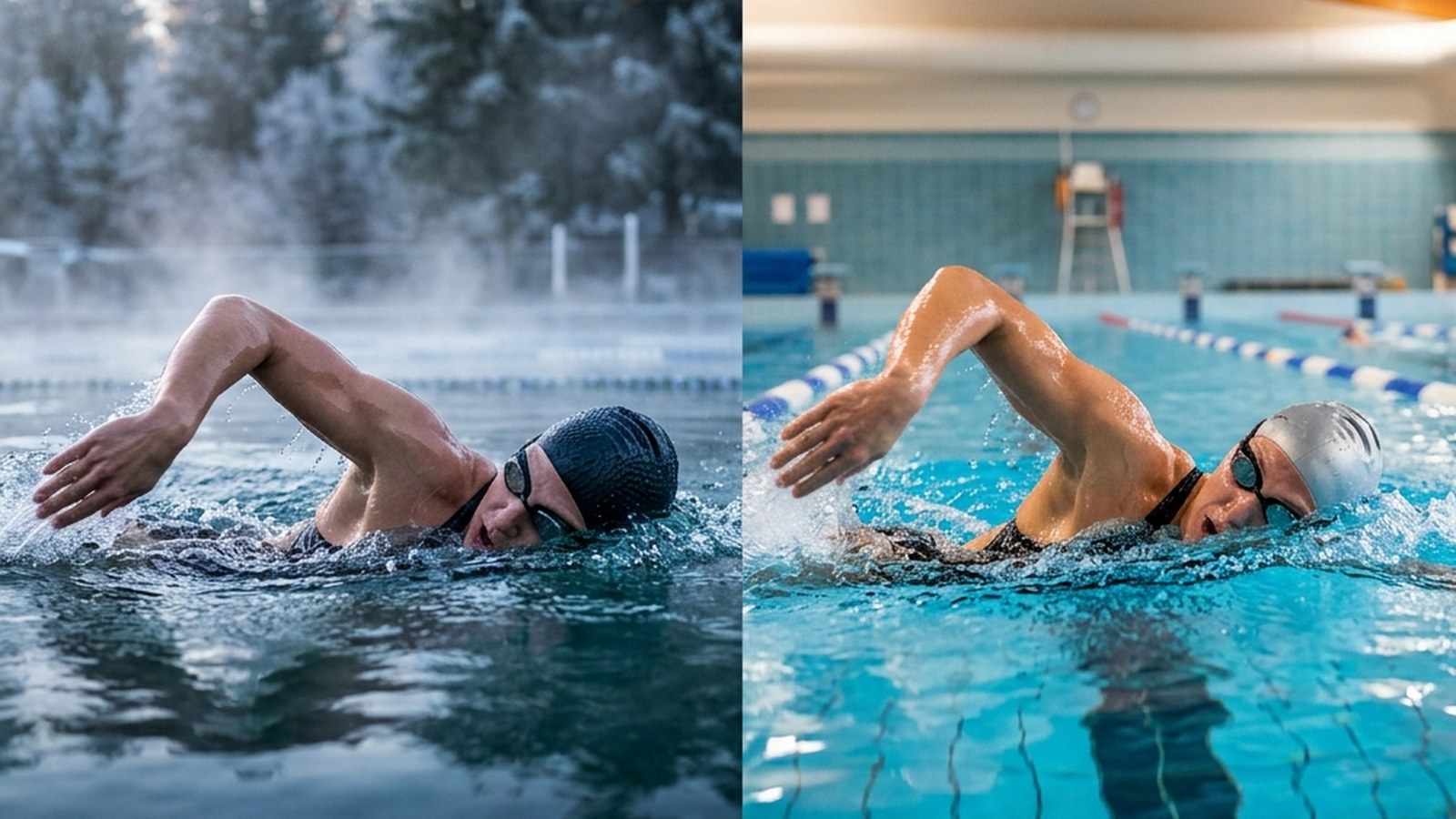
Open-water swimming punishes the habits that pool swimming forgives. Three things change in open water: waves disrupt your breathing, sighting forces your head up, and cold water triggers an involuntary gasp in the first 30 seconds. The fix is technique, not just fitness.
The three open-water-specific challenges:
- Chop and waves mean you can’t reliably get a breath when you turn your head. Solution: breathe to both sides (every 3 or 5 strokes) so you can pick whichever side is calmer
- Sighting (lifting your head to see where you’re going) raises your front and drops your hips, wrecking efficiency unless trained
- Cold water triggers an involuntary gasp reflex in the first 30 seconds — the cause of many drowning incidents in cold lakes Tipton 2017. The fix is gradual acclimation
Bilateral breathing also protects your shoulder by spreading the rotation load evenly across both sides. Shoulder pain in competitive swimmers is primarily driven by cumulative training volume rather than any single mechanical fault Sein 2010. High-mileage single-side breathers likely add an avoidable asymmetry on top of that load, though that specific comparison — breathing side versus volume — was not directly tested in that trial.
This article walks through the physiology, the shoulder mechanics, the situations where breath-holding training is genuinely dangerous, and the field tests that distinguish real progress from accumulating injury.
Educational journalism, not medical advice. Every claim here is checked against its cited sources by editor Timothy Bunce — a health writer, not a physician. It isn’t specific to your situation: for health decisions, talk to your own clinician. How we work →
Some links in this article are affiliate links. If you buy through one, The Beachside Reader earns a commission at no extra cost to you. It never changes which products we pick, or what we say about them. Full affiliate disclosure →
What the evidence actually says
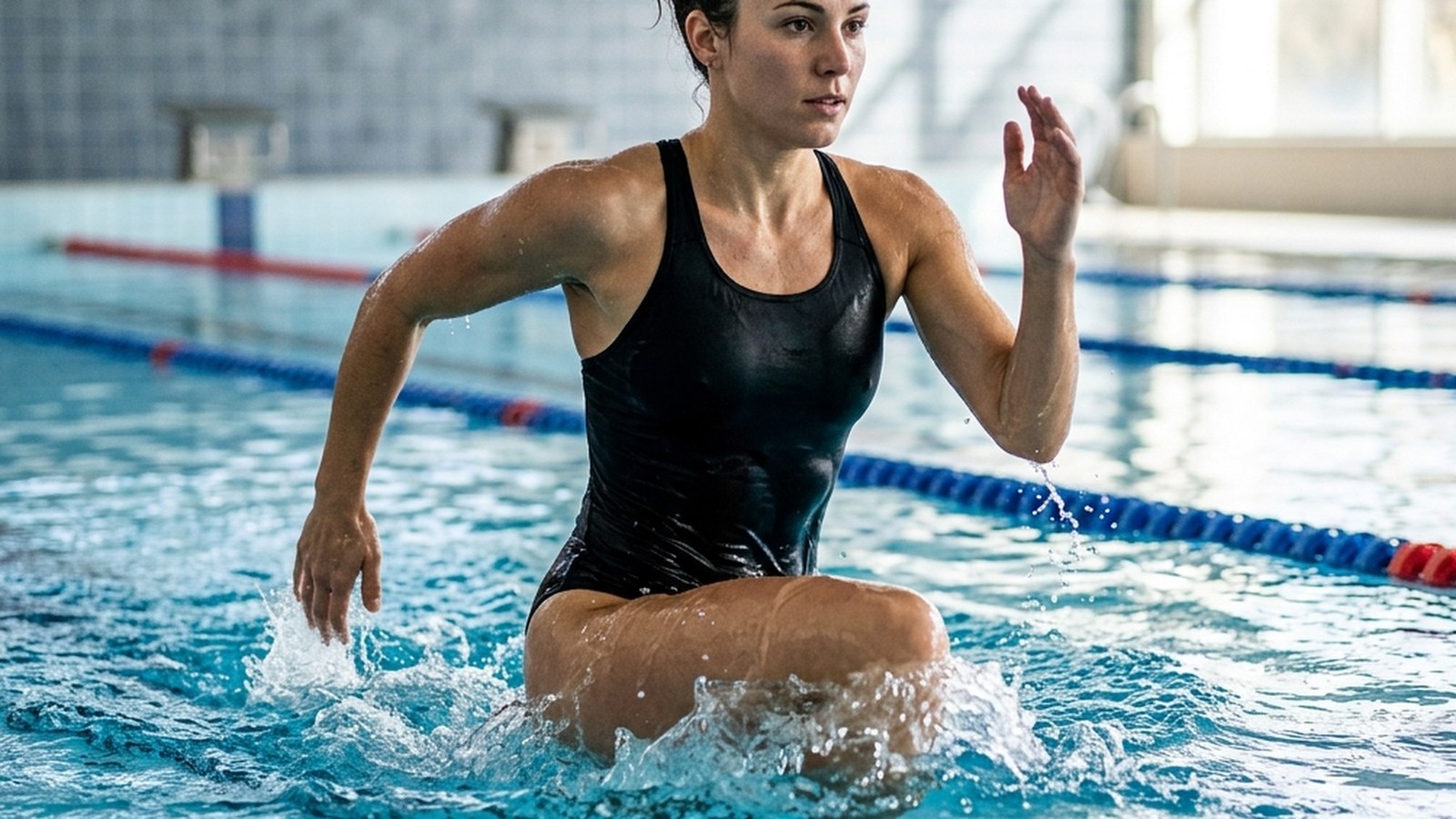
Open-water swimming differs from pool swimming in three measurable ways: chop disrupts the inhalation window, navigation requires sighting (raising the head), and water temperature changes the autonomic response to immersion Tipton 2017. The breath cadence that works in a calm 25-metre pool fails when 30 cm of chop crosses your face on the breathing side. Bilateral breathing — alternating sides every 3 or 5 strokes — preserves the option of breathing into the lee side regardless of chop direction.
The shoulder side of the equation is well documented in competitive swimmers. Shoulder pain in this population is primarily driven by supraspinatus tendinopathy tied to cumulative training volume rather than any single mechanical fault, and the risk tracks with weekly swim mileage Sein 2010.
The CO2-tolerance pathway is the third axis. A controlled trial of 18 novice swimmers found that training with two breaths per pool length instead of seven, over 12 sessions, improved running economy by 6% in the low-breathing-frequency group specifically, while maximal expiratory pressure rose by 11% across the full cohort regardless of breath frequency, with no change in vital capacity Lavin 2015. The proposed mechanism is improved respiratory-muscle endurance — not bigger lungs.
How it actually works
The CO2-tolerance pathway is straightforward physiology. The respiratory drive that triggers a panicked breath is dominated by arterial CO2, not low oxygen, in the typical swimmer’s effort zone. Training with a lower breath frequency (every 3 or 5 strokes instead of every 2) builds tolerance for that CO2 buildup; a 12-session breath-frequency training trial in novice swimmers produced measurable gains in expiratory muscle strength and running economy Lavin 2015. The adaptation is visible within a few weeks of consistent practice, though the direct evidence comes from one small trial rather than a large literature.
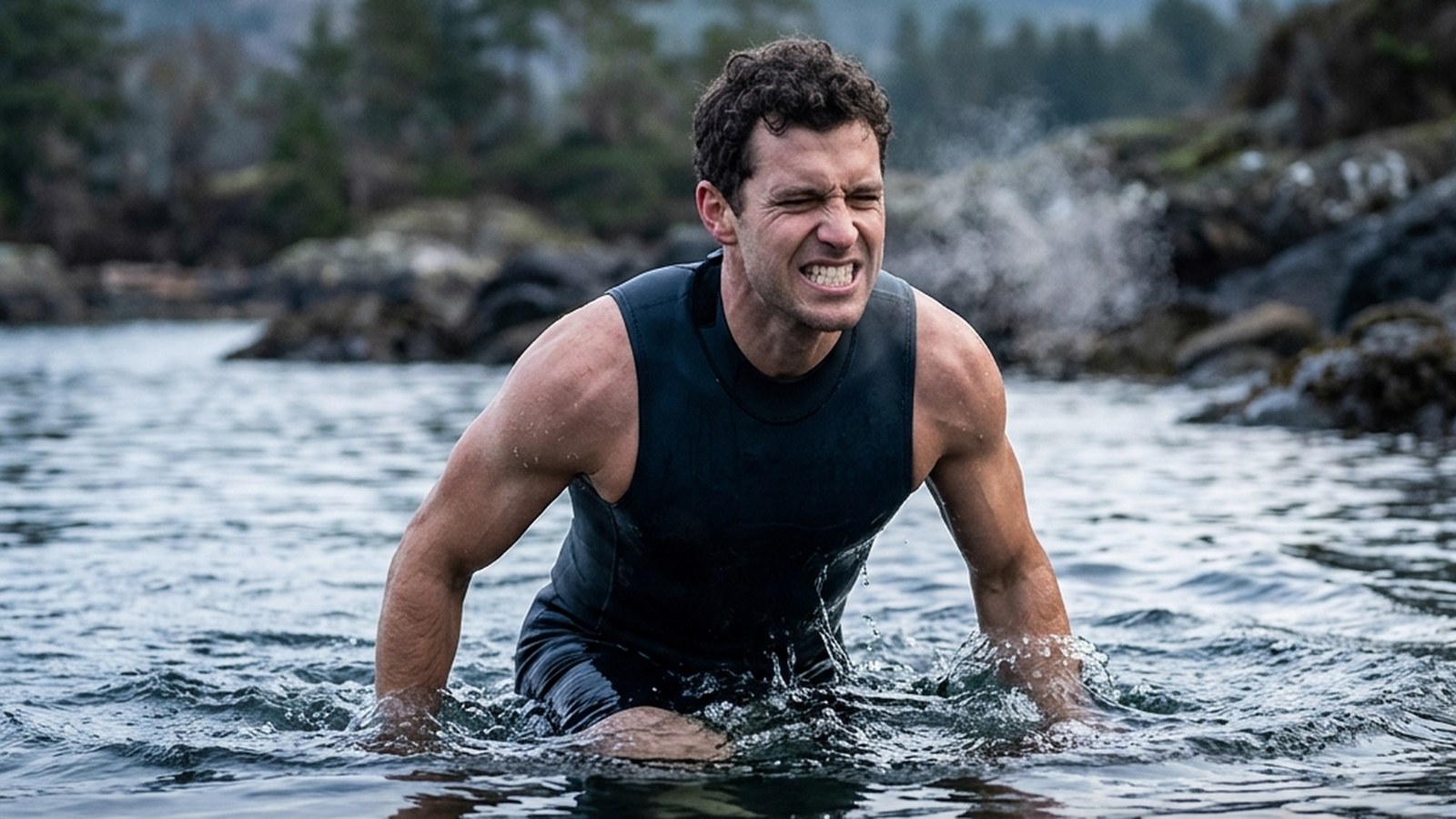
The cold side adds a sympathetic-nervous-system layer the textbook breath-control literature does not capture. Below 15°C, immersion produces an involuntary gasp reflex driven by skin thermoreceptors firing in unison; the reflex peaks in the first 30 seconds and resolves within 2-4 minutes in acclimated swimmers Tipton 2017. During the gasp window, breath-pattern training is irrelevant — the body is overriding any voluntary cadence. The implication for early-season Georgian Bay or Lake Huron swims is operational: the first 2-4 minutes are about not aspirating water, not about technique drills.
The shoulder mechanics are the most measurable consequence of training load. Elite swimmers accumulate 10,000-30,000 strokes per week, and shoulder pain in this population is primarily explained by supraspinatus tendinopathy driven by that cumulative volume rather than a single technique fault Sein 2010. Bilateral breathing does not eliminate that load, but it avoids stacking a consistent one-sided asymmetry on top of it.
The interaction between breath cadence and stroke length deserves separate attention. Sprint swimmers breathe every 2 strokes because the time between exhalation and inhalation is too short to delay; distance swimmers can afford the longer 5-stroke cycle because their stroke rate is lower and their cardiac output is steady-state rather than transient. Rushing the transition from one cadence to another — for example, switching to 5-stroke breathing the week before an event — tends to backfire. The chemoreceptor adaptation that makes 5-stroke breathing sustainable takes 4-6 weeks to develop; an athlete attempting it without that base will hyperventilate at the start, fatigue early, and abandon the cadence by the middle of the race. The rule that holds across the literature is to introduce cadence work at low intensity in the first 4 weeks of the season, then layer race-pace work onto the cadence base in weeks 5-8.
Cold-water acclimation: the protocol the literature actually supports
The cold-shock response — the gasp, elevated heart rate, peripheral vasoconstriction — is trainable. A controlled trial found that volunteers who underwent six additional cold-water immersions (15°C) showed a significantly reduced breathing-rate and heart-rate response on a further immersion, and the reduction was still measurable when the same group was retested seven months later Tipton 2000. By 14 months the breathing-rate effect had faded back toward baseline, though the heart-rate effect persisted. For Wasaga readers, this is a 2-3 week pre-season investment that converts the early-summer swim window from dangerous to functional.
The populations where cold acclimation is not recommended are well-defined. Anyone with a history of cardiac arrhythmia, uncontrolled hypertension, severe asthma triggered by cold, or known long-QT syndrome should defer cold-water acclimation entirely until cleared by a clinician; the catecholamine surge during immersion can trigger arrhythmia in susceptible hearts and is responsible for most cold-water deaths in the first 30 seconds Tipton 2017. Pregnancy is a relative reasons not to do this; the autonomic response shifts during pregnancy and the published acclimation protocols were not validated in this population.
The acclimation sequence is concrete: week 1, 1-2 minute head-out immersions in 14-16°C water, three sessions; week 2, 2-3 minutes in 12-14°C water, three sessions; week 3, 3-5 minutes in 10-13°C water with brief face submersion, three sessions. Always with a flotation buoy, always with a buddy on shore, never alone in the first six sessions.
Who should be careful
Hypoventilation training is the highest-risk component of structured open-water work. The shallow-water blackout literature documents that even healthy swimmers can lose consciousness during prolonged breath-holds; the warning signs (tunnel vision, tingling, urge to breathe that suddenly disappears) are subjective and absent from many cases until the moment of unconsciousness Pearn 2015. The cadence work this article describes (3-stroke or 5-stroke breathing) is breath-spacing, not breath-holding, and the distinction matters: spacing slightly elevates CO2 between breaths but never produces the hypoxia that drives blackout.
Despite that distinction, four populations should not progress to even the cadence work without medical clearance. Anyone with seizure history, anyone with cardiovascular disease or unmedicated hypertension, anyone in pregnancy, and anyone diagnosed with shallow-water blackout or breath-hold-induced syncope. For these readers, regular pool-swim training at 2-stroke breathing is the appropriate ceiling.
Open-water-specific risks compound for solo swimmers. Boat traffic, current, water temperature, and visibility change minute-to-minute Szpilman 2012. Wasaga Beach’s designated swim zones use marker buoys that boat traffic respects; venturing outside those zones eliminates the only structural safety the local swim culture provides.
How to measure progress
Three field tests track open-water adaptation reliably. First, the 5-stroke pool test: 100m at controlled pace breathing every 5 strokes. The metric is whether the swimmer can complete the 100m with a relaxed catch and no terminal gasp; if the last 25m breaks down into a 3-stroke or 2-stroke pattern, the cadence work is not yet established. Aim for 4 weeks of 5-stroke 100m repeats before adding open-water mileage.
Second, the bilateral-symmetry check: a third party watches a 50m swim from the deck and notes whether the swimmer’s body roll appears equal on each breath. Persistent asymmetric roll is worth tracking alongside total training volume, since volume — not breathing side alone — is the strongest documented driver of swimmer’s shoulder Sein 2010.
Third, the cold-water heart rate test: in 12-15°C water, immersed to the chest, count the heart rate over a 60-second window after the first minute. Acclimated swimmers show heart rates within 15 beats per minute of resting; unacclimated swimmers stay 30-50 beats above resting throughout the immersion. The test takes 90 seconds, requires no instrumentation beyond a finger-on-pulse, and tracks acclimation progress better than self-report.
The caveats people skip
The first underdiscussed caveat is that open-water swimming is not pool swimming with worse visibility. The autonomic, navigational, and thermal demands stack onto the breath-control demands, and novice open-water swimmers often fatigue faster than their pool times suggest; some fatigue-related drownings happen because the swimmer extrapolated from pool fitness without accounting for chop and cold Szpilman 2012. Build open-water duration gradually, regardless of pool fitness.
The second is gear. Cold-water swimmers under 15°C ambient should always carry a flotation buoy, both for visibility to boats and as an emergency rest platform. Wetsuits change the autonomic response (less skin cooling, less gasp) but also change buoyancy, which alters the stroke geometry that breath cadence is calibrated against. If you switch wetsuit thickness mid-season, expect the breath-cadence work to recalibrate over 1-2 weeks.
Practical takeaways
- Train bilateral breathing in calm water before open water. The technique transfers; learning bilateral while also dealing with chop and sighting overloads working memory.
- Build breath cadence over 4-6 weeks. Pool sets of 100m at 3-stroke breathing, then 100m at 5-stroke, until 5-stroke feels sustainable through the last 25m.
- Acclimate to cold over 2-3 weeks before any meaningful open-water mileage. A six-immersion protocol significantly reduces the breathing and heart-rate response to cold shock, and the effect is still measurable seven months later Tipton 2000.
- Sight every 6-10 strokes during open-water swims. Brief sights add minimal asymmetric load if you breathe normally on either side of them.
- Skip hypoventilation training entirely if you have seizure history, heart disease, pregnancy, or prior blackout history. The CO2-tolerance benefits do not outweigh the risks for those populations. The same caution applies to anyone whose primary-care physician has not been consulted about an upcoming open-water-swim training plan; the medical history that would normally surface during a conditioning consult is the same history that flags hypoventilation training as inappropriate.
- Track three metrics: 5-stroke pool consistency, bilateral roll symmetry, and cold-water heart rate. Progress on all three precedes safe scaling of open-water mileage.
Frequently asked questions
How long does it take to learn bilateral breathing?
Most adults reach functional bilateral breathing in 4-6 weeks of regular practice. The non-dominant side never feels as natural, but it does not need to — it just needs to be reliable when chop forces the issue.
Will breath-cadence training help my pool times?
Possibly, though the direct evidence is thin. A small controlled trial found that training with fewer breaths per pool length improved running economy and expiratory muscle strength in novice swimmers over 12 sessions, but it did not test race times at specific distances Lavin 2015. Sub-100m sprints depend more on start, turn, and stroke power than breath pattern.
Is sighting bad for my shoulders?
Brief sights every 6-10 strokes add minimal asymmetric load. The shoulder issue is from sustained unilateral breathing on a single side over thousands of strokes, not occasional sighting.
What is hypoventilation vs breath-holding?
Hypoventilation is breathing less often (e.g., every 5 strokes instead of every 2), which slightly elevates CO2 between breaths. Breath-holding is sustained apnea. The first is trainable; the second risks shallow-water blackout and should not be practiced unsupervised.
How cold is too cold for open-water swimming?
Below 15°C produces the gasp reflex; below 10°C, hypothermia risk rises within 20-30 minutes of immersion. Early-season Georgian Bay and Lake Huron temperatures fall into the dangerous range; use a wetsuit, acclimate first, or wait.
Should I train with a wetsuit or without?
Wetsuits dampen the autonomic gasp response and change buoyancy enough to alter stroke geometry. Use the same gear in training as in competition. If you switch thickness mid-season, expect 1-2 weeks of breath-cadence recalibration.
How do I know if I'm acclimated to cold water?
After the first minute of immersion in 12-15°C water, your heart rate should be within 15 beats per minute of resting. Unacclimated swimmers stay 30-50 beats above resting throughout. The 60-second pulse check on shore is the field test that tracks acclimation progress.
References
Lavin 2015Lavin KM, Guenette JA, Smoliga JM, Zavorsky GS. Controlled-frequency breath swimming improves swimming performance and running economy. Scandinavian Journal of Medicine & Science in Sports. 2015;25(1):16-24. View source →Tipton 2017Tipton MJ, Collier N, Massey H, Corbett J, Harper M. Cold water immersion: kill or cure? Experimental Physiology. 2017;102(11):1335-1355. View source →Tipton 2000Tipton MJ, Mekjavic IB, Eglin CM. Permanence of the habituation of the initial responses to cold-water immersion in humans. European Journal of Applied Physiology. 2000;83(1):17-21. View source →Sein 2010Sein ML, Walton J, Linklater J, et al. Shoulder pain in elite swimmers: primarily due to swim-volume-induced supraspinatus tendinopathy. British Journal of Sports Medicine. 2010;44(2):105-113. View source →Pearn 2015Pearn JH, Franklin RC, Peden AE. Hypoxic blackout: diagnosis, risks, and prevention. International Journal of Aquatic Research and Education. 2015;9(3):342-347. View source →Szpilman 2012Szpilman D, Bierens JJ, Handley AJ, Orlowski JP. Drowning. New England Journal of Medicine. 2012;366(22):2102-2110. View source →