The 60-second version
Wasaga Beach has roughly a dozen public outdoor fitness stations spread between the RecPlex perimeter, the Beach Drive corridor, and the Provincial Park access points — plus an under-recognised “outdoor gym” in the form of the wooden lifeguard towers, beach posts, and stair sets that local calisthenics practitioners use freely. The headline finding: a serious bodyweight strength routine is achievable in Wasaga without a gym membership, using these municipal-and-incidental structures. The best 30-minute outdoor circuit combines pull-ups on the RecPlex monkey bars, dips on the Beach Drive parallel bars, and step-ups or jump-squats on the wooden Provincial Park stairs. Free, year-round (with appropriate weather gear), and the surface variety drives proprioception in ways indoor weight-room work doesn’t.
Educational journalism, not medical advice. Every claim here is checked against its cited sources by editor Timothy Bunce — a health writer, not a physician. It isn’t specific to your situation: for health decisions, talk to your own clinician. How we work →
Some links in this article are affiliate links. If you buy through one, The Beachside Reader earns a commission at no extra cost to you. It never changes which products we pick, or what we say about them. Full affiliate disclosure →
Where the official fitness stations are
The Town of Wasaga Beach has installed three primary outdoor fitness installations, each with multiple stations Town of Wasaga Beach:
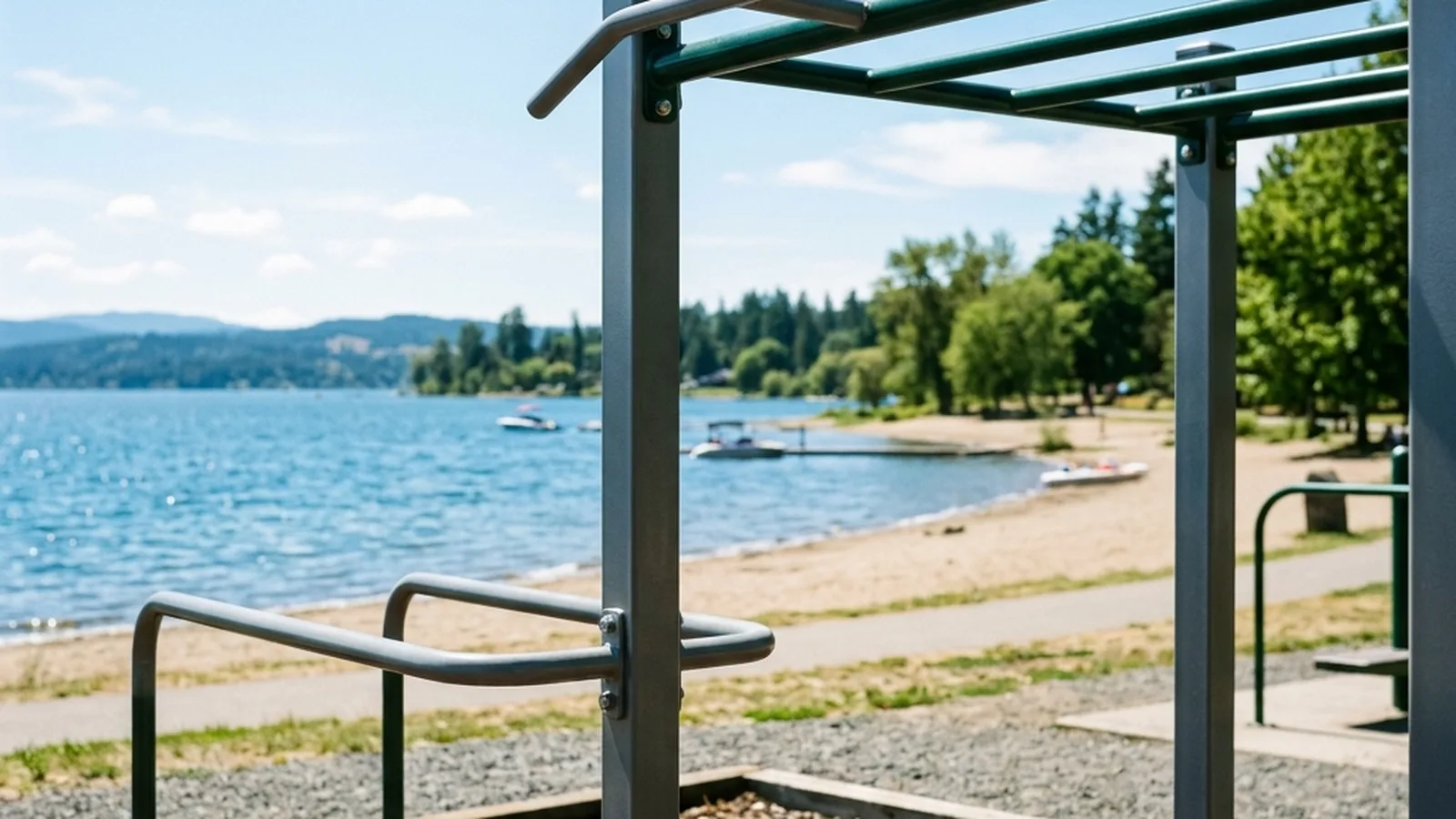
- RecPlex perimeter circuit (River Road East): 6 stations including pull-up bars, parallel-bar dip station, ab bench, leg-raise station, balance beam, and a stretching post. Adjacent to the RecPlex perimeter walking loop. The most-used installation, with the best surface (rubber mat under each station) and the most-recent equipment refresh (2024).
- Beach Drive corridor: 4 station clusters spaced roughly every 1.5 km along the Areas 1-4 stretch. Each cluster has a pull-up bar, parallel-bar dip station, and a step-up bench. Surface is gravel and sand-mix; less polished than the RecPlex but functional.
- Provincial Park Day Use Area (Beach Area 2): 3 stations clustered near the visitor centre. Pull-up bar, dip station, and a vertical-jump test marker. Park parking fee applies for use.
All municipal stations are first-come, first-served. Realistic wait times: most stations are unoccupied on any given visit; mid-summer Saturday mornings between 8-10 am are the only consistently busy windows. The beach-corridor stations get more use than the RecPlex stations because they’re visible from the Beach Drive walking corridor and attract spontaneous use from beach visitors.
The incidental outdoor gym (the under-recognised resource)
Beyond the official stations, the Wasaga shoreline has structures that local calisthenics practitioners have been using as bodyweight tools for years:
- Wooden lifeguard towers (each Beach Area has one) provide a 2-metre overhead bar suitable for pull-ups, hanging knee-raises, and L-sits. The horizontal cross-beams support clean pull-up form. Most accessible May through October when the towers are in service; they’re removed mid-October for winter.
- Beach posts and bollards at the Provincial Park parking-lot entrances function as box-jump and step-up stations. The standard Provincial Park bollards are 60-65 cm tall, which puts them in the standard plyometric box height range for adult lifters.
- The wooden boardwalk stair sets at the Provincial Park accessible boardwalk and at several private cottage-strip access points (where municipal trespass rules permit) work as step-up and stair-sprint surfaces. Twelve to fifteen risers each, varying tread depths.
- Picnic tables throughout the Beach Drive corridor work as decline-push-up surfaces (feet on bench, hands on ground) and as Bulgarian split-squat back-foot support.
The trick to the “incidental gym” approach: build a routine that doesn’t require any specific structure, then improvise with whatever’s actually available at your venue that day. A pull-up substitute (high-knee plank to push-up plank, or sand-pit handstand work) handles the day no overhead bar is reachable.
A 30-minute beach-area calisthenics circuit
The most effective full-body circuit using these resources:
- Warm-up walk (5 minutes) — brisk pace from your starting point to the RecPlex or the nearest beach-corridor cluster.
- Round 1 (10 minutes): 3 sets of 8-12 pull-ups (or pull-up substitute), 12-20 parallel-bar dips, 15-20 box jumps or bench step-ups. 60 seconds rest between sets.
- Round 2 (10 minutes): 3 sets of 10-15 push-ups (decline on a picnic table for harder progression), 10-12 single-leg squats per leg, 30-second plank hold. 60 seconds rest between sets.
- Cooldown (5 minutes) — stretching post or open ground for hamstring, hip-flexor, and shoulder mobility work.
This circuit produces a roughly 350-450 kcal expenditure for an average adult and produces meaningful upper-body strength stimulus combined with lower-body plyometric loading Schoenfeld 2010. Twice a week is the right frequency for general fitness; three times a week for someone targeting a specific calisthenics progression (first muscle-up, planche progression, etc.).
Building toward harder calisthenics goals
For practitioners specifically targeting calisthenics progressions, the Wasaga outdoor stations support most intermediate-to-advanced movements:
- Pull-up progression toward muscle-up: the RecPlex monkey-bar station has the right bar height and clearance for muscle-up attempts once you have 10+ strict pull-ups. The wooden lifeguard towers work too but the cross-beam is wider than standard and grip-fatigue arrives faster.
- Dip progression toward ring dips: the parallel bars are at the standard 60 cm width on the RecPlex and Beach Drive stations. For ring-dip work, bring a portable ring set; the pull-up bar overhead supports rings at appropriate heights.
- Handstand work: the soft-sand surface at the Provincial Park is forgiving for handstand-walking practice. The harder packed-sand strip near the waterline is closer to a gym-floor surface for static handstand holds.
- Plyometric progressions: the bollard heights (60-65 cm) work for intermediate box-jump training. For higher boxes, the wooden stair-set top step varies by access point but typically reaches 80-90 cm.
Seasonal considerations
Summer (June-August): early morning (6-8 am) is the optimal window. Bug pressure on the RecPlex stations is lower than the beach-area trails because the venue is less wooded. Hydration and sun protection matter; the stations are exposed.
Autumn and Spring shoulder seasons (April-May, September-October): peak season for outdoor calisthenics. Comfortable temperatures, no bugs, full station availability. Most local practitioners do their highest-volume training in these months.
Winter (November-March): the RecPlex stations are usable with gloves through most of the winter (the rubber-mat surface stays grip-able). Beach-corridor stations are variable depending on snow accumulation. Lifeguard towers are removed October-May. The realistic winter outdoor calisthenics venue is the RecPlex perimeter; everything else gets unreliable.
Practicalities
- Cost: all RecPlex and Beach Drive stations are free. Provincial Park stations require day-use parking ($14/day or $69/year individual Ontario Parks pass).
- Weather variables: rubber-mat surface gets slippery in rain; metal bars get cold-painful in winter without gloves. Plan accordingly.
- Station etiquette: share. If someone’s waiting, finish your set and let them work in. The local calisthenics community is small and overlapping; treating the stations as shared keeps the goodwill that has prevented the Town from restricting access.
- Reporting damaged equipment: the Town accessibility line accepts equipment-damage reports; turnaround is typically 2-3 weeks for repair. The community has prevented shutdowns by staying on top of reports.
Where this fits vs a gym membership
For general fitness goals (cardiovascular health, basic strength, body composition), the Wasaga outdoor stations cover 80% of what a typical gym membership delivers, free, with the proprioception-and-fresh-air bonus. For specific goals (heavy compound lifts, machine-isolated bodybuilding work, environmental-controlled HIIT classes), the gym is still the better tool.
A pragmatic local-resident approach: outdoor stations as the primary venue April-November, gym membership December-March (when outdoor reliability drops). Or outdoor as the everyday, gym for once-weekly heavy work. Most local calisthenics practitioners blend the two rather than committing fully to either.
Practical takeaways
- 3 official Town fitness installations (RecPlex perimeter, Beach Drive corridor, Provincial Park) plus extensive incidental structures.
- The 30-minute circuit: pull-ups + dips + jumps for round 1, push-ups + single-leg squats + plank for round 2.
- Twice a week is the right frequency for general fitness; three times for specific calisthenics progression goals.
- RecPlex perimeter is the year-round option. Beach corridor and Provincial Park are seasonal.
- Calisthenics covers ~80% of typical gym goals for free, with a proprioception bonus indoor weight-room work doesn’t produce Zemková 2014.
Frequently asked questions
Can I really get gym-level results outdoors?
For general fitness, yes — 80% of typical gym outcomes (cardiovascular, basic strength, body composition) are achievable with bodyweight calisthenics if you progress the difficulty over time. For specific goals (heavy compound lifts, isolated bodybuilding work) a gym is still the right tool.
What if all the stations are occupied?
Realistically rare. The busiest windows (mid-summer Saturday mornings) might mean a 5-10 minute wait at the RecPlex. The improvised-station approach — using picnic tables, lifeguard towers, beach posts — means you almost never have to wait if you’re flexible about where you train.
Are the stations dangerous in winter?
Cold metal is uncomfortable but not unsafe with gloves. The rubber surfaces don’t freeze hazardously. The realistic winter risk is slipping on ice in the surrounding pavement transitions; carry appropriate winter footwear and skip the day if the freeze-thaw cycle has produced glare ice.
Are the lifeguard towers really OK to use?
Yes during open-beach season (May-October) when they’re manned; the lifeguards are generally fine with reasonable bar use that doesn’t interfere with their visibility. Don’t climb on the structure itself; just use the cross-beam as a pull-up bar from below.
Where can I find a local outdoor calisthenics community?
The Wasaga Beach Outdoor Fitness Facebook group and the local calisthenics meetup that runs Sunday mornings at the RecPlex stations (8-10 am, drop-in, mixed-ability). Both surface ways to find training partners and the latest community-norm changes.
References
Schoenfeld 2010Schoenfeld BJ. The mechanisms of muscle hypertrophy and their application to resistance training. Journal of Strength and Conditioning Research. 2010;24(10):2857-2872. View source →Zemková 2014Zemková E. Sport-specific balance. Sports Medicine. 2014;44(5):579-590. View source →Town of Wasaga BeachTown of Wasaga Beach. Public outdoor fitness installations and accessibility coordinator information. View source →