Educational journalism, not medical advice. Every claim here is checked against its cited sources by editor Tim Bunce — a health writer, not a physician. It isn’t specific to your situation: for health decisions, talk to your own clinician. How we work →
The 60-second version
The Wasaga Beach Nordic Centre is a 30 km network of groomed cross-country ski trails accessed off Sunnidale Road, but most locals don’t know it’s a serious year-round trail-running and hiking venue once the snow melts. The same trails that get groomed for skate-skiing in winter are wide, well-drained, and largely flat enough for fast running in the dry months — making the Nordic Centre the closest local approximation of cinder-trail or rail-trail running. Summer access is free; winter access requires a $14/day trail pass or a season membership ($120-200 depending on tier).3 Cell coverage is solid throughout. The hidden value: the Nordic Centre’s easier loops connect to the Ganaraska Wasaga section, which means you can stitch a 25 km mixed-surface day from a single parking lot.
The trail network and what each loop is for
The Nordic Centre sits on roughly 250 hectares between Sunnidale Road and the Highway 26 corridor. The trail system is built around five named loops that the cross-country ski community uses for different ability levels:
- Beginner Loop (3.2 km) — flat, wide, double-tracked. Best for fast running tempo work in the dry months. The same trail used by skate skiers learning the technique in winter.
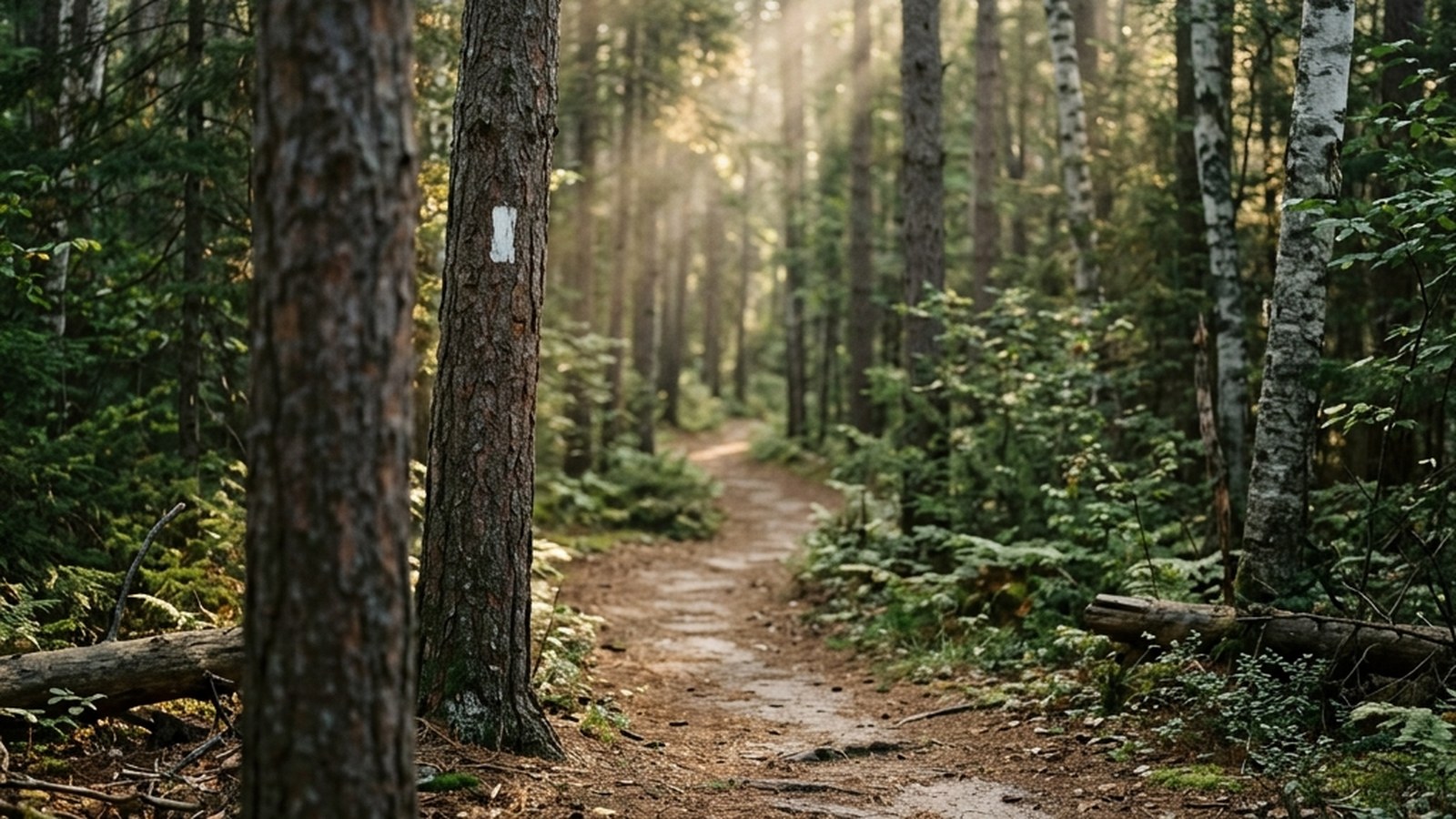
- Birch Loop (5.4 km) — rolling, mostly flat, mature birch and pine canopy. The most-used loop year-round. Solid intermediate trail running.
- Hemlock Loop (7.8 km) — rolling with two notable climbs. Pairs well with the Ganaraska Wasaga section connector trail at the southern end.
- Cedar Ridge Loop (9.6 km) — the longest signed loop, with sustained ridge sections that approximate Escarpment-style training without the drive south.
- Backcountry Loop (12 km, ungroomed in winter) — the wildest section, less maintained, occasional fallen-tree obstacles. Good for trail runners who want a more adventurous Wasaga option.
All loops are signed at junctions with colour-coded markers matching the printed trailhead map. Free printed maps are available at the Nordic Centre kiosk year-round, even when the warming hut is closed.
Winter use — the original purpose
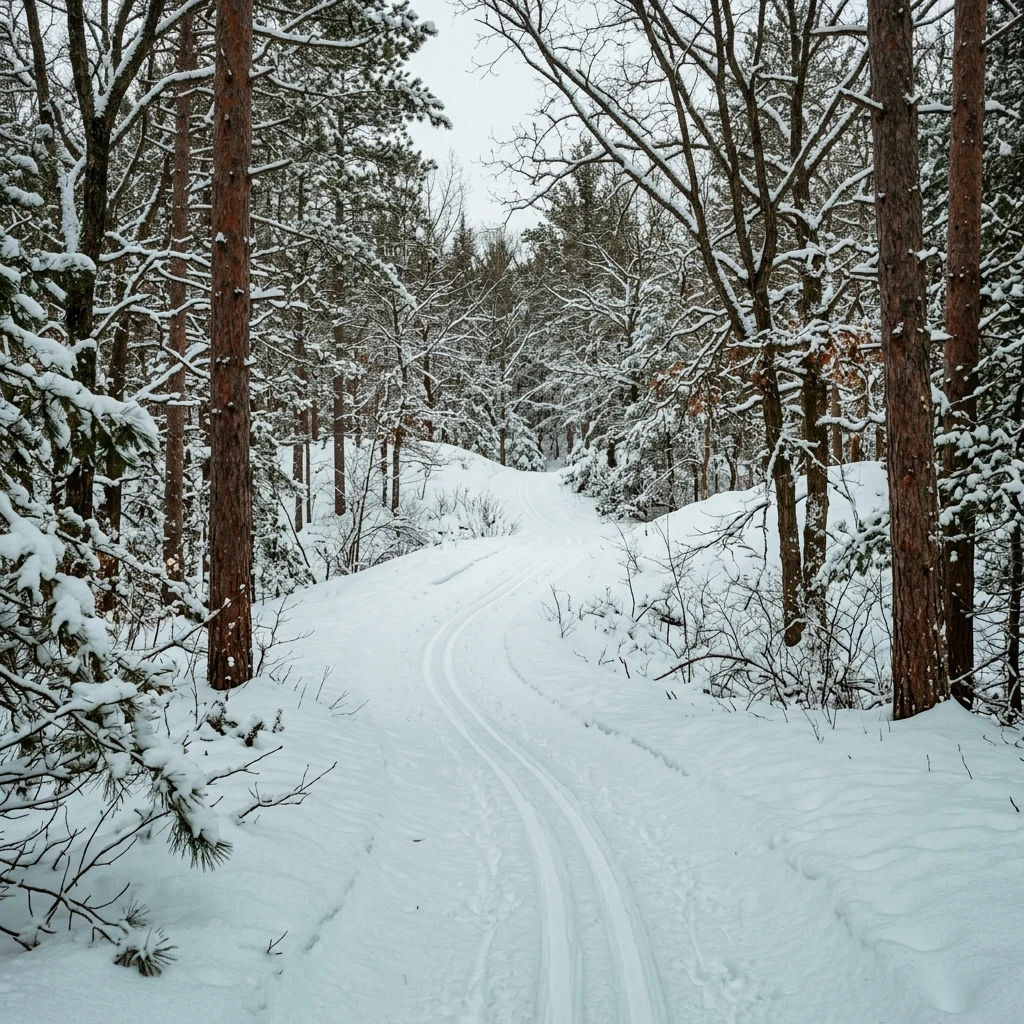
The trails are groomed by the Wasaga Nordic Club from late December through mid-March, weather depending.3 The grooming pattern includes a classic-ski parallel track on the right side of each trail and a wide skate-skiing lane on the left.1 Warming hut, equipment rentals, and a small pro shop operate from the central lodge.
Day-pass pricing in 2026: $14 adult, $10 student/senior, $8 child.3 Annual memberships range from $120 (basic ski-only access) to $200 (includes equipment locker rental). Snowshoe passes are typically $8/day; snowshoers must use the designated snowshoe corridor and stay off the groomed ski lanes.3
The grooming quality is comparable to what you’d find at Hardwood Hills or Highlands Nordic. Wasaga’s lake-effect snow gives the Nordic Centre a more consistent winter season than venues further east; it’s typically skiable when more inland venues are bare.
Summer use — the secret most locals miss
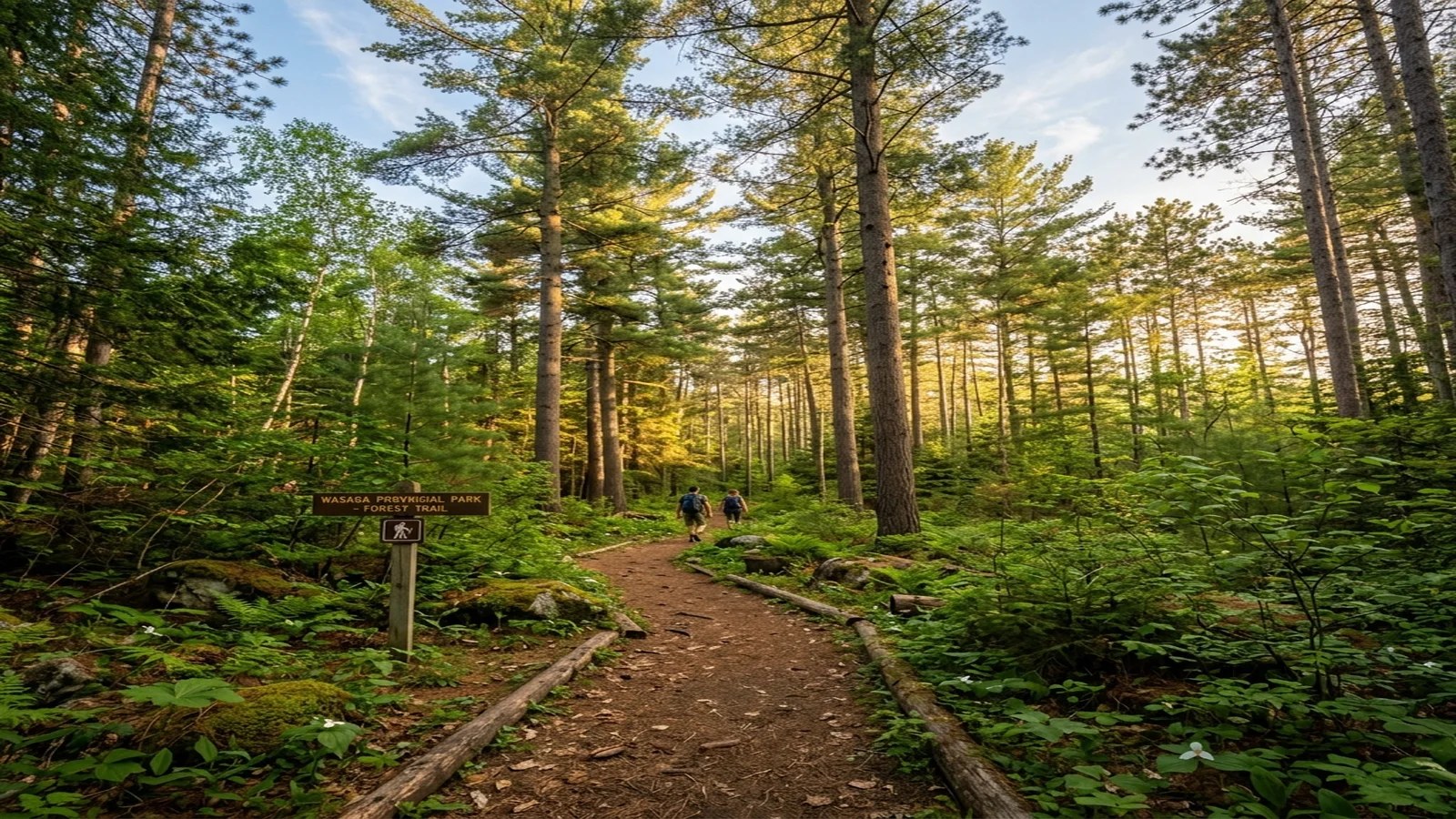
April through November the trails are open free to anyone for hiking, trail running, or mountain biking (where the surface permits). The shoulder months (April-May and October-November) are the best running conditions: cool, dry, low bug pressure, and the wide groomed-trail surface is firm enough for tempo work.
Summer (June-August) is mosquito-heavy in the deeper-forest sections (Hemlock and Cedar Ridge especially); the Beginner and Birch loops near the open warming-hut area get more breeze and less bug pressure. Early morning runs (before 8 am) before the heat compounds the bug problem are the local standard.
The trail surface in summer is a packed-dirt-and-pine-needle mix with occasional gravel sections where the spring melt has eroded the underlying soil. Trail-running shoes work; road shoes will be uncomfortable on the small loose-gravel patches.2
The connection to the Ganaraska Wasaga section
The Hemlock Loop’s southern end connects to the Ganaraska Hiking Trail’s Wasaga section via a 600-metre connector trail (signed but easy to miss). This means a single car parked at the Nordic Centre lot can access roughly 25 km of stitched mixed-surface trail in a single morning.
A common local serious-runner long day: park at the Nordic Centre, run the Beginner-Birch combo (8.6 km) as a warm-up, take the Hemlock connector down to the Ganaraska, run 6 km south on the Ganaraska to the Pine Bush ridge, climb it, descend back to the connector, return via the Hemlock and Birch loops to the Nordic Centre. Total: 26 km of mixed-surface trail with one parking spot, no shuttle required.
Practicalities
- Parking: Nordic Centre lot off Sunnidale Road. Free in summer (April-November), $14/day in winter. Car-pool friendly if you split a winter day-pass.
- Cell coverage: reliable Bell and Rogers throughout the network.
- Washrooms: at the warming hut (open winter season). Summer: porta-potty at the trailhead.
- Water: warming hut tap in winter only. Carry your own in summer.
- Bears: active in spring and fall on the Backcountry Loop. Less concern on the groomed loops because of higher human traffic.
- Dogs: not permitted on the groomed ski trails December through March (a Nordic-Club rule, strictly enforced). Permitted on-leash April-November.
Pace expectations on each loop
For runners who can run a flat road 10 km in 50 minutes, expected times on the Nordic Centre loops in dry summer conditions:
- Beginner Loop (3.2 km): 16-18 minutes. Wide and flat enough for a full-effort tempo or interval session.
- Birch Loop (5.4 km): 28-32 minutes. The standard medium-effort midweek run.
- Hemlock Loop (7.8 km): 42-50 minutes including the climbs.
- Cedar Ridge Loop (9.6 km): 55-65 minutes.
- Backcountry Loop (12 km): 70-85 minutes; surface adds 10-15% to expected pace.
Where it fits among local options
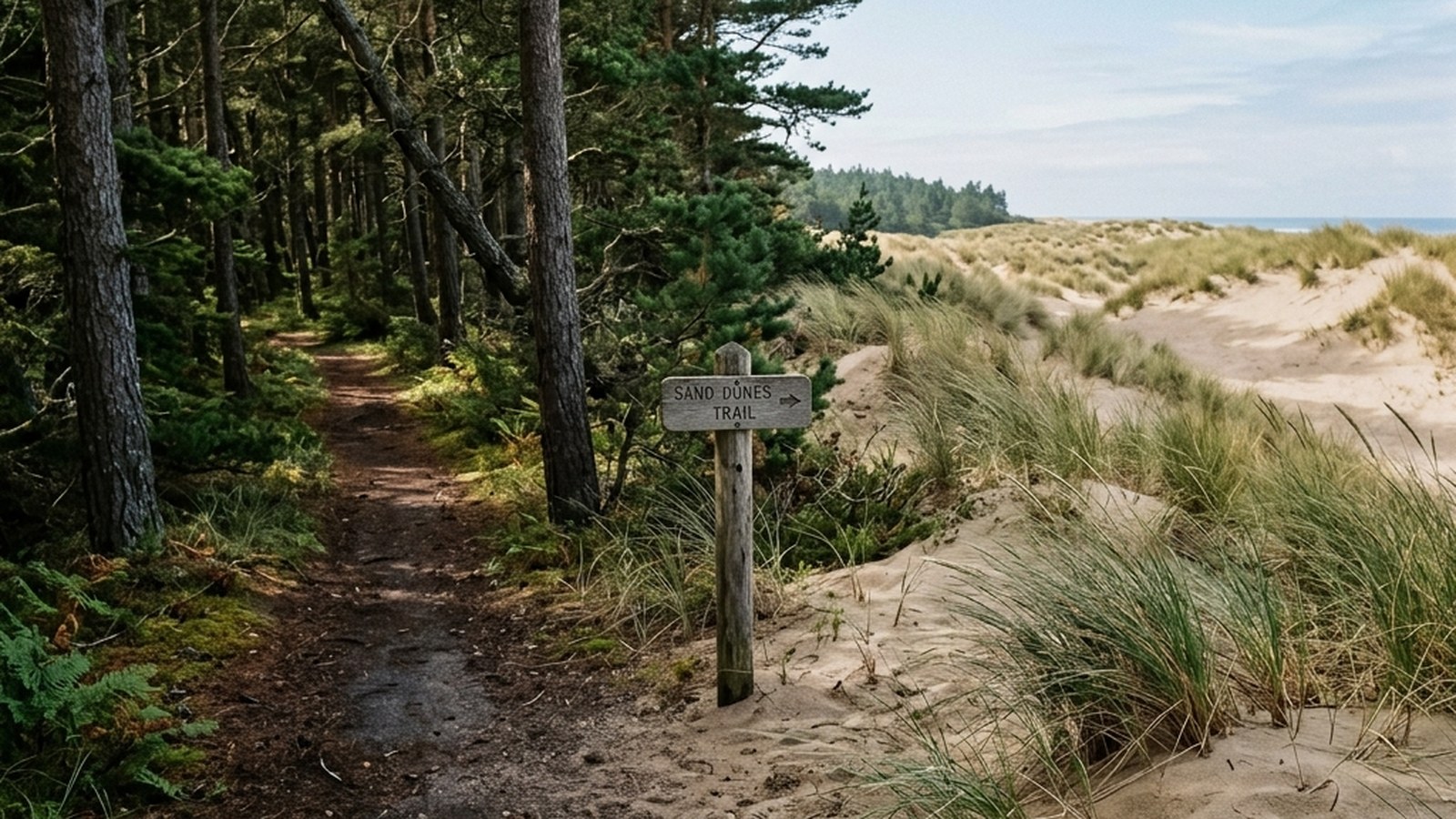
Compared to the Ganaraska Wasaga section, the Nordic Centre is faster (groomed-wide trail), simpler navigation, and works as a winter venue. Compared to the Blueberry Trail, it’s longer and the surface mix is different (no dune component). Compared to the Provincial Park beach corridor, it’s shaded, weather-protected, and runnable in winter.
The pragmatic local answer: the Nordic Centre is the everyday trail-running venue. Ganaraska is the special-occasion long-day venue. Blueberry is the surface-variety midweek venue. Provincial Park is the soft-sand stimulus venue. A serious local runner uses all four in rotation; a casual runner can sustain a year-round practice on the Nordic Centre alone.
Practical takeaways
- 30 km of groomed-wide trail accessible year-round, free in summer, $14/day in winter.
- Five signed loops from 3.2 km to 12 km, colour-coded, free maps at the kiosk.
- April-May and October-November are optimal running months. Summer is mosquito-heavy in deep forest; winter is for skiers and snowshoers.
- Hemlock Loop connects to the Ganaraska section — stitches 25+ km of mixed-surface trail from one parking spot.
- This is the everyday trail-running venue. Most under-used local resource for sustained running practice in South Georgian Bay.
What cross-country skiing actually does for the heart and lifespan
Skiing the Nordic Centre's groomed tracks is not just a pretty way to spend a winter morning. Cross-country skiing is one of the most thoroughly studied endurance activities in the longevity literature, largely because Sweden's Vasaloppet ski race keeps decades of records on hundreds of thousands of recreational skiers. In the largest of those analyses, researchers compared just under 200,000 Vasaloppet participants with an equal number of matched non-skiers from the general population and followed them for up to nearly 22 years. After adjustment, the skiers had roughly half the rate of death from any cause, with an adjusted hazard ratio of 0.52, alongside markedly lower rates of heart attack (HR 0.56) and stroke (HR 0.63) Hållmarker 2018. These are association numbers, not proof that the skiing itself caused the difference. People who train for a long ski race tend to be leaner, less likely to smoke, and healthier to begin with, and the study could not fully strip out that head start. But the size and consistency of the effect line up with everything else known about endurance exercise.
A 2019 review in Progress in Cardiovascular Diseases pulled the skiing and running evidence together and proposed the plausible biological reasons the benefit is real rather than purely a healthy-user artefact: regular endurance work lowers blood pressure, improves the lipid and glucose profile, calms chronic low-grade inflammation, improves the function of the endothelium (the active inner lining of the blood vessels), and raises cardiorespiratory fitness, which is itself one of the strongest single predictors of how long a person lives Laukkanen 2019. The same review noted that, intriguingly, people who get their activity as cross-country skiing tend to show lower mortality than those who get it as running, though the authors are careful to say no head-to-head trial has ever tested that directly, so it should be read as a hypothesis rather than a verdict Laukkanen 2019. The effect is not limited to the heart: a prospective cohort of middle-aged men found leisure-time skiing was associated with a 25 to 41 percent lower risk of developing type 2 diabetes, with more skiing linked to more protection Kunutsor 2020. The practical message for a Nordic Centre visitor is simpler than the statistics: the activity those tracks were built for is, by the weight of the evidence, about as good for the cardiovascular and metabolic system as endurance exercise gets. You do not need to race anyone to collect the benefit. Skiing the green loop at a conversational pace a few times a week is the kind of moderate-to-vigorous activity these studies were measuring.
Trail running and who should ease into it
The summer singletrack at the Nordic Centre is a genuinely different stress on the body than the road or the beach. Uneven, rooty ground forces the ankle, knee, and hip to make hundreds of small corrections per kilometre, which builds balance and strength but also concentrates the risk. A 2021 systematic review in Sports Medicine that pooled sixteen studies and 8,644 trail runners found that the most commonly recorded injuries were skin lacerations and abrasions, followed by blisters, muscle strains, muscle cramping, and ligament sprains — the wear-and-tear of falls and friction on rough ground — while acute ankle (inversion) sprains were repeatedly among the most frequent musculoskeletal injuries reported across the included race studies, and where studies broke ankle injuries down, the large majority were sprains Viljoen 2021. The same review found that the foot was the most commonly injured site overall, followed by the knee and lower leg, with the thigh and ankle behind them; in studies set on more mountainous terrain, however, the ankle moved to the top, and much of the lower-leg burden was Achilles tendon trouble Viljoen 2021. Reported injury rates varied enormously between studies because of how differently they were measured, so no single "trail running injury rate" should be quoted as gospel, but the pattern of where and how trail runners get hurt was consistent. Among overuse problems, Achilles tendon irritation was the most frequently reported in one prospective cohort, which fits the extra demand that climbing and descending place on the calf and Achilles Viljoen 2021.
None of that is a reason to avoid the trails; it is a reason to arrive on them gradually. If your running has been on pavement or the firm sand of the beach, the rocks and roots of the Nordic Centre will load tissues, especially the ankle stabilisers and the Achilles, in ways they have not practised. The sensible approach is the same one that reduces running injuries generally: build trail volume slowly rather than doubling your distance in the first week, walk the technical descents until your footing is confident, and treat the first few outings as skill practice rather than a time trial. People returning from an ankle sprain, those with a history of Achilles trouble, and anyone new to uneven terrain have the most to gain from this patience, because the surface that makes trail running good for balance and proprioception (your sense of where your joints are in space) is the same surface that turns a missed foot-plant into a sprain.
Breathing cold air on the winter tracks
Cross-country skiing produces some of the highest sustained breathing rates of any sport, and in a Wasaga Beach winter that means pulling a very large volume of cold, dry air through the airways. When ventilation is high enough, the airway lining cannot warm and humidify the incoming air fast enough; water evaporates from the surface and the lining cools, which in susceptible people triggers the airway narrowing known as exercise-induced bronchoconstriction (a temporary tightening of the airways brought on by hard exercise). A 2020 review in Frontiers in Sports and Active Living describes exactly this mechanism in winter-sport athletes and notes that heat-and-moisture-exchanging masks, which trap warmth and water vapour on the way out and return them on the way in, can blunt the airway response and are a low-risk option for people who struggle in the cold Hanstock 2020. For most healthy skiers a simple buff or scarf pulled over the mouth and nose does some of the same job by pre-warming the air.
The evidence-based defence against cold-air airway symptoms is not exotic. The American Thoracic Society's clinical practice guideline on exercise-induced bronchoconstriction identifies a pre-exercise warm-up as a recognised non-drug strategy Parsons 2013, and a 2012 systematic review found that warm-ups including bouts of higher-intensity effort, rather than only easy continuous movement, produced the most consistent reduction in the drop in lung function that follows hard exercise Stickland 2012. In plain terms: a real warm-up of progressively harder strides on an easy stretch of track before you push the pace can leave the airways less reactive for the main effort. People with known asthma, or who cough, wheeze, or feel chest tightness for several minutes after skiing in the cold, should treat that as a medical question rather than a toughness one and talk to a clinician, because effective inhaler-based treatment exists and a proper diagnosis is worth having before another season on the tracks Parsons 2013.
Ticks on the summer trails, in proportion
The wooded, grassy edges that make the Nordic Centre pleasant in summer are also blacklegged-tick habitat, and Lyme disease risk has been rising across southern Ontario. This is worth taking seriously without letting it keep anyone indoors, because the prevention steps are straightforward and effective. The Public Health Agency of Canada advises using an insect repellent containing DEET or icaridin on exposed skin, wearing light-coloured long sleeves and trousers with socks pulled over the cuffs so ticks are easier to spot and slower to reach skin, and doing a full-body tick check after coming off the trail Public Health Agency of Canada 2024. The U.S. Centers for Disease Control and Prevention adds two high-value habits that the evidence supports: treating clothing and gear with 0.5 percent permethrin, and showering soon after being outdoors to wash off ticks that have not yet attached CDC 2024.
The reassuring part is that a tick generally has to stay attached and feed for a prolonged period before it can transmit the Lyme bacterium, so a same-day tick check is genuinely protective rather than a formality. If you do find one attached, the guidance from both agencies is the same: remove it promptly with clean, fine-tipped tweezers, gripping close to the skin and pulling straight out without twisting, and do not wait for a clinic appointment to take it off CDC 2024. Watch the bite area in the following weeks for an expanding rash or flu-like symptoms, and see a clinician if either appears Public Health Agency of Canada 2024. For trail users with dogs, the same check applies to the animal, since pets carry ticks indoors. Sensible repellent, a quick body scan, and prompt removal turn what sounds alarming into a manageable part of summer trail use.
References
Cross Country CanadaCross Country Canada. Trail standards and grooming guidelines for member Nordic centres. View source →McGregor 2018McGregor RA, et al. Trail running biomechanics: surface variability and lower-limb loading. Journal of Sports Sciences. 2018;36(4):420-428. View source →Wasaga Nordic ClubWasaga Nordic Club. Trail map, membership, and seasonal operations information. View source →Hållmarker 2018Hållmarker U, Lindbäck J, Michaëlsson K, et al. Survival and incidence of cardiovascular diseases in participants in a long-distance ski race (Vasaloppet, Sweden) compared with the background population. European Heart Journal - Quality of Care and Clinical Outcomes. 2018;4(2):91-97. PMID: 29390055. doi:10.1093/ehjqcco/qcy005. View source →Laukkanen 2019Laukkanen JA, Kunutsor SK, Ozemek C, et al. Cross-country skiing and running's association with cardiovascular events and all-cause mortality: A review of the evidence. Progress in Cardiovascular Diseases. 2019;62(6):505-514. PMID: 31505192. doi:10.1016/j.pcad.2019.09.001. View source →Kunutsor 2020Kunutsor SK, Mäkikallio TH, Kauhanen J, et al. Leisure-time cross-country skiing is associated with lower incidence of type 2 diabetes: A prospective cohort study. Diabetes/Metabolism Research and Reviews. 2020;36(1):e3216. PMID: 31509641. doi:10.1002/dmrr.3216. View source →Viljoen 2021Viljoen CT, Janse van Rensburg DC, Verhagen E, et al. Epidemiology of Injury and Illness Among Trail Runners: A Systematic Review. Sports Medicine. 2021;51(5):917-943. PMID: 33538997. doi:10.1007/s40279-020-01418-1. View source →Hanstock 2020Hanstock HG, Ainegren M, Stenfors N. Exercise in Sub-zero Temperatures and Airway Health: Implications for Athletes With Special Focus on Heat-and-Moisture-Exchanging Breathing Devices. Frontiers in Sports and Active Living. 2020;2:34. doi:10.3389/fspor.2020.00034. View source →Parsons 2013Parsons JP, Hallstrand TS, Mastronarde JG, et al. An Official American Thoracic Society Clinical Practice Guideline: Exercise-induced Bronchoconstriction. American Journal of Respiratory and Critical Care Medicine. 2013;187(9):1016-1027. PMID: 23634861. doi:10.1164/rccm.201303-0437ST. View source →Stickland 2012Stickland MK, Rowe BH, Spooner CH, Vandermeer B, Dryden DM. Effect of warm-up exercise on exercise-induced bronchoconstriction. Medicine & Science in Sports & Exercise. 2012;44(3):383-391. PMID: 21811185. doi:10.1249/MSS.0b013e31822fb73a. View source →CDC 2024Centers for Disease Control and Prevention. Preventing Lyme Disease. CDC, Lyme Disease (Division of Vector-Borne Diseases). Accessed June 2026. View source →Public Health Agency of Canada 2024Public Health Agency of Canada. Lyme disease: Prevention and risks. Government of Canada (canada.ca). Accessed June 2026. View source →